DE X INSIGHTS
Electrical Work Quotation in Chennai: A Practical Guide

You've probably seen it already. One contractor gives you an attractive electrical figure over WhatsApp, then the number changes after the site visit. A second quotation looks expensive but includes the distribution board, concealed conduit, testing, and material supply. A third appears reasonable until you realise it covers labour only.
That's why an electrical work quotation in Chennai should be read as a scope document, not just a price list. Chennai residential benchmarks commonly place full-house wiring at ₹60 to ₹150 per square foot, while point-based rates vary by point type and load, as shown in Chennai electrical quotation benchmarks. The useful question isn't “Which contractor is cheapest?” It's “Are all three contractors pricing the same work?”
Why Two Chennai Quotations Can Diverge by Lakhs
A homeowner in Porur recently shortlists three contractors for a 2BHK rewiring project. The quotations come in at ₹45,000, ₹90,000, and ₹1,35,000. At first glance, the middle quote feels like a safe compromise. After a closer reading, the numbers aren't comparable.
The first contractor has counted only the visible switches and sockets. The second has included concealed conduit, a dressed distribution board, circuit separation, and testing. The third has priced labour alone, with wires, boxes, switches, and protection equipment billed separately at retail. The gap isn't created by a mysterious Chennai premium. It comes from different assumptions recorded during the site visit.
Practical rule: Never negotiate the rate until every contractor has priced the same point schedule, material list, and completion responsibility.
A quotation can look low because it excludes work that still has to be done. Chasing walls, laying conduit, terminating the DB, coordinating with carpenters, removing debris, and testing circuits may appear later as additions. Labour-only pricing creates another layer of uncertainty because the homeowner carries the material selection and purchase risk.
Chennai references show how widely labour and installed pricing can move. Independent electricians may charge ₹575 to ₹1,725 per visit, with full-day rentals of ₹920 to ₹2,070, while new point wiring is listed around ₹580 to ₹1,380 per point in one service guide, Chennai electrician rate references. These figures don't establish your final project cost. They show why a headline total means little without a defined scope.
The right starting point is a common quotation format. Ask every vendor to declare point quantities, brands, circuit requirements, labour inclusions, exclusions, and payment milestones. Once the scope is aligned, price negotiation becomes useful. Before that, it only rewards the contractor who omitted the most work.
Anatomy of a Residential Electrical Quotation
A usable quotation has a visible structure. It should let you trace the project from the property description to the final testing responsibility without relying on verbal promises. If a contractor sends one lump-sum figure with no schedule, you're not comparing a quotation. You're comparing an assumption.
Property and routing details
The opening block should identify the site address, BHK configuration, floor area, and construction condition. Mention whether the home has an RCC roof, terrace construction, false ceiling, or existing concealed conduits. Routing decisions change when the electrician must work around beams, slab drops, wardrobes, kitchen lofts, or finished surfaces.
The point schedule is the working core. It should separately count switch points, socket points, fan points, light points, AC points, geyser points, and TV or data points. Chennai quotations commonly use measurable units, with full-house wiring benchmarks of ₹60 to ₹150 per square foot, light points around ₹300 to ₹800, and AC power points around ₹800 to ₹2,000, according to the Chennai cost guide for residential electrical work. The schedule should also state whether the rate includes boxes, plates, conduit, wire, labour, and termination.
Protection, earthing, and completion
The DB block must name the main DB, sub-DB if required, isolator, MCB quantity, RCCB or ELCB rating, and surge protection. “DB included” isn't enough. Ask for the enclosure size, brand, module capacity, and circuit allocation.
Earthing and safety need their own block. State the earthing method, earth continuity arrangement, and testing responsibility. Tamil Nadu's electrical rules require authorised handling and approved safety measures for work on live electrical supply lines or apparatus, as set out by the Tamil Nadu Electricity Board rules.
Close with warranty terms, payment milestones, quotation validity, visit charges, and exclusions. Chasing, drilling, carpentry coordination, debris removal, scaffolding, and fixture installation should be explicit. For a broader way to inspect proposal structure, use this guide to reading an interior proposal in Chennai.
Per-Point Versus Per-Square-Foot Pricing in Chennai
Per-point pricing is usually easier to audit because the contractor declares the work unit by unit. It works well when the electrical layout is already developed and the homeowner knows how many lights, sockets, fans, appliances, and dedicated circuits are needed. It becomes less reliable when a quotation counts only the final switch positions but ignores long conduit runs, concealed junctions, DB work, and load segregation.
Area pricing offers a simpler starting point. Chennai benchmarks place complete wiring at about ₹60 to ₹150 per square foot, while point-based schedules commonly place power points around ₹400 to ₹1,200, light points around ₹300 to ₹800, and AC points around ₹800 to ₹2,000, as recorded in this Chennai electrical point-rate reference. The broad ranges reflect material grade, circuit complexity, and the level of installation included.
The table below is a comparison model, not a market quotation. It uses the requested illustrative rates of ₹550 per point and ₹140 per square foot. The figures are calculated examples, so they shouldn't be treated as verified Chennai pricing.
Per-Point vs Per-Square-Foot Pricing in Chennai
Flat Type | Area (sq ft) | Typical Points | Per-Point Quote (₹550) | Per-SqFt Quote (₹140) | Difference |
|---|---|---|---|---|---|
Compact 2BHK | 900 | 70 | ₹38,500 | ₹1,26,000 | ₹87,500 |
Standard 2BHK | 1,000 | 80 | ₹44,000 | ₹1,40,000 | ₹96,000 |
Larger 2BHK | 1,200 | 95 | ₹52,250 | ₹1,68,000 | ₹1,15,750 |
3BHK apartment | 1,500 | 120 | ₹66,000 | ₹2,10,000 | ₹1,44,000 |
The difference in this illustration demonstrates why the unit definition matters. A per-square-foot package may include labour and basic materials, while a per-point offer may exclude modular plates, boxes, DBs, earthing, or dedicated appliance circuits. Conversely, a large home with fewer points can become expensive under an area package because the price follows floor area rather than actual point density.
For a 1,000 sq ft home, the area benchmark alone indicates ₹60,000 to ₹1,50,000 for wiring, before additions such as modular switchgear, DBs, earthing, and dedicated circuits, according to the India wiring cost reference for new homes. Ask the contractor to show both equivalents, then compare the included scope rather than the lower arithmetic result.
A Chennai Quotation Template You Can Hand to Any Contractor
Give every contractor the same sheet before requesting a final rate. A structured template prevents a vendor from merging switches, sockets, fans, and appliance points into one vague category. It also makes material substitutions visible before work begins.
Start with the project name, site address, apartment or villa details, floor area, and existing-condition notes. Add columns for switch points, socket points, fan points, light points, AC points, and geyser points. The contractor should fill quantities first, then rates and amounts. A blank quantity is a warning sign because it leaves the final total open to interpretation.
Sample Electrical Work Quotation Template for Chennai Homes
Line Item | Specification / Brand | Unit | Quantity | Rate (₹) | Amount (₹) | Notes |
|---|---|---|---|---|---|---|
Switch points | Brand and series | Point | Include box and plate | |||
Socket points | Rating and brand | Point | State dedicated circuits | |||
Fan points | Regulator and hook detail | Point | Include ceiling preparation | |||
Light points | Conduit and wire route | Point | Include fixture connection | |||
AC points | Dedicated circuit specification | Point | State isolator and cable size | |||
Geyser points | Dedicated circuit specification | Point | State protection arrangement | |||
Main DB | Brand and module capacity | Set | Include isolator and MCBs | |||
RCCB or ELCB | Brand and rating | Each | State testing responsibility | |||
Earthing | Pit or continuity specification | Set | Include earth connection | |||
Wire or cable | Brand and specification | Coil or metre | State approved equivalent | |||
Conduit | Type and diameter | Metre | Concealed or surface | |||
Modular plates | Brand and series | Each | Match approved finish | |||
Chasing and making good | Wall and ceiling scope | Job | State exclusions | |||
Testing and commissioning | Circuit testing and handover | Job | Must be included | |||
Debris removal | Collection and disposal | Job | Clarify responsibility | |||
Warranty | Labour and material terms | Job | State duration and exclusions |
The DB row forces a discussion about protection and spare capacity. The earthing row prevents a single vague “earthing included” statement. Wire, conduit, modular plate, and brand fields expose substitutions that otherwise appear only after installation.
Use the notes column for lift access, scaffolding, transportation, debris removal, carpentry coordination, and warranty. If the project involves a complete interior, align the electrical schedule with the vendor-neutral BOQ approach for Chennai interiors. It helps keep electrical work comparable even when different vendors recommend different brands.
The Hidden Costs That Move Your Final Bill
The lowest opening rate often wins attention and loses control. A contractor may quote ₹350 per switch point, then add separate visits, chasing, conduit laying, DB termination, testing, and material purchases. The homeowner eventually pays for the same work, but the original figure no longer provides a reliable budget.
Chennai rate cards show call-out fees starting around ₹230 to ₹575, emergency or night service reaching ₹800 to ₹2,000 per hour, and labour for larger jobs reaching ₹2,875 to ₹11,500 before materials, as documented in this Chennai electrician charges reference. These amounts make labour-only comparisons particularly risky.
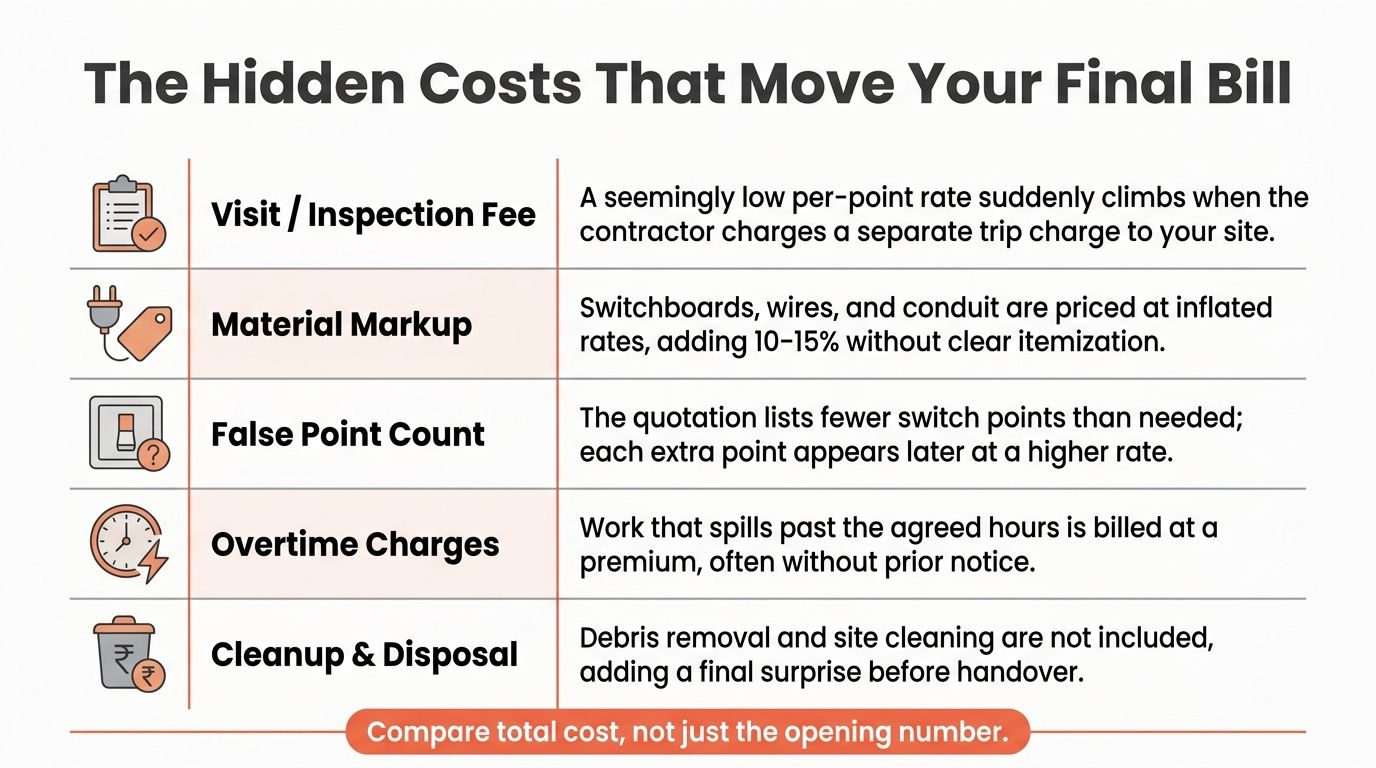
Treat each possible addition as a contract question:
Visit charges: Ask whether inspection and follow-up visits are included within Chennai city limits.
Material markup: Require brand, specification, unit rate, and approval before purchase.
Overtime: State working hours and require written approval for any premium labour.
Consumables: Confirm that tape, screws, connectors, lugs, and insulation materials are included.
Testing and cleanup: Make testing, commissioning, debris removal, and handover part of the quoted completion scope.
The same discipline helps with related household administration. If electrical work is being coordinated with a broader move-in process, homeowners can automate utility processing with Matil rather than leave service-related tasks scattered across messages.
The contractual fix is simple. Put inclusions and exclusions beside the rate, not in a verbal conversation. A useful quotation states whether materials are contractor-supplied, whether retail invoices are shared, whether transport is included, and whether the final payment depends on testing and snag completion.
Common Scope Gaps in Chennai Interior Electrical Work
Interior electrical work fails at the interfaces. The electrician thinks in circuits and routes. The carpenter thinks in cabinet dimensions. The homeowner sees the finished switch, light, appliance, and storage system. Unless those views are coordinated before execution, a technically workable installation can still create expensive rework.
The gaps that deserve a site discussion
DB sizing is often based on today's circuits without enough spare ways for later additions such as an inverter, automation, or another geyser. Ask the contractor to show the proposed circuit list and unused capacity on the DB schedule.
Earthing is another area where a single line item hides a design decision. A quotation may mention one chemical pit without explaining the soil condition, continuity path, or bonding arrangement. Don't approve an earthing allowance until the contractor states the method, connection route, and testing responsibility.
AC circuits need special attention because the load is higher than a standard light or socket point. A shared circuit for multiple indoor units may create nuisance tripping or voltage concerns during simultaneous starting. The quote should identify each AC point, its circuit arrangement, isolator, and cable specification.
Carpentry coordination is equally practical. Backsplash switches, loft lights, tall-unit lights, wardrobe lighting, TV points, and concealed charging sockets must be positioned against the approved furniture drawings. The interior wiring checks for Chennai villa owners are useful when reviewing these junctions.
Scope Gap | Typical Risk in Chennai Homes | Verification Check Before Signing |
|---|---|---|
DB capacity | No practical room for later circuits | Review circuit list and spare ways |
Earthing | Incomplete continuity or unclear pit scope | Request method, route, and test responsibility |
AC points | Shared or underspecified high-load circuits | Confirm one schedule entry per appliance |
Modular coordination | Wrong cutouts or finished-wall chasing | Mark points on approved furniture drawings |
Testing and handover | Faults discovered after final payment | Include testing, labels, and snag closure |
Before signing, run five checks: match every point to a room plan, confirm every high-load appliance, inspect the DB schedule, approve brands in writing, and define who repairs finished surfaces after electrical changes. Also confirm that the contractor is authorised to perform regulated electrical work and will follow the applicable safety requirements.
Comparing Quotations on Equal Terms and Next Steps
Put all three quotations on one comparison sheet before discussing discounts. Strip out optional fixtures, map every line to the same template, and calculate a comparable point or area equivalent only after identifying what each rate includes.
A ₹45,000 quote for 28 points and a ₹1,60,000 quote for 95 points aren't automatically contradictory. They become readable when the sheet shows quantities, material supply, DB specification, earthing, conduit type, and cabling distance. A low total with missing rows isn't cheaper. It's incomplete.
Chennai Electrical Quotation Comparison Sheet
Line Item | Quote A (Contractor 1) | Quote B (Contractor 2) | Quote C (Contractor 3) | Normalized Rate |
|---|---|---|---|---|
Point schedule | ||||
Wire and cable | ||||
Conduit and boxes | ||||
Main DB and protection | ||||
Earthing | ||||
AC and geyser circuits | ||||
Chasing and making good | ||||
Testing and commissioning | ||||
Warranty | ||||
Timeline and milestones |
Score each quotation on scope completeness, brand quality, warranty terms, and timeline clarity. Flag any version that omits DB details, earthing, conduit type, or point-to-point cabling distance. Then request a revised quotation instead of trying to estimate the missing items yourself.
Shortlist two contractors for a site walkthrough. Ask each one to identify the other quotation's exclusions, then record the answers in writing. The final agreement should contain one point-wise schedule, one approved material list, named testing responsibilities, payment milestones, and a fixed start date.
Interiors by DeX coordinates residential electrical planning with lighting, modular detailing, renovation, site execution, and handover for Chennai apartments and villas. Visit Interiors by DeX to discuss a clearly scoped interior project and align the electrical quotation with your furniture and lighting plans before work begins.