
An open-plan Chennai home can feel bright and spacious until everyday life starts competing for the same room. The dining table becomes a work desk, the living room faces the kitchen, and a bedroom door no longer gives enough privacy. You want separation, but a solid wall would cut daylight, restrict airflow, and make the home feel smaller.
That's where the right jali partition design earns its place. The result depends on more than pattern. Openness, material, location, sightlines, cleaning effort, privacy, and installation type all affect how the partition performs. A dense screen may suit a bedroom, while a more open pattern works better between living and dining areas.
Jali has served Indian architecture as a climate and privacy system for more than 2,000 years, from early perforated screens at Bedsa in Maharashtra to refined Mughal stonework in Agra, Ahmedabad, and Delhi. Architectural Digest's history of jali work traces that long development, while the 1799 Hawa Mahal shows how perforated screening could shape an entire façade for airflow, filtered light, and privacy. The Asian Review of Books explains this architectural lineage.
The eight options below move from pattern-led choices to material-led and adaptable systems. If the partition forms part of a larger renovation, Interiors by DeX can coordinate space planning, lighting, material selection, manufacturing, installation, and handover. For a different approach to visual separation, compare these ideas with interior glass wall designs.
1. Geometric Lattice Jali Partitions
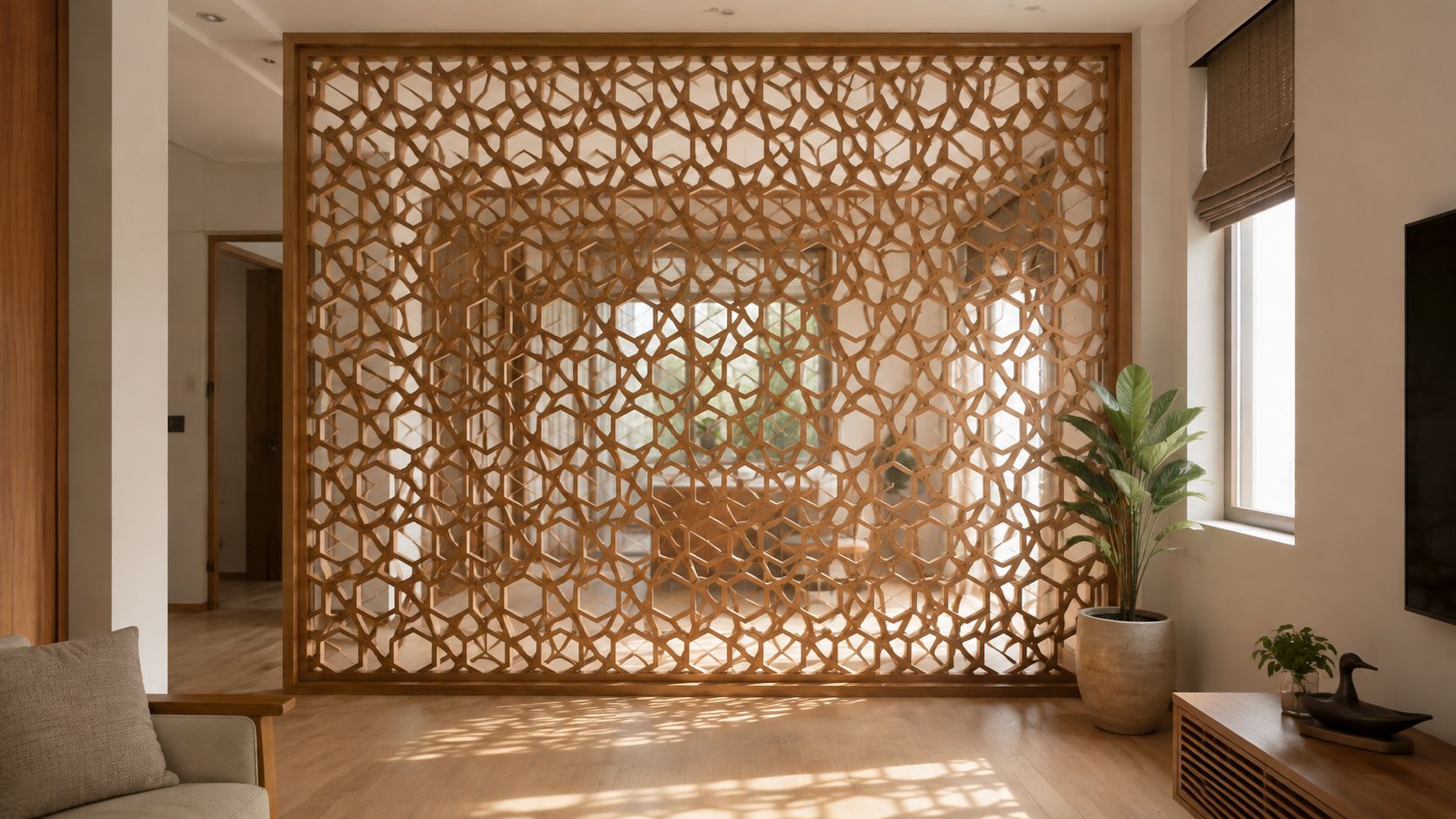
Geometric lattice is the safest starting point for a contemporary home. Squares, diamonds, hexagons, and interlocking shapes create a clear visual rhythm without making the partition feel heavy. In a Chennai apartment, that balance works particularly well between the living and dining zones, where you need definition but still want conversations, daylight, and sightlines to continue across the room.
The pattern density matters more than the motif itself. Larger openings preserve spaciousness, especially in compact flats. Smaller openings create stronger privacy and more dramatic shadow patterns, but they can make a small room feel visually busy. The National Building Code guidance also makes an important practical distinction: when a jali provides ventilation or lighting, the usable opening area excludes the solid portion of the screen, so the free area matters more than the outer panel size. Read the relevant Indian building guidance on jali and grill openings.
Practical rule: Choose the pattern by sightline first, then by style. A beautiful screen placed directly across a high-traffic path can become an obstacle.
Where geometric patterns work best
Living and dining dividers: Use an open grid to define the zones without blocking the room's visual width.
Kitchen boundaries: A geometric screen keeps the cooking area visible while reducing the sense that the kitchen opens directly into the living room.
Compact bedroom separators: A denser pattern can create privacy without the claustrophobic effect of a full-height opaque wall.
Evening feature lighting: Concealed LED lighting behind the screen can turn repeated openings into a soft architectural pattern.
Paint the frame in a colour that relates to your furniture rather than treating the jali as an isolated feature. Wood tones bring warmth, while a wall-matched finish makes the screen recede. Check door swings, furniture movement, and walking routes before fixing the panel.
2. Floral and Nature-Inspired Jali Designs
Floral jalis soften a room that feels too architectural. Carved flowers, leaves, vines, lotus forms, and botanical curves introduce movement, making them well suited to a master bedroom, living room, or prayer area. Their visual language connects with Indian craft traditions, including the garden-inspired aesthetics associated with Mughal design, while still working in a modern apartment when the finish stays restrained.
This is a pattern that needs visual discipline. A highly detailed floral screen already carries plenty of information, so surrounding it with patterned wallpaper, bright upholstery, and several decorative finishes can make the room feel crowded. A solid-coloured wall and a limited palette give the botanical work enough space to read clearly.
Match softness with useful privacy
A floral jali can provide privacy, but the open areas should be assessed at standing and seated eye level. If the screen separates a bedroom from a passage, a denser lower or eye-level zone can prevent direct views while the more open upper area continues to carry light. That approach is more useful than selecting one uniform pattern and hoping it works everywhere.
For a Chennai villa, a floral screen behind a bed can create a decorative backdrop without adding another solid surface. In a premium apartment, it can separate a lounge from a dining area while preserving a softer visual connection. A lotus or plant motif can also define a meditation or prayer corner without making it look like a commercial shrine unit.
Keep the frame quiet: Neutral or muted finishes help the carved or cut details lead.
Repeat one natural cue: Botanical cushions, artwork, or indoor planting can connect the screen to the rest of the room.
Plan for dust: Intricate openings need accessible edges and a regular cleaning routine. If the pattern is too fine to reach comfortably, it will lose clarity quickly.
Use warm illumination carefully: Backlighting or side lighting can reveal the pattern, but test shadows before final installation.
Floral jalis suit homes that value character and shadow play more than strict minimalism. They're less forgiving than geometric designs, but the right room can make their detail feel calm rather than ornate.
3. Contemporary Metal Frame Jalis
Metal frame jalis are the practical choice when durability and structural stability matter. Steel, aluminium, brass, and metal mesh can support different infills, including timber, acrylic, fabric, or perforated metal. In an open-plan Chennai apartment, a slim steel frame between the kitchen and living area can establish a boundary without adding the visual mass of cabinetry.
The finish changes the mood. Matte black pushes the room towards industrial styling, while bronze or champagne gold brings a softer contemporary character. Polished metal can look sharp when new, but it shows fingerprints and reflections more readily. Matte or textured finishes are easier to live with in high-use areas.
Avoid harsh shadows and mismatched hardware
Metal members can cast strong lines when sunlight or directional lighting hits them. Coordinate the partition with the room's lighting plan rather than adding a spotlight after installation. Diffused ceiling light or concealed illumination usually produces a calmer effect than a bright source aimed straight at the frame.
A brass-framed screen with acrylic infill can suit a modern villa, while a metal mesh panel works when you want maximum visual continuity. Wood infill helps balance the harder character of steel and creates a bridge between contemporary and traditional interiors. For further guidance on finishes and upkeep, see material choices that keep interiors low-maintenance.
Metal is durable, but the wall connection still determines whether the partition feels solid. Specify the fixing method, frame weight, and substrate before fabrication.
Use a metal finish that relates to handles, light fittings, taps, or other architectural hardware. A single coordinated finish usually looks more intentional than several unrelated metallic accents. For broader context on ironwork craftsmanship from Five40 Remodeling, the key lesson is that the frame should be designed as part of the architecture, not added as a decorative afterthought.
4. Carved Wood Panel Jalis with Traditional Motifs
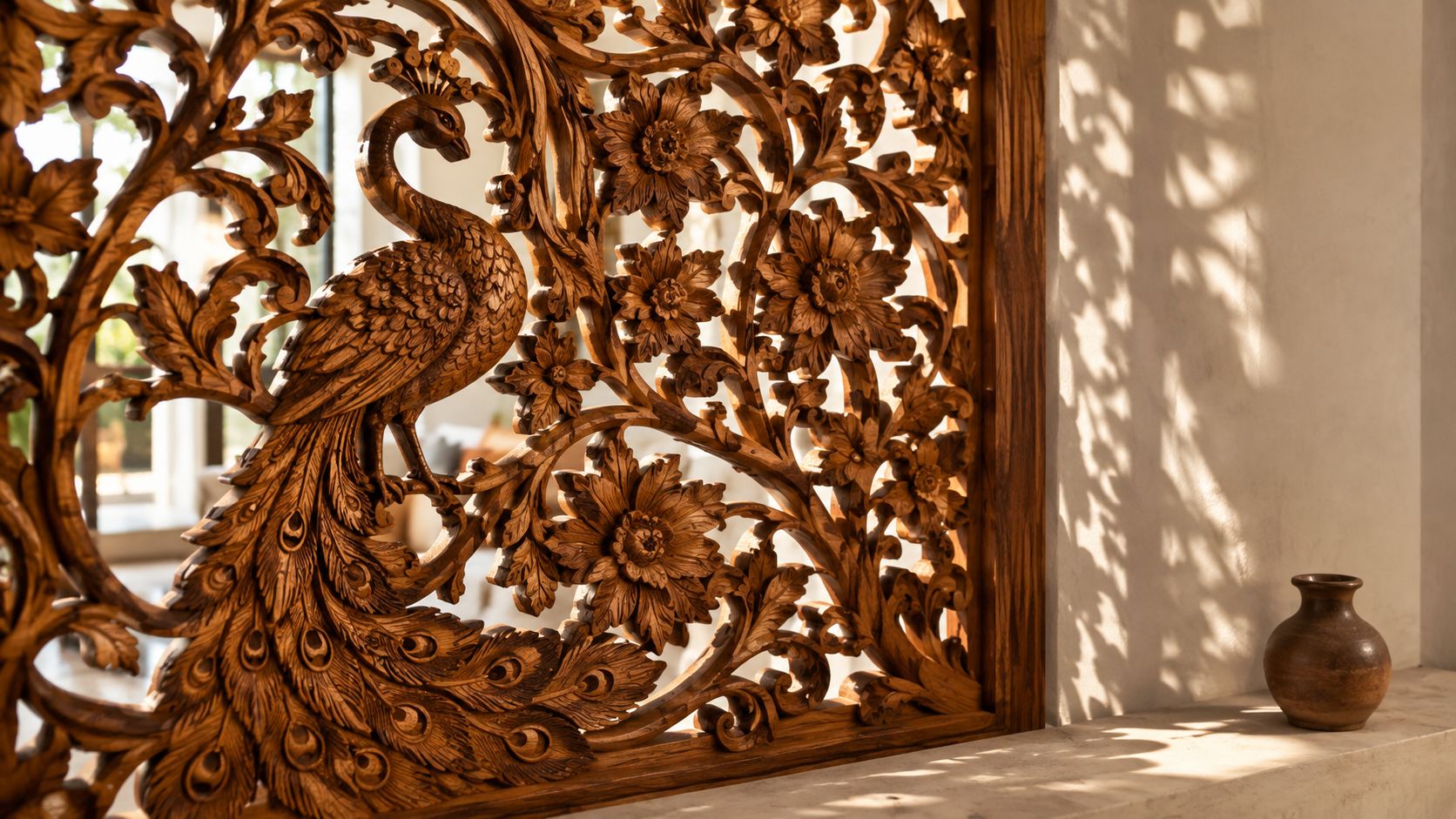
Carved wood gives a jali partition a depth that printed or routed surfaces can't fully reproduce. Peacock figures, elephants, temple gateways, scrollwork, and floral motifs turn the screen into a crafted focal point. In a Chennai villa, a peacock-carved panel can separate the master bedroom from a dressing area, while a temple-inspired screen can give a living room or prayer space a clear Indian identity.
The trade-off is maintenance. Wood responds to moisture, heat, cleaning products, and poor seasoning, so material selection and finishing are not optional details. In humid coastal conditions, use a protective oil or water-resistant coating and confirm that the timber has been properly seasoned. Avoid placing the most delicate carving where furniture, children, pets, or frequent movement can cause repeated contact.
Let the carving do the visual work
A carved panel already produces natural highlights and shadows. Warm accent lighting from the side or behind can reveal the depth, but excessive brightness may turn the relief into a busy wall pattern. Pair the screen with simpler furniture, solid wall finishes, and a controlled colour palette.
For a master bedroom: Choose motifs with moderate density so the screen feels intimate without becoming visually restless.
For a living room: A larger traditional design can act as a room divider and conversation piece.
For a prayer area: Use culturally meaningful motifs, but leave enough accessible surface for regular cleaning.
For long-term use: Work with a manufacturer who can explain timber selection, joining, finishing, and repair access.
Detailed carving also needs specialist cleaning. Dust settles inside recesses, and aggressive wiping can damage edges or remove finish. A simple design with deliberate negative space may perform better than an extremely intricate panel in a busy household.
For a coordinated built-in solution, explore custom furniture and carpentry from Interiors by DeX, particularly when the jali must align with a bed, display unit, wardrobe, or prayer cabinet.
5. Sliding Track Jali Partitions
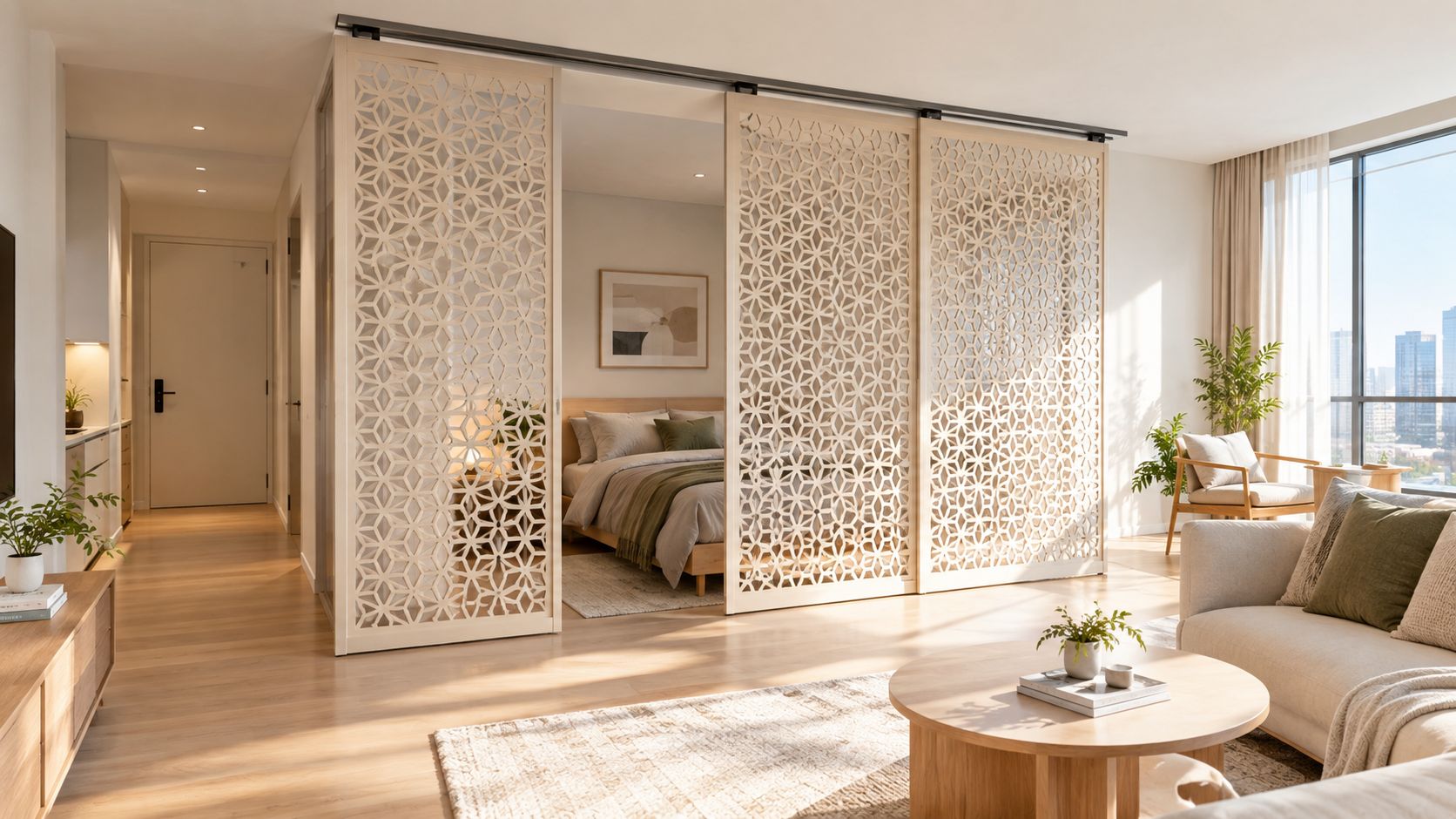
A sliding jali solves a planning problem that a fixed screen can't. The panels move along ceiling-mounted or floor-mounted tracks, allowing one room to serve different purposes at different times. That makes the system useful in studio apartments, open-plan villas, and homes where a living area must shift between work, entertaining, sleeping, and family use.
A sliding partition is flexible, but it isn't automatically effortless. Track alignment, panel weight, floor level, ceiling clearance, and handle position all affect daily operation. Lightweight aluminium-frame, acrylic, or carefully engineered timber panels are easier to move than heavy solid constructions. A soft-close mechanism reduces slamming and protects the panel edges, track, and adjoining walls.
Design the movement before the pattern
Start by marking the panel's open and closed positions. The parked panels need somewhere to go without blocking a doorway, switchboard, kitchen cabinet, or furniture. In an open-plan Chennai villa, a sliding screen can create a temporary work zone, but it won't help if the track ends in the middle of the main circulation route.
Ceiling tracks: These create a cleaner floor line, but the ceiling must accept the fixing load and provide adequate clearance.
Floor tracks: They can guide heavier panels, but they collect dust and may interrupt walking.
Quality rollers: Use durable ball-bearing hardware from a reputable manufacturer rather than treating the track as a minor accessory.
Early coordination: Confirm electrical, plumbing, air-conditioning, and lighting positions before finalising the partition line.
A sliding jali offers adaptable zoning, not complete acoustic separation. It can moderate views and define use, but conversations and household noise will still travel through the openings. Choose it for flexibility and visual control, not for the performance of a solid wall.
6. Textured and Patterned Concrete Jali Designs
Concrete jalis make a strong architectural statement. Cast or three-dimensional patterned panels combine the porous logic of traditional jali with the weight and texture of contemporary construction. They suit a modern Chennai villa, an industrial living room, or an entertainment area with exposed brick, timber, and metal accents.
This option is about permanence. Concrete resists daily wear and can be simple to maintain once sealed, but its mass affects transport, installation, fixing, and structural safety. Apartment owners should obtain a structural assessment before approving a heavy panel. A lighter fibre-reinforced concrete alternative may reduce the load for less demanding applications, but the manufacturer still needs to confirm the system's support and fixing requirements.
Humidity and staining also deserve attention. Apply an appropriate sealant, especially where the screen sits near an entrance, kitchen, balcony, or other area exposed to moisture and dirt. A raw surface can develop an attractive patina, but it can also show marks that are difficult to remove. Decide whether you want a deliberately aged appearance before installation.
Warm the industrial finish
Concrete looks better when the surrounding materials provide contrast. Pair it with natural wood, woven textures, warm lighting, or a muted metal finish. Cool white light can make a concrete partition feel stark, while warmer illumination brings out the depth of the pattern and makes the room more comfortable at night.
A geometric concrete screen can separate living and dining areas in a large villa. In a smaller apartment, use it selectively as a feature panel rather than building a heavy divider that consumes visual and physical space. For outdoor-to-indoor continuity, see these coloured concrete overlay ideas for patios, while keeping the different exposure conditions in mind.
Concrete works when the home can carry its visual weight. It doesn't work well as a last-minute decorative panel added without checking structure, access, and lighting.
7. Acrylic and Resin Jali Partitions with Embedded Elements
Acrylic and resin screens offer the lightest visual presence in this list. Clear, coloured, or translucent panels can carry embedded dried flowers, metallic accents, coloured paper, or abstract decorative elements. They're useful in compact Chennai apartments where a timber or concrete screen would feel too substantial, especially between a living room and dining area.
The material passes light differently from a traditional perforated screen. A transparent panel maintains clearer sightlines, while a translucent panel creates privacy through diffusion rather than dense pattern. That distinction matters in a bedroom. If you need a stronger visual barrier, select a textured or coloured infill instead of assuming that clear acrylic will provide privacy.
Specify the surface for real daily use
Sun exposure, scratches, and cleaning technique determine whether the panel continues to look refined. Choose UV-protected acrylic for bright rooms, particularly near large windows. A protective film can help in high-traffic areas where furniture may brush against the screen, though the film itself needs to be replaced or maintained when it becomes marked.
Cast acrylic: Prefer it when clarity and a cleaner edge are priorities.
Metal support frames: Use a slim frame to control flex and give the panel a finished architectural boundary.
Embedded elements: Keep them selective. Too many flowers, metallic pieces, or colours can make the screen look like a display board.
Cleaning: Use a soft cloth and suitable cleaner. Abrasive pads can create visible scratches.
Acrylic and resin suit rental homes and contemporary interiors because they're relatively light and easy to reposition compared with masonry or thick wood. They're less appropriate where heat, impact, or intense handling is likely. In a kitchen-facing location, keep the panel away from direct heat and plan a finish that won't trap grease around decorative inserts.
8. Modular Jali Screen Systems for Flexible Living Spaces
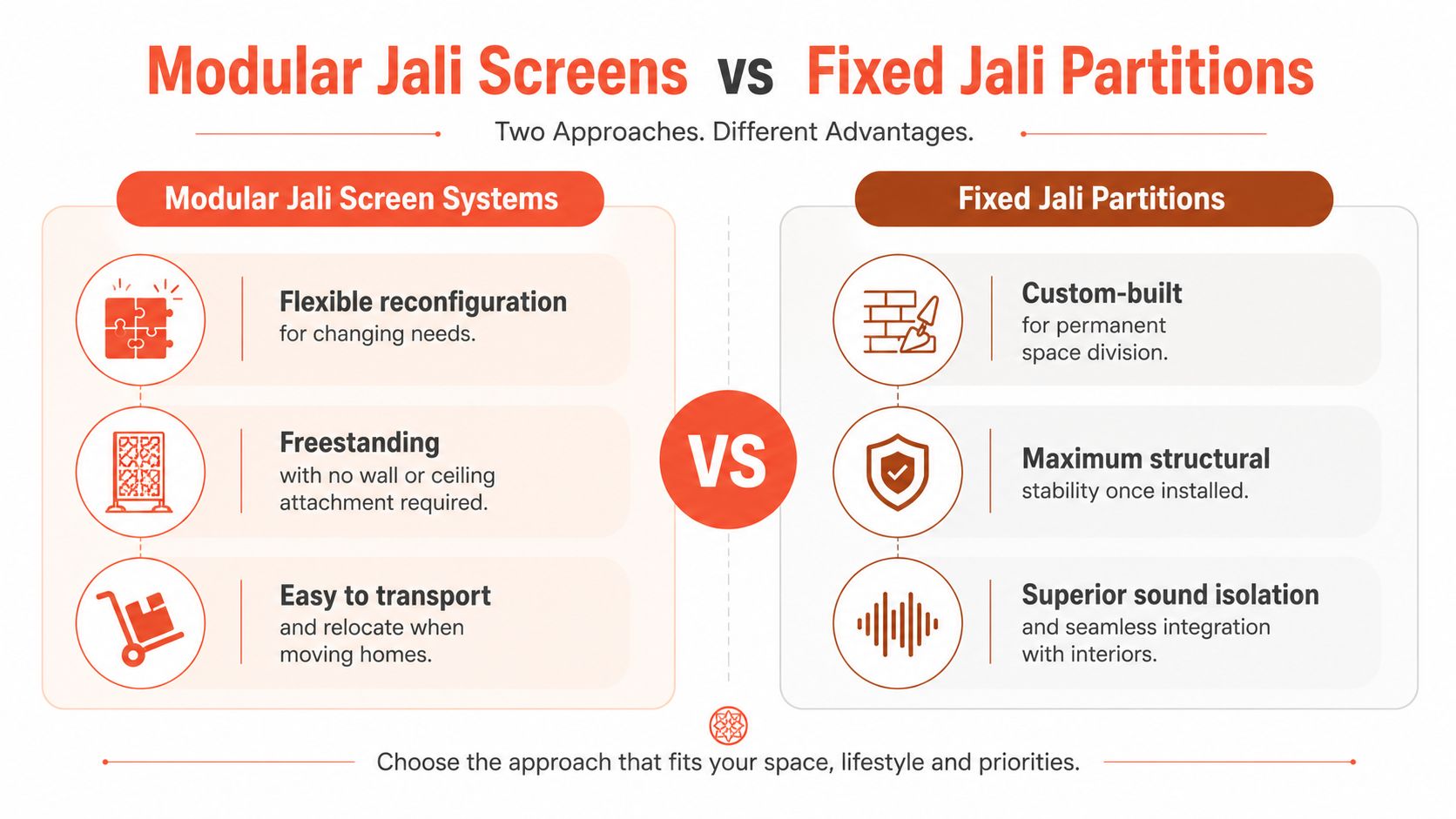
Modular jali screens are designed for homes that may change. Interlocking panels can be arranged, separated, or stored without committing the room to a permanent wall. That makes them especially useful for renters, NRI properties, resale homes, and open-plan spaces that need to support different occupants or activities over time.
The system's flexibility comes with a stability trade-off. A portable screen must stand securely without becoming a tipping hazard. Weighted bases, anti-slip pads, and a level installation surface help, but the final configuration still needs to respect traffic flow, door clearances, children's movement, and furniture placement.
Plan the next arrangement, not just today's
A modular screen can create a private work corner during the week, open the room for entertaining, and define a sleeping zone when guests arrive. The panels shouldn't be arranged so tightly that they block the only comfortable route through the room. Keep access to switches, windows, storage, and cleaning areas in mind.
For rental apartments: Choose a freestanding arrangement that avoids drilling and can move with the tenant.
For NRI-owned homes: Select durable finishes and a straightforward configuration that local occupants can adjust safely.
For changing work zones: Use panels that can form a shallow screen rather than forcing a full enclosure.
For visual variety: Combine related jali patterns across panels, but keep the frame language consistent.
For safety: Check the base, joints, and anti-slip protection after every major rearrangement.
Modular systems provide the least permanence and the greatest adaptability. They won't feel as architecturally integrated as a fixed wood, metal, or concrete partition, but that's precisely their value when the room's purpose may change.
If you're deciding between a factory-coordinated system and site-built work, compare the practical implications in modular versus on-site carpentry in Chennai.
Comparison of 8 Jali Partition Designs
Design / Visual Character | Implementation Complexity 🔄 | Resource & Maintenance ⚡ | Effectiveness / Outcomes ⭐📊 | Ideal Use Cases | Key Advantages 💡 |
|---|---|---|---|---|---|
Geometric Lattice Jali Partitions, repeating squares/diamonds/hexagons, modern-traditional, open sightlines | Medium 🔄, CNC cutting, scalable panels | Low–Medium ⚡, affordable materials; regular dusting | ⭐⭐⭐⭐, good light filtration, preserves sightlines, moderate privacy | Living/dining dividers, bedroom separators, kitchen boundaries in apartments/villas | Cost-effective; easy to manufacture/install; complements minimalist interiors |
Floral and Nature-Inspired Jali Designs, botanical motifs, ornate and elegant | High 🔄, skilled carving or precise laser-cutting | High ⚡, premium materials; meticulous cleaning required | ⭐⭐⭐⭐, strong aesthetic/focal impact; moderate privacy | Master bedrooms, prayer rooms, premium living areas | Artisanal beauty; soothing organic aesthetics; heritage character |
Contemporary Metal Frame Jalis, slim metal frames with varied infill, industrial-contemporary | Medium 🔄, metal fabrication, powder-coating, simple install | Low ⚡, durable, low upkeep; may show fingerprints | ⭐⭐⭐, durable and clean-looking; acoustic performance varies by infill | Open-plan apartments, modern villas, industrial interiors | Highly durable; customizable infills; faster installation |
Carved Wood Panel Jalis with Traditional Motifs, hand-carved motifs, warm heirloom quality | Very High 🔄, artisan labor, long lead times, complex carving | Very High ⚡, costly woods; regular care; humidity protection needed | ⭐⭐⭐⭐⭐, outstanding cultural/aesthetic value; limited soundproofing | Premium villas, heritage-conscious apartments, feature statements | Authentic craftsmanship; develops patina; strong heritage appeal |
Sliding Track Jali Partitions, movable jali panels on ceiling/floor tracks | Medium–High 🔄, precise hardware alignment and installation | Medium ⚡, track maintenance and lubrication; prefer lightweight panels | ⭐⭐⭐⭐, highly flexible spatial control; moderate privacy | Studio apartments, open-plan homes, rentals needing adaptable layouts | Flexible space division; space-saving; reversible and versatile |
Textured and Patterned Concrete Jali Designs, cast or 3D-printed concrete patterns, industrial look | High 🔄, molds/3D-printing and structural support needs | Medium ⚡, very durable, low routine maintenance; sealing recommended | ⭐⭐⭐⭐, bold visual impact, good acoustics, permanent solution | Modern villas, feature walls, industrial-minimalist apartments | Extremely durable; excellent sound dampening; distinctive contemporary aesthetic |
Acrylic and Resin Jali Partitions with Embedded Elements, translucent/transparent panels with inlays | Low–Medium 🔄, fabrication and embedding, simpler assembly | Low ⚡, lightweight, easy to clean; use UV protection | ⭐⭐⭐, maximizes light, highly customizable; lower acoustic and scratch resistance | Studios, rental apartments, contemporary minimalist interiors | Lightweight; easy maintenance; customizable embedded designs |
Modular Jali Screen Systems for Flexible Living Spaces, interlocking freestanding panels | Low 🔄, tool-free assembly, reconfigurable | Low ⚡, portable, replaceable parts; occasional tightening | ⭐⭐⭐, extremely flexible and portable; limited stability and sound isolation | Rental units, NRI properties, homes needing frequent reconfiguration | Portable and reconfigurable; renter-friendly; cost-effective and no-permit solution |
Choose the Pattern That Performs Best
The best jali partition isn't the one with the most elaborate pattern. It's the one that solves the room's actual planning problem without creating a new maintenance, privacy, or circulation problem.
Choose geometric lattice when you want clean contemporary separation between living, dining, kitchen, or bedroom zones. Keep the openings generous in compact rooms, and make the frame relate to the furniture and wall colours. Choose floral jali when the room needs softness, decorative detail, and layered shadow. It suits bedrooms, living areas, and prayer spaces, but the pattern should have enough accessible surface for regular cleaning.
Choose carved wood when craftsmanship, warmth, and cultural character matter more than low maintenance. It can become an heirloom element, but only when the timber, seasoning, protective finish, and cleaning plan are handled properly. Metal is better for busy homes that need a durable, structurally reliable screen. Select matte or textured finishes if fingerprints and glare would be distracting, and coordinate the frame with the home's hardware.
For a bold and permanent intervention, concrete brings depth, texture, and an industrial presence. It needs early structural review and careful sealing, particularly in humid or stain-prone locations. Acrylic and resin work when you want lightness, visual clarity, or artistic embedded elements. They're easier to handle than heavy panels, but they need protection from scratches, strong heat, and unsuitable cleaning products.
The adaptable options solve different problems. Sliding track jalis are right for homes where rooms change function during the day, provided the track, parked position, panel weight, and services are planned early. Modular screens suit renters, NRI properties, and homeowners who may reconfigure the room. They offer flexibility rather than permanent architectural integration, so stability and traffic planning become essential.
Before approving a design, review the following with the fabricator or interior team:
Opening size: Judge the free area, not just the outer panel dimensions, because the solid portions don't contribute to usable airflow or daylight.
Sightlines: Check what someone can see while standing, sitting, entering, and moving past the screen.
Airflow and daylight: A jali can filter light and support ventilation, but the pattern must suit the façade, room orientation, and intended use.
Privacy: Bedrooms and prayer areas usually need denser visual screening than living and dining dividers.
Cleaning: Fine floral carving and deep grooves need more attention than a simple metal or acrylic surface.
Structural support: Heavy concrete, thick timber, and large fixed panels need suitable wall, ceiling, floor, and transport planning.
Lighting: Test the shadow pattern before finalising spotlights or backlighting.
Traffic movement: Confirm door swings, furniture clearance, track paths, and emergency access.
Future changes: Decide whether the partition should remain fixed, slide away, or be reconfigured.
Jali has always worked best when beauty and performance are considered together. Traditional Indian screens were used to manage light, airflow, and privacy, not merely to decorate a wall. Research on residential jaali fenestration in Delhi found a screen configuration with a 70% solid and 30% void ratio at 100 mm depth produced well-lit, thermally comfortable, and glare-free interiors under the study conditions. Read the peer-reviewed jaali fenestration study. A separate Ahmedabad study also found that the most effective screen specifications varied by façade orientation, with different depths, cavity arrangements, and perforation conditions performing better on south and west elevations. Review the Ahmedabad jaali performance research.
That evidence supports a simple design position. Don't choose the same openness, material, or depth for every room. A Chennai living-dining divider, a bedroom screen, a pooja enclosure, and an entry partition each need a different balance of visibility, airflow, light, privacy, durability, and upkeep.
For a coordinated residential project, discuss the jali location before cabinetry, electrical work, lighting, and flooring are finalised. A residential interior team such as Interiors by DeX can bring space planning, lighting coordination, material selection, manufacturing, installation, and handover into one project conversation, which helps prevent a screen from becoming an isolated decision.
If you're planning a Chennai apartment, villa, rental property, or renovation, visit Interiors by DeX to discuss jali placement alongside space planning, lighting, material selection, manufacturing, and installation. Their residential team can help turn the partition idea into a coordinated interior plan with project guidance from design development through handover.