
The most popular advice about modular kitchen sinks is also the most misleading. You're told to upgrade the material, pick the sink that looks premium in a photograph, and let the plumber sort the rest. That order is backwards.
A sink fails after the counter is cut, not in the showroom. If the base cabinet, cut-out, waste trap and water quality don't suit your choice, a costly finish won't save it. Judge modular kitchen sinks by fit, failure and upkeep first, and by colour second.
The Right Modular Kitchen Sink at a Glance
Start with this shortlist and circle one row today. The default for most Indian flats and villas is a 304 grade stainless steel single bowl. Another row should win only when your counter length, cabinet strength and cleaning habit clearly support it.
Sink choice | Best for | Main limit | Typical role |
|---|---|---|---|
304 stainless single bowl | Daily cooking with kadais and pressure cookers | Mirror polish shows hard-water spots | Default for most apartment modules |
Stainless with drainboard | Washing plus a drip area | Needs more counter length than a 600 mm bay | Longer runs that still use steel |
Double bowl stainless | Soaking and rinsing at the same time | Each bowl is too narrow for large vessels | Wide counters and villas only |
Quartz or granite composite | Quieter colour and less obvious water marks | Heavy, needs support, slower to replace | Design-led option, not an automatic upgrade |
Fireclay or ceramic | Smooth glaze and a light colour | Chips on impact and spots show on pale glaze | Careful premium use |
Why the Single Bowl Is the Default
A single bowl keeps one wide space for a pressure cooker, a large kadai and tall everyday vessels. It also suits the common 600 mm module in compact Chennai apartments. A drainboard helps when plates need somewhere to drip, but it takes counter length you might need for preparation.
A double bowl sounds flexible until you try to turn a wide vessel inside either half. It's a sensible layout on a wide run. In a small kitchen, it usually turns one useful bowl into two restrictive ones.
Composite and fireclay can work in design-led projects. They need a cabinet that can carry the weight, careful handling of heavy cookware and an owner who accepts that an exact replacement may take longer to source. Don't choose either material just because the showroom lighting makes it look better than steel.
The market pattern supports that practical starting point. The IndexBox India kitchen sinks market assessment reports that stainless steel represents roughly 70 to 75% of unit volume, while composite granite, fireclay and copper together account for an estimated 20 to 25% of market value but only around 10 to 12% of volume. Indian buyers still put durability, cleaning ease, corrosion resistance and affordability ahead of display value.
For a domestic stainless sink, request IS 13983:1994 in the specification. Ask for that reference in writing rather than accepting a vague promise that the product is stainless.
The winning row is the one your base cabinet, cut-out and plumber can support, not the finish that looks best in a showroom photo.
Circle one row now. Carry that choice into the measurement, mounting and plumbing checks before anyone authorises a counter cut.
Why the Sink Belongs to the Cabinet
Think of a window fitted into its frame. You don't build the frame, tile around it and then hope a random window fits. A modular sink works the same way, because it's a fitted part of the cabinet and counter assembly.

In a factory-coordinated kitchen, the sink, countertop cut-out, tap holes, waste outlet and base-unit width are resolved together. Change one item late and the others may no longer line up. The bowl can move away from the drain, or the new rim can leave too little counter material around the opening.
What Goes Wrong When the Sink Is Chosen Late
Say a Chennai flat owner approves a base unit with a deep drawer. The sink arrives later, but its bowl and trap need the same space as the drawer box and runners. The installer now has to cut the drawer, shift the plumbing or replace the unit.
Another late change can leave a narrow strip of stone or laminate beside the cut-out. That strip carries clips, sealant and daily knocks from vessels. If it cracks or the seal fails, water reaches the cabinet carcass and the damage stays hidden until swelling or smell gives it away.
The wider move from site-built masonry kitchens to factory-made systems makes this coordination more important. The Grand View Research India modular kitchen outlook estimates sector revenue at approximately USD 519.3 million in 2020 and projects it could reach USD 2,727.2 million by 2028. More fitted kitchens means more sinks whose plumbing and dimensions must be settled before production.
For a new Chennai flat, the sink affects how you move between washing and preparation, what you can store underneath, when trades can install their parts and whether handover reveals leaks. Those outcomes matter more than a small difference in shine.
Workflow: The bowl position decides where wet vessels and food preparation meet.
Storage: The trap and waste route decide whether drawers or pull-outs can work below.
Installation order: The approved sink drawing controls cabinet production and counter fabrication.
Handover quality: Correct alignment makes leaks easier to spot and repair.
Name IS 13983:1994 when you specify a domestic stainless sink for dimensions, workmanship and finish. Treat the sink as part of the cabinet from the first drawing, not as a basin you can swap freely after tiling.
Materials That Survive Daily Indian Cooking
A premium sink can look convincing in a showroom and still create trouble after the counter is cut. Judge each material by how it handles everyday use, what support the cabinet needs, and whether a matching replacement is available if the bowl is damaged.

The Bonafide Research India kitchen sinks market report forecasts annual growth of approximately 16.39% for quartz composites through 2031. That growth makes the material more visible, but it does not make it the safest choice for every cabinet, cooking routine or replacement need.
Specify the Steel Properly
For a stainless modular kitchen sink, specify 304 stainless steel (EN 1.4301). Daily contact with water, salt, food acids and detergent makes corrosion resistance important. Forming quality matters too: inspect the bowl for smooth joins and avoid sharp, weak creases.
Ask the maker for a material declaration. Check the weld finish and look underneath for reinforcement and support. Press near the bowl base. A poorly supported bowl may flex or make a tinny oil-canning sound when a full vessel lands in it.
Bare stainless steel handles routine contact with hot vessels well. In a busy cooking routine, a kadai or cooker may move from hob to sink during clean-up. Coated and resin-based surfaces may have different limits, so follow the product's care instructions rather than assuming every material tolerates the same treatment.
Where Composite and Fireclay Ask for Compromise
Quartz and granite composites offer more colour choice, and water marks can be less obvious than on polished steel. Those benefits can suit an open kitchen, but weigh them against the cabinet's capacity to support the sink, the cut-out accuracy required, impact damage, repair options and replacement lead time.
A heavy composite may need extra bearers that a standard sink cabinet does not have. Cast iron dropped against the bowl can chip it. If the model is discontinued, finding a replacement that fits the existing cut-out may take time.
Fireclay has a smooth, glazed appearance, but a dropped kadai can chip it. Copper is a small premium niche, not a typical first choice for heavy daily washing. Either material may suit a particular design, but neither is automatically tougher than steel.
Failure test: Before paying more for a premium material, ask how the sink will be supported, how damage can be repaired and how quickly an identical replacement can reach your home.
Compare the total installed cost, fabricator requirements, warranty coverage, drainage performance and local availability. Material choices for low-maintenance interiors help frame the decision beyond the purchase price, which does not account for support, care or disruption.
Choose 304 stainless steel unless another material's design value clearly outweighs its weight, repair risk and lead time. In Chennai, also consider the upkeep required to keep the chosen finish looking presentable in hard-water conditions. A showroom finish matters less than a sink that fits, stays supported and can be maintained after installation.
Bowl Depth and the Measurements That Fit
A sink can fit the counter opening and still fail in use. The internal bowl, counter support and space beneath it all need to match the cabinet before the fabricator cuts.
Item | Typical starting point | Why it matters |
|---|---|---|
Bowl depth | 150 mm minimum | Splash control and room for tall vessels |
Rectangular bowl, internal | About 380 mm by 340 mm or larger | Usable washing area, not the outer rim |
Round bowl, internal | About 360 mm diameter or larger | A smaller bowl may limit room for large pots |
Sit-on edge clearance | About 15 mm | Starting allowance for rim support |
Inset edge clearance | About 30 mm | Counter left around the cut-out |
Tap hole | 30 ± 2 mm for relevant configurations | Helps the mixer fit the prepared hole |
Usual apartment module | 600 mm cabinet, bowl near 600 by 450 mm | A starting size to check against the product drawing |
Waste pipe | About 40 mm, with a fall | Allows water to drain without pooling |
The BIS IS 13983:1994 stainless steel sink standard specifies a minimum bowl depth of 150 mm, measured from the top edge to the base, and references a 30 ± 2 mm tap-hole diameter for relevant configurations. Treat the other dimensions in the table as typical starting points, not fixed fabrication rules. The manufacturer's drawing gives the cut-out and clearances for the particular sink.
Three Numbers Buyers Confuse
Overall sink size, usable bowl size and support margin describe different things. A sink's outside dimensions may suit a 600 mm cabinet while its internal bowl leaves too little room for your largest vessel. The cut-out can also leave less counter material around the edge than the chosen mount requires.
A common apartment starting point is a 600 mm module with a single bowl near 600 by 450 mm. Check that pairing against the sink drawing before approving the counter cut. The drawing should show the cut-out, rim width, corner radius, overflow provision and waste position.
Cabinet measurements can add another layer of confusion: carcass width, door width and internal clear width are not interchangeable. Compare the project drawing with standard base cabinet measurements and confirm whether the quoted module is external, internal or based on the door.
Check the Space Below the Bowl
A deeper bowl gives tall vessels more room and can help contain splashes. It also places the waste outlet lower, which may bring it into conflict with a trap, drawer runner, pull-out bin or service void.
Check the section drawing, not only the plan view:
Measure internal height: Confirm clear cabinet space, rather than relying on the outside cabinet height.
Mark the plumbing zone: Reserve space for the inlets, waste pipe and trap.
Clear the trap route: Check that shelves, drawer boxes and runners leave room for the trap and access for cleaning.
Match the product drawing: Compare the cut-out, corner radius, rim width, tap-hole position and waste size with the counter drawing.
Record the services: Add the sink centreline and trap route to the coordinated services drawing so the layout remains clear for future leak inspection.
A sink module may look right in plan and still fail in section. The modular kitchen dimensions guide helps put the cabinet and counter sizes in context. Ask for a drawing that shows the bowl, trap and drawer together at full height.
The showroom finish cannot resolve a poor fit after the counter is cut. Confirm the internal bowl, support margin and trap route against the manufacturer's drawing before approving the opening.
Bowl Layouts and How the Sink Mounts
Layout decides how you wash. Mounting decides how the fabricator cuts and supports the counter. Don't merge those decisions into one vague style choice.

A single bowl provides one uninterrupted space for Indian vessels. A drainboard includes a sloped drying ledge, but that ledge reduces the preparation length on the same counter run. A double bowl separates soaking from rinsing, yet each bowl becomes tight unless the counter is very wide.
Choose the Mount Your Counter Can Carry
Sit-on or top-mount sinks drop over the opening and rest on their rim. This is the most forgiving option for laminate and compact quartz because the rim covers the cut edge. Small cutting tolerances are easier to manage, and replacement is usually less disruptive.
An inset sink sits into a prepared or rebated edge. It needs enough counter material around the opening for support and sealing. The fabricator must follow the exact product profile rather than cutting a generic rectangle and hoping sealant will hide the difference.
An undermount sink fixes below a solid counter so crumbs and water can be wiped directly into the bowl. It suits suitable stone or engineered surfaces with a finished, moisture-resistant cut edge and proper mechanical support. It's a poor match for laminate because the exposed core can swell when wet and can't be polished like stone.
Pick the mount the counter material can support, then lock the tap-hole count before the factory cuts the top.
Tap position isn't a cosmetic afterthought. A mixer mounted through the sink deck, through the counter or on the wall produces different holes, clearances and splash patterns. Decide it while the counter drawing is still editable.
Drainage also needs a clear, accessible route with enough fall to keep waste moving. Slow drainage often gets blamed on the bowl when fault sits in a flat pipe, a badly positioned trap or food waste building up below. If you're comparing symptoms and repair methods, these blocked drain fixes in Caroline Springs show why access and pipe condition matter, although your Chennai plumber should diagnose your own pipework on site.
For most apartment modular kitchen sinks, a single bowl with a sit-on mount is the easiest combination to install and maintain. Move to inset or undermount only when the counter material, edge finish and support method are all confirmed in the fabrication drawing.
Hard Water Care for Chennai Kitchens
A premium finish cannot prevent hard-water spots if droplets dry on the bowl every day. Choose a surface that suits your cleaning routine, then judge it by how it will look and function after installation.
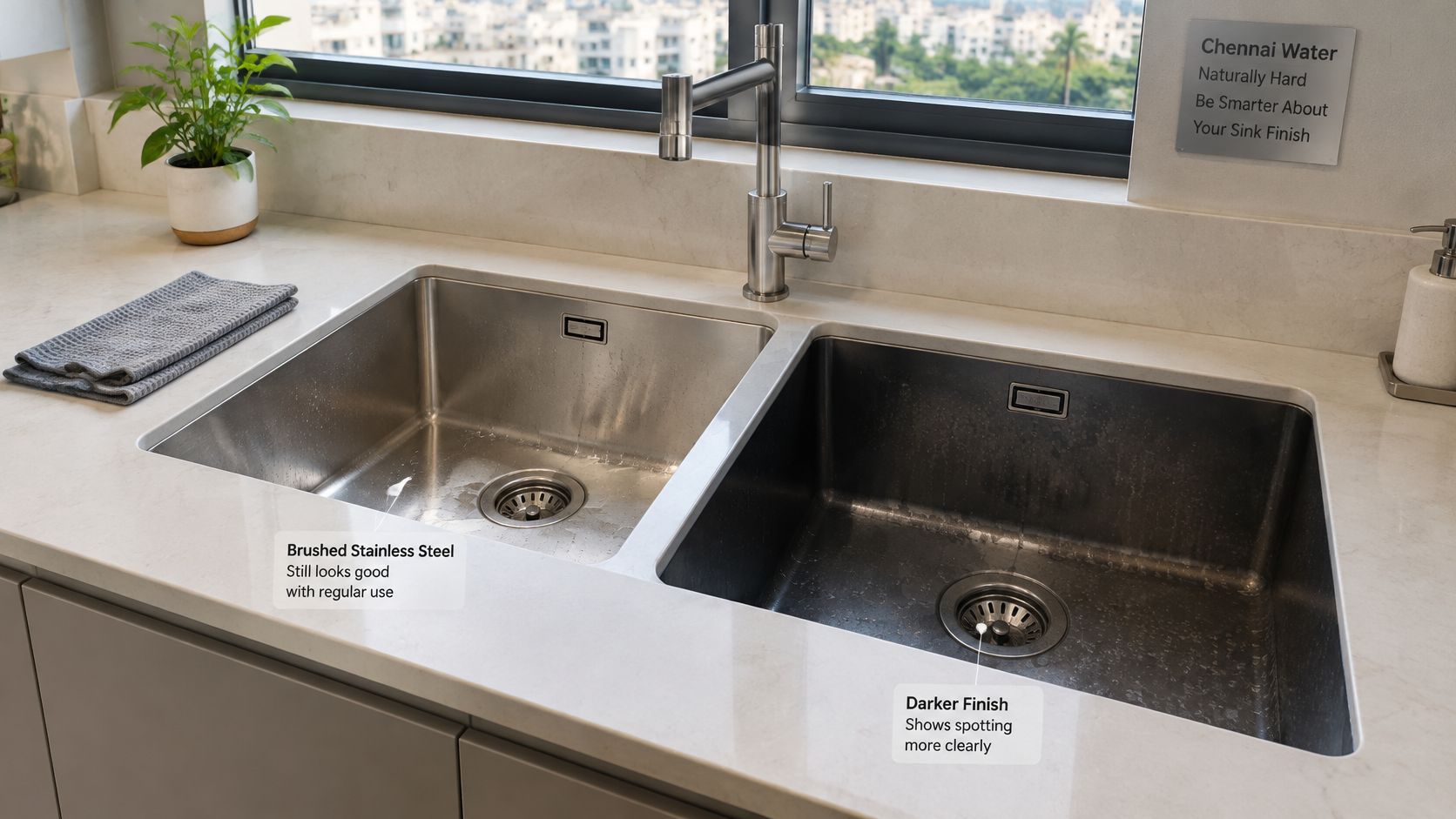
Minerals in hard water can leave deposits as water evaporates. Polished stainless steel and light-coloured ceramic make those marks easier to see. Mirror polish reflects each dried droplet sharply, while brushed, matte or linen-textured steel softens the contrast.
Stainless steel is durable and corrosion resistant, but its upkeep depends on the finish and what is left on the surface. A textured finish may make spotting less noticeable; it does not remove mineral deposits.
Separate Scale From Corrosion
A white mark and a brown pit need different responses. Treating both with a harsh cleaner can damage a finish without solving the underlying problem.
Mark seen | Likely cause | First action |
|---|---|---|
White chalky film that wipes off | Mineral scale from hard water | Short vinegar dwell, then full rinse |
Brown pit that stays after wiping | Possible corrosion, including from salty water left standing or a weaker grade | Check the grade declaration, clear standing salt, and consult the installer |
Scratches on mirror finish | Abrasive pad or cutlery contact | Use a soft pad; consider a textured finish |
Dull patch on coated sink | Harsh scourer damaging the coating | Use a soft pad and do not leave acid on the coating |
White chalky film is usually scale on the surface. A brown pit that remains after gentle wiping may indicate corrosion in the metal. Check the sink's declared grade and ask the installer to assess persistent pitting rather than scrubbing harder.
A Care Rhythm That Prevents Most Marks
After the last wash of the day, wipe the bowl dry. During the week, use mild detergent and a soft pad. On brushed steel, move with the grain so cleaning does not add conspicuous scratches.
For visible scale on bare stainless steel, use a short vinegar dwell, then rinse thoroughly and dry. Keep acid away from coloured coatings, sealant and stone joints. If the finish is unusual, test the cleaner on a small, inconspicuous area first. The hard water guidance for South Florida homeowners offers general background on mineral-heavy water, but the sink's own finish and the counter material determine which cleaner is suitable.
Pay attention to the rim and counter joint, where pooled water can leave marks or affect sealant and laminate. If daily spotting is the main concern, consider textured stainless steel before choosing a heavier composite. A showroom finish is only part of the decision: after the counter is cut, the sink must still fit its cabinet and support.
Freeze the Sink Drawing Before the Factory Cuts
Turn your shortlisted row into one drawing that the factory, counter fabricator and plumber all use. If each trade works from a different product sheet, the sink becomes three separate guesses.
Write these items on the approved drawing.
Material and grade: Use 304 stainless steel unless you've accepted the weight and replacement terms of an alternative.
Layout and mount: Record bowl count, drainboard position, mounting method and bowl depth.
Cabinet fit: State cabinet width, internal clearances and whether access comes from a dummy drawer front or a full-height door.
Counter details: Confirm cut-out size, corner radius, rim support and finished edge treatment.
Tap and waste: Mark tap-hole count and diameter, waste position and the full trap route.
Commercial terms: Add the quoted installed cost, replacement lead time and warranty terms for the exact product.
Changing modular kitchen sinks after the counter is cut usually means replacing the top, not making a simple swap. Adding a heavier composite late can also overload a cabinet and support system designed for steel. Neither problem is solved by buying a more expensive sink at the last minute.
Take your shortlisted row, measurement checklist and a note about hard-water spotting to the design review. Approve the sink centreline before the carcass is built. These principles for how to design a modular kitchen will help you connect the sink decision with workflow, storage and services rather than reviewing it alone.
For Chennai flat owners, villa owners and NRI owners who want one accountable team, Interiors by DeX (https://interiorsbydex.com) can coordinate the sink drawing from workflow layout through factory production and installation. Confirm the exact scope, timelines and warranty terms in writing before work starts.
If your modular kitchen sink still exists only as a catalogue link, bring the product drawing, cabinet section and water finish choice to one coordinated design review. Interiors by DeX can align the sink, counter cut-out, plumbing route and factory-made cabinet before production begins, so you aren't paying to correct avoidable clashes on site. Visit Interiors by DeX to discuss your Chennai kitchen and freeze the right specification before the first cut.