
Your new flat is nearly ready, the cabinets are chosen, and the stone dealer is waiting for an answer. Black granite, white quartz, or something that looks like marble. The samples all look good under showroom lights. The real test starts later, with a hot kadai, a pressure cooker, turmeric on your fingers, and water splashing from the sink every single day.
Why Your Kitchen Platform Stone Matters
Morning in a Chennai apartment usually starts at the platform. Filter coffee on one side, dosa batter near the hob, and a cooker building pressure while someone chops onions for lunch. By midday there's oil near the stove, tamarind water by the sink, and a wet cloth moving across the surface after every round of cooking.
That cycle repeats for years. Your choice of stone for kitchen platform work has to survive direct heat, sharp vessel edges, coloured spices, acidic food, and constant wiping. It's not a decorative panel. It's the hardest working surface in the house.
What goes wrong with a poor match
A pale, absorbent stone looks calm on day one and then holds a turmeric shadow by month two. A heat sensitive surface can discolour where a tawa rested for thirty seconds. A slab laid over weak cabinet support can crack near the sink cut out, where the stone is narrowest and wettest.
None of these failures mean the material was bad. They usually mean nobody matched the material to the household. A family that fries daily and moves vessels straight off the flame needs different compromises from a couple who cook lightly and wipe spills immediately.
Water quality adds another layer. Mineral deposits build up around taps and sink edges, and rough scrubbing to remove them can dull a polished finish over time. If your home gets hard water, keep hard water stain removal tips handy and use gentle methods first, because aggressive cleaners create their own damage.
Comfort is part of performance
Stone choice also sits on top of basic ergonomics. Slab thickness, cabinet height, and your hob position decide whether rolling dough or stirring a deep pot feels easy or tiring. It's worth checking standard kitchen platform height guidance before fabrication, since the finished height changes once the slab and edge band are added.
Practical rule: Judge a stone by your busiest cooking hour, not by how it looks in an empty kitchen.
Three questions run through every sound decision. How much direct heat will the surface take. How much oil, pigment, and acid will land on it. And how much sealing, wiping, and careful handling will your household sustain after the novelty wears off. Answer those and the shortlist usually narrows itself.
Understanding the Main Stone Options
Most Chennai homeowners meet five names at the dealer. Granite, engineered quartz, marble, other engineered stone, and ultracompact surfaces such as Dekton. They sit side by side in the yard, but they're built very differently, and that construction explains how each one behaves.

Granite the heat tolerant workhorse
Granite is a natural igneous stone cut from quarried blocks. Its speckled mineral pattern hides crumbs, small marks, and joints better than a plain surface, which is a quiet advantage in a busy kitchen. It tolerates hot vessels better than resin based materials and takes daily vessel movement well when the slab is sound and properly supported.
The trade off is variation. Two slabs sold under one commercial name can differ in colour, pattern, and porosity. You should select the actual slab, not a small sample, and inspect it for cracks, patches, and uneven polish.
Quartz and other engineered stone
Engineered quartz is manufactured from mineral aggregate bound with polymer resin. That factory process gives you uniform colour, which is why it suits pale, minimal kitchens where granite patterns feel busy. Its manufactured surface has very low accessible porosity, so everyday liquid staining is less of a worry and routine sealing isn't part of ownership.
The resin is also its limit. Concentrated heat from a pan base acts on the binder first. Dekton type ultracompact surfaces are made differently, through high pressure and heat, and they handle heat and sunlight well, but they demand skilled fabrication and careful edge handling because the material is unforgiving during cutting and transport.
Marble the elegant but delicate option
Marble brings soft veining that many people love, and it stays cool, which bakers enjoy. In a main Indian cooking zone, though, it's the most demanding choice on this list. Acids in lemon, tomato, tamarind, and vinegar based cleaners can etch the surface. Etching is physical surface damage, not a stain you can wipe away.
The hardness gap is measurable. Granite sits at approximately 6 to 7 on the Mohs hardness scale, while marble is approximately 3 to 5, and reported granite water absorption is about 0.1% to 0.5% compared with roughly 0.2% to 0.6% for marble, as set out in India focused guidance on kitchen marble and granite. Lower hardness means knives, vessel bases, and gritty scrubbers mark marble sooner.
Keep one distinction clear before you compare prices. Natural stone varies by slab and needs inspection. Manufactured stone varies by brand, batch, and warranty terms, so the paperwork matters as much as the sample.
Granite vs Quartz vs Marble vs Engineered Stone
Side by side numbers help, but daily behaviour decides the winner. A household that puts a screaming hot tadka pan down wherever there's space will punish quartz. A household that leaves beetroot and turmeric spills through a long lunch will test granite and marble far more than quartz.
Material | Durability | Heat Resistance | Stain Resistance | Maintenance | Cost Band |
|---|---|---|---|---|---|
Granite | High, hard natural stone | High, most forgiving with hot vessels | Moderate, varies by slab | Periodic sealing, prompt spill wiping | Wide, from economical to premium |
Engineered quartz | High for daily impact and scratches | Limited, always use trivets | High for everyday liquids | No routine sealing, heat discipline needed | Mid to premium |
Marble | Moderate, softer and etch prone | Moderate | Low, acids etch the surface | Sealing plus careful cleaner choice | Premium, varies by variety |
Engineered stone and Dekton type surfaces | High when fabricated well | High for ultracompact types | High | Low routine care, specialist repair | Premium |
Heat against stain resistance
This is the central trade off, and dealers often blur it. Engineered quartz shouldn't be treated as a direct substitute for heat proof natural granite, because quartz surfaces combine mineral aggregate with polymer resin and heat from a pan, tawa, or pressure cooker base can affect the resin rich binder even when the mineral portion stays stable, as explained in technical guidance comparing quartz and granite for India. The damage usually shows as a pale ring or a dulled patch exactly where the vessel sat.
Granite flips the compromise. It forgives heat, but oil left overnight near the hob can darken a more absorbent variety. Sealing slows that absorption. It doesn't make the stone stain proof, and anyone who promises otherwise is overselling.
Marble loses on both spill categories in a heavy cooking kitchen. Pigments can stain it and acids etch it, so you get two failure modes instead of one. It can still work on a low use breakfast ledge or a dry pantry counter, away from the main firing line.
Maintenance and cost over the full life
Purchase price is only the opening payment. Granite and quartzite type natural stones may need resealing, and the interval depends on porosity and simple water testing rather than a fixed calendar. Quartz removes sealing from your list but adds a permanent rule about trivets, and every family member and cook has to follow it.
Granite running costs: Sealer, occasional edge repair, and your time wiping oil promptly.
Quartz running costs: Trivets beside the hob, careful cleaner choice, and possible heat mark repair.
Marble running costs: Sealing, gentle cleaners only, and acceptance of etch marks building up.
Ultracompact running costs: Low daily effort, but specialist help if an edge chips.
Stain resistant doesn't mean stain proof. Turmeric and oil left long enough will test almost any platform in this comparison.
Cost bands also move with slab size, edge profile, cut outs, and wastage, not just the per square foot rate the dealer quotes first. Ask for the fabricated and installed price for your exact layout. That's the only figure worth comparing across materials.
How Granite Is Specified and Tested in India
Colour is the easiest thing to judge in a stone yard and the least useful predictor of performance. Two black granites can look identical at noon and behave differently with oil and water. India has standards and test methods for exactly this problem, and you can use them when you buy.
The Indian Standard behind polished granite
Polished granite is covered by IS 14223 (Part 1), and the standard evaluates properties including strength, specific gravity, water absorption, porosity, durability, abrasion resistance, and capillary water transmission, with a maximum water absorption value of 0.50% for the applicable granite classification, as summarised in BIS material on building material standards. That gives you a reference point beyond the dealer's description of a slab as premium or commercial.
Dimensional control matters too. Slab geometry and thickness consistency decide whether joints sit flush, whether the edge line runs straight, and whether the stone beds evenly on your cabinets. A slab that varies in thickness forces the installer to pack and level, and those hidden adjustments show up later as rocking vessels or a lipped joint that traps grime.
Why water absorption deserves your attention
Absorption describes how much liquid the pore network inside the stone can take in. Lower absorption means less room for oil, pigment, and moisture to travel below the polished surface. In a Chennai apartment kitchen with wet cleaning several times a day, sink splashing, and frequent spice and oil spills, that single property predicts a lot of your staining experience.
It isn't the whole story. A low absorption slab can still crack if it spans an unsupported dishwasher gap or a long hob cut out without reinforcement. Test results describe the material. Support and fabrication decide whether the material survives installation and use.
What to ask before the slab is cut
Ask the supplier to name the exact stone variety and provide test evidence based on IS 1124, the Indian test method for water absorption, apparent specific gravity, and porosity. A material specific report beats a generic brochure figure every time, because absorption varies by variety and quarry lot.
Inspect the full slab: Check for hairline cracks, resin patches, colour drift, and dull patches in the polish, ideally in daylight.
Verify thickness at several points: Measure corners and centre rather than trusting the nominal size.
Mark cut outs on the actual slab: Keep sink and hob openings away from weak veins or patched areas.
Record the selection: Photograph the slab with its lot identification before fabrication begins.
India's quarrying base is large and established, so granite isn't a niche imported product with uncertain backup. That said, national scale guarantees nothing about the individual slab standing in front of you. Your inspection and the test report do the work, and both take less than an hour.
Choosing the Right Stone for Chennai Kitchens
Chennai adds its own conditions to the decision. Humidity keeps surfaces damp longer, floors and platforms get wet mopped often, and apartment kitchens are compact, so the hob, sink, and prep zone sit close together. Spills travel. Heat sources sit near everything.

Start with cooking behaviour
Heat versus stain resistance is often explained poorly for Indian cooking, because the useful question isn't which stone wins in a brochure. Granite generally tolerates direct heat better, quartz offers stronger stain resistance but should be protected from very hot cookware, and marble is vulnerable to acid etching, which is surface damage rather than ordinary staining, a distinction drawn out in guidance on countertop materials for Indian kitchens. Your household's habits pick the compromise.
Run through three honest checks.
Heat exposure: Do vessels go straight from flame to platform during busy cooking, and will that change the surface.
Spill exposure: How often do turmeric, oil, coffee, and acidic foods sit on the surface before someone wipes them.
Maintenance discipline: Will sealing happen when it's due, and will everyone in the house use trivets every time.
High heat with loose habits points to granite. Controlled cooking, immediate wiping, and a strong preference for pale uniform colour points to quartz, provided trivets live permanently beside the hob. Marble belongs in low intensity zones, whatever the showroom suggests.
Zone the kitchen instead of forcing one answer
You don't owe the whole kitchen a single material. Granite can carry the hob and sink run while a lighter engineered surface handles a dry breakfast counter. Zoning costs a little coordination and saves you from forcing one stone to do two conflicting jobs.
Support decisions belong in this conversation too. Long spans, seating overhangs, and undermount sinks all load the stone differently, and thickness should follow the support structure rather than appearance alone. In compact flats, lift size and corridor turns can also limit slab length, which affects where joints fall.
If low upkeep is your main driver across the whole home, it helps to readstone selection alongside material choices that keep interiors low maintenance, since cabinet finishes and flooring carry their own cleaning demands. A platform that's easy to live with inside a demanding kitchen still leaves you with a demanding kitchen.
Fabrication safety check: Ask where cutting happens, whether wet cutting and dust extraction are used, and what respiratory protection the crew wears.
That last point matters for engineered stone in particular. Cutting and grinding can release respirable crystalline silica dust, so workshop fabrication with wet methods is preferable to dry cutting inside your occupied flat. A professional fabricator won't be offended by the question. You'll learn a lot from how directly they answer it.
Modular Kitchen Workflow and Stone Integration
In a modular kitchen, the stone isn't an afterthought placed on finished cabinets. Cabinet modules, appliance gaps, sink choice, and hob size all set the platform dimensions, and the fabrication drawing should be frozen before anyone cuts a slab.

Slab sizes and thickness in practice
Indian granite kitchen platforms commonly use slabs around 17 to 18 mm thick, with thicker 20 mm and 30 mm slabs also available, and cutter size slabs of approximately 8 feet by 3 feet alongside gang saw slabs of approximately 10 feet by 6 feet, as described in an India focused guide to countertop materials and slab sizes. Larger slabs mean fewer joints on a long run, but they also mean harder transport, tighter lift handling, and more wastage cost if your layout is small.
Joints aren't failures. A well placed joint away from the sink, filled and levelled properly, performs fine for years. A joint forced through a wet zone because nobody planned slab sizes against the layout is a different matter.
Coordination points that prevent rework
Freeze the sink model and hob model before templating, because cut out sizes differ between brands. Confirm whether the sink is top mount or undermount, where the tap holes go, and how much stone remains between the sink cut out and the front edge. That narrow front strip is the most fragile part of most platforms.
Appliance planning belongs here too. If a dishwasher sits under the platform, its height, water feed, and drain position affect cabinet support and service access, and Jays Plumbing and Sewer's installation advice is useful background on the plumbing side before the stone goes in. Stone laid over an unsupported appliance gap needs proper reinforcement, not hope.
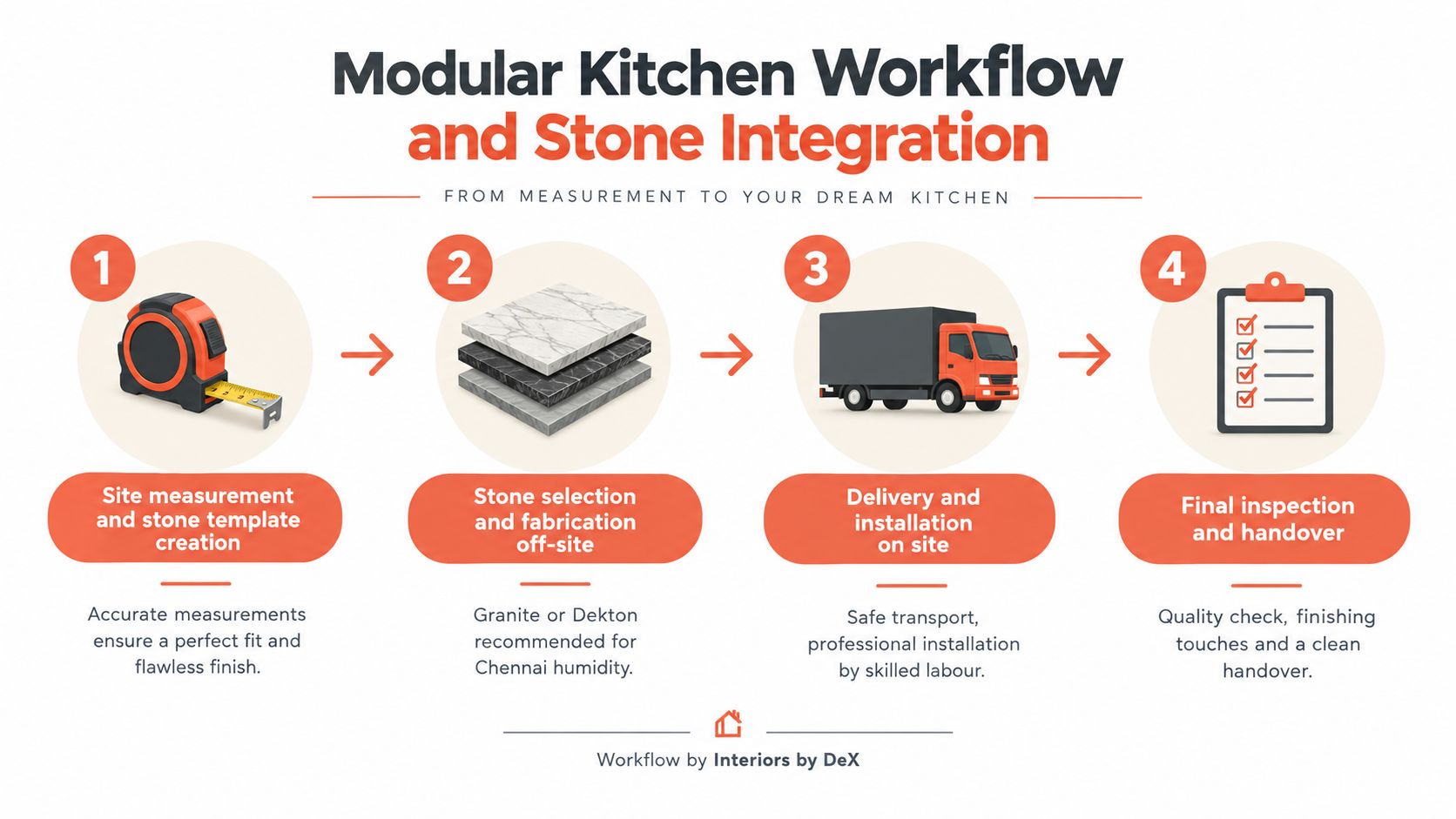
Sequencing matters on site as well. Cabinets get levelled first, templates confirm wall irregularities, fabrication happens off site where possible, and only then does the slab arrive for fixing, jointing, and edge finishing. For a fuller picture of how this fits apartment projects, see how modular kitchen installation in Chennai apartments is typically sequenced from measurement to handover.
Final Recommendations for Your Kitchen Platform
Match the stone to the household, then hold the specification properly. That's the whole method, and it produces different right answers for different Chennai homes.
Recommendations by household profile
Heavy daily cooking with high flame work: Choose granite, verify the slab, seal it as the supplier recommends, and keep trivets in use anyway for the hottest vessels.
Appearance led kitchen with disciplined habits: Choose engineered quartz for uniform colour and stain resistance, and treat the no hot vessels rule as non negotiable.
Low use or dry secondary counters: Marble or ultracompact surfaces can work where acids, pigments, and vessel traffic stay light.
Whichever material you pick, verify performance through measurable tests rather than appearance, covering water absorption, compressive strength, flexural strength or modulus of rupture, abrasion resistance, chemical resistance, and dimensional accuracy, and note that one India based granite source cites typical water absorption below 0.4% while advising buyers to request a material specific report, as set out in granite testing guidance from an Indian exporter. Paperwork feels dull at purchase and priceless during a warranty dispute.
Record the brand or stone variety, slab thickness, edge profile, colour batch, joint positions, and warranty exclusions in your project documents. Photograph the selected slab before cutting. Confirm cabinet support at sinks, hobs, and appliance gaps before installation day.
One accountable team reduces the gaps
Most platform problems I see trace back to split responsibility. The cabinet vendor blames the stone fabricator, who blames the plumber's sink position. A turnkey provider such as Interiors by DeX, which handles design, modular manufacturing coordination, site execution, and handover under one team, removes those hand off gaps and keeps material selections documented from the start.
Get the fabricated and installed price in writing, with cut outs, edge work, jointing, and sealing listed rather than assumed. Ask who returns if a joint opens or an edge chips, and how quickly. Clear answers at quotation stage predict clear behaviour after handover.
Your platform will take heat, water, colour, and weight every day for years. Choose the compromise your household can live with, specify it with test data, and install it on proper support. Do those three things and the stone stops being a gamble.
If you're planning a modular kitchen in Chennai and want your platform stone specified against test data, fabricated off site, and installed on properly planned cabinet support, talk to Interiors by DeX about an end to end kitchen with documented material selections and transparent pricing. Bring your layout, your cooking habits, and your shortlist of stones, and you'll leave with a recommendation matched to how your household cooks.