DE X INSIGHTS
8 Wooden Shoe Rack Designs for Home in 2026

You're standing in a narrow entryway with shoes spilling toward the door, while the rack you bought earlier no longer matches the growing collection. Daily sneakers, office footwear, school shoes, sandals, and monsoon pairs all need different storage. The right wooden shoe rack isn't the one with the best finish. It must match your available width, floor area, ventilation needs, shoe types, access frequency, and whether you need a freestanding, modular, or built-in solution.
This guide compares eight wooden shoe rack designs for home through real residential situations, including compact Chennai apartments, balconies, under-stairs areas, walk-in wardrobes, and integrated interiors. Each format is assessed through material choice, dimensions, capacity, installation, maintenance, and styling. If you're planning a wider renovation, a useful interior layout guide for Columbus homeowners also shows why circulation and furniture placement should be considered before selecting storage.
Custom interior planning can connect shoe storage with wardrobes, benches, lighting, or unused architectural zones. For Chennai apartments and villas, Interiors by DeX is one option for coordinating those elements as part of a broader residential interior.
1. Wall-Mounted Floating Shoe Rack
A floating wooden shoe rack is the strongest choice when your entryway is narrow and every inch of floor space matters. It attaches directly to the wall, leaving the floor clear for sweeping, mopping, and movement. In a compact Chennai apartment, that open strip below the rack can make the entrance feel less crowded without sacrificing daily access.
Use this format on a narrow entry wall, bedroom wall, walk-in closet, or under-stairs surface. Keep the rack 12 to 18 inches above the floor so toes don't catch the lower edge and cleaning tools can pass underneath. The exact height should also account for children, older residents, and the position of the door swing.
Practical rule: Use the wall vertically before adding another piece of furniture to the floor.
Installation and layout
Wall condition determines whether this design is suitable. A solid masonry wall can support a properly anchored rack, while hollow or damaged surfaces need appropriate reinforcement. Use wall anchors rated for the combined weight of the wooden unit and stored footwear, not just the empty rack.
Shelf spacing must reflect your collection. Everyday shoes can use tighter shelves, but boots and high-top footwear need additional clearance. Add an under-shelf basket for polish, brushes, laces, and washable shoe covers. Keep daily pairs at hand height and less-used footwear higher up.
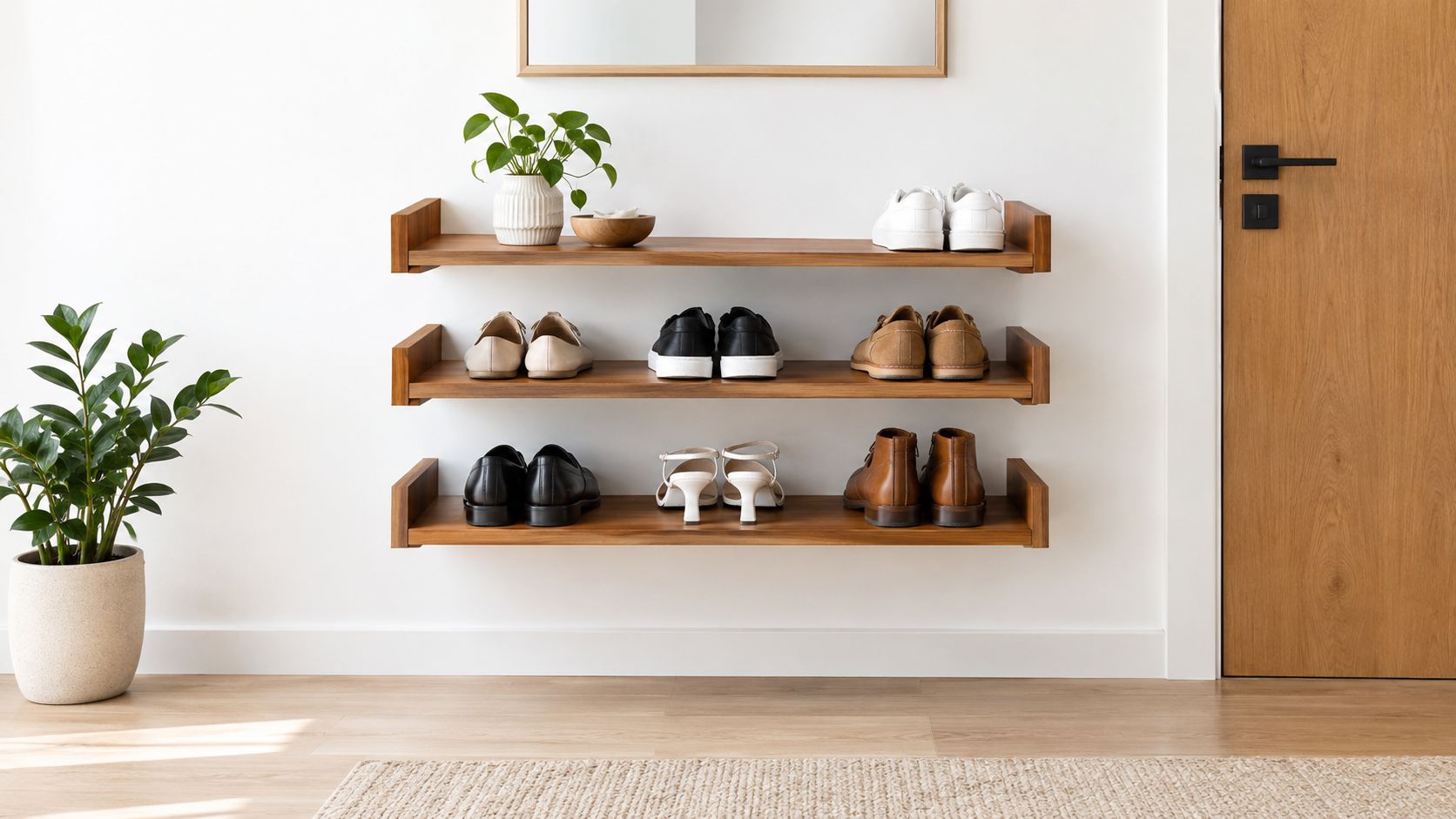
A floating rack suits modern apartment entryways in Chennai's premium developments, villa walk-in closets, and bedroom storage in compact 2-BHK flats. For a wall-integrated design with matching cabinetry, custom carpentry for Chennai home interiors can help coordinate the rack with nearby wardrobes and finishes.
2. Angled Slat Shoe Rack
Angled slats turn footwear into part of the room's visual arrangement. Instead of hiding shoes behind doors, the rack holds them on inclined wooden supports so the fronts remain visible. This works well on a covered balcony, a villa entryway, or a fashion-focused walk-in closet where ventilation and quick selection matter.
Set the slats at roughly 35 to 40 degrees for a practical balance between visibility and stability. A steeper angle can make shoes slide, especially smooth-soled formal footwear. Add non-slip matting or a narrow grip strip to each slat, and test the rack with heavier shoes before loading every level.
Make the display look intentional
This design rewards order. Arrange footwear by colour, occasion, or type instead of mixing sports shoes, sandals, and formal pairs randomly. A full-length mirror nearby makes the rack useful during outfit selection, particularly in a master bedroom entryway or walk-in closet.
Mount the unit at eye level or slightly above if the purpose is display. For a family entryway, keep frequently worn pairs on the most accessible levels and reserve higher sections for occasional footwear. The open slats promote air movement, but they don't protect shoes from dust, rain splash, or direct balcony exposure.

Choose this format for modern apartment foyers displaying designer footwear, master bedroom entrances in Chennai villas, and walk-in closets where shoes are selected visually. Skip it if you want a calm, concealed entrance or if muddy footwear needs separation from the living area.
3. Drawer-Style Wooden Shoe Cabinet
A drawer-style cabinet is designed for homeowners who want shoes out of sight. Pull-out compartments keep dust away and create the visual calm of a coordinated bedroom or dressing area. This format suits premium Chennai villas, larger apartments, and wardrobe-integrated storage where finish consistency matters more than a low initial investment.
Use internal dividers to separate heels, flats, sports shoes, and seasonal footwear. Label each drawer by category so you don't need to open several compartments before finding a pair. Silica gel packets can help manage moisture inside drawers, but they don't replace dry shoes and regular airing.
Enclosed storage versus open shelves
Open shelves make footwear immediately visible and allow air to move freely. Drawers provide a cleaner appearance and stronger dust protection, but they need reliable ventilation, durable runners, and enough depth for the shoes you own.
Drawer depth should accommodate the longest footwear without forcing toes against the back panel. Select soft-close mechanisms for quiet operation, and check that the runners can carry the combined weight of multiple pairs without sagging. Don't pack drawers tightly. Overfilled compartments reduce access and can trap dampness.
This design works particularly well inside a walk-in closet system in a 3+ BHK apartment or as part of a new flat's integrated wardrobe. Match the cabinet laminate, veneer, or paint finish to the wardrobe and bedside furniture so the shoe storage reads as one continuous interior. For broader purchasing decisions, this guide to comparing dressers and cabinets before buying offers useful points about construction and hardware.
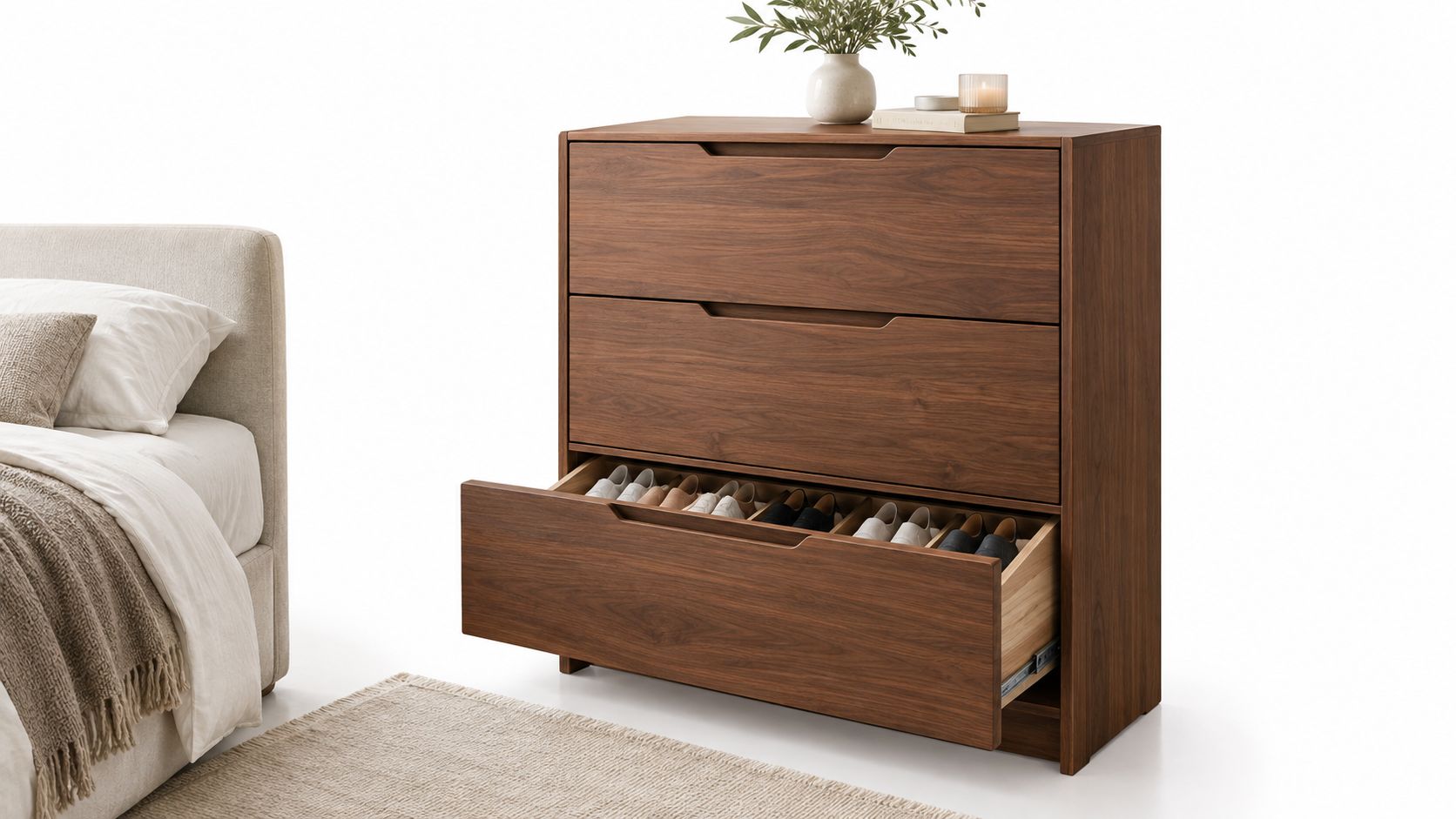
Choose drawers when dust protection, finish matching, and a quiet appearance are priorities. Choose open storage when daily ventilation and instant visibility matter more.
4. Ladder-Style Tiered Shoe Rack
The ladder-style rack uses a vertical frame with horizontal steps or rungs. It's a lightweight freestanding option for narrow apartment entries, bedroom corners, and villa passageways. Because the structure rises instead of spreading wide, it adds storage without visually filling the entire wall.
This format works best when you need a modest, accessible collection rather than maximum capacity. Place frequently worn shoes at the middle levels, where they're easy to reach without bending too low or stretching upward. Use the top step for seasonal or decorative footwear.
Stability matters more than height
Set the rack on level flooring and use adjustable feet if the surface isn't even. Keep it away from a high-traffic turning point, where a shoulder, bag, or opening door could cause movement. Tall, narrow furniture should be anchored when children or pets use the area.
The open construction supports air circulation, which is useful near an entryway or covered passage. It also exposes footwear to dust, so a regular cleaning routine is essential. A small rug beneath the rack defines the arrival area, catches outside debris, and gives the freestanding unit a more finished position. Wall hooks above it can hold keys, bags, or lightweight jackets.
Organise each level by colour or frequency of use. Consistency prevents the rack from looking cluttered, especially when it sits between the foyer and living room. A ladder rack suits modern apartment entryways in Chennai's new developments, compact flat bedrooms, and villa hallways where a slim decorative profile is more valuable than concealed storage.
5. Cubicle Wooden Shoe Storage Unit
Cubicle storage is the adaptable choice for a changing collection. Each square or rectangular compartment can hold one or two pairs, depending on footwear size and arrangement. The repeated geometry keeps categories visible while allowing the unit to expand, reconfigure, or move with you in a rented apartment.
Use consistent grouping inside each cube. Keep daily sneakers together, reserve another compartment for sandals, and add small baskets or dividers for accessories. In a compact 2-BHK flat, the unit can sit at or below eye level in the entryway or bedroom corner without making the room feel top-heavy.
Build in flexibility from the start
Cube proportions around 12 to 15 inches support practical grouping for many everyday shoes, but measure your largest pairs before ordering a fixed unit. Boots, high-tops, and wider footwear may need combined or open sections. Leave selected cubes empty so seasonal footwear can rotate in without forcing every compartment to overflow.
A tall stack needs anchoring, particularly in homes with children. A low configuration can work as a transitional piece between the entryway and living room, while a wider arrangement can sit below a display shelf or mirror. Paint or stain the cubes to match the wardrobe system, TV unit, or existing woodwork.
This design suits modular entryway systems in Chennai apartment complexes, living-room transition zones in villas, and bedroom corners in compact flats. If the rack needs to connect with wardrobes or lofts, explore wardrobes and storage solutions as part of the same storage plan.
6. Slanted Wooden Shelf Shoe Rack
Slanted shelves offer more control than open angled slats. Each shelf slopes gently from the back toward the front, usually at about 15 degrees, so shoes remain visible while sitting securely. The gentler slope is especially useful in walk-in wardrobes and dedicated bedroom storage where you want an organised display without the stronger visual cascade of a slat rack.
Use shelf dividers to stop shoes from shifting sideways. Keep heavier footwear on lower shelves, and arrange taller pairs toward the back or in sections where they won't block shorter shoes. Leave the rear edge clear enough to place footwear easily instead of pushing every pair hard against the back panel.
Plan around footwear height
Shelf depth should reflect the longest shoes in the collection. Measure boots, high-tops, and formal shoes before finalising the cabinet. A shelf that looks spacious with sandals can become difficult to use once taller footwear is added.
For a walk-in closet in a premium Chennai villa, position the most frequently worn pairs between waist and shoulder height. Keep occasional footwear lower or higher, and use labels if several shelves look similar. This rack also works in new apartment bedroom storage and luxury residential closet systems because its sloping profile adds depth without requiring a fully enclosed cabinet.
Use a finish that repeats elsewhere in the room. Natural wood can soften a white wardrobe, while a painted or laminate finish can blend the rack into a darker dressing area. For styling ideas that apply to open shelving, consult this shelf styling guide from Indian River Furniture, then keep decorative objects limited so the shoe zone remains functional.
7. Bench-Style Wooden Shoe Rack with Storage
A bench-style rack solves two entryway problems at once. It gives you a stable place to sit while removing footwear and hides storage beneath or behind the seat. This makes it more useful than a standard rack in a villa foyer, apartment entrance with dedicated space, or premium flat where the arrival zone needs to look complete.
Plan the bench around circulation first. It needs enough room for a person to sit, turn, and put on shoes without blocking the doorway. A very narrow entrance may suit a floating rack better, while a wider foyer can accommodate a bench, rug, mirror, and wall hooks as one coordinated composition.
Create a complete arrival zone
Store daily footwear below the seat and place less-used pairs in a separate compartment. Add soft-close hinges to lift-up storage doors, and use removable, washable cushions so regular use doesn't turn maintenance into a problem. Choose durable wood and a cushion fabric that relates to the wardrobe, console, or nearby wall finish.
Hooks above the bench can hold bags and jackets. A mirror helps with final checks before leaving, while coordinated lighting makes the zone easier to use at night. Keep wet or muddy shoes on a removable tray rather than placing them directly inside the wooden compartment.
This format suits villa entryways in Chennai's gated communities, apartment foyers with defined entrance space, and modern flat entries in premium developments. For a coordinated bench, wall panel, cabinet, or other built-in piece, consider custom furniture and carpentry.
8. Rotating Carousel Wooden Shoe Rack
A rotating carousel is a specialist solution for a large shoe collection in a compact floor plan. Multiple tiers sit around a central axis, allowing you to rotate the unit instead of walking around it or pulling out several boxes. It creates a strong design statement in a premium wardrobe, but its mechanism means it shouldn't be the default choice for every home.
Check the carousel's diameter against the available floor area and confirm that the ceiling leaves enough clearance for the top tier. The surrounding space must allow full rotation without hitting a wardrobe door, wall, or dresser. Place the unit on a stable hardwood or tile floor, and distribute weight evenly around each section to prevent tipping during movement.
Convenience comes with maintenance
Organise each segment by colour, type, or occasion so rotation remains intuitive. Keep heavier footwear low and avoid loading one side more heavily than another. Clean the rotating mechanism quarterly, and inspect for dust or movement that could affect smooth operation.
The carousel works in master bedroom closets in premium Chennai villas, fashion-focused walk-in closets, and luxury apartment storage systems. It's less suitable for a damp balcony, a busy family entryway, or a home where several people need quick, simultaneous access.
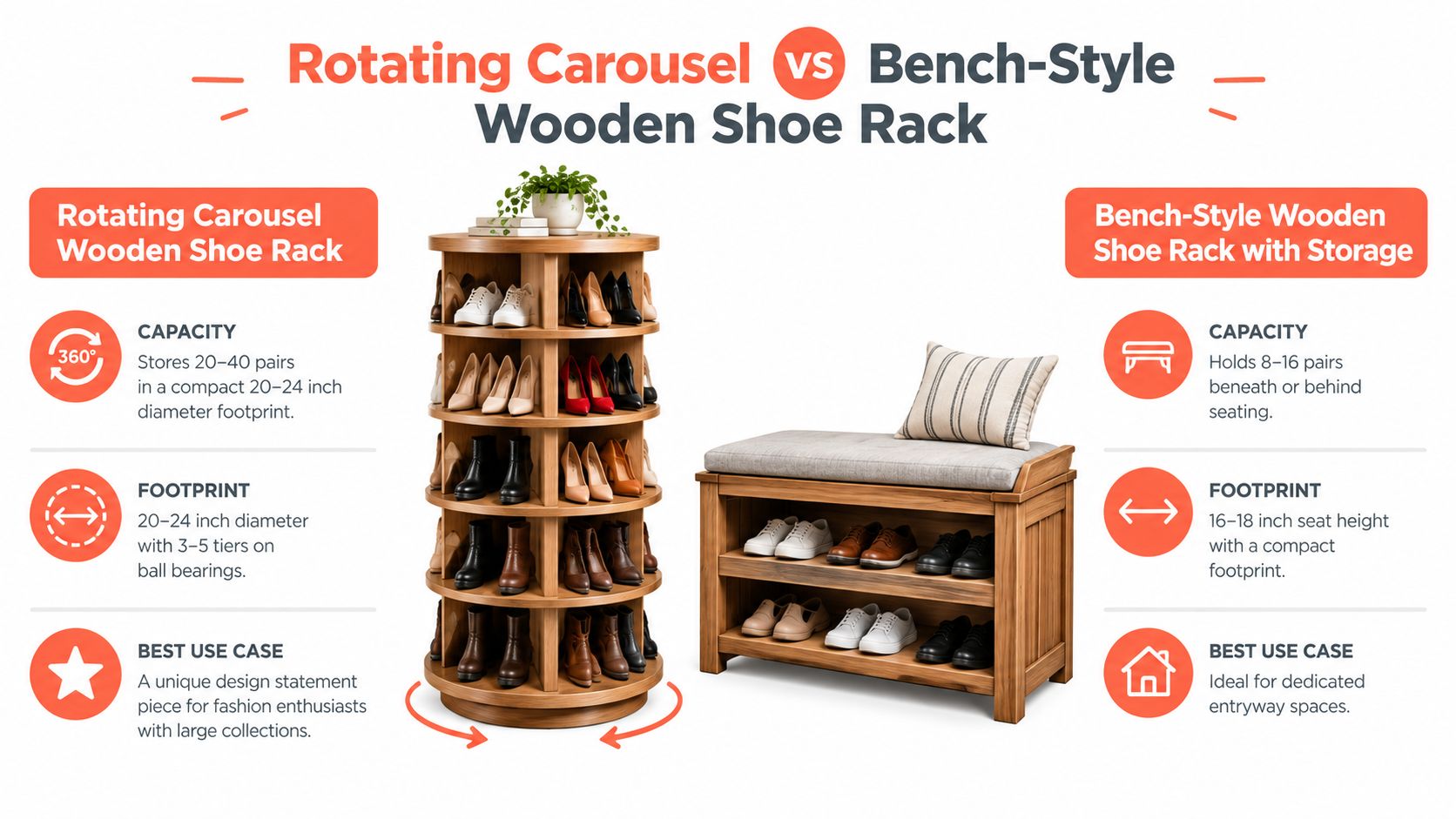
Choose the mechanism only when access efficiency justifies the added complexity. A well-built open or drawer unit is easier to maintain if your collection doesn't need rotating access.
8 Wooden Shoe Rack Designs Comparison
Design | Complexity 🔄 | Resources & Space ⚡ | Expected Outcomes ⭐📊 | Ideal Use Cases | Key Advantages 💡 |
|---|---|---|---|---|---|
Wall-Mounted Floating Shoe Rack | 🔄🔄 Medium, wall drilling & anchoring; stud-dependent | ⚡ Small floor footprint; Low–Med material cost; capacity 6–12 pairs | ⭐⭐⭐, saves floor space; airy look; easier cleaning; 📊 6–12 pairs | Compact apartments, narrow entryways, under-stairs walls | Saves floor space; modern aesthetic; easy clean-under; install 12–18" above floor |
Angled Slat Shoe Rack | 🔄🔄 Medium, precise slat angles and non-slip treatment | ⚡ Moderate cost; open construction; capacity 8–20 pairs | ⭐⭐⭐⭐, excellent visibility + ventilation; display-focused; 📊 8–20 pairs | Balconies, villa entryways, walk-in closets for display-led storage | High visibility; better airflow reduces odor; ideal for display; use 35–40° angle & non-slip mats |
Drawer-Style Wooden Shoe Cabinet | 🔄🔄🔄 High, built-in/wardrobe integration, drawer hardware | ⚡ High cost; larger floor footprint; premium finishes; variable capacity per drawer | ⭐⭐⭐⭐, dust/UV protection; cohesive furniture look; 📊 secure, enclosed storage | Premium flats, integrated wardrobes, 3+ BHK homes | Full dust protection; refined aesthetic; configurable dividers; choose soft-close slides |
Ladder-Style Tiered Shoe Rack | 🔄 Low, simple freestanding assembly | ⚡ Low cost; lightweight footprint; capacity 12–24 pairs | ⭐⭐⭐, stylish vertical use; easy repositioning; 📊 12–24 pairs | Narrow apartment entries, bedroom corners, villa passageways | Visually interesting; portable; simple assembly; place daily pairs at mid-levels |
Cubicle Wooden Shoe Storage Unit | 🔄🔄 Medium, modular assembly; anchoring for tall stacks | ⚡ Med cost; scalable footprint; per-cube 1–2 pairs; expandable | ⭐⭐⭐, adaptable and organized; 📊 modular capacity | Changing collections, rented layouts, balconies, 2-BHK flats | Highly customizable & expandable; multipurpose; anchor tall stacks; leave some cubes empty to reduce visual weight |
Slanted Wooden Shelf Shoe Rack | 🔄🔄 Medium, precise 10–20° slope and divider planning | ⚡ Med cost; compact footprint; capacity 12–20 pairs | ⭐⭐⭐, controlled visibility without sliding; organizes by height; 📊 12–20 pairs | Walk-in closets and dedicated wardrobe zones | Prevents sliding with minimal hardware; good heel-height organization; angle ~10–15° recommended |
Bench-Style Wooden Shoe Rack with Storage | 🔄🔄🔄 Medium–High, integrated seating + storage carpentry | ⚡ Med–High cost; larger footprint; capacity 8–16 pairs; needs circulation clearance | ⭐⭐⭐, multifunctional entryway solution; concealed storage; 📊 8–16 pairs | Entryways with space, villa foyers, apartment foyers | Combines seating and storage; conceals shoes; add hooks/mirror; use removable washable cushion |
Rotating Carousel Wooden Shoe Rack | 🔄🔄🔄🔄 Very High, rotating mechanism, balance, maintenance | ⚡ High cost; compact diameter but tall; capacity 20–40 pairs; requires level floor & clearance | ⭐⭐⭐⭐, maximizes storage in small footprint; fast access; statement piece; 📊 20–40 pairs | Large collections, premium wardrobes, fashion enthusiasts | Max storage per footprint; 360° access; unique design; needs periodic maintenance and stable flooring |
Choose the Rack That Fits Your Routine
Start with the way you use shoes, not the appearance of the rack. If floor area is tight, choose a floating or ladder format. Floating racks keep cleaning access open and work well on narrow walls, while ladder racks provide freestanding storage but need careful placement and stability.
Choose angled slats when visibility and ventilation matter. They're suitable for display-led foyers, balconies, and walk-in closets, but they expose shoes to dust. Choose drawers when dust protection and visual calm matter most. Enclosed storage looks cohesive beside wardrobes and bedroom furniture, but it requires better hardware, sensible ventilation, and enough depth for your largest footwear.
Cubes are the practical answer when your collection may grow or your layout may change. They can be reconfigured, expanded, or moved, although tall arrangements need anchoring. Slanted shelves suit dedicated wardrobes because they provide controlled visibility and make it easier to separate tall and short footwear. A bench is the strongest choice for a functional entryway because it combines seating, storage, and arrival-zone styling. Use a carousel only when a large collection and limited floor plan justify its mechanism.
India's storage demand supports this focus on practical, space-efficient furniture. The home storage market was estimated at USD 1.6 billion in 2025 and is projected to reach USD 2.3 billion by 2034, with a 4.85% CAGR during 2026 to 2034, according to India home storage market data. Modular furniture was estimated at USD 4.0 billion in 2025 and is projected to reach USD 7.7 billion by 2034, with a 7.23% CAGR for 2026 to 2034, as reported in India modular furniture market research. These projections reinforce the value of storage planned around real rooms and routines.
Final selection checklist
Measure the zone: Record available width, depth, height, door swing, skirting, and circulation space.
Measure footwear: Check shelf, drawer, or cube dimensions against adult shoes, boots, heels, and high-tops.
Plan capacity: Count current pairs, then allow room for seasonal footwear and future additions. A household with 25 pairs should plan for about 30-pair capacity, based on published Indian shoe-storage guidance from Woodage's foyer cabinet design recommendations.
Check ventilation: Use open fronts, louvered doors, or breathable sections where monsoon humidity is a concern.
Choose the finish: Match the rack to wardrobes, benches, doors, flooring, or nearby display furniture.
Confirm installation: Check wall strength, anchoring, levelling, and the stability of tall units.
Protect cleaning access: Keep floor-mounted designs clear of mops, rugs, and door paths.
Separate wet footwear: Use a removable tray and let shoes dry before storing them in enclosed wooden compartments.
Coordinate the interior: Connect the rack with lighting, mirrors, hooks, benches, under-stairs storage, balconies, or wardrobes where the layout allows.
For narrow entryways and humid climates, a wall-mounted cabinet with flip-down compartments and louvered or ventilated fronts is a particularly effective configuration. Expert guidance recommends 12 to 16 mm plywood for this type of cabinet because it saves floor space while allowing moisture to escape through ventilation. Review the detailed wall-mounted shoe rack cabinet guidance before finalising a closed design.
Wood remains central to Indian home furnishing. One market estimate places wood at about 50% of India's furniture market by material type in 2026, while another reports that wood captured 61.95% of India's home furniture market value in 2025, as detailed by MarkNtel Advisors' India furniture market report. The broader wood furniture market in India was valued at USD 18.59 billion in 2025 and is projected to reach USD 25.09 billion by 2031, implying a 5.12% CAGR during 2026 to 2031, according to Mordor Intelligence's India wood furniture market report.
Measure the intended zone today, shortlist two formats that fit your routine, and only then choose the finish, hardware, and styling details. If the rack must connect with a wardrobe, under-stairs cabinet, balcony storage, lighting, or a complete home interior, custom planning will produce a cleaner result than forcing a standard unit into the space.
Interiors by DeX plans, manufactures, and executes residential interiors in Chennai, including wardrobes, custom storage, benches, and carpentry that can integrate a wooden shoe rack into your home. Visit Interiors by DeX to discuss your space, storage habits, finishes, and end-to-end interior requirements.