
Many homeowners in Chennai sign interior contracts while still feeling unsure about what they are actually getting. The drawings look nice, the numbers are large, and the contract language is dense. The real concern is simple: what exactly is included, what may change later, and how do you avoid surprises during installation.
We work with residential projects every day, from compact 2BHK apartments to larger independent homes and builder-finished units. Over time we have seen that a simple, structured way of reading the contract can take away a lot of stress. This article lays out three practical tools: a scope matrix, a BOQ cross-check, and basic site measurement verification. Together, they help you read your interior contract like a project map instead of a bundle of fine print.
Key Takeaways
Learn to verify scope, BOQ and site measurements for interior design and execution in Chennai, helping you avoid surprises and sign with confidence.
Why Interior Contracts in Chennai Often Feel Unclear
In Chennai, most residential projects fall into a few common types: new apartments with basic builder finishes, bare-shell flats, and independent homes that need custom work. Even a small 2BHK often includes kitchen, wardrobes, TV units, false ceiling, and painting. That is a lot of work to cover in one contract.
Homeowners often worry about things like:
Price changes after paying the booking amount
Items shown in the 3D design not appearing in the final quote
Confusion on what is “included” vs “extra”
Gaps between modular vendor, designer, and on-site contractor
One key reason for this confusion is fragmentation. You may have a designer, a modular kitchen vendor, a separate electrician, and a civil contractor. If each one has their own agreement, it becomes hard to see the full picture.
Auditing your main interior contract before signing is therefore useful. It is not about trying to catch someone out. It is about creating clarity on three things:
What will be done (scope matrix)
In what quantity and material (BOQ)
In what size on your actual site (measurements)
Reading Your Interior Contract Like a Project Map
A complete interior contract for a Chennai home should usually cover:
Scope of work, room by room or category-wise
Materials and finishes, with brands where possible
BOQ or item list with quantities and units
Reference to drawings, both 3D and 2D working drawings
Timelines and payment milestones
Warranty, guarantee, and rectification terms
The most important link is between the design and the paperwork. If you can see a major item in the 3D visuals, it should appear in:
The scope description, and
The BOQ, in some measurable way
Common gaps to watch for include:
Phrases like “as per site condition” without clear limits
Missing brand or material specifications
Only lump-sum values, no quantities
Broad lines like “miscellaneous works” with a big amount
A simple habit helps: keep everything in one folder, digital or printed. Put the signed contract, latest drawings, detailed BOQ, and any written commitments from email or messages together. When you review, you see one project, not scattered promises.
Tool 1: Building a Scope Matrix Room by Room
A scope matrix is a simple table that shows each room against each type of work. It helps you see what is included, what is excluded, and what is optional.
Start with a basic list of spaces for a 2BHK or 3BHK in Chennai:
Foyer
Living
Dining
Kitchen
Bedrooms
Utility
Balconies
Bathrooms
Across the top, list categories like:
Carpentry and modular (kitchen, wardrobes, TV unit, lofts, study, pooja)
False ceiling and lighting provision
Electrical point shifting and new points
Painting and wall finishes
Civil work (demolition, tiling, counters)
Loose furniture and décor elements
For each cell in the table, mark:
Included
Not Included
Optional / Separate Quote
Writing “Not Included” clearly where you do not plan any work is just as important as listing what you are doing. It avoids later statements like “we thought bathroom cabinets were part of the package.”
The scope matrix also prompts direct, practical questions, such as:
Are bedroom lofts included or are they treated as extras?
Are bathroom mirror cabinets and under-counter storage part of the contract?
Is the pooja unit modular or custom carpentry, and is it in the main quote?
In Chennai apartments, builders often provide a basic kitchen or wardrobes. Check the matrix to see:
What is being retained as-is
What is being modified
What is being completely replaced
This helps you avoid paying twice for the same zone.
Quick Scope Matrix Checklist
- [ ] Every room in the flat is listed as a row
- [ ] Every major work category is listed as a column
- [ ] Each cell is marked Included / Not Included / Optional
- [ ] Builder-provided elements are clearly marked as retained / modified / replaced
- [ ] Any assumptions (like lofts, bathroom storage) are written down, not verbal

Tool 2: Cross-Checking BOQ with Pricing and Materials
The BOQ, or Bill of Quantities, turns the design discussion into numbers. Each line item usually has:
Description of work
Quantity
Unit (sqft, rft, number)
Rate
Amount
Material and hardware notes
Reading a BOQ line is not just about the total amount. You want to know what that amount represents. “Per sqft” by itself means very little unless the material, thickness, and finish are stated.
A Simple Three-Step BOQ Audit
Pick 3 to 5 major items like kitchen, wardrobes, TV unit, false ceiling.
Check if the sizes roughly match your drawings or room sizes.
Confirm the finish, shutter type, and hardware category against what you discussed.
Example: Master Bedroom Wardrobe
Item | BOQ Entry | What You Should Check |
Size | 7 ft (H) x 6 ft (W) | Does this match your wall and drawing? |
Rate Basis | Per sqft of shutter area | Is it shutter area, carcass, or both? |
Material | BWR plywood, 18mm | Is it matching the material you agreed on? |
Shutter Finish | Laminate, 1 mm | Does the design show another finish type? |
Hardware | Standard hinges, normal channels | Was soft-close or premium hardware discussed? |
Low-looking rates can sometimes reflect changes in material or hardware that are not obvious on a quick read. When something seems much lower than similar items, it is reasonable to ask what is different in terms of board type, thickness, or hardware.
Indicative Cost Structure (for Orientation Only)
The actual numbers will vary by firm and specification, but a Chennai homeowner will often see BOQ lines that broadly fall into these kinds of bands:
Component | Typical Basis | Typical Range Insight* |
Modular kitchen (mid-range) | Per running foot / sqft | Varies mainly by board type & hardware |
Wardrobes (hinged, laminate) | Per sqft | Varies by height, board, hardware |
False ceiling (basic) | Per sqft | Varies by design complexity & lights |
Painting (interiors) | Per sqft of built-up | Varies by paint brand & finish |
*These are not quoted prices, but a way to read your own BOQ: if one item is far outside the pattern for similar items, it deserves a closer look.
Quick BOQ Review Checklist
- [ ] Major items (kitchen, wardrobes, TV unit, false ceiling) checked against room sizes
- [ ] Each key item shows quantity, unit, rate, and amount (not only lump-sum)
- [ ] Board type, thickness, and finish written for major carpentry
- [ ] Hardware category (standard / soft-close / premium) is specified
- [ ] Any unusually low or high line item has been questioned and clarified in writing
Tool 3: Verifying Site Measurements Before You Sign
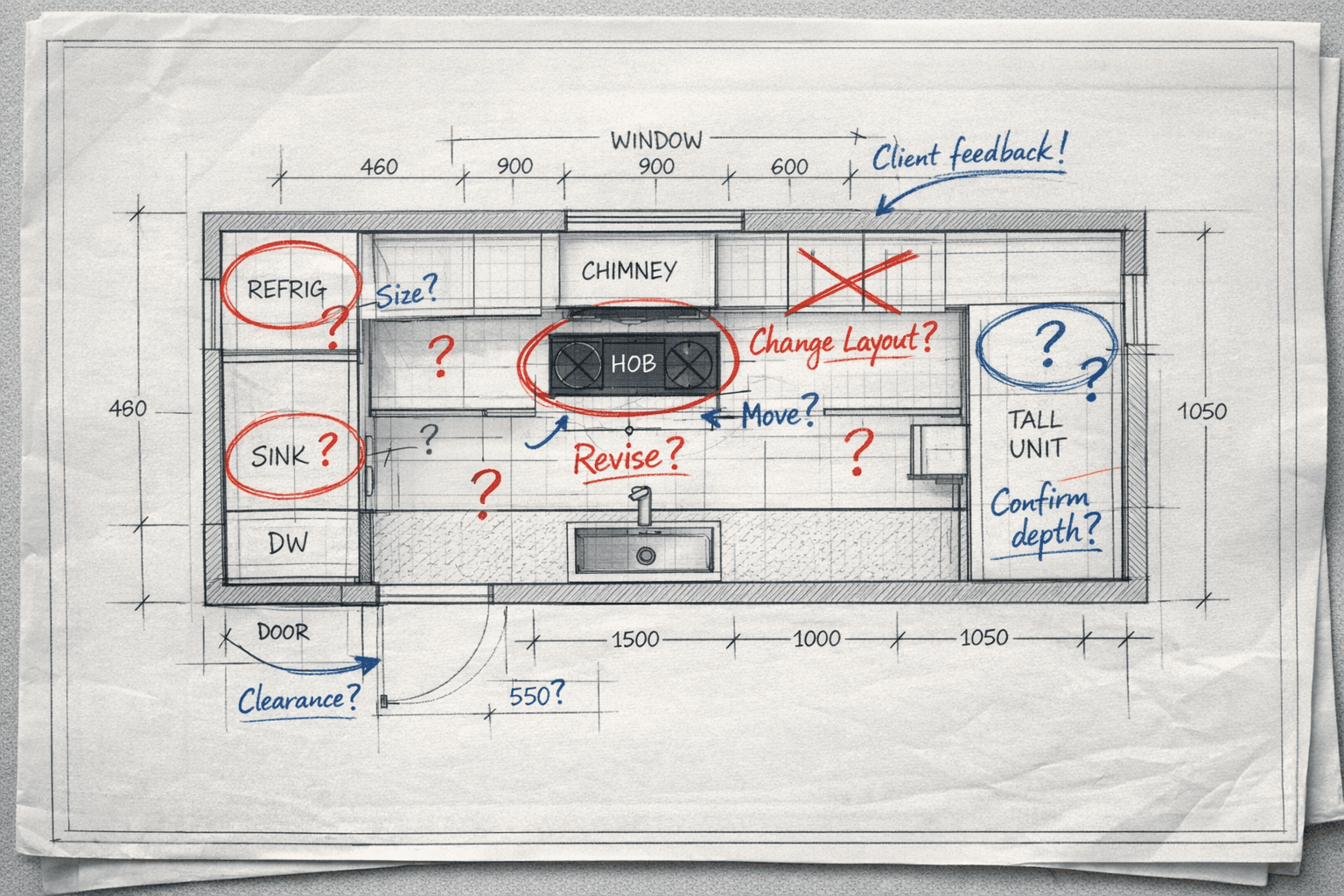
Even in new Chennai apartments, walls may not be perfectly straight, corners may be out of square, and there may be beams, offsets, or plumbing shifts. Small differences in measurement can lead to gaps, extra fillers, or rework, which often means extra time and cost.
A proper interior measurement typically includes:
Each wall length, floor-to-ceiling height, and beam drops
Door and window sizes and positions
Kitchen water inlets, drains, hob and chimney points, and power points
Obstructions like columns, lofts, window grills, and existing cabinets
On measurement day, a basic checklist helps:
- [ ] All walls are being measured, not just a few “approximate” ones
- [ ] Wardrobe niches and recesses are measured inside, not just wall to wall
- [ ] Balcony doors, French windows, and sill heights are captured, especially near TV units or study tables
- [ ] Beam drops and bulkheads are marked in the drawings
You do not need to re-measure the whole flat yourself. But you can:
Pick 2 or 3 critical walls, like the bed wall or main wardrobe wall
Check the lengths with a tape
See if those match the rough sizes shown in drawings and the main BOQ items
This quick verification ties the contract to your actual home, not just to a builder plan.
Aligning Timelines, Payments and Guarantees
Once scope, quantities, and measurements are clearer, the next part is timing and protection.
Timelines should mention:
When design is frozen
When site work begins
Approximate phases for modular production, dispatch, and installation
How finishing works like painting and cleaning fit in
How delays due to building rules or festival periods are treated
Payments feel safer when they relate to milestones, not only dates. For example:
Booking or advance at the start
A stage linked to design completion and approval
One or more stages linked to production
A stage at installation
A final stage at handover and snag completion
Warranty and Guarantee Terms are also part of this picture. Where modular products carry a replacement guarantee, it usually covers manufacturing or hardware issues, not misuse or water damage. For these terms to help you later, the contract should clearly record:
Board type and thickness
Hardware category and, where relevant, brand
Also look for a written defects rectification process:
A period after handover where you list snags
A timeline in which rectifications will be attended to
Any conditions on access or building timing
Quick Protection Checklist
- [ ] Timeline includes design freeze, site start, and installation phases
- [ ] Payment stages are linked to clear milestones, not only dates
- [ ] Board type, thickness, and hardware category are written, not implied
- [ ] Warranty / guarantee document is attached or referenced in the contract
- [ ] Snagging period and rectification process are clearly described

A Practical Way to Move From Confusion to Clarity
Putting it together, three simple tools can organise your contract:
Scope Matrix: defines what work is included in each room
BOQ Cross-Check: shows how much is being built and in what material
Site Measurement Verification: links all of this to your actual flat
A realistic order for any homeowner could be:
Sit with your designer or execution partner and fill out a room-wise scope matrix.
Ask for a BOQ that reflects this matrix, then review four or five major items in detail.
Be present for site measurement or review the measurement-based drawings, and match a few key walls with a simple tape check.
If any part still feels unclear, it is reasonable to:
Ask the firm to walk you through the BOQ line by line for your main items
Invite a friend or family member with construction experience to join one meeting
Request that ambiguous words or “miscellaneous” items be broken into clearer notes
At Interiors by DeX in Chennai, these upfront clarifications are built into the way residential projects are run, because they tend to reduce friction later and support a smoother experience for both sides.
Calm Next Step for You as a Homeowner
Before signing any interior contract in Chennai, you can simply:
Print or draw a one-page scope matrix for your home
Mark the main items in your BOQ and check them against that matrix
Compare a few key wall measurements with what is shown in the drawings
Taking this one structured review pass usually gives enough clarity to decide whether you are comfortable proceeding, or whether you need one more round of questions with your interior partner.
Conclusion
Transform Your Chennai Home With Expert Interior Design
Bring your ideas to life with our tailored interior design and execution in Chennai, thoughtfully planned for both style and practicality. At Interiors by DeX, we work closely with you to understand your lifestyle, budget and timelines, then manage every detail from concept to completion. If you are ready to take the next step with a personalised consultation, simply contact us and we will guide you through the process.
Frequently Asked Questions
Do I Need a Lawyer to Review My Interior Contract?
Not always. Many homeowners first use a structured review like the scope matrix, BOQ cross-check, and measurement verification. If the project value is high or clauses seem unclear, it can be sensible to have a legal professional review specific sections, especially around cancellation, delays, and liability.
How Detailed Should My BOQ Be for a Typical 2BHK in Chennai?
For most 2BHKs, a practical BOQ will list each major item (kitchen, wardrobes, TV unit, study, false ceiling, etc.) with quantities, units, rates, and materials. Extremely granular detail on every screw is not required, but the items that drive most of the cost should be clearly measurable and specified.
Is It Normal for Prices to Change After Discussions?
Initial ballpark figures often change once designs are frozen and measurements are taken. What you want to avoid is unexplained changes after you have agreed on scope, BOQ, and drawings. Clear documentation and a dated, signed BOQ help limit such surprises.
What If the Builder Already Provided a Basic Kitchen or Wardrobes?
In that case, the scope matrix should clearly mark what is retained, what is modified, and what is replaced. The BOQ should only charge for the actual new work or modification, not for elements you are keeping as-is.
Can I Negotiate the Total Amount or Review Line Items?
Most homeowners focus on the total. However, for clarity, it is better to understand and, if needed, negotiate at the line-item level for major components. This way you see exactly what is changing, material, size, hardware, or finish, when a discount is offered.