DE X INSIGHTS
Bathroom Renovation in Chennai: Cost & Timeline Guide

A standard 40 sq ft bathroom renovation in Chennai typically costs ₹80,000 to ₹2,50,000, and a realistic timeline is 18 to 25 working days. The final figure depends less on the tile showroom and more on plumbing changes, waterproofing, curing, access, and the condition revealed after demolition.
You may be standing in a cramped apartment bathroom with damp corners, loose tiles, a slow drain, or a finish that belongs to another decade. A villa bathroom can present different problems, such as cracked screed, poor ventilation, or a shower area that sends water across the entire floor. In Chennai, the visible defect is often only the last symptom of a concealed wet-area problem.
The practical way to approach bathroom renovation in Chennai is to plan from the substrate outward. A good project protects the structure first, corrects water movement, and only then adds sanitaryware, storage, lighting, and finish materials.
Planning Your Chennai Bathroom Renovation
A homeowner in an older apartment may begin with a simple request, “Replace the tiles and fit a new wash basin.” After the first tiles come off, the team may find a weak screed, poorly placed pipework, or dampness extending beyond the shower zone. That's why the original ₹80,000 to ₹2,50,000 benchmark should be treated as a scope range, not a promise.
The broader market supports a continuing replacement-and-upgrade cycle. India's bathroom furniture market was valued at USD 1.1 billion in 2023 and is projected to reach about USD 1.9 billion by 2032, growing at a 5.7% CAGR, according to the India bathroom renovation sector report. The same report places India's bath fittings category at USD 11.49 billion in 2025, with a projection of USD 17.97 billion by 2031 and a 7.74% CAGR. For Chennai homeowners, that reflects regular improvement of existing homes, not only new construction.
Decide what the renovation must solve
Before choosing colours, write down the actual problems:
Water movement: Note ponding, slow drainage, staining below the bathroom, and water escaping from the shower area.
Plumbing function: Check pressure, odour, flush performance, access to traps, and the position of existing supply lines.
Daily usability: Assess storage, mirror height, ventilation, lighting, towel placement, and clearance around the WC.
Layout value: Keep the toilet and floor trap positions where possible. Moving them can create more cutting, slope work, and coordination risk.
For a compact Chennai flat, a wall-mounted basin, mirrored storage, and a clear shower zone can improve use without changing the entire layout. In a villa, the better investment may be a stronger exhaust arrangement, a larger vanity, or a separated wet and dry area.
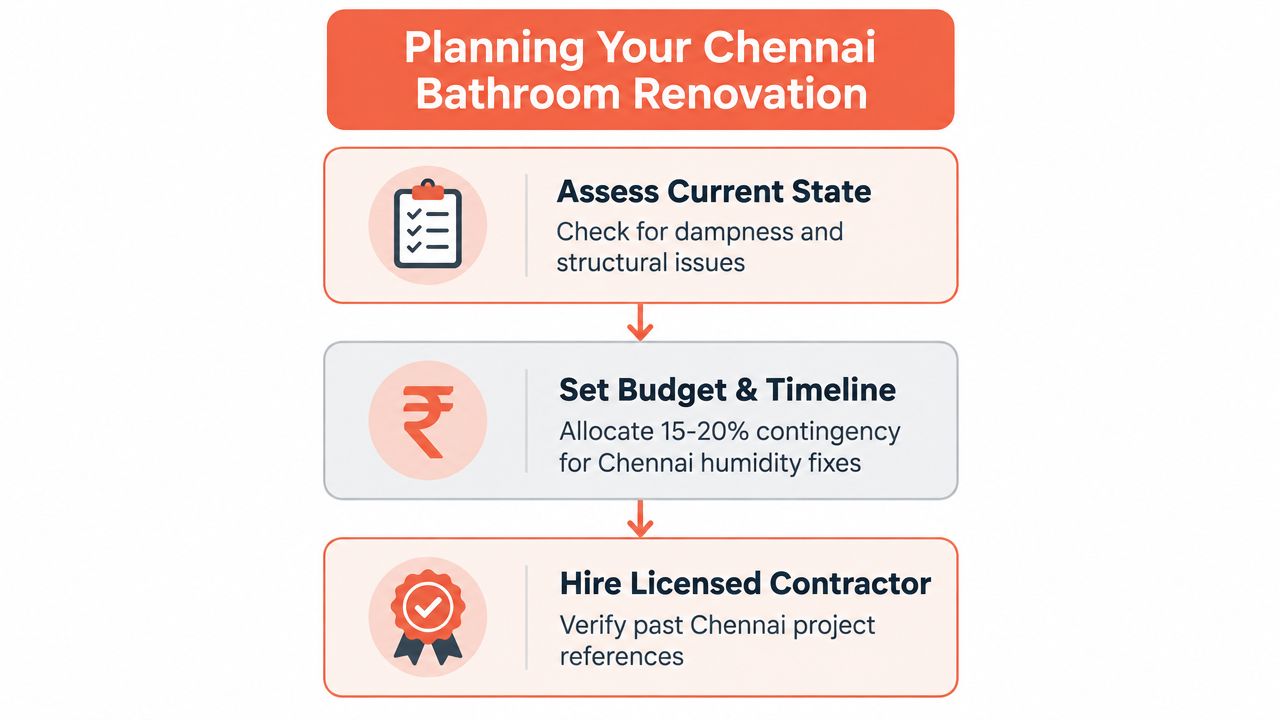
A realistic programme should include demolition, repair, waterproofing, curing, tiling, fitting installation, testing, and handover. For a useful general reference on bathroom renovation timelines and design, compare the sequence rather than copying another market's prices.
Material and Design Choices for Chennai Bathrooms
Material selection should follow the water pattern of the room. A glossy wall tile may be easy to wipe, but it won't make a shower floor safe. A fashionable dark tile may look refined at handover, yet it can show salt marks, soap residue, and standing water more clearly than a medium-tone surface.
Select the wet-area materials first
Use low-absorption wall and floor materials with a suitable anti-skid finish. Bathrooms and water-closets should use water-tight, non-absorbent finishes, and the floor needs a slope that directs water to the drain, as set out in India's standardised development and building regulations.
Where a shower is provided, impervious wall finishing should rise to 2.1 m from finished floor level. The floor should be sunk by 25 mm from the adjoining floor, with a recommended 1:100 slope towards the outlet, as specified in IS 13182:2020. These dimensions matter more than decorative patterns because they control how water behaves.
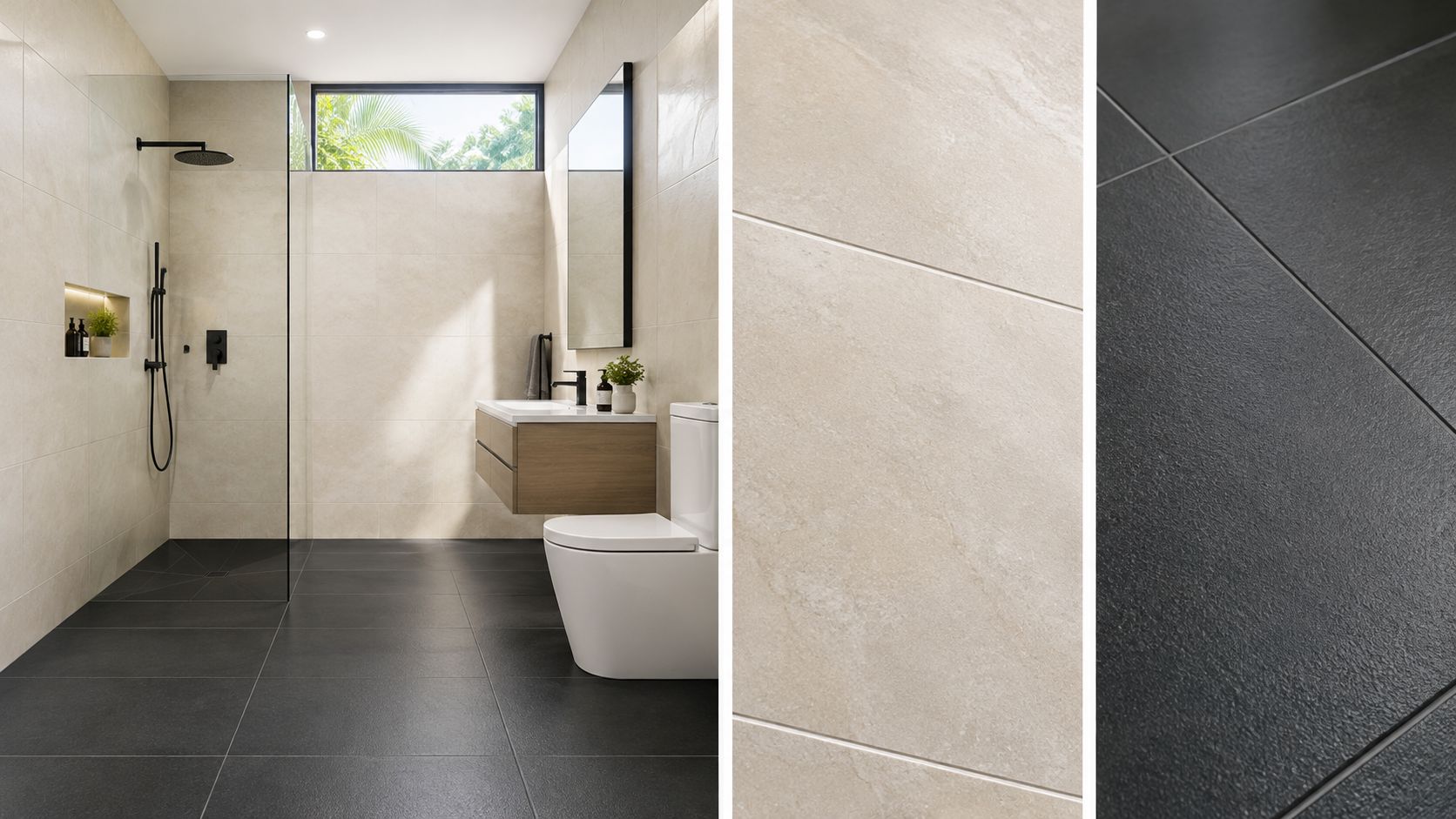
For floors, choose a finish that remains grippy when wet and confirm that the drain sits at the low point. Large-format tiles can reduce grout lines, but they demand a properly prepared base and accurate falls. Smaller tiles can follow a sloped floor more easily, though they create more joints to clean.
Match fittings to maintenance habits
Chrome, brushed metal, and black finishes all need regular cleaning in humid conditions. Concealed cisterns create a clean appearance but require an accessible service route. Open shelves offer quick access, while a floating vanity keeps the floor easier to mop.
Membrane choice deserves more attention than showroom colour. Chennai contractors commonly use elastic polymer-modified or low-absorption membrane systems for wet areas. The important detail is continuity, especially at corners, pipe penetrations, and the floor-to-wall junction.
Material rule: Choose the finish for the wettest part of the bathroom first. A beautiful tile cannot compensate for poor drainage or an incomplete membrane.
The Renovation Sequence That Prevents Expensive Rework
Most bathroom failures begin before the first fitting is installed. A team that starts with tile fixing before confirming plumbing, falls, and waterproofing may produce a neat-looking room that leaks behind the finish.
The reliable order is demolition, substrate repair, plumbing and electrical first-fix, slope correction, waterproofing, curing, flood testing, tiling, grouting, and sanitary installation. Recent Indian renovation guidance also stresses that waterproofing must cure fully before tiling, particularly where humidity and monsoon moisture can slow drying.
Follow the wet-area-first workflow
Survey and protect the site. Record existing dampness, inspect the ceiling below where possible, isolate services, and protect lifts, corridors, and occupied rooms.
Demolish carefully. Remove sanitaryware and tiles without damaging structural elements or shared stack lines. Bag debris and agree on disposal arrangements before work begins.
Repair the base. Replace weak screed, seal cracks, expose faulty joints, and correct the floor fall. Do not use tile adhesive to hide a badly sloped substrate.
Complete first-fix work. Set supply pipes, waste lines, electrical conduits, exhaust points, niches, and mirror-light provisions before closing the walls.
Apply the waterproofing system. Treat the floor, upstands, corners, penetrations, and shower walls as one continuous assembly. Chennai market guidance places bathroom waterproofing at roughly ₹20 to ₹55 per sq ft, depending on membrane type, with the waterproofing phase often quoted at 1 to 2 days alone, as described by Chennai bathroom renovation contractors.
Cure and flood test. Keep the area undisturbed for the specified curing period, fill the wet area for a controlled test, and inspect the room below or adjacent walls before covering the membrane.
Tile only after approval. Check line, level, slope, grout width, and cuts around outlets. Fit the WC, basin, taps, shower, and accessories after the tile work is stable.
The flood test isn't a formality. One thin coat, unsealed corners, or an unprotected pipe penetration can leave a concealed route for water. Local service guidance places bathroom waterproofing at ₹2,000 to ₹4,000 per bathroom, or ₹5,000 to ₹15,000 depending on condition and extent, and recommends checking membrane continuity before tiling through Chennai bathroom renovation service listings.

Apartment work needs one extra discipline. Inform the association or building manager before shutting water lines, cutting near a shared shaft, or scheduling noisy demolition. A leak dispute becomes harder when nobody can prove whether the source is a private bathroom, a common stack, or the unit above.
For practical questions about pipe access, fixture positioning, and homeowner coordination, the homeowner bathroom remodel tips from EZ Plumbing are a useful supplementary reference.
Cost and Timeline Breakdown by Project Type
A quote should show what is included, not just a single total. The same bathroom can fall into different cost bands depending on whether the team is replacing finishes only, repairing the substrate, moving plumbing, or adding custom storage and premium fittings.
Use the table below as a planning framework for a standard 40 sq ft room. The overall benchmark remains ₹80,000 to ₹2,50,000, while the 18 to 25 working day programme assumes ordinary access and no major structural surprise.
Scope | Estimated Cost | Timeline |
|---|---|---|
Basic refresh, limited layout change, standard sanitaryware and finish replacement | ₹80,000 to ₹1,20,000 | 18 to 20 working days |
Standard renovation, wet-area repairs, new tiles, plumbing adjustments and mid-range fittings | ₹1,20,000 to ₹1,80,000 | 20 to 23 working days |
Extensive renovation, concealed services, upgraded storage and premium fittings | ₹1,80,000 to ₹2,50,000 | 23 to 25 working days |
These figures are editorial planning bands for the stated bathroom size, not fixed market quotations. A ready flat with sound plumbing may remain near the lower end. An older apartment or villa can move upward when demolition exposes broken lines, inadequate falls, damp masonry, or access restrictions.
Spend on the parts that disappear
The strongest allocation usually goes to waterproofing, substrate repair, drainage, pipe joints, and electrical safety. These are difficult to replace after tiling. You can simplify decorative borders, niche detailing, hardware upgrades, or cabinet finishes without weakening the wet-area system.
Keeping the existing WC and floor-trap positions often makes the programme more predictable. A full layout change can require deeper cutting, new slopes, shaft coordination, and extra restoration beyond the bathroom itself.
For a broader way to think about allowances and scope, the guide to budgeting a bathroom renovation in Colorado is useful for its budgeting logic, although Chennai labour, materials, building rules, and climate conditions are different. For wider Chennai home renovation planning, see home renovation in Chennai and compare the bathroom scope with related electrical, painting, and carpentry work.
Contractor Coordination and Aftercare in Chennai
A competent bathroom team should be able to explain the work in the same order it will happen on site. If the quotation talks only about tiles, fittings, and labour but says nothing about substrate repair, membrane treatment, flood testing, curing, or debris removal, the scope is incomplete.
Ask for a written schedule with clear decision points:
Before demolition: Confirm layout, selected fittings, access hours, service isolation, and protection of common areas.
Before waterproofing: Approve the repaired base, pipe positions, floor falls, and corner treatment.
Before tiling: Record the waterproofing product, application coverage, curing status, and flood-test result.
Before handover: Test every tap, waste outlet, flush, exhaust point, light, sealant joint, and cabinet hinge.
Apartment projects need building-manager coordination, especially for shared stacks, water shutdowns, lift use, debris movement, and work-hour restrictions. A villa may offer more access, but it still needs protection for adjacent rooms and a clear decision on where waste, material storage, and temporary water connections will go. Whether formal approval is required depends on the work and the property's rules, so confirm with the association, manager, or relevant local authority before starting.
Make aftercare part of the agreement
Keep the tile brand, batch details, grout type, membrane product, sanitaryware models, and approved drawings in one handover file. The contractor should state what is covered, how defects are reported, and who responds when a seal fails or a fitting needs adjustment.
Interiors by DeX is one Chennai-based option for homeowners seeking renovation and remodelling support across apartments and villas, with bathroom work coordinated alongside plumbing, electricals, fit-out, and handover. Their guide to vetting interior design contractors in Chennai can help structure questions before appointing any team.
Handover rule: Don't accept “looks fine” as a completion test. Run water, inspect the room below where possible, and document the result.
Why the Cheapest Bid Is Rarely the Best Value
A low quote often looks attractive because it leaves out work that isn't visible in a showroom. The missing items are usually substrate preparation, corner reinforcement, pipe-penetration sealing, curing time, flood testing, proper debris handling, or final adjustment.
That omission creates a false comparison. One contractor may quote for tile removal and refixing, while another includes screed correction, a complete membrane system, testing, and documented handover. The second price can look higher even though it covers the work that protects the building.
Compare the method, not only the total
Ask each bidder these questions:
What happens after demolition? Request a process for weak screed, damaged plaster, and unexpected pipe leaks.
Where does waterproofing stop? Confirm floor coverage, wall height, corners, penetrations, and shower junctions.
How is the floor tested? Require a flood test before tile fixing and a record of the result.
What can change the price? Separate genuine discovered conditions from vague “extra work” clauses.
Who owns coordination? Clarify responsibility for the plumber, electrician, tile setter, building manager, and final cleaning.
Recent Indian renovation guidance emphasises that waterproofing should fully cure before tiling. It also explains why rushed sequencing in Chennai costs more than the tile or fitting choice itself, because monsoon moisture, high humidity, and apartment seepage risks can turn hurried work into retrofit repairs, as discussed in this bathroom planning guidance for Indian homes.
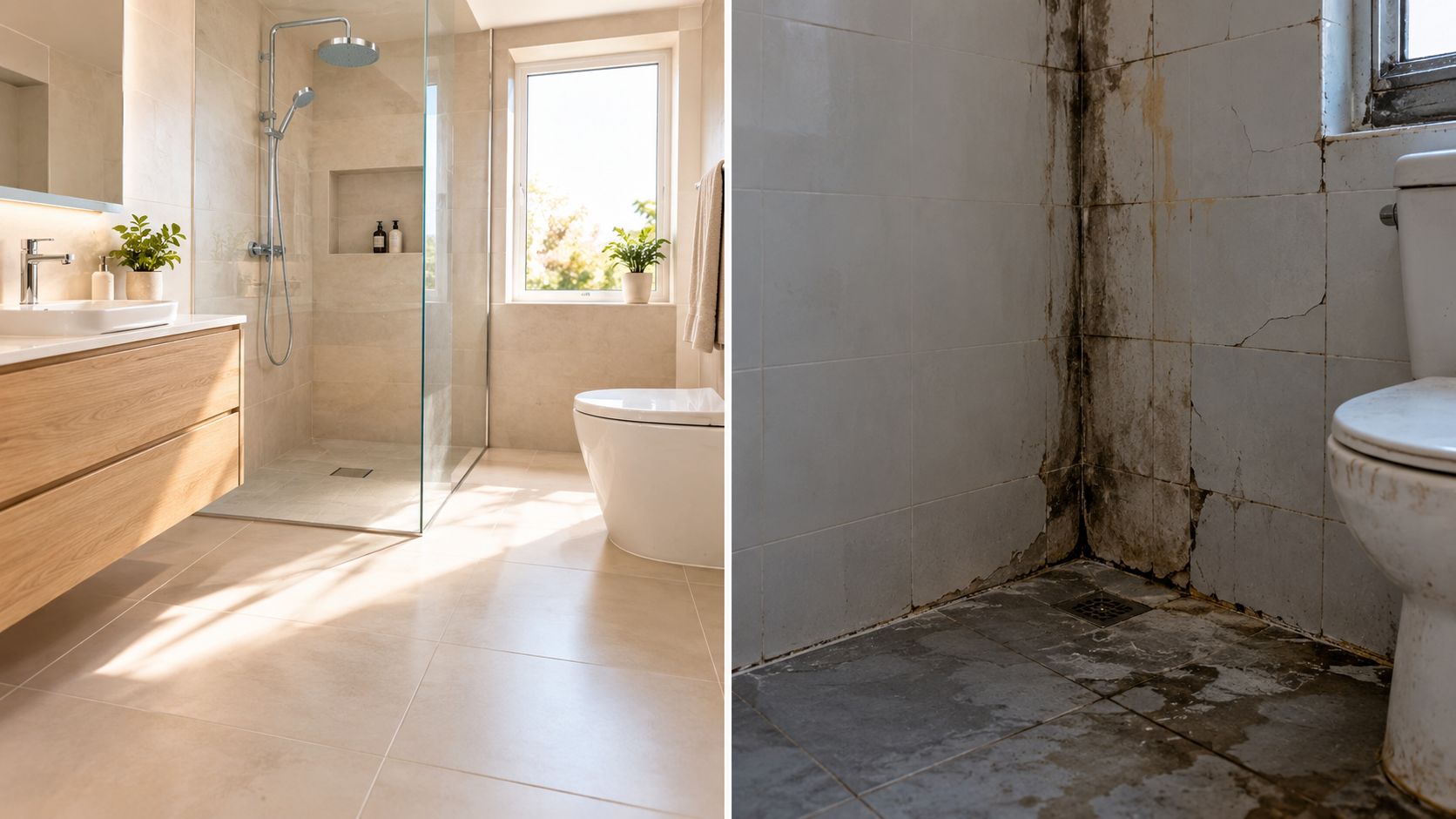
The contrarian conclusion is practical. The cheapest bathroom renovation is rarely the lowest-cost renovation over its life. A carefully tested membrane, a correct slope, fully cured layers, and documented coordination may add to the initial quote, but they reduce the chance of opening the room again after the finish is complete.
If you're planning a bathroom renovation in Chennai, Interiors by DeX can help coordinate design, material selection, plumbing, electrical work, execution, and handover for apartments and villas. Visit Interiors by DeX to discuss your bathroom scope, review a clearer execution plan, and request a renovation consultation.