
Indian-style bedrooms don't need to look crowded to feel Indian. The best rooms today are usually the most controlled ones, with fewer visual interruptions, better storage, and a clearer link between culture and daily comfort. That matters in Chennai, where compact homes, heat, humidity, and real storage pressure shape every design decision.
The strongest bedroom designs Indian style are not just about carved furniture or bright fabrics. They work because they balance palette, furnishings, materials, lighting, circulation, and maintenance. In this list, each direction is treated as a real design choice, with its own strengths, limits, and execution rules, so you can choose one that fits your room size, your light, and how you live.
1. Traditional Rajasthani Palace Inspired Bedrooms
A Rajasthani-inspired bedroom should feel rich, not chaotic. Use it when the room can handle carved wood, layered textiles, and a stronger decorative presence, because the whole style depends on visual depth. In Chennai villas and larger apartments, that can work beautifully, especially where ceiling height gives ornate furniture room to breathe.
Keep the grandeur under control
The mistake is to combine carved beds, patterned curtains, mirror work, and dark walls all at once. That turns a statement room into a heavy one, especially in smaller Chennai bedrooms where airflow and visual lightness matter as much as style. Keep the walls neutral, then let the bed, one wardrobe surface, and selected textiles carry the Rajasthani character.
Practical rule: limit the room to 2 or 3 dominant colors and keep every accessory inside that palette. That keeps the royal feeling without making the bedroom look busy.
For execution, use custom wardrobes that echo the furniture language, not glossy off-the-shelf units that fight the carved bed. Brass pendant lights and wall sconces add warmth, but they need to be layered with daylight so the room doesn't turn cave-like at night. If you're using dark wood or rich fabrics, add better ventilation and lighter bedding so the room still feels usable in Chennai weather.
A good real-world fit is a villa bedroom in Kodambakkam with a carved bed, or a heritage apartment near Fort St. George using a Rajasthani color palette without overfilling the room. Done well, this style reads as heritage. Done badly, it reads as overload.
2. Modern Minimalist Indian Bedrooms with Local Elements
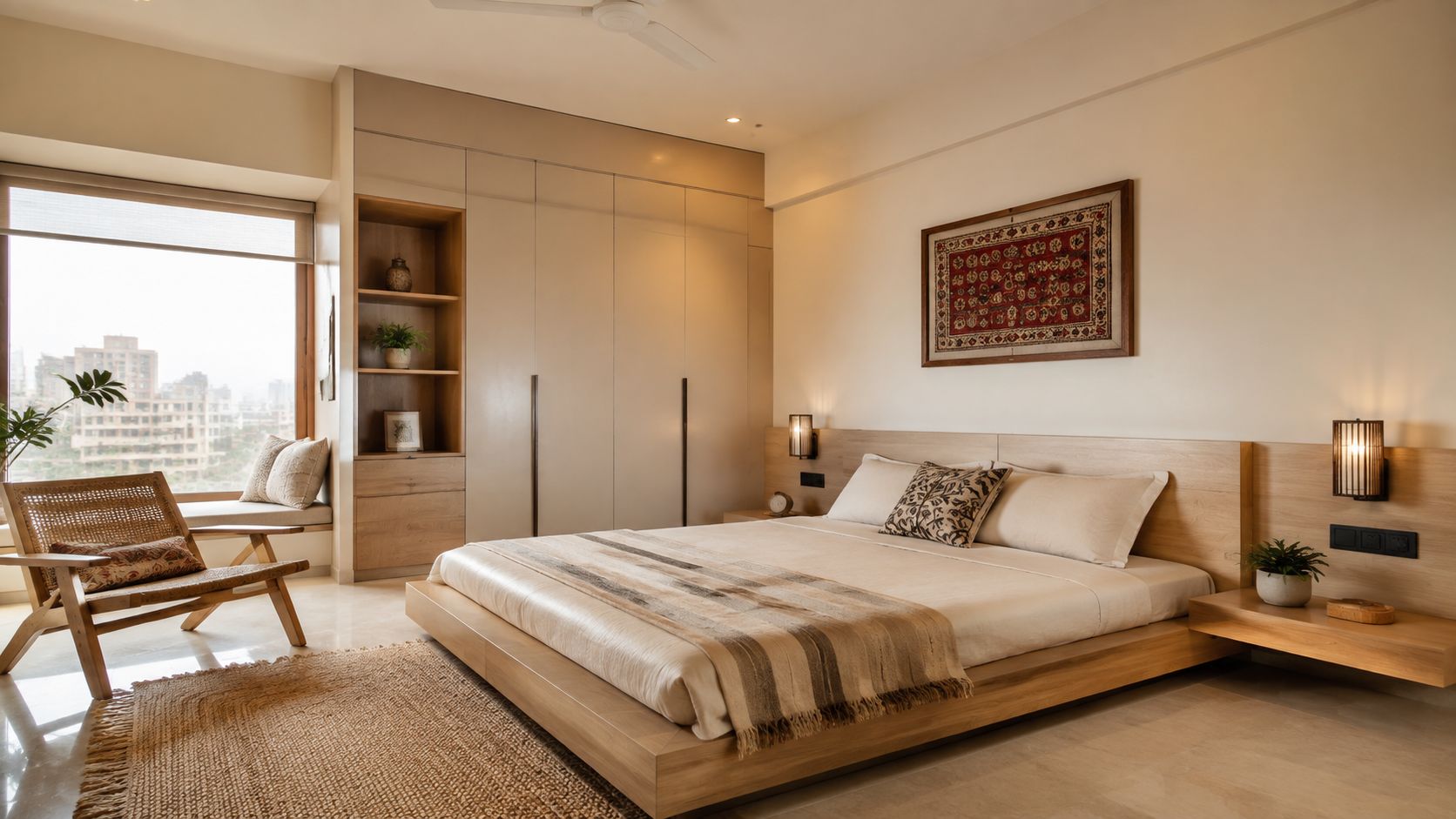
This is the smartest choice for new apartments that need calm, storage, and clean room geometry without losing Indian identity. The style depends on restraint. Plain surfaces, earthy tones, one or two cultural accents, and storage that disappears into the architecture do the work.
It also fits how bedrooms are used in India. Compact flats often ask one room to serve as sleep space, study corner, and dressing area. That makes a layout like a bedroom with attached bathroom plan useful, because the room has to handle more than one routine without feeling crowded. Census housing data compiled in the PMAY-Urban housing compendium shows 91.49 million households, about 37%, lived in one dwelling room, and 78.12 million households, about 32%, lived in two dwelling rooms, so compact, multi-use bedrooms are the norm for many homes (MOSPI table 25).
Make storage invisible
Use modular wardrobes, lofts, and a simple platform bed so the room stays visually steady. One traditional artwork, a handloom throw, or a sculptural lamp is enough to signal Indian character. Skip carved panels, multiple prints, and ornate furniture in the same room.
In Chennai apartments, this style works best when the bed frame stays low and the wardrobe runs floor to ceiling. That improves circulation, makes cleaning easier, and reduces dust-catching edges. Hidden lighting behind the wardrobe or bed panel adds warmth without cluttering the sightline.
A minimalist Indian bedroom should feel finished, not empty. The finish comes from material quality, not from stuffing the room with decor.
Use this style if you want a bedroom that looks current and still feels grounded. It is easy to maintain, easier to keep cool-looking, and forgiving in compact urban layouts.
3. South Indian Classical Bedrooms with Wooden Architecture
South Indian classical design belongs in homes that want local heritage to feel structural, not decorative. It's strongest when wood, brass, jaali work, and temple-inspired detailing are handled as a coherent system. In Chennai, that makes it ideal for homeowners who want a room that feels rooted in Tamil tradition without turning museum-like.
The style can be calming because it brings rhythm into the room. Wooden pillars, carved beds, and brass lamps add presence, but the room still needs air and light to stay comfortable. A teak bed in T. Nagar or a heritage renovation in Mylapore can carry this style beautifully if the wardrobe and lighting are designed with the same discipline.
Let the wood breathe
Dark wood needs balance. Use bright task lighting, a clean wall finish, and enough negative space so the room doesn't feel closed in. Jaali screens can add texture while still allowing privacy, which is useful when the bedroom needs to separate sleep from dressing or work.
Custom carpentry for Chennai home interiors matters here because local craftsmanship is part of the style, not an accessory. A custom wardrobe in matching wood tone looks intentional. A mismatched laminate wardrobe doesn't.
Use brass fittings for warmth, but don't overheat the room visually. Better to have one strong carved bed, one well-built wardrobe system, and simple curtains than to spread ornament across every surface. In practical terms, this is a style for people who want tradition with discipline. It rewards careful execution and punishes clutter.
4. Mughal Inspired Luxury Bedrooms
Mughal-inspired bedrooms suit homeowners who want symmetry, refinement, and a more polished sense of Indian opulence. The style depends on balance. Arches, mirrors, lattice work, and rich textiles need to feel planned, not accumulated. If Rajasthani design is about royal warmth, Mughal design is about ordered luxury.
Use this style in premium villas or spacious master bedrooms where symmetry can be maintained. The room should feel composed from the entrance itself. That means matching bedside proportions, centered headboards, and clear alignment between the bed, lights, and surrounding joinery.
Use layering, not density
Heavy textiles and dark colors can quickly make a room feel dense, especially in Chennai humidity. That's why warm layered lighting is essential. Add wall washers, bedside lights, and a soft ambient layer so the room doesn't depend on a single harsh source.
Commission lattice screens or arch details only if the rest of the room is quiet. The architectural feature should be the anchor, not one more thing competing for attention. Hidden storage in alcoves is the smartest move here because it preserves the Mughal look without forcing extra cabinets into view.
The room should feel ceremonial when you enter it, and restful when you close the lights. If it feels theatrical all day, it's too much.
Simple furniture works better than ornate furniture in this setting. Let marble inlay, arched lines, and fabric do the work. Keep maintenance in mind too, because intricate detailing gathers dust faster than plain surfaces. This style is beautiful when the room has enough space to support it and enough discipline to keep it elegant.
5. Coastal Indian Bedrooms with Nautical and Natural Themes
Coastal Indian bedrooms work because they suit Chennai's climate and daily use, not because they look summery. In humid homes, a lighter room is easier to live in, easier to cool, and easier to maintain. This style fits ECR villas, apartments near the coast, and compact city bedrooms that need air, not extra weight.
Use pale wood, white finishes, cane, rattan, and natural fabrics. Keep the coastal palette grounded with Indian textiles in muted sea tones so the room feels local, not like a generic beach resort. A bedroom in Royapuram, Neelankarai, or a waterfront flat can handle this look if the materials are honest and the details stay restrained.
Design for cooling first
Start with ventilation. In Chennai, airflow affects comfort more than decorative choices do, and moisture-resistant finishes protect the room from the slow wear that coastal humidity causes. If the room can stay cooler and drier, everything else becomes easier to live with.
Daylight planning matters too. Keep the room shallow if possible and avoid building thick elements around the windows. A coastal-ready turnkey villa interior design guide helps with overall planning, but the window placement still has to do the work. A design guideline for Indian homes says usable daylight usually penetrates about 2 to 2.5 times the window head height, and a 2.4 m tall window with a 0.9 m sill can project daylight roughly 5.25 m into a room, while a 1.2 m window reaches only about 2.6 m into it (StudioMatrx daylight guide). That makes room depth and opening placement more important than just making the window wider.
Use light furniture, moisture-safe finishes, and ceiling fans with cane or rattan accents. The room should feel breezy, not themed.
For styling, keep the layers calm. Sheer curtains, potted plants, and low-contrast textiles add softness without crowding the room. If you want a practical reference for how to stage a coastal bedroom, use it to check balance, then edit out anything that adds visual noise. This style gives you a bedroom that stays relaxed, clean, and workable in Chennai heat.
6. Bohemian Indian Fusion Bedrooms
Bohemian-Indian fusion works for people who want personality without rigid symmetry. It's a collected style, but it still needs a plan. The best rooms mix Indian textiles, vintage pieces, artisan objects, and global boho elements in a way that feels curated, not random.
This style suits creatives, young professionals, and NRI returnees in Chennai who want the bedroom to feel expressive. It also works well if you already own art, quilts, travel objects, or inherited pieces. A Besant Nagar apartment or a personal-use guest room can carry this look easily if the room is not overloaded.
Control the pattern density
Start with a color anchor, then build around it. If you don't limit the palette, the room turns restless. Use one or two dominant tones, then layer handloom throws, rugs, and wall art in related values rather than unrelated colors.
Open shelving can work here, but only if the storage is disciplined. This style can slip into clutter fast. Modular storage should still be present, just visually softened. Pair practical cupboards with woven baskets, textured fronts, or open display zones so the room keeps its character without becoming messy.
Easy boho bedroom steps is useful as a styling reference, but the design rule is simpler. Every collected piece needs a job. If it doesn't support sleep, storage, or visual balance, it doesn't belong in the bedroom.
This is a strong choice if you want warmth, informality, and cultural layering. It's less suited to people who hate visible objects or who want ultra-low maintenance. Used well, it feels personal and lived-in. Used badly, it just looks unfinished.
7. Contemporary Indian Heritage Bedrooms with Artistic Accents
This is the smartest way to bring Indian identity into a modern bedroom without falling back on tired motifs. Use contemporary furniture, a restrained palette, and heritage references that feel edited, not decorative. It suits professionals in Chennai who want a room that looks current, but still carries cultural weight.
Keep the room modern first. Let heritage arrive through curation. A gallery wall with Indian contemporary art, a textile panel, Asian sculptures for a bedroom, or one crafted bedside piece does more for the room than a cluster of themed objects.
Make the art the anchor
Treat the wall above the bed as the main visual field, then keep everything else quiet. That gives the room a clear hierarchy and stops it from feeling crowded. Choose one or two statement pieces, then keep the wardrobe, bed, and lighting visually simple.
This style works well in premium flats, especially where floor area is tight and storage has to stay clean. Natural wood accents soften polished surfaces, and focused lighting makes art and display pieces feel deliberate. If you are working with a designer, ask for balance, not decoration. One strong visual idea beats three competing ones.
Use objects with restraint. A carved stool, a framed textile, or a heritage-inspired lamp can ground the room in culture without overwhelming the contemporary framework. That approach also helps with maintenance, since fewer objects mean less dusting and less visual noise.
For Chennai homes, this style has a practical advantage. It handles changing art, changing furniture, and changing storage needs without forcing a full redo. That makes it a better long-term choice than trend-led styling, especially if you want a bedroom that feels personal, refined, and easy to live with.
8. Sustainable and Eco Conscious Indian Bedrooms
Sustainable bedrooms make sense for Chennai homeowners who want comfort, responsibility, and long-term durability in one plan. The style uses reclaimed wood, organic textiles, natural dyes, and low-VOC finishes, but the bigger idea is lifespan. A bedroom should age well, not just look responsible on day one.
This is a strong choice for villas, renovation projects, and NRI homes where quality sourcing matters. It also fits Indian material culture naturally, because local craft, natural fibers, and practical durability are already part of the tradition. The room feels calm when the materials are honest.
Choose materials that last
Use reclaimed or sustainably certified wood for the major pieces. Select organic cotton, linen, and other natural fibers for bedding and soft furnishings. Low-VOC finishes matter because the bedroom is where air quality directly affects comfort.
The best sustainable rooms also stay modular. That lets you repair and replace parts without redoing the whole bedroom. Keep wardrobes practical, choose durable hinges and fittings, and plan for maintenance from the beginning. A beautifully sourced room that falls apart in three years isn't sustainable.
Coastal-ready turnkey villa interior design guide is relevant if you want a natural-material bedroom that also handles Chennai conditions. The overlap between climate-aware and eco-aware design is real. Both depend on choosing the right material for the right job.
If you care about responsible luxury, this is one of the smartest bedroom directions available. It avoids waste, supports local craftsmanship, and usually ages better than heavily styled rooms. The room stays quiet, healthy, and practical.
Comparison of 8 Indian Bedroom Styles
Style | 🔄 Implementation Complexity | ⚡ Resource Requirements | ⭐ Expected Quality | 📊 Typical Outcomes / Impact | 💡 Ideal Use Cases |
|---|---|---|---|---|---|
Traditional Rajasthani Palace-Inspired Bedrooms | High, intricate carving, architectural elements and mirror work | High, hand-carved wood, brass/copper fixtures, skilled artisans; premium budget | ⭐⭐⭐⭐, strong luxury and heritage appeal | Dramatic, timeless statement rooms; high perceived value; needs space | Villas, large apartments, heritage renovations |
Modern Minimalist Indian Bedrooms with Local Elements | Moderate, careful curation and integrated storage | Mid to premium, modular systems, quality textiles, some custom joinery | ⭐⭐⭐, clean, adaptable, culturally subtle | Space-efficient, low-maintenance, versatile for changing tastes | Compact apartments, new flats, urban studios |
South Indian Classical Bedrooms with Wooden Architecture | High, traditional joinery and carved pillars, jaali work | High, teak/rosewood, brass, skilled woodcarvers; premium | ⭐⭐⭐⭐, authentic, durable, culturally rooted | Serene, naturally cooling interiors; strong craft expression | Villas, heritage properties, traditional homes |
Mughal-Inspired Luxury Bedrooms | Very high, symmetry, inlay work, custom lattice and arches | Very high, marble/faux marble, semi-precious accents, specialized labor | ⭐⭐⭐⭐⭐, highly luxurious and romantic | Grand master bedrooms with strong visual impact; social/media appeal | Luxury villas, large master suites, high-end apartments |
Coastal Indian Bedrooms with Nautical and Natural Themes | Low–Moderate, material selection and ventilation focus | Mid, weathered wood, natural fibers, moisture-resistant finishes | ⭐⭐⭐, relaxed, breezy, climate-appropriate | Calm, thermally comfortable spaces; easy seasonal updates | Coastal properties, sunlit apartments, villas with sea influence |
Bohemian-Indian Fusion Bedrooms | Moderate, layered styling, sourcing and curation | Mid, mixed textiles, vintage/secondhand finds, artisan pieces | ⭐⭐⭐, highly personal and visually rich | Eclectic, personality-driven rooms; flexible and evolvable | Creative professionals, younger homeowners, small apartments |
Contemporary Indian Heritage Bedrooms with Artistic Accents | Moderate–High, art curation and high-quality finishes | Premium, commissioned artwork, quality contemporary furniture | ⭐⭐⭐⭐, sophisticated, gallery-like heritage integration | Timeless modern-heritage balance; showcases artists and craftsmanship | Design-conscious homeowners, professional couples, premium flats |
Sustainable and Eco-Conscious Indian Bedrooms | Moderate, sourcing certified materials and artisans | Mid–Premium, reclaimed/sustainably sourced wood, organic textiles | ⭐⭐⭐–⭐⭐⭐⭐, healthy, durable, ethically appealing | Lower environmental impact, improved indoor air, long-term value | Eco-conscious homeowners, villas, resale/rental-focused projects |
Turn Inspiration Into a Bedroom That Works
The right bedroom designs Indian style choice depends on how much space you have, how much maintenance you'll accept, and how much cultural detail your room can carry without feeling crowded. For compact apartments, modern minimalist Indian and contemporary Indian heritage rooms are the safest because they preserve circulation, simplify cleaning, and give storage a clear role. For Chennai homes near the coast or in humid zones, coastal Indian and sustainable bedrooms make more sense because they respect light, airflow, and material durability.
If your room is larger and the budget supports more execution work, Rajasthani, South Indian classical, or Mughal-inspired bedrooms can feel rich and grounded. They need stronger cabinetry, better lighting, and tighter coordination, but they reward that effort with real character. Bohemian-Indian fusion sits in the middle, good for people who want personality, but only if they're willing to edit hard.
Use a simple planning checklist before you sign off on any bedroom. Limit the colour palette to a few tones. Match bed size and wardrobe depth to the room, not to a showroom. Protect ventilation. Use layered lighting, not one overhead fixture. Choose materials that suit Chennai humidity and your cleaning habits. And make sure the execution team is accountable for carpentry, electrical coordination, finishes, and handover, because a beautiful concept can still fail in the details.
If you want that coordination handled in one place, Interiors by DeX is a relevant Chennai option for space planning, custom wardrobes, lighting coordination, manufacturing, installation, and handover through one residential interiors team. For homeowners who want a bedroom that looks Indian, works daily, and fits the room it's built into, that kind of end-to-end delivery matters.
If you're planning a bedroom redesign in Chennai, talk to Interiors by DeX about space planning, custom wardrobes, lighting coordination, and execution under one team. They handle residential bedrooms as part of turnkey interiors and renovation work, which makes it easier to keep the design coherent from concept to handover.