
You're in a Chennai flat with the slab still bare, and the contractor wants the false ceiling profile before anyone has marked the fan. That sequence is how rooms end up with a short downrod, blades that clear the frame by a few centimetres, and a cable that gets cut open after painting.
A false ceiling design with fan works better when the fan is the fixed point. Downrod length, blade tip clearance, the hook in the structural slab, and the route for the cable and the light runs all have to be decided before the frame goes up. Chennai heat and coastal humidity make those choices sharper. A deep ceiling that looks finished can still trap warm air, rattle the gypsum, or hide a joint that corrodes.
In a three-bedroom home, several fans share one cavity with lights, so the first drawing should show every hook, not the cove colour. These eight designs put the fan first, with notes on airflow, lighting, and mounting. Before the board is closed, run through these safe DIY ceiling fan checks for wobble, noise, and whether the earth is connected. Then pick the shape that fits the height you have.
1. Coffered False Ceiling with Central Fan and Cove Lighting
A coffered false ceiling splits the plane into recessed squares or rectangles. The fan mounts in the main coffer, with LED cove light along the recess, so the blades are the focal point rather than one more fitting.
Say a symmetrical apartment living room in Chennai, sofa on axis, dining beyond. Mark the room centre on the slab before any channel is screwed. A villa dining room can use one square coffer the same way, so a pendant-style fan stays inside the bay and clear of the beams.
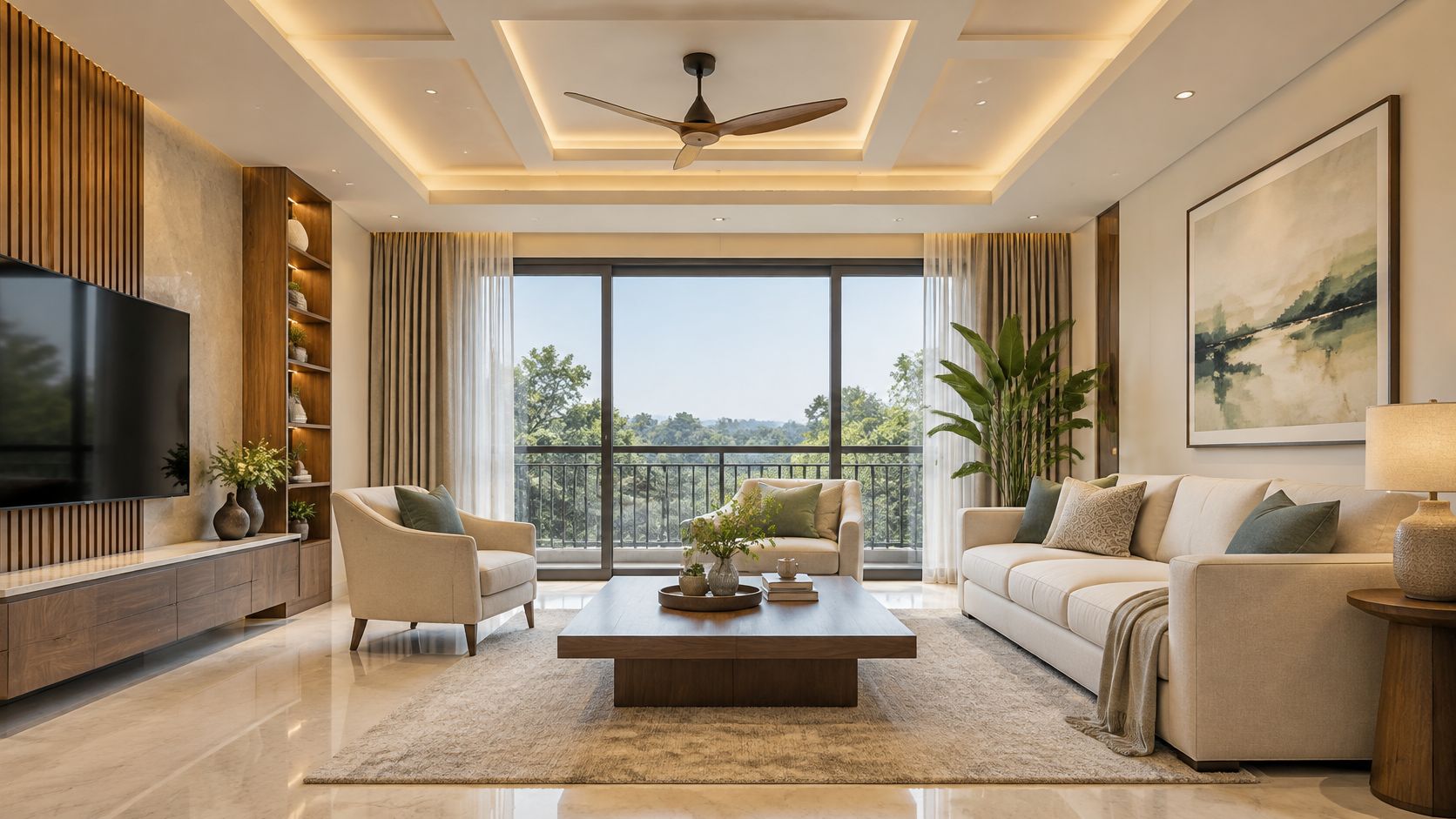
Hook and blade clearance
Anchor the hook to the structural slab, not the board. BIS certification guidance confirms ceiling fans fall under mandatory standards such as IS 374:2019 and IS 302-2-80:2017, so compliance belongs in the buy, not only the finish. Run the fan cable and the cove driver on separate routes, or one fault means opening the whole coffer.
On site: Keep about 300 mm from the blade tip to the ceiling surface, or the air only swirls inside the coffer.
Cove colour: Warm white around 3000K keeps a living room calm and doesn't glare off the canopy.
Two fans: Wider halls need a second point, and false ceiling designs for a hall with two fans show how to split coffers without a blade clash.
2. Circular POP False Ceiling with Fan Medallion
A round plaster medallion softens a square room. The fan drops through the centre of the rosette, and the circle becomes the frame instead of another set of boxes.
Traditional family homes in Chennai still ask for a lotus medallion over the fan. Ornamental villa ceilings do the same with a decorative rosette. The look fails when the medallion is wider than the room can carry, or when coastal damp stains the plaster within a season.
Size, moisture, and the downrod
BIS IS 374 covers ceiling fans in 900, 1050, 1200, 1400, and 1500 mm sweep sizes, and it calls for checks on air delivery, suspension strength, earthing, and silent running. Pick the sweep for the room first. Then size the medallion, usually no larger than about one-third of the room width.
Humidity: Use moisture-resistant POP, or a reinforced base, and finish with a sealant or anti-fungal coat.
Downrod: Set the length so the blades clear the medallion's lower edge. If they kiss the plaster, you'll hear it every night.
Access: Leave the junction reachable. A pretty rosette that hides a loose earth is not a finish.
3. Tray Ceiling with Fan and Indirect LED Lighting
Bedrooms in new Chennai flats often get a shallow tray. The perimeter drops, the centre steps up, and a low-profile fan hangs on a short downrod in that raised bay. Indirect LEDs wash the step, so a modest room feels less crushed. Master bedrooms in villas use the same step for a fan that shouldn't dominate the bed.

A Chennai indoor thermal study found that room orientation can produce about a 4°C temperature variation for the same opening size, and it treated ceiling fans as one factor in measured and simulated comfort. A deep full-room drop won't fix a west-facing bedroom. A shallow tray might.
Lower the whole ceiling only if you still have blade room and a path for air toward the window.
Depth: Keep the tray between 100 mm and 150 mm so you don't give away headroom.
Fan: A short downrod or a low-profile fan fits the recess. Turn it by hand before the cove is closed.
Light: Strips at 2700K to 3000K suit sleep better than a cool white that flashes on the canopy.
4. Flush-Mount Fan in a Recessed Gypsum Ceiling
In a compact Chennai bedroom with a ceiling below 10 ft, a long downrod can leave too little blade clearance. A hugger fan fits close to the slab, while a shallow circular recess keeps the gypsum ceiling visually flat. This suits compact 2BHK bedrooms, balconies, and utility bays where headroom is limited.
Power draw and the real support
An unlabelled AC-induction fan typically uses about 70–75 W, compared with about 50 W for a 5-star AC-induction model and 32 W for a BLDC model, according to this India-focused appliance-efficiency analysis. Replacing a 75 W fan with a 32 W BLDC model and running it 8 hours a day saves approximately 125.6 kWh a year. At an illustrative ₹8/kWh, that is about ₹1,005 before speed changes. Specify a BEE star-rated or BLDC fan, then record the chosen model and rating in the electrical schedule before ordering.
The gypsum cutout is only a finish. Fix the fan hook into the slab, and reinforce the recess so the board carries no fan load. Check the hook position against the fan's canopy and wiring route before closing the ceiling. Keep the blades about 2.3 m above the floor to reduce the risk of people clipping them on a balcony.
5. Cove Ceiling with Fan and Ambient Lighting
A cove works well when the fan stays in the open centre and the lighting runs around the room's edge. The curved or angled drop hides the LED strip, while the flat field keeps the blades clear. In Chennai apartments, this arrangement can frame a living-room fan or connect living and dining areas with one ceiling profile.
Keep the fan clear of the cove
A cove 100 mm to 150 mm deep gives the perimeter light a defined recess. Set the fan in the flat field, and check its blade sweep against the cove before fixing the frame. Run the light and fan cables while the ceiling is open. Put the ambient lights on a separate switch from the fan so the room can be dimmed without changing fan speed.
India's Bureau of Energy Efficiency states that LED bulbs can save approximately 88% to 91% energy compared with incandescent bulbs, and about 50% to 55% compared with CFLs, depending on the lumen requirement. Bedroom layouts can use these ceiling light ideas for bedrooms. For a sit-out, compare patio cover lighting fixtures before choosing fittings for the outdoor space.
6. Wooden Slat Ceiling with Central Fan
Parallel timber or wood-laminate slats, in a line or a grid, with the fan in a framed opening at the centre. Modern villa living rooms in Chennai use this when they want grain, not another white box. Dining rooms pair the same slats with a linear light beside the fan, which only works if the opening was set out before the first batten.

Timber that survives the coast
Ordinary ply with a thin laminate will cup and stain in this weather. I won't sign off a full slat lid if the electrician can't show the junction before the varnish goes on.
Material: Moisture-resistant, termite-treated timber, or engineered wood, then a sealant against moisture and insects.
Spacing: Keep the gap even, and leave the whole blade circle clear of every slat end.
Service: Plan an access panel in the slat field. Cutting a hatch after the finish looks like a repair, because it is one.
A slat ceiling hides drivers well and then makes them painful to reach. A simpler perimeter tray is the better trade when servicing matters more than the grain.
7. Suspended Ceiling with Fan and Service Access Panel
This is the design I recommend when the cavity also carries ducts, drivers, and a junction box. A suspended gypsum or metal frame gets a removable panel at or beside the fan, so a service visit doesn't mean breaking the paint. Chennai apartments that stack wiring over the fan, and villa bedrooms with a discreet hatch in a border, are the usual cases.
Put the panel near a wall or inside a recessed border. A magnetic or flush cover keeps the surface even. Place it before finishing, or the painter will centre it on a joint you didn't want.
What the cavity is allowed to hold
National Building Code commentary states that low- and medium-voltage wiring in false ceilings should run in metal conduits, that 230-volt wiring above a false ceiling should use 660-volt-grade insulation, and that the false ceiling, including its suspension fixtures, should be non-combustible with adequate fire resistance. The same provisions call for MCBs and ELCBs on the circuits. The hook still fixes to the slab, not the suspended frame. For how that hatch sits in a full plan, see smart false ceiling planning in Chennai.
8. Ornamental Dome Ceiling with Fan and Concealed Lighting
A shallow dome lifts the eye. The fan sits at the apex, and concealed light rings the base of the curve. Formal living rooms in Chennai villas, and entrance foyers that need a single gesture, are where this earns its cost.
Use it only where the ceiling height is at least 10 ft. Below that, the dome eats the proportion and the downrod looks awkward. Support the curve with light-gauge steel or a proper gypsum framework, not a free POP shell that cracks at the first wobble. Align the fan to the apex, or the whole shape looks off-centre. Wash the curve with warm light, and keep hard downlights off the blades so you don't get a strobe every evening.
A dome is a statement, not a way to hide a badly placed hook.
If the foyer is narrow, skip the dome and keep a flat centre with a cove. You'll spend less, and the fan will still clear a curve you didn't build.
How the eight false ceiling designs compare for fan fit, lighting, and cost
Item | Best For | Ceiling Height Needs | Lighting Approach | Relative Cost |
|---|---|---|---|---|
Coffered False Ceiling with Central Fan and Cove Lighting | Symmetrical living and dining rooms seeking a premium look | Adequate height; minimal height reduction | Concealed LED cove lighting | Higher than a plain false ceiling |
Circular POP False Ceiling with Fan Medallion | Traditional rooms needing a decorative focal point | Better suited to rooms without low ceilings | Optional spotlights or concealed lighting in the outer ring | Higher with intricate detailing |
Tray Ceiling with Fan and Indirect LED Lighting | Medium rooms seeking a sense of height and spaciousness | Avoid in low-ceiling rooms; shallow tray helps preserve headroom | Concealed indirect LED strips | Moderate |
Flush-Mount Fan in a Recessed Gypsum Ceiling | Low-ceiling rooms needing a clean, practical finish | Suitable for limited ceiling height | No specific lighting feature; clean, minimal ceiling | Lower installation complexity |
Cove Ceiling with Fan and Ambient Lighting | Living rooms, bedrooms, and kitchens needing soft ambient light | Slight height reduction | Concealed LED strips in the cove | Moderate |
Wooden Slat Ceiling with Central Fan | Contemporary interiors seeking natural warmth and texture | No specific height requirement; allow fan clearance | Optional backlighting behind slats | Higher than gypsum or POP |
Suspended Ceiling with Fan and Service Access Panel | Apartments needing convenient fan and wiring maintenance | Slight height reduction from suspension | No specific lighting feature; concealed electrical runs | Moderate |
Ornamental Dome Ceiling with Fan and Concealed Lighting | Larger formal spaces seeking a statement feature | At least 10 ft recommended | Concealed lighting around the dome base | High |
Pick the Fan Ceiling That Fits Your Room Height
Start with a tape from the finished floor to the slab, not to the false ceiling you hope to build. Mark where a hook can bite the structural concrete, clear of beams, conduits, and any bathroom drop on the floor above. Then match the profile to the room size, the lighting zones, and how often someone will need that junction box.
A coffer or a dome suits a tall, formal room. A tray, a cove, or a hugger fan suits a typical Chennai apartment bedroom. Wooden slats suit a villa that will maintain timber. A suspended ceiling with a hatch suits any home that will service the fan more than once. Bring that fan position to the design consultation before a single channel is fixed. Framing around a guessed centre is how blades meet bulkheads.
A Lawrence Berkeley National Laboratory study reported that India sold approximately 29 million ceiling fans annually in 2009, with sales growing at about 10% per year, and that conventional single-phase induction-motor fans typically consumed around 75 watts at full speed. For a fan operated 8 hours daily, a 75-watt model consumes about 219 kWh annually, compared with roughly 88 kWh for a 30-watt model, a difference of approximately 131 kWh per year per fan. That gap is why the electrical schedule should name the model, the sweep, and the rated input before procurement, not after the canopy is painted.
On site, the misses are boring and expensive. The hook is screwed to the gypsum. The downrod is a size too short. The regulator sits above a sealed cove. The light and the fan share one switch, so the room is either bright and breezy or neither. A pre-handover check should record wobble, abnormal noise, speed response, earthing continuity, and clearance from bulkheads. If any of those fail, don't accept the paint as complete.
Interiors by DeX, a Chennai residential interior firm, plans and executes false ceilings as part of apartment and villa work, and coordinates ceiling-fan locations, sweep clearance, and solid mounting points with the lighting layout. That coordination is what keeps the fan as the fixed element and the ceiling as the layer built around it.
Interiors by DeX plans and executes home interiors in Chennai, including false ceilings coordinated with fan hooks, sweep clearance, lighting zones, and electrical routes. The same team takes apartments, villas, and renovations from design through installation and handover, so the ceiling isn't drawn by one vendor and wired by another. Visit Interiors by DeX to book a consultation and lock the fan position before framing starts.