
You're getting ready for work, searching for clothes, and trying not to wake your partner, but the bedroom has one harsh ceiling fixture doing every job at once. The same light needs to support morning routines, dressing, reading, winding down, and sleep. It usually fails at least one of them.
The strongest ceiling light ideas for a bedroom don't begin with a decorative fixture. They begin with the role each light must play, then match the fixture, placement, switch, and colour temperature to that role. A dimmable ambient source can handle general illumination, bedside pendants or sconces can support reading, strips and cove lighting can add a quiet evening glow, and daylight can reduce dependence on artificial light during the day.
This roundup covers 10 practical options, including recessed lights, pendants, LED strips, sconces, layered systems, drum shades, track lights, smart bulbs, cove lighting, and skylights. They suit different Chennai apartments, villas, and premium residences, and they also suit different project stages. Coordinating lighting while planning the room can prevent later rewiring, false-ceiling changes, and furniture conflicts. For broader inspiration, explore these bedroom lighting ideas before finalising the electrical layout.
1. Recessed Ceiling Lights with Dimming Capability
Recessed lights sit flush with the ceiling, keeping sightlines clear and the room visually quiet. In Chennai apartments, they also suit ceilings with limited depth, where a large hanging fixture could feel crowded. Villas and premium residences offer more flexibility, but the same low-profile approach works when the ceiling design is intentionally minimal.
Their main value is adjustable ambient light. Use a brighter setting for dressing and morning routines, then lower the output before sleep. A bedroom needs less general intensity than a kitchen. An India-focused lighting guide suggests 100 to 150 lux for bedroom ambient lighting and about 300 lux for bedside reading. It also notes that an average 100 to 150 sq. ft. bedroom may use 3 to 4 recessed 10W LED downlights for general illumination, as outlined in India-focused home lighting guidance.
Place fixtures in relation to the bed, wardrobe, and circulation route rather than copying a regular ceiling grid. A downlight directly above the pillow can create glare when you are lying down, while poorly spaced fittings can leave darker areas near storage or corners.
Use warm LEDs: Choose 2700K to 3000K for a comfortable evening setting.
Coordinate early: Confirm cut-outs, wiring, and dimmer compatibility before drywall or false-ceiling work.
Protect the ceiling plan: Keep fittings clear of beams, fan locations, and access panels.
Control from useful points: Install the main dimmer near the door, with bedside control where practical.
Practical rule: Aim recessed light at the room's usable zones, not directly into your eyes from the bed.

For cut-out planning, beam clearance, and dimmer selection, review these best practices for recessed lighting.
2. Pendant Lights Over Bedside Areas
A pendant over each bedside table can replace a table lamp while freeing the surface for books, chargers, or a glass of water. In a compact apartment, that extra space matters. In a larger bedroom, matching pendants can create a clear visual frame around the bed without making the ceiling feel crowded.
The placement needs more care than the style. A pendant that's too low can obstruct movement and feel visually heavy. One that's too high may look attractive but won't provide useful reading light. Keep the bottom of the pendant comfortably above the mattress and check the view from a lying position before fixing the final cord length.
Warm light works best here. Bedroom guidance commonly recommends 2700K to 3000K for warmer colour and a dim, low-stimulation atmosphere at night, as discussed in bedroom lighting planning guidance.
A Scandinavian-style flat might use simple geometric pendants above the headboard, while a Chennai villa could use a brass or hand-finished fixture with an Indian motif. The fixture should complement the headboard, wall finish, and bedside furniture rather than compete with them.
Use separate circuits: Each side should ideally operate independently.
Check glare: Choose an opaque or diffused shade if the bulb is visible from the pillow.
Mind the ceiling height: Long cords suit taller rooms, but low ceilings need compact drops.
Protect symmetry: Centre each pendant on the bedside zone, not necessarily on the entire wall.
Pendants work well when you want both task light and decoration. They don't work as the only ceiling light if the wardrobe and dressing area need even illumination.
3. LED Strip Lighting Behind Headboards
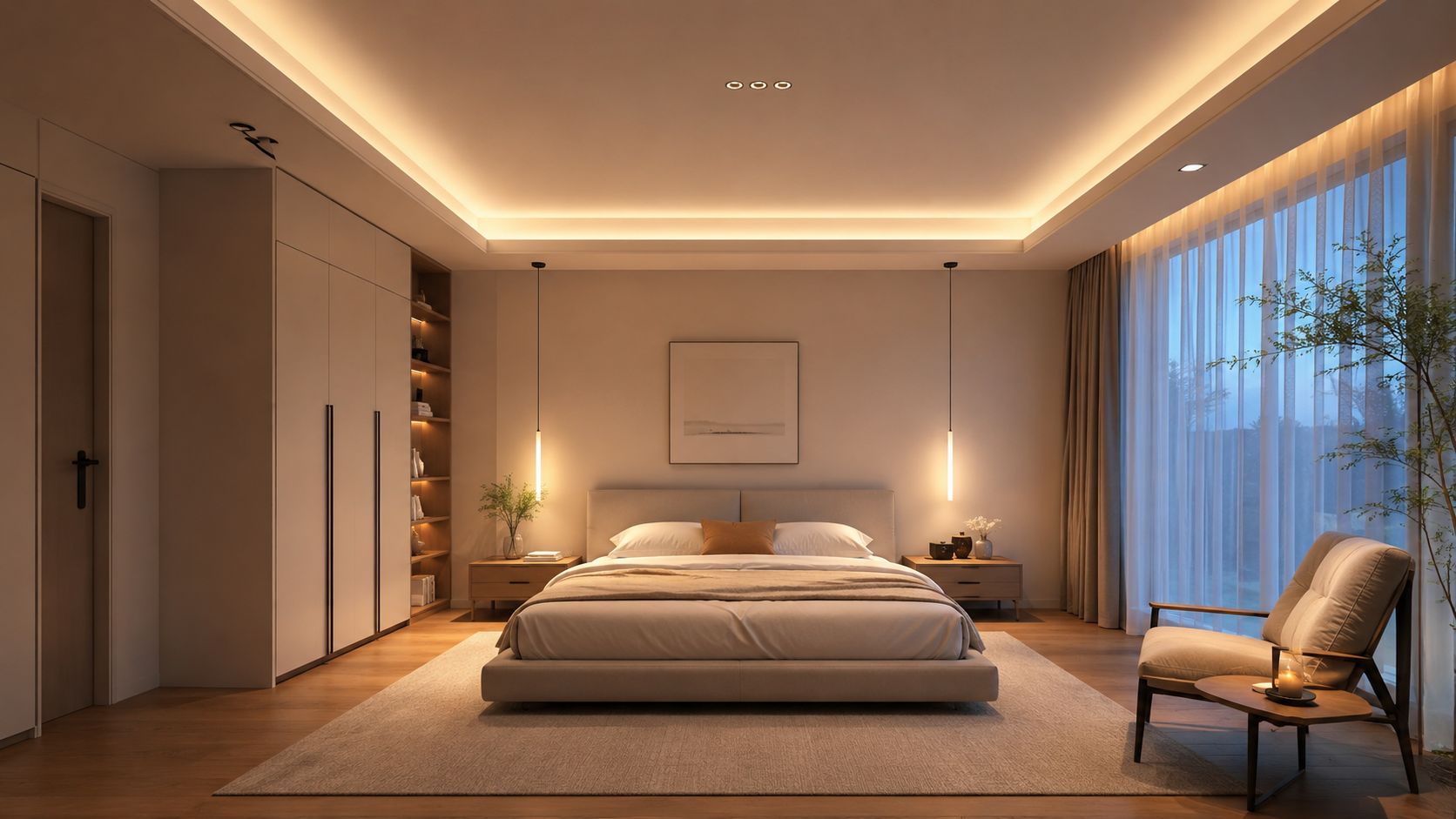
LED strips behind a headboard create indirect light, so the wall glows instead of the bulb appearing as a bright point. This is one of the easiest ways to add depth to a bedroom, particularly behind a plain upholstered headboard or a full-height wood panel.
The strip should stay hidden. Leave enough space behind the headboard for the light to spread across the wall rather than forming a line of dots. A shallow channel, diffuser, or concealed recess usually gives a cleaner result than sticking the strip directly onto a painted surface.
Use warm white for everyday bedroom lighting. 2700K to 3000K suits a relaxed evening setting, while RGB colour-changing strips are better treated as occasional mood lighting rather than the primary source. A rental apartment might use a removable system, while a villa renovation can integrate the strip into joinery with concealed wiring and a dedicated driver location.
Humidity and dust deserve attention in Chennai. Adhesive can loosen on unsuitable paint or dusty surfaces, and poorly accessible drivers make future repairs frustrating.
Create a soft wash: Position the strip so it throws light onto the wall, not directly into the room.
Keep wiring hidden: Coordinate the power point with the headboard and bedside joinery.
Use a diffuser: It reduces visible hotspots and gives the wall a more continuous glow.
Separate the control: Put the strip on its own switch or dimmer instead of tying it to the main ceiling light.
Plan access: Leave a practical route to the driver for maintenance.
This layer is excellent for winding down, but it won't replace task lighting at the wardrobe or reading position.
4. Wall Sconces for Balanced Ambient Lighting
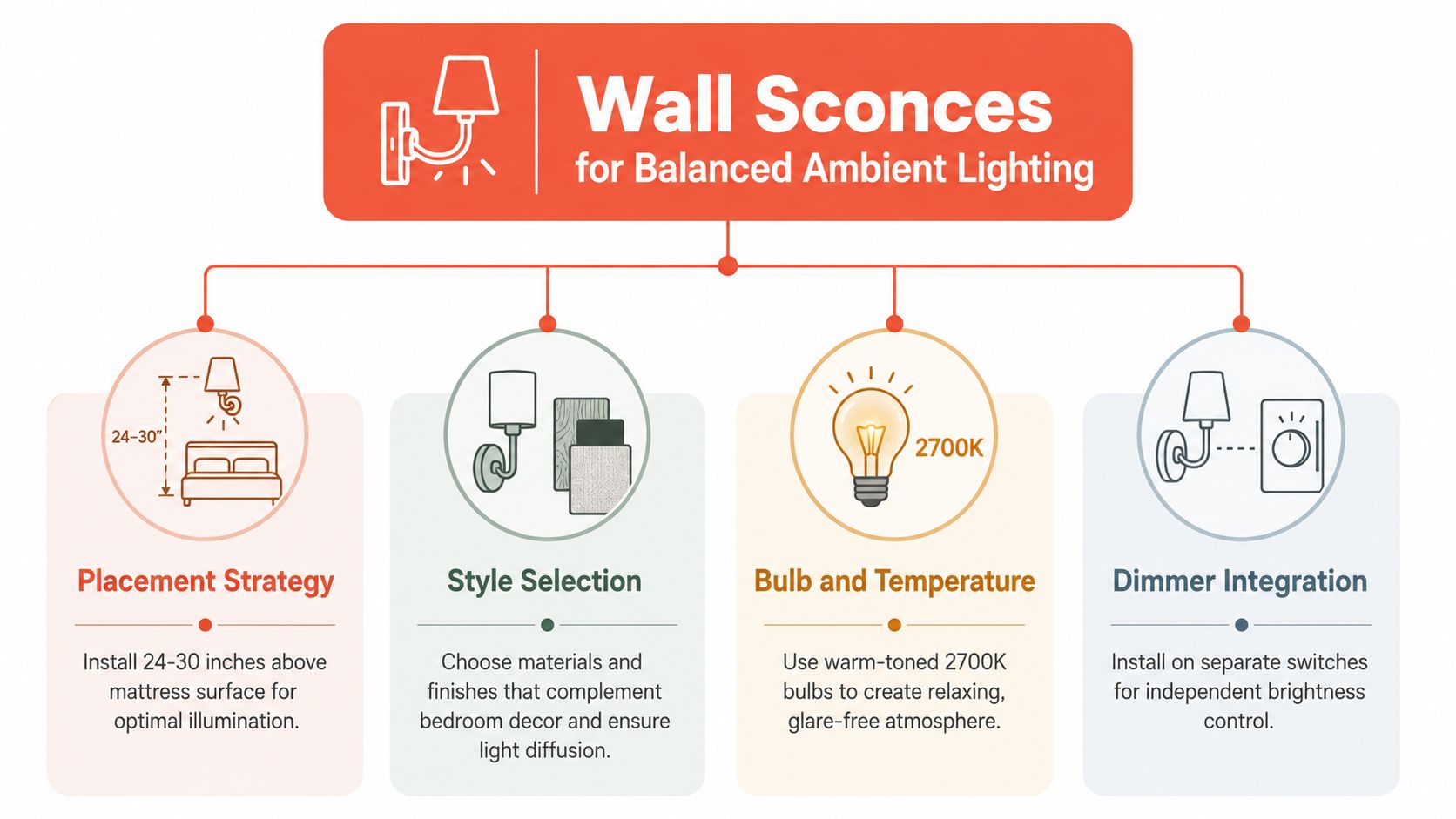
Wall sconces are especially effective when the bed has a defined headboard wall. Mounted on either side, they provide local light without consuming bedside-table space. Their light can wash upward, downward, or through a fabric shade, making them more comfortable than an exposed bulb above the bed.
A Chennai villa with a brass headboard and upholstered wall may suit sculptural sconces. A renovated Mumbai flat might benefit from vintage or mid-century fixtures that add character without requiring a new ceiling layout. The choice should follow the wall architecture and furniture proportions.
Sconce height depends on the headboard and mattress. A practical starting point is to position the fixture around 24 to 30 inches above the mattress surface and roughly 6 to 12 inches above the headboard, then adjust based on the fixture's shade and reading angle. These dimensions come from the project planning brief and should be checked on site because mattress thickness and headboard height vary.
Soft light should reach the book and the wall, not the sleeper's eyes.
Use upward-facing or diffused sconces if the room is mainly for relaxation. A fully exposed downward beam may create a bright patch on the pillow and make the room feel harsher than expected.
Wire before panelling: Wall treatment can make later electrical changes expensive.
Add individual switches: Each person can control their side without disturbing the other.
Choose diffusing materials: Fabric, frosted glass, and perforated metal soften the output.
Check bedside reach: A switch should be usable from bed if the fixture is the main reading source.
Sconces offer a strong balance of function and design. They aren't ideal when the bed position may change frequently, unless the wiring and furniture plan allow flexibility.
5. Layered Ceiling Lights with Multiple Control Zones
A single central light has one major weakness. It can't provide low, comfortable evening light and strong dressing light at the same time without compromise. Layering solves that by combining general illumination with task and accent sources, each controlled separately.
A practical Chennai bedroom might use recessed downlights around the circulation area, a pendant or sconce on each bedside, and a concealed LED strip behind the headboard. A premium apartment could add automated scenes for waking, dressing, reading, and sleep. The benefit isn't the number of fixtures. It's the ability to switch off the layers you don't need.
India's residential lighting guidance recommends 100 to 150 lux for bedroom ambient light, while bedside reading is commonly separated at about 300 to 500 lux in Indian lighting references from the lighting guidance library. That difference explains why one bright overhead fitting often feels uncomfortable for reading.
Plan the controls before the false ceiling and joinery are finalised. The smart false ceiling planning guidance in Chennai is relevant when recessed lights, cove details, switch locations, and electrical routes need to work together.
Ambient zone: Use dimmable ceiling fixtures for general movement and dressing.
Task zone: Give each bedside or wardrobe its own useful light.
Accent zone: Use headboard strips or cove light for low-level evening atmosphere.
Control zone: Keep switches accessible at the entry and, where possible, from the bed.
Test sample fixtures before installation. A drawing may look balanced, but the actual room can reveal glare from a glossy wardrobe, shadows from a tall headboard, or an awkward switch position.
6. Fabric Drum Shade Ceiling Fixtures for Soft Ambiance
A fabric drum shade keeps the familiar central ceiling-light arrangement but makes it less severe. The shade diffuses the bulb, softens shadows, and gives the bedroom a warmer focal point than a basic bare fitting.
This option suits homeowners who don't want a false ceiling or multiple electrical zones. A linen drum shade can work in a Chennai apartment with a classic palette, while a larger villa bedroom may use a patterned or designer shade as a decorative centrepiece. The fixture should still be sized to the room and furniture. An oversized shade can dominate a low ceiling, while a small shade may look lost over a large bed.
Use warm bulbs in the 2700K to 3000K range for a relaxed atmosphere. A dimmer is important because the same fixture may need to support early-morning dressing and low evening light. For larger bedrooms, choose a fitting with adequate bulb capacity rather than relying on one weak source hidden inside a large shade.
The shade also creates a maintenance obligation.
Choose washable fabric: This is more practical in a humid, dusty environment.
Plan cleaning access: Dust reduces the amount of light passing through the material.
Coordinate the colour: The shade changes how the room's wall and bedding colours appear.
Pair with bedside lights: The central fixture alone won't provide comfortable reading light.
For a bedroom with Indian materials, timber detailing, or woven textures, these Indian-style bedroom design ideas can help keep the drum shade connected to the wider interior rather than treating it as an isolated purchase.
7. Track Lighting for Flexible, Directional Illumination
Track lighting earns its place when the bedroom has several points of interest. Adjustable heads can aim at a wardrobe, artwork, textured wall, dressing mirror, or reading chair. That flexibility is useful in a room where the furniture layout may evolve or where fixed downlights would create too many ceiling cut-outs.
It shouldn't usually be the only bedroom light. Multiple spotlights aimed across a room can produce hard pools of brightness and strong shadows, especially against glossy wardrobes or reflective artwork. Use the track as a directional layer, then combine it with a softer ceiling or wall source.
A loft-style apartment might use a slim black track along the wardrobe wall. In a villa, the track could highlight a feature wall or artwork. For a contemporary flat, a simple white or brushed-metal system can blend into the ceiling.
Aim each head carefully. A 45-degree angle can help avoid direct glare and create a more controlled wash, but the final angle depends on ceiling height, furniture, and the beam spread of the selected fitting.
Light the vertical plane: Direct beams toward walls, wardrobes, or artwork instead of the pillow.
Choose warm output: 2700K spotlights keep the system from feeling too commercial.
Check circuit capacity: Multiple heads may need a dedicated electrical provision.
Leave adjustment room: Don't position the track so a wardrobe door or curtain blocks the heads.
Track lighting works best for changing routines. It works poorly when the homeowner wants a uniformly calm, shadow-free ceiling with no visible hardware.
8. Smart Light Bulbs with Colour Temperature Adjustment
Smart bulbs offer a practical upgrade when the fixture already exists but the control is inadequate. You can adjust brightness and colour temperature through an app, voice control, or programmed scene, depending on the bulb and system. That makes them particularly useful in renovations where opening the ceiling for new wiring isn't desirable.
A bedroom can use warmer light for winding down and a brighter setting for morning tasks. India-facing bedroom guidance often recommends 2700K to 3000K for evening use, while smart systems may provide cooler settings for active tasks. The key is not to keep the room bright and cool late at night just because the bulb can do it.
Start with the fixture that causes the most inconvenience. In a rental, that may be a central pendant or floor lamp. In a new apartment, you can test the ecosystem before specifying smart switches across the whole home.
Check compatibility: Confirm the bulb fits the socket and works with the chosen app or voice platform.
Protect manual control: A smart bulb needs continuous power, so a wall switch that cuts power can make it appear unavailable.
Plan for connectivity: Test Wi-Fi or Bluetooth performance in the bedroom.
Create useful scenes: Separate morning, reading, evening, and night settings instead of using one complicated routine.
Keep a fallback: Manual control should remain possible if the app or network fails.
Smart bulbs add convenience, but they won't correct bad fixture placement. A glare-producing downlight will still be uncomfortable when dimmed or colour-adjusted.
9. Cove Lighting for Indirect Ambient Glow
Cove lighting hides the light source in a ledge, recess, or false-ceiling perimeter and lets the ceiling or wall reflect the glow. Because the source isn't directly visible, the room feels softer and more architectural. This approach suits premium residences where the ceiling is being designed as part of the interior rather than treated as a surface for fixtures.
The trade-off is installation complexity. Cove lighting needs a carefully built recess, accessible drivers, clean junctions, and a ceiling profile that doesn't make the room feel lower. It also needs a functional layer. Cove light is excellent for ambience, but it won't adequately illuminate a wardrobe, dressing mirror, or reading book on its own.
A Chennai upscale flat might use a perimeter cove with recessed downlights near the wardrobe. A villa could extend the cove around a larger master-bedroom ceiling, with dimming that allows the perimeter glow to remain on at a very low level.
Use continuous, diffused LED output rather than exposing individual points. The cove should look like an even wash across the ceiling, not a dotted line of bright sources.
Design before construction: The recess dimensions and wiring route must be agreed with the false-ceiling contractor.
Provide maintenance access: Drivers and strips eventually need inspection or replacement.
Use warm white: 2700K supports a calm evening atmosphere.
Add independent dimming: Cove light should be controllable without switching on the brighter functional layer.
Keep the bed glare-free: The reflected glow should reach the ceiling, not shine directly toward the pillow.
For a fuller bedroom scheme, combine cove lighting with recessed lights or sconces, especially around the bed and wardrobe.
10. Skylights or Roof Lights for Natural Daylight Integration
Natural daylight can make a bedroom feel larger and reduce the need for artificial light during the day. Skylights and roof lights are most realistic in villas, top-floor apartments, and new construction where roof access, structure, and waterproofing can be addressed properly.
A fixed roof light may bring daylight into a dark bedroom, while an operable model can add ventilation. Both need careful solar control in Chennai. Direct sun can create heat, glare, and fading, so the opening should be paired with a blackout shade and appropriate glazing rather than treated as a decorative window in the ceiling.
The installation details matter more than the image in a design catalogue. Waterproof flashing, insulation, UV protection, and structural coordination all affect the long-term result. A roof opening that leaks or overheats the room defeats the purpose of an otherwise beautiful daylight strategy.
Control daytime brightness: Use motorised or manual blackout shades where the room is used for daytime sleep.
Manage heat: Select thermally insulated, UV-filtering glazing suited to a tropical climate.
Coordinate structure: A structural engineer should review the roof before cutting or framing an opening.
Protect privacy: Check sightlines from neighbouring buildings and upper terraces.
Retain artificial layers: Daylight disappears at night, so keep a dimmable ambient source and bedside lighting.
In a Chennai villa, a skylight above a circulation zone or near the dressing area may be more practical than positioning it directly over the bed. For planning bedrooms with connected spaces, review this bedroom with attached bathroom plan alongside the daylight and privacy strategy. You can also explore these natural light solutions for bedrooms for broader design references.
Top 10 Bedroom Ceiling Light Ideas Comparison
Item | 🔄 Implementation Complexity | ⚡ Resource Requirements | 📊 Expected Outcomes | 💡 Ideal Use Cases | ⭐ Key Advantages |
|---|---|---|---|---|---|
Recessed Ceiling Lights with Dimming Capability | High, requires ceiling cavity, professional wiring and placement planning | Moderate–High, recessed fixtures, dimmers, electrician | Even, minimalist ambient light with adjustable mood control | Apartments with sufficient ceiling depth; modern minimalist bedrooms | Seamless ceiling integration; uniform illumination; supports dimming |
Pendant Lights Over Bedside Areas | Medium, wiring and careful height/placement needed | Low–Medium, pendant fixtures, canopy, electrical connection | Focused bedside task lighting and decorative impact | Small bedrooms, bedside-area lighting where table space is limited | Space-saving; targeted light; strong design statement |
LED Strip Lighting Behind Headboards | Low, adhesive strips, simple electrical feed; often DIY-friendly | Low, LED strips, driver, optional controller/smart hub | Indirect accent/mood lighting; energy-efficient and color-customizable | Rentals, DIY upgrades, layered lighting behind headboards | Flexible installation; low power use; easy smart integration |
Wall Sconces for Balanced Ambient Lighting | Medium, requires wall wiring or hardwiring during renovation | Moderate, sconces, wiring, electrician for flush installs | Soft, glare-free ambient light; symmetrical architectural effect | Flanking beds or feature walls; any ceiling height | Frees nightstand space; balanced, glare-reduced illumination |
Layered Ceiling Lights with Multiple Control Zones | High, coordinated design, multiple circuits and controls | High, multiple fixtures, dimmers, smart control systems | Maximum flexibility for activities; energy-efficient when zoned | Multifunctional or larger bedrooms; luxury renovations | Versatile scenes; circadian-supporting control; adaptable over time |
Fabric Drum Shade Ceiling Fixtures for Soft Ambiance | Low, simple ceiling mount similar to standard fixtures | Low, single fixture and bulbs | Warm, diffused general illumination suitable for relaxation | Traditional or transitional bedrooms preferring central light | Affordable; flattering soft light; easy to replace or update |
Track Lighting for Flexible, Directional Illumination | Medium, track mounting and wiring; positioning planning | Moderate, track kit, multiple adjustable heads | Directional task/accent lighting with reconfigurable aim | Highlighting artwork, wardrobes, or changing furniture layouts | Highly adjustable; easy to re-target light without major rewiring |
Smart Light Bulbs with Color Temperature Adjustment | Low, screw-in retrofit but requires app/setup and connectivity | Low–Medium, smart bulbs, reliable WiFi or hub | Tunable color temps and schedules; supports circadian routines | Renters, phased upgrades, tech-forward households | No rewiring; app/voice control; scheduling and scene presets |
Cove Lighting for Indirect Ambient Glow | High, needs architectural cavity or false ceiling integration | High, hidden LED strips, drivers, ceiling/contractor work | Soft, shadowless indirect glow that feels luxurious and calming | Bedrooms with false ceilings or custom architectural details | Clean architectural lines; zero-glare ambient light; premium feel |
Skylights or Roof Lights for Natural Daylight Integration | Very High, structural work, waterproofing, possible permits | Very High, skylight units, structural modification, installer | Significant daylighting, mood and circadian benefits; reduced daytime electric use | Top-floor apartments, villas with roof access, daylight-focused designs | Natural light source; improved well-being; potential ventilation option |
Choose a Layered Plan That Fits the Room
The best choice depends on the room you're building, not on the most impressive fixture in a catalogue. For a compact Chennai apartment with a modest ceiling, a dimmable flush or recessed ambient source, paired with bedside sconces or pendants, usually gives better control than a large decorative fitting. For a villa or premium residence with a false ceiling, cove lighting can add a refined evening layer, but it should still be supported by functional light around the wardrobe and dressing areas.
Start with one reliable foundation. A dimmable ambient ceiling light should provide comfortable general illumination without placing glare directly over the pillow. India-focused guidance places bedroom ambient lighting around 100 to 150 lux, while task areas such as bedside reading require a higher level, around 300 lux, according to this home lighting guide for Indian rooms. That difference is why a separate bedside layer is more useful than increasing the brightness of the central fixture.
Add task lighting where your routines happen. Use pendants or sconces for reading, directional light near wardrobes and mirrors, and a low-level strip or cove layer for winding down. Keep each role on an independent switch or dimmer. A smart bulb can improve control in an existing fixture, but it won't fix a badly positioned fitting or replace proper electrical planning.
Before finalising, check:
Ceiling depth: Confirm whether recessed fittings and cove details can be installed without reducing the room's usable height.
Furniture placement: Mark the bed, wardrobe, dressing area, and reading chair before locating fixtures.
Wiring routes: Plan switch lines, drivers, and junction boxes before drywall, panelling, or false-ceiling work.
Glare and heat: View each fitting from the pillow and check whether glossy finishes reflect the light.
Maintenance: Keep drivers, strips, shades, and controls accessible for cleaning and replacement.
Blackout needs: Pair skylights and strong daylight with shades if the bedroom supports daytime sleep.
Daily control: Put switches where people enter, dress, read, and lie down.
Lighting and electrical coordination are easier when they happen alongside space planning, wardrobes, beds, and ceiling design. Interiors by DeX works on apartments, villas, and premium residences in Chennai, with services covering space planning, lighting coordination, false-ceiling additions, renovation, modular detailing, site execution, installation, and handover. That end-to-end approach can be useful when a bedroom renovation or new interior project needs one accountable team rather than separate vendors solving disconnected parts of the room.
If you're planning a Chennai bedroom renovation or new home interior, Interiors by DeX can coordinate the ceiling lighting, electrical layout, false ceiling, furniture placement, and execution as one residential project. Visit the team to discuss your room plan, preferred lighting roles, and the practical constraints of your apartment or villa.