DE X INSIGHTS
Iron Wardrobe Design for Chennai Homes

A Chennai bedroom can look perfectly organised in the showroom and become difficult to use after one wet season. A shutter starts rubbing against the floor, a hinge loosens, clothes are packed into shelves that are too shallow, and a faint rust mark appears near the back panel where the wall stays damp. In another home, plywood edges swell while a steel cupboard remains structurally sound, but its doors feel dated and its interior wastes valuable space.
That contrast explains why iron wardrobe design is receiving fresh attention. The useful question isn't whether iron looks modern. It's whether the material, finish, structure, shutter system, and internal layout suit your room, your clothes, and Chennai's humidity. We'll work through those decisions in practical steps, starting with what people mean when they say “iron wardrobe”.
Why Iron Wardrobes Are Back on the Radar
In a Mylapore flat or an apartment along OMR, storage has to cope with more than clothes. It shares walls with bathrooms, sits close to windows, and often occupies a tight passage where a wide hinged door can interrupt movement. During humid weather, the room may have limited air circulation, especially when the wardrobe is pushed tightly against an external wall.
That doesn't automatically make iron the right choice. Bare iron rusts, but a properly prepared and coated steel wardrobe can provide a more suitable structure for high-use storage than a poorly protected cabinet. Indian guidance on steel corrosion explains that protection depends on separating the metal from moisture and oxygen, while good detailing prevents water from collecting at joints and edges. The INSDAG guidance on corrosion prevention is useful because it treats coating and detailing as part of the system, not as decorative afterthoughts.
Why the material suits compact rooms
A metal carcass can support slim partitions, integrated shelves, and sliding shutters without relying entirely on thick boards. That helps in apartments where every bit of floor clearance matters. A sliding wardrobe can sit beside a bed or near a corridor without needing a large swing zone, although its track still needs careful cleaning and alignment.
Iron wardrobes also fit current modular planning. A homeowner might combine a full-height wardrobe with a loft, a fluted shutter, a side study desk, or a compact dressing corner. The frame can be fabricated around a pillar or awkward alcove instead of forcing the room to follow a standard catalogue module.
The market is moving beyond the old image of the plain steel almirah. Reporting on Indian metal furniture describes slim profiles, powder-coated finishes, internal customisation, and mirror integration, while also noting that metal furniture is projected to grow at a 13.73% CAGR through 2031. The Indian steel almirah market snapshot places that growth in settings where durability and low maintenance matter.
Practical rule: Treat “iron wardrobe” as a starting label, not a complete specification. Ask what metal, what thickness, what treatment, and what shutter hardware you're actually paying for.
A basic mild-steel box, a galvanised cabinet, and a designer powder-coated wardrobe may all be sold under the same name. Their rust resistance, weight, finish quality, and repair options can differ substantially. That distinction will matter more than the colour you select.
What Iron Wardrobe Design Actually Means
The word “iron” creates confusion because furniture sellers often use it for several different materials. Wrought iron is shaped for decorative work and is more commonly associated with gates, grills, and furniture details than with a complete wardrobe carcass. Mild steel is the usual fabrication material for practical storage units because it can be cut, bent, welded, and finished in local workshops.
Galvanised steel has a zinc coating that provides an additional layer of corrosion protection. That makes it useful where humidity is difficult to control, including coastal rooms. Stainless steel resists corrosion well but is usually chosen selectively because its cost, appearance, and fabrication requirements differ from ordinary mild-steel furniture. A quotation should name the material rather than merely say “iron”.
Reading the specification sheet
Start with the primary load paths. Indian furniture specifications commonly use 14 to 16 gauge mild-steel frames with electrostatic powder coating of about 60 to 80 microns for durable storage furniture. The Indian hostel furniture specification reference connects section sizing and coating to practical performance in storage furniture.
Gauge is easy to misunderstand. The number should be read together with the supplier's actual sheet thickness and intended use, because different fabricators may describe panels and frame sections separately. A thin shutter panel may be acceptable if it has proper folds and support, while a long shelf or hanging-rail support needs a stiffer section.
Material | Typical Gauge | Corrosion Behaviour | Best Use |
|---|---|---|---|
Mild steel | 14 to 16 gauge for primary frame members | Needs surface preparation and a protective coating | Main carcass, shelves, rails, and custom storage |
Galvanised steel | Confirm the base section and zinc treatment in the quotation | Zinc offers sacrificial protection when the surface remains intact | Humid rooms and coastal-facing locations |
Stainless steel | Confirm the specified grade rather than accepting a generic label | High corrosion resistance, subject to grade and fabrication quality | Selected exposed details or specialist applications |
Wrought iron | Usually a decorative specification rather than a standard cabinet material | Depends heavily on preparation and protective finish | Decorative frames, handles, and feature elements |
A thicker panel is less likely to dent near the floor when footwear, vacuum cleaners, or luggage makes contact. A well-finished welded joint is less likely to create an early rust bloom than a rough seam with exposed scale. Powder coating is generally preferred to ordinary liquid paint because it creates a more uniform, durable skin, but it still fails if the steel wasn't cleaned and pre-treated first.
For a Velachery bedroom or an ECR-facing flat, pay special attention to cut edges, welded corners, screw holes, and the rear panel. These are the places where moisture can reach the metal. The finish system matters more than the word “iron” on the quotation.
Iron Wardrobes Compared With Wood Based Options
A Chennai homeowner usually chooses between several materials, not between one perfect wardrobe and one poor alternative. Plywood, MDF, particle board, and iron can all create useful storage. Their performance depends on the room, the edge treatment, the quality of installation, and how much weight the internal layout carries.
Plywood generally offers a familiar finish and is easy for carpenters to modify. Its vulnerable points are exposed edges, cut-outs, and areas close to damp walls. MDF can produce smooth painted shutters, but long shelves may sag if they aren't supported properly. Particle board can be economical and tidy when kept dry, yet repeated screw removal and refitting can weaken its holding power.
Iron behaves differently. A coated steel frame doesn't absorb water in the same way board materials do, and a welded joint can often be repaired on site rather than replaced as a complete panel. The trade-off is weight. Installation may require more planning, and a badly designed metal cabinet can feel harsh, noisy, or difficult to adjust.
A side-by-side decision
Consideration | Plywood | MDF | Particle board | Coated iron or steel |
|---|---|---|---|---|
Humidity response | Protect edges and keep away from persistent damp | Vulnerable to swelling and sagging when exposed | Needs careful sealing and dry conditions | Depends on pre-treatment, coating, joints, and floor contact |
Repairs | Panels can often be replaced or modified | Damaged edges can be difficult to repair cleanly | Screw holes may lose grip after repeated work | Welds, brackets, and panels may be patched or replaced |
Finish choice | Veneer, laminate, paint, and other surface treatments | Smooth paint-ready surface | Laminate-led finish options | Powder coat, textured finishes, mirror, glass, and selected prints |
Installation | Familiar to most modular teams | Usually straightforward | Usually straightforward | Heavier, with greater attention needed for alignment |
Relocation | Panels may be dismantled, depending on construction | Can chip during movement | Can break at joints | Heavy, but a durable frame may tolerate relocation better |

A wardrobe beside a bathroom wall may favour a well-sealed metal system, while a dry room with a strong preference for warm veneer may make plywood attractive. Durability isn't only a material decision. It also comes from shelf spans, fasteners, ventilation, edge protection, and the skill of the installer.
Don't assume a steel cabinet will always last because it feels heavy. A rough weld, unsealed cut edge, or poor roller can create maintenance trouble. Likewise, don't reject wood-based storage because one swollen panel failed. Compare the complete build, the room conditions, and the service arrangement.
Design Styles and Finishes That Work in Chennai
A shutter style should solve a room problem before it creates a visual effect. In a narrow bedroom, hinged shutters need clear swing space and comfortable access to the full interior. Sliding shutters reduce that swing zone, but the tracks need to stay clean and the overlap can make one portion of the wardrobe less immediately accessible.
Mirrored shutters help bounce available light in a compact or darker room. They also add a dressing function without requiring a separate full-height mirror. Keep the mirror away from a wall that regularly collects condensation, and specify secure backing and edge protection rather than treating the mirror as a simple decorative insert.
Match the finish to the room
Louvered shutters can support a lighter visual expression and may assist airflow where the interior needs it, but the openings also collect dust. Fluted shutters hide fingerprints and add texture, while a matte powder coat can reduce glare in a room with strong daylight. Gloss finishes reflect more light but show marks and surface irregularities more clearly.
Wood-look transfer finishes can soften the appearance of a metal carcass. Patina-style finishes create an intentionally aged effect, but they shouldn't be confused with uncontrolled rust. Ask whether the patina is a sealed decorative finish and how the supplier will repair a scratched area.
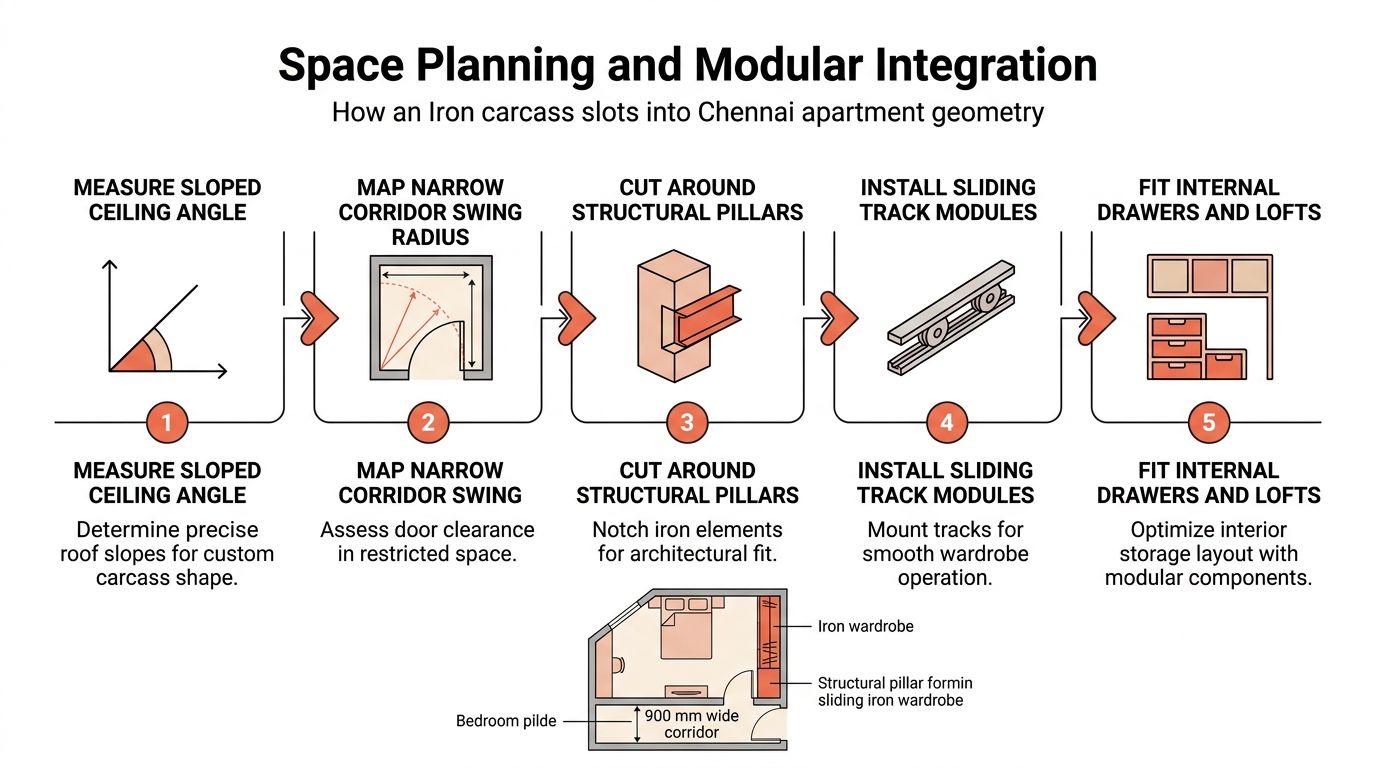
The shutter also changes the carcass plan. A sliding system may need a track zone and overlapping panels. A hinged system needs a swing calculation around the bed, side table, and corridor. A fluted shutter beside a window may catch changing light beautifully, while the same texture in a dim dressing corner may make the unit feel visually heavy.
Think beyond the front elevation
The side panel can become a study surface, open shelf, or mirror return. A loft can hold luggage and seasonal items without placing daily clothes above eye level. In a rental or resale home, neutral powder-coat colours and replaceable hardware may be more practical than a highly specific decorative treatment.
Choose the shutter after measuring the room, not before. A beautiful finish won't compensate for a door that hits the bed or a mirror positioned where it constantly collects marks.
Space Planning and Modular Integration
The most efficient iron wardrobe starts with a measurement exercise. Record the wall length, ceiling height, skirting depth, electrical points, window trim, beam drops, and the path from the bedroom door to the bed. In Chennai apartments, a wardrobe may need to work around a structural pillar, a sloped ceiling, or a narrow corridor that wasn't obvious in the floor plan.
A sliding system can reclaim the area needed for door swing, but it doesn't make the entire room available. Leave enough working space to pull drawers out, stand at the hanging section, and remove clothes without blocking the circulation route. Floor-to-ceiling planning can use the upper zone for suitcases, festive textiles, blankets, or less frequently accessed items.
Plan for the Indian textile mix
A wardrobe for an Indian household can't be planned only around shirts and trousers. The storage-planning guidance for Indian homes notes that households may hold 30 to 40% more textile, festive, and religious items than western reference homes. The India-focused storage planning guide highlights why sarees, lehengas, sherwanis, and occasion wear need deliberate zones rather than leftover shelf space.
Separate the interior by frequency of use:
Daily wear: Place frequently used folded clothes and hanging items between comfortable hand and eye level.
Long hang: Reserve uninterrupted height for sarees, dresses, sherwanis, and other garments that shouldn't be folded repeatedly.
Occasion wear: Use protected shelves or drawers for festive clothing, with enough depth to prevent careless compression.
Small items: Add drawers or divided trays for accessories, innerwear, jewellery, and folded garments.
Seasonal storage: Use lofts for items that aren't part of the weekly routine, but label the zones so the loft doesn't become an unplanned dump.
A 2-foot bay, a 3-foot bay, or a 4-foot run shouldn't be promised as a fixed clothing capacity without knowing the shelf spacing, garment thickness, and user habits. One household may need more long-hang space, while another needs deeper folded storage for sarees and bedding. The correct unit is not the number of bays. It's the number of usable storage actions the household performs.
For a corner or bay window, use return panels and short shelves rather than forcing a deep rectangular box into the alcove. A slim iron partition can separate a study desk from the wardrobe without making the room feel fully divided. If you need a reference for organising these zones, this guide to planning wardrobe internals for Chennai living offers a useful planning direction.
A wardrobe can also influence nearby doors and passages. If you're comparing how folding openings affect circulation, this overview of modern bifold door designs provides useful visual context, even though a wardrobe may use a different hardware system.
Durability, Humidity, and After-Sales Reality
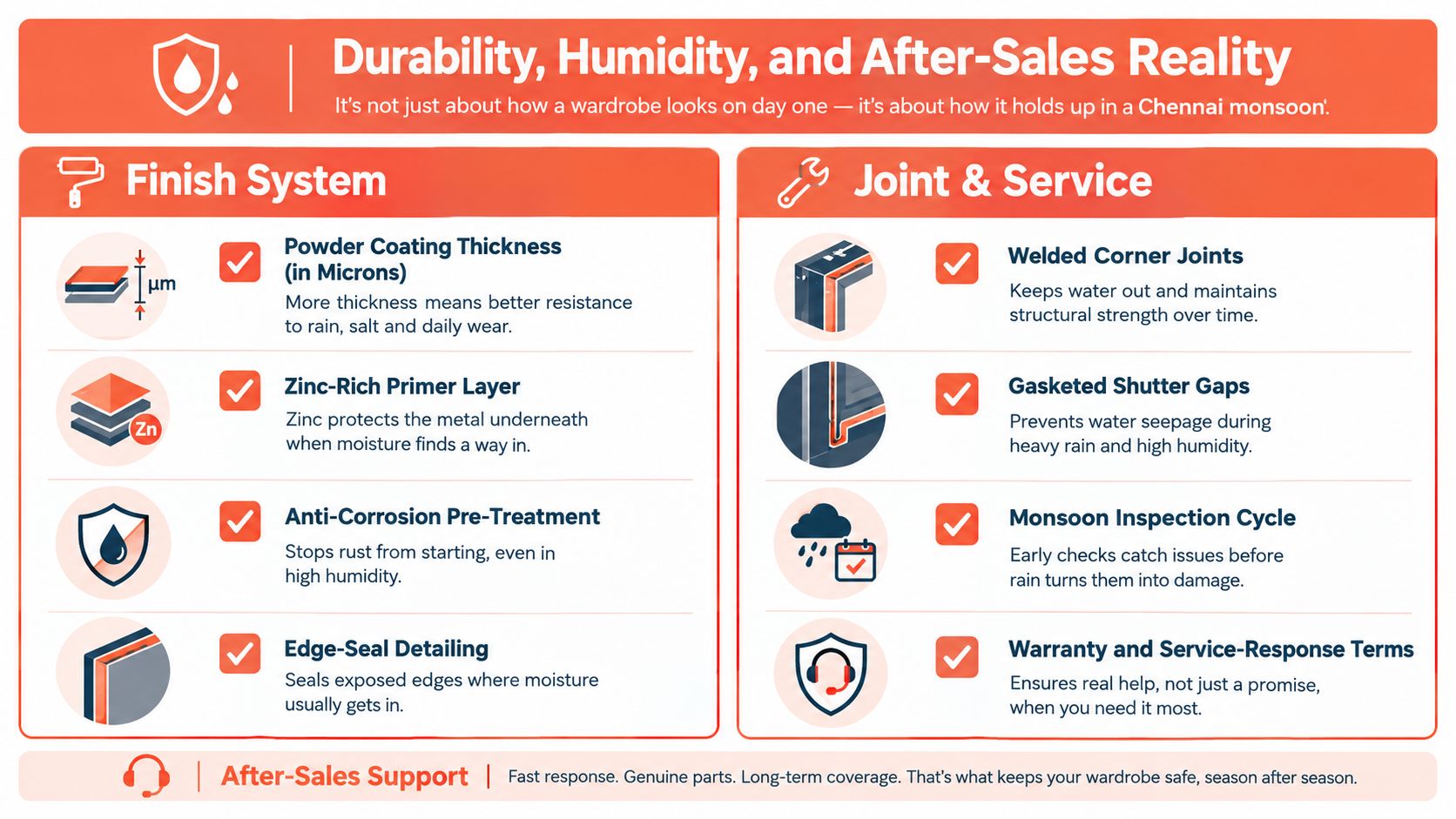
The wardrobe's survival in Chennai depends more on its invisible edges and joints than on the front finish you choose. A matte black shutter and a wood-look shutter can perform similarly if the steel preparation, coating, weld cleanup, and installation are comparable. They can perform very differently if one unit has exposed cut edges and the other has properly sealed details.
Powder coating should be specified as part of a complete finish system. Confirm surface cleaning, pre-treatment, coating thickness, and how the fabricator will protect the finish during transport. A zinc-treated substrate can add sacrificial corrosion protection, which is particularly relevant in humid or coastal locations. The Indian corrosion-prevention guidance also stresses drainage, air gaps, and the avoidance of moisture-trapping joints.
Inspect the parts buyers rarely see
At handover, open every shutter slowly. Listen for scraping, check whether the doors remain aligned, and inspect the lower corners with a torch. Tap the panels lightly to find loose sections, look at weld seams, and check whether the back panel allows sensible air movement without leaving clothes exposed to dust.
Floor contact deserves special attention. A metal leg or base should not sit in a place where water from mopping remains trapped. Cut edges around handles, hinges, vents, and fasteners need a protective treatment. If the wardrobe is against a damp wall, a small planned gap can be more useful than pushing the cabinet tightly against the surface.
Hardware also needs its own warranty conversation. Hinges, drawer channels, sliding rollers, soft-close mechanisms, and mirror fittings experience different loads. Ask which parts the fabricator will replace, whether the service team handles alignment, and how quickly a reported issue receives an inspection.
Before handover: Take photographs of the rear, base, welds, shutter gaps, and hardware. These records make future service conversations clearer.
A climate-aware contract should state what happens if coating damage, rust, roller failure, or door misalignment appears after installation. It should distinguish manufacturing defects from damage caused by drilling, flooding, or harsh cleaning. For broader low-maintenance material thinking, this guide to material choices for low-maintenance interiors can help you compare the wardrobe with adjacent finishes.
The practical question isn't whether a vendor promises a “rust-proof” wardrobe. Ask what protection has been applied, where it ends, and who will repair the first failed joint.

Cost, Customisation, and Common Misconceptions
The idea that iron wardrobes are always cheaper sounds logical because metal can be fabricated in straightforward box forms. It becomes less reliable once you add high-quality coating, galvanisation, mirror panels, soft-close hardware, custom drawers, fluting, lofts, delivery, and installation. A low quotation may also hide a thinner section, fewer internal supports, or a finish that wasn't designed for humid conditions.
Don't compare only the material rate. Compare the complete specification: carcass sections, shutter construction, shelf supports, hardware brand, coating process, edge sealing, transport, installation, and service terms. A simple hinged cabinet and a full-height sliding wardrobe with integrated lighting belong to different cost categories even if both are called iron wardrobes.
Customisation has structural consequences
CNC-cut fluting and laser-etched patterns can create a distinctive front, but every cut-out needs proper finishing. Mixed glass-and-metal shutters add visual lightness, though they introduce glass handling and replacement considerations. A loft built around the actual ceiling height may be more useful than a standard top box, especially where beams or ducts interrupt the upper wall.
Hidden costs appear during value engineering:
Joint quality: Poorly cleaned welds can become rust initiation points.
Gauge substitution: A cheaper section may dent, flex, or lose alignment sooner.
Track replacement: Uncommon rollers can be difficult to source later.
On-site welding: Repairs inside an occupied apartment create dust, access, and repainting work.
Internal omissions: A low price may exclude drawers, dividers, pull-down rails, or protective liners.
Budgeting principle: Ask what the wardrobe will cost to maintain, adjust, and use, not just what it costs to install.
A proper comparison with a mid-range plywood system should include finish repair, relocation, hardware replacement, and the value of usable internal storage. A wooden wardrobe may offer easier local modifications, while a metal system may provide a more durable carcass in the right conditions. Neither material removes the need for precise measurement and good workmanship.
Before signing, organise the decision alongside electrical, painting, flooring, and other renovation choices. A 10-step home remodeling checklist for 2026 can help place wardrobe work within the wider project sequence. For custom storage planning, custom-built wardrobe guidance is another useful reference point.
Choosing the Right Iron Wardrobe for Your Home
Start with the room, not the catalogue image. Identify the wall that stays driest, measure the circulation path, mark windows and sockets, and note whether the wardrobe will sit beside a bathroom, external wall, or air-conditioning unit. Then decide whether hinged or sliding shutters provide the most usable access.
Next, divide the interior according to real clothing behaviour. Give long garments uninterrupted hanging space, keep folded daily wear within easy reach, reserve drawers for small items, and assign loft storage to occasional textiles. If two people share the wardrobe, separate their zones before selecting the exterior finish. This prevents a visually minimal unit from becoming an overcrowded one.
A practical pre-purchase checklist
Confirm the metal. Ask whether the carcass is mild steel, galvanised steel, stainless steel, or another specified material.
Check the structure. Request the gauge and section details for frames, shelves, hanging supports, and shutter members.
Specify the coating. Record the pre-treatment process and powder-coating thickness. Durable storage specifications commonly refer to about 60 to 80 microns of electrostatic powder coating. This Indian furniture specification reference provides useful context for that range.
Inspect the edges. Confirm that cut edges, welded corners, screw holes, and floor contact points receive corrosion protection.
Test the hardware. Open and close shutters repeatedly. Check rollers, hinges, channels, handles, soft-close movement, and noise.
Review the interior. Measure shelf spans and ask where supports prevent deflection. Hanging rails should be fixed to a structure designed for their expected load.
Ask about coastal conditions. Get the treatment and service response in writing if the home is exposed to salt-laden air or persistent humidity.
Examine a sample joint. Don't rely only on a shutter sample. Look at a corner, weld, rear panel, base, and edge detail.
Clarify handover. Confirm installation alignment, cleaning instructions, touch-up material, warranty coverage, and the process for reporting faults.
Compare the whole proposal. Assess usability, serviceability, finish quality, and lifecycle cost alongside the invoice.
A professional consultation is valuable when the wardrobe needs to work around pillars, sloped ceilings, compact passages, integrated desks, or culturally specific textile storage. The right solution may still be plywood, a hybrid system, or a coated steel carcass. What matters is that the decision follows the room's humidity, geometry, and daily use rather than a material trend.
If you're planning a Chennai apartment, villa, or renovation, Interiors by DeX can help with wardrobe planning, custom storage, modular detailing, installation, and handover. Share your room measurements, textile storage needs, preferred shutter style, and humidity concerns so the design can be developed around how your home works.