
You're standing in a Chennai kitchen showroom, running your hand over a spotless white countertop and imagining an organised, modern cooking space. Six months later, the same surface may be dealing with turmeric, tamarind, mustard oil, hot tadka, pressure-cooker steam and the dampness that comes with coastal weather. The showroom sample tells you how the material looks. Your cooking routine decides whether it remains practical.
The right kitchen top materials choice depends on more than colour and price. Granite, quartz, solid surface, laminate, wood and stainless steel each respond differently to heat, stains, scratches, moisture and installation quality. This guide gives you the advice I'd give during a Chennai site visit, before a fabricator cuts the first slab.
Why Kitchen Top Materials Matter in Chennai Homes
A homeowner in a Velachery apartment may fall for a clean white quartz top because it looks bright, smooth and expensive. That choice can still work well, but only if the household uses trivets, wipes spills promptly and accepts that compact counters receive more abuse than a large showroom island. A hot dosa tawa, a splash of turmeric gravy and wet utensils placed beside the sink create a very different test from a staged display kitchen.
Chennai's humidity adds another layer. The countertop itself may perform well while the cabinet base, edge joint or sink cut-out begins to absorb moisture. In a compact two-bedroom apartment, the worktop often serves as a preparation zone, appliance platform, breakfast ledge and temporary storage surface at the same time. There's little spare space, so people place hot vessels and wet grinders wherever the workflow allows.
Practical rule: Choose the surface for your busiest cooking day, not your quietest weekday.
The Indian countertop category is already a substantial and expanding market. India's countertop market generated USD 11,861.5 million in 2024 and is projected to reach USD 25,071.0 million by 2033, with an 8.7% CAGR from 2025 to 2033, according to Grand View Research's India countertop market outlook. Granite led revenue in 2024, while engineered quartz was the fastest-growing material segment. That combination reflects what I see locally: granite remains the trusted workhorse, while quartz is gaining ground among homeowners seeking a cleaner, more uniform finish.
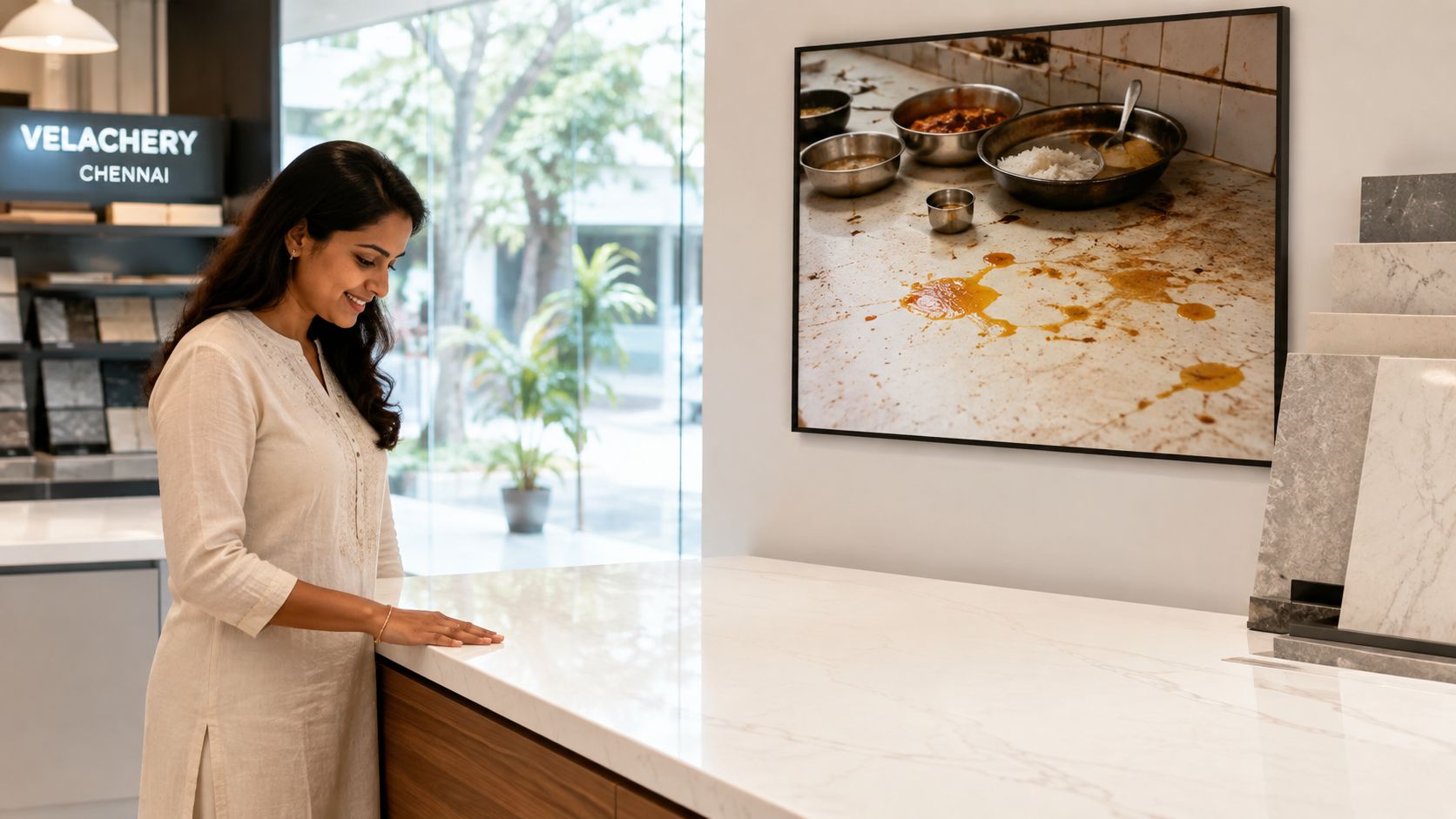
The real Chennai test
A surface that looks beautiful but demands constant caution can become irritating in a busy home. Conversely, a darker granite with natural variation may hide everyday marks and tolerate direct heat more comfortably, even if it lacks the polished showroom uniformity of quartz.
The most useful decision usually balances stain resistance, heat tolerance and maintenance discipline. If a material fails one of those tests, the installation team must compensate through layout, protective accessories or a different material in a separate zone. For further ideas on finishes that reduce upkeep across a home, see these low-maintenance interior material choices.
Overview of Popular Kitchen Top Materials
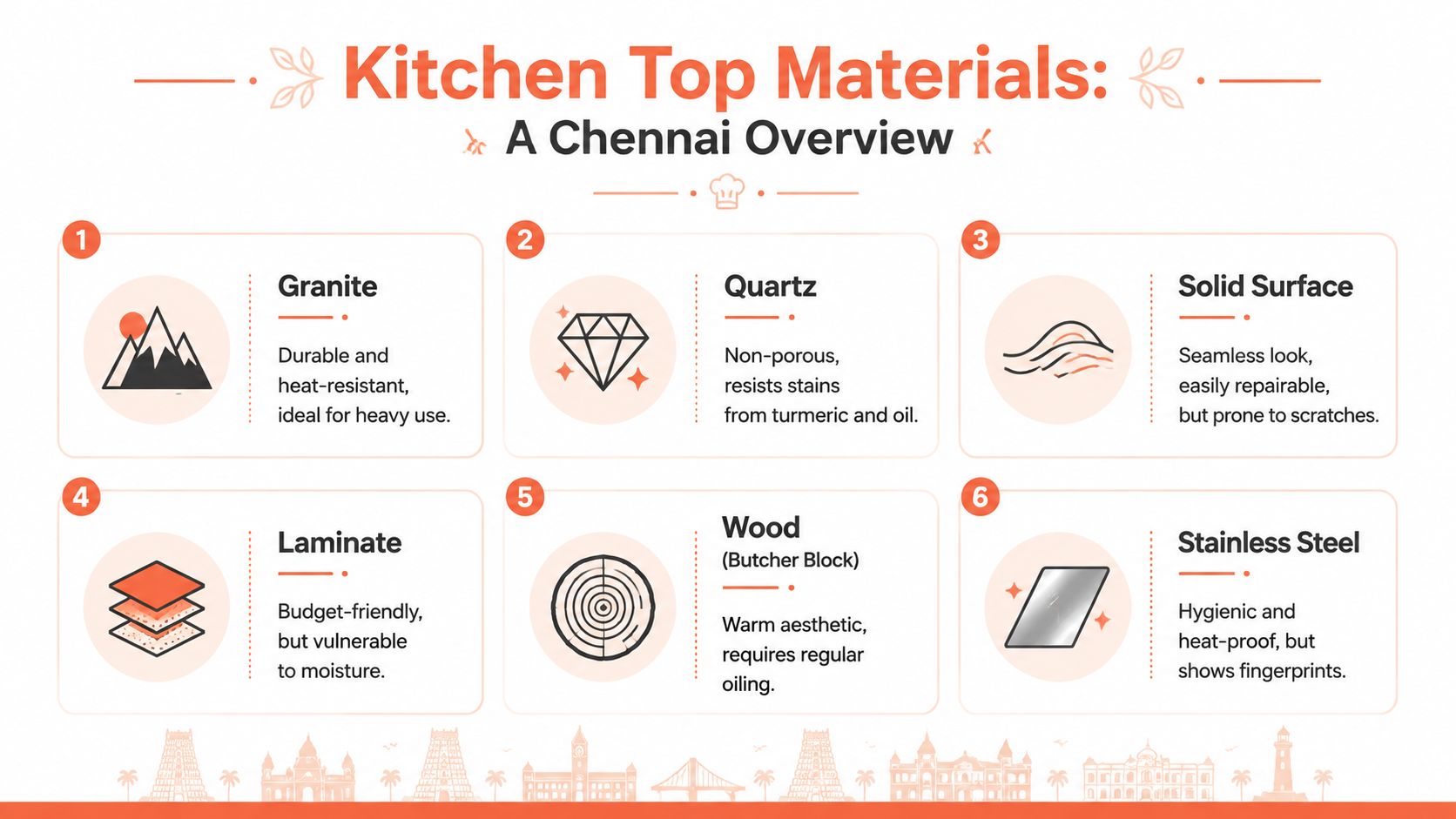
Chennai kitchen studios mainly present six practical countertop families. They differ not only in performance, but also in how they reach your home and which fabricators can work with them confidently.
Material | What it is | Typical local thickness | Chennai site impression |
|---|---|---|---|
Granite | Natural stone slab | Usually 18 to 20 mm | Varied, solid and familiar |
Engineered quartz | Crushed quartz bound with resin | Commonly around 20 mm | Uniform, contemporary and refined |
Solid surface | Repairable, thermoformable sheet | Sheet-based specification | Seamless and sculptural |
Laminate | Decorative sheet bonded to a board base | Board-dependent | Affordable and design-flexible |
Wood | Pre-oiled timber or butcher block | Custom plank thickness | Warm and furniture-like |
Stainless steel | Custom-fabricated metal unit | Fabricated to the support frame | Professional and hygienic |
Granite is natural stone, and local fabricators handle it routinely. It arrives as a heavy slab, then gets cut, polished and edge-profiled for the sink, hob and corners. Granite gives a kitchen visual weight and tolerates high heat well. Don't assume every granite behaves identically, though. Porosity varies, and sealing quality still matters.
Engineered quartz combines crushed quartz with resin. India-focused guidance describes it as roughly 90% to 95% crushed quartz, with a non-porous finish that resists turmeric, oil and food spills without routine sealing, as explained in this India countertop comparison. Quartz slabs are heavy and need professional transport, cutting and installation. It's also not the same as natural quartzite. Quartzite is a natural stone, while engineered quartz is factory-manufactured.
Solid surface, including Corian-type products, comes in sheets that can be joined with inconspicuous seams and thermoformed into curves or integrated sinks. Experienced kitchen fabricators can create a very clean result, but specialised installers are preferable for complex shapes. It looks soft and continuous, although scratches and heat marks need realistic expectations.
Laminate is a decorative sheet bonded to a plywood or board base. It's lightweight compared with stone, economical and available in many colours and patterns. Local carpenters understand the basic process, but moisture protection at joints and edges determines whether it lasts.
Wood, often specified as a butcher-block style top, arrives as pre-oiled planks or a custom timber assembly. It brings warmth that stone can't replicate, yet it demands regular oiling and careful separation from wet areas. Use a specialist joiner rather than treating it like a laminate sheet.
Stainless steel is custom-welded around a support structure. Fabricators who build commercial kitchens usually handle it best. It offers a professional appearance and strong hygiene credentials, but fingerprints, fine scratches and dents become part of its visual character.
For a broader visual reference before finalising the look, you can find modern kitchen inspiration. For Chennai-specific planning around dark stone and modular layouts, review this guide to modular kitchen design with black granite.
Comparing Durability Maintenance and Cost
The cheapest surface isn't always the cheapest ownership decision. A low-cost top can make sense in a rental or lightly used kitchen, while a premium material can be poor value if the household ignores its limitations. Compare the material against actual contact with heat, oil, spices, utensils and water.
Material | Heat Resistance | Stain Resistance | Scratch Resistance | Maintenance Level | Cost (₹/sq ft) |
|---|---|---|---|---|---|
Granite | Excellent for hot pans and heavy cooking | Good after proper sealing | High, though edges can chip | Moderate, resealing typically needed every 1 to 2 years | Varies by stone and fabrication |
Quartz | Good for normal use, but protect from direct high heat | Very high and effectively non-porous | High in daily use | Low, no routine sealing | ₹450 to ₹800 |
Solid surface | Moderate, protect from hot cookware | Good when cleaned promptly | Moderate, scratches can be repaired | Moderate | Mid to premium |
Laminate | Low to moderate, avoid direct hot vessels | Moderate, vulnerable at exposed joints | Moderate to low | Moderate, edge care is important | ₹80 to ₹150 |
Wood | Moderate with heat protection | Moderate when sealed and maintained | Moderate, marks can be sanded | High, regular oiling required | Varies by timber and fabrication |
Stainless steel | Very high | Excellent | Moderate, surface scratches show | Low to moderate | Varies by fabrication |
The heat distinction between granite and quartz is decisive for many Chennai homes. India-oriented technical guidance places dense granite at around 300°C or more for heat resistance, while quartz resin can begin softening around 150°C and may discolour above roughly 180°C, as outlined in this quartz and granite heat comparison. Those figures aren't an invitation to abuse granite, but they explain why a granite worktop is more forgiving when someone sets down a hot kadai in a hurry. Quartz needs trivets every time.
How surfaces age
Granite generally develops a lived-in appearance without looking damaged, provided the owner maintains the seal and avoids neglecting spills. Quartz keeps its pattern consistent and wipes clean easily, but heat marks can be irreversible. Solid surface can often be refinished locally, which is useful when scratches accumulate.
Laminate ages from the edges inward. Once water reaches a weak joint or the board beneath, the visible sheet may lift or swell. Wood can develop an attractive patina if maintained, but unprotected areas near the sink can darken or deform. Stainless steel gains scratches quickly, yet those marks usually affect appearance rather than basic food-contact hygiene.
For a wider material decision based on modular kitchen use, this modular kitchen countertop material guide is useful. My own ranking for a heavy-use Chennai kitchen is granite first for heat tolerance, quartz first for low maintenance, stainless steel for a deliberately utilitarian design, and laminate only where budget or replacement strategy justifies the compromise.
Choosing the Right Material for Your Cooking Style
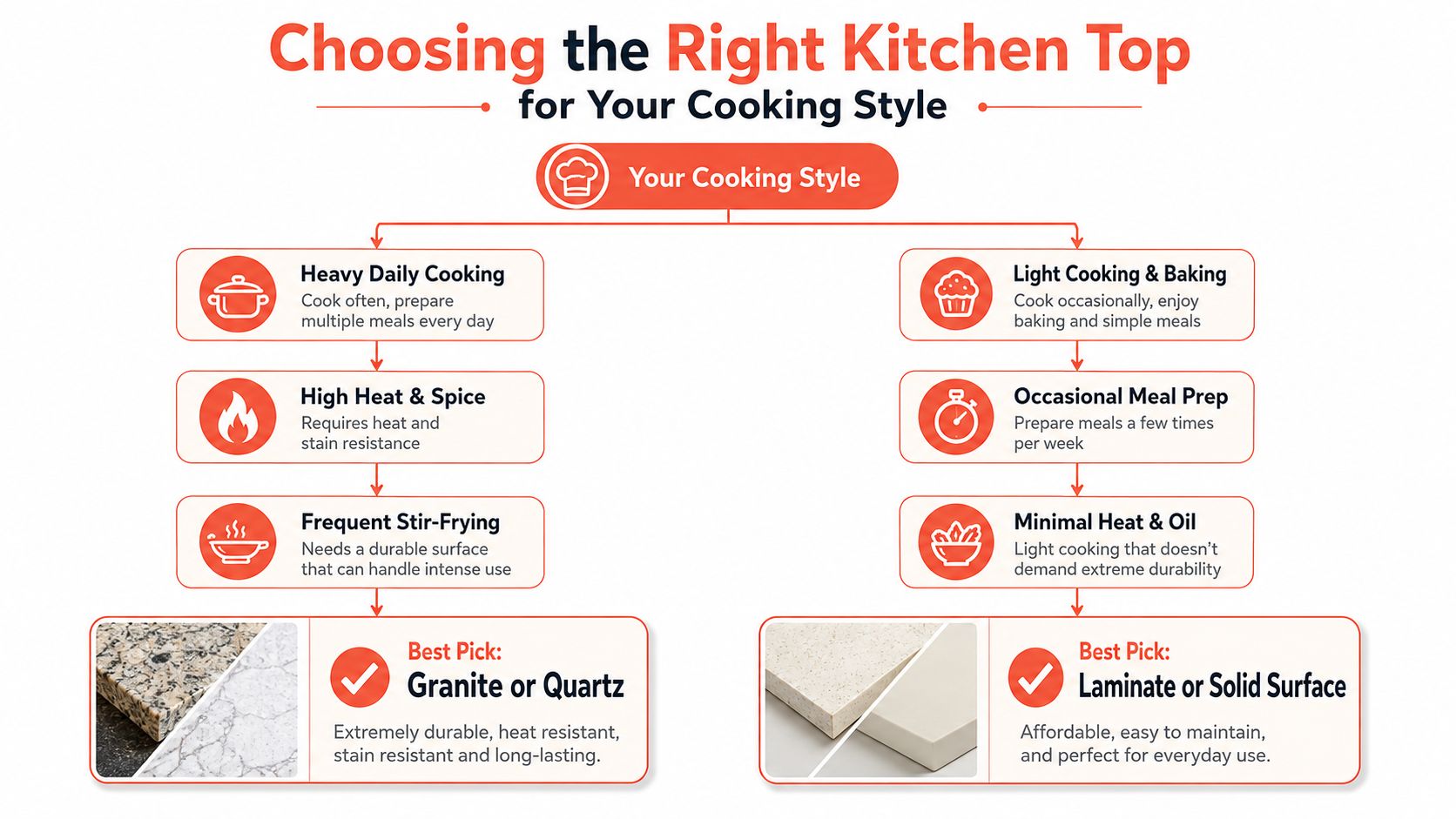
Start with behaviour, not colour. Ask what happens between breakfast and dinner, which counter receives the wet grinder, where the pressure cooker is opened and whether anyone wipes spills immediately.
Heavy daily cooking
If your household prepares tempering, deep-frying, sambar, rasam and spice pastes every day, prioritise heat resistance and stain control. Granite is the safest all-round recommendation when hot tawas, kadais or pressure cookers regularly touch the top. Quartz also works well if everyone uses trivets and values quick cleaning.
Families using a stone grinder or mortar and pestle should give the main preparation counter a resilient surface. Avoid placing the grinding equipment on a delicate decorative zone because it looks attractive in photographs. Dark or medium-toned granite can also make oil splashes and visual variation less noticeable than a pristine white top.
Moderate cooking
A couple preparing meals regularly but not running several burners all day can choose quartz, high-quality granite or solid surface. Quartz is particularly convenient near the sink and preparation area because its effectively non-porous surface doesn't need sealing and resists common food stains. Solid surface suits homeowners who want curved edges, integrated sinks or a visually continuous counter, provided they accept scratch management.
Layout matters here. Put the most heat-tolerant surface beside the hob, and reserve a visually softer material for a breakfast ledge or low-risk serving zone. You don't need one material throughout a compact kitchen if zoning improves performance.
Light cooking
Working professionals who mainly reheat food, prepare breakfast or bake occasionally can consider laminate or solid surface. Laminate offers strong value when the board base is protected from water and the owner accepts that direct heat is off limits. Solid surface costs more, but its smooth appearance can make a small apartment kitchen feel calmer and less visually crowded.
Household size changes the wear pattern. A joint-family kitchen experiences more simultaneous activity, more utensil movement and more opportunities for hot vessels to be placed without thought. A studio or small nuclear-family kitchen may have less volume but tighter clearances, so every square foot becomes a high-contact zone.
If you know someone will ignore the trivet, don't specify a surface that depends on perfect trivet discipline.
Think in terms of a five-to-ten-year ownership period. A surface that needs occasional maintenance may be the better choice if it tolerates your habits, while a low-maintenance surface can fail quickly if used outside its heat limits.
Installation and Cabinet Factors That Affect Performance
A good slab cannot rescue a weak cabinet carcass. Countertop failures often begin below the visible surface, through poor levelling, inadequate support, moisture exposure or careless cut-outs.
Indian kitchen guidance commonly places countertop thickness at 18 to 20 mm, with 20 mm preferred for better support and 30 mm used for unsupported spans or islands, as described in this India kitchen countertop sizing guide. The exact support detail depends on the material, span and cabinet design. Don't let a contractor choose thickness only from what is available in the yard.

The cabinet base carries the risk
Plywood is the stronger long-term choice for kitchen carcasses where moisture and screw holding matter. An India-specific cabinet material benchmark estimates plywood lifespan at 12 to 20 years, while particle board is estimated at 3 to 5 years, with plywood rated much higher for moisture resistance and screw holding in the same kitchen cabinet material comparison. The cabinet must also be level across its full run. Small inconsistencies can place stress on slabs and seams.
Use moisture protection around the sink, dishwasher connection and wall junction. Keep seams away from the sink and hob where possible. A seam in a dry, accessible preparation area is easier to monitor than one exposed to constant water or heat.
Details that prevent avoidable damage
Rounded or eased edges are safer in busy kitchens than sharp corners. They reduce impact concentration and feel more comfortable in narrow apartment aisles. Overhangs for breakfast counters need proper brackets, especially when someone leans on the edge or places weight on it.
Check these points before handover:
Cabinet levelling: Use a spirit level across the full counter run, not just at the corners.
Cut-out finishing: Confirm that sink and hob cut-outs are smooth, sealed and free from visible cracks.
Seam location: Ask why each seam has been placed, particularly near wet or hot zones.
Edge profile: Inspect the polish or laminate bonding around corners and exposed ends.
Support structure: Verify brackets and internal supports beneath overhangs and unsupported spans.
Adhesive and curing: Confirm that the correct adhesive has been used and allowed to cure before heavy use.
Recommendations for Different Chennai Homeowners
A joint-family kitchen needs a surface that forgives rushed decisions. I'd specify medium or dark granite for the primary worktop, or a high-grade quartz surface if the household consistently uses trivets. Granite is the practical choice for multiple burners, heavy spice preparation and frequent hot-pan contact. Budget varies by selected stone and fabrication, so obtain a slab-specific quote rather than relying on a generic catalogue rate. The maintenance habit is simple but essential: keep granite properly sealed and wipe acidic or oily spills instead of leaving them overnight.
A young professional couple in a compact apartment can choose quartz for a clean, low-maintenance look, or solid surface if continuous curves and integrated detailing matter more. Quartz sits in a premium range of ₹450 to ₹800 per sq ft, based on this India kitchen countertop material pricing reference. The key habit is using trivets for hot cookware. Solid surface needs prompt cleaning and occasional scratch repair, but it suits moderate cooking and visually open kitchens.
For a rental property, laminate makes strategic sense when replacement cost and appearance matter more than decades of service. The practical budget band is ₹80 to ₹150 per sq ft, and the essential maintenance habit is keeping water away from exposed edges and seams. Use a sound plywood base, protect the sink zone and don't specify laminate beside a hob if tenants are likely to place hot vessels directly on the top.
A luxury villa with an open kitchen can justify premium quartz, selected natural stone or stainless steel. Quartz gives controlled veining and a polished architectural appearance, natural stone provides unique movement, and stainless steel creates a deliberate professional-kitchen statement. For all three, the most important habit is matching the finish to the household's willingness to accept marks, variation and regular cleaning.
Visit local slab yards, not only kitchen studios. Request samples, test them with turmeric and hot oil, inspect the underside and ask who will cut and install the material before you pay an advance.
Common Questions About Kitchen Top Materials
Can quartz handle a hot dosa tawa directly?
No. Quartz offers excellent stain resistance, but direct high heat can damage the resin. Use a trivet every time.
Does granite need annual sealing in Chennai?
Not necessarily annually. India-focused guidance commonly places resealing at every 1 to 2 years, depending on the stone, sealant and use. Ask the fabricator what product was applied and how to test the seal.
Will laminate survive wet grinding?
It can survive moderate use if the edges and board base stay dry. Repeated water exposure around joints is the main failure risk, not the laminate face alone.
Is solid surface easy to repair?
Minor scratches can often be sanded or refinished, but deep damage, replacement sections and colour matching still cost money. Repairability doesn't make it maintenance-free.
Do scratches on stainless steel make it unsafe?
Surface scratches mainly affect appearance. Keep the worktop cleaned, avoid trapping food in damaged joints and use a cutting board.
Can I mix materials?
Yes. Granite near the stove and wood on a breakfast counter can work well when the zones are clearly separated. Prioritise slab support and correct installation first, then choose the edge profile that suits traffic and safety.
Interiors by DeX plans and executes modular kitchens in Chennai, including workflow planning, storage, material selection, countertop installation and handover. Visit Interiors by DeX to discuss a kitchen top that matches your cooking habits, cabinet construction and apartment layout.