
The most popular advice about modular kitchen materials is also the least useful: choose one “best” board and use it everywhere. That sounds simple, but an Indian kitchen isn't exposed to moisture, heat, steam, and cleaning water evenly. The cabinet below a sink has a very different job from a loft, and neither behaves like a shutter beside the hob.
The better answer to what material is best for modular kitchen is zone-based. Put the strongest water-resistant board where leaks and splashes are likely, use a suitable moisture-resistant board in drier storage areas, and select shutter substrates and finishes according to the look and maintenance you want. This approach protects the vulnerable parts without forcing you to over-engineer every cabinet.
Why One Material Cannot Build Your Entire Kitchen
A kitchen has several exposure levels, not one uniform environment. The sink base deals with plumbing connections, wet utensils, cleaning water, and concealed leaks. Lower cabinets away from the sink still face mopping, cooking spills, and humidity. Wall units and lofts generally remain drier, while shutters deal with fingerprints, oil, turmeric, heat, and repeated wiping.
Indian homes add another layer of stress. Daily steam enters joints and edges, monsoon humidity affects exposed surfaces, and frequent cleaning sends water towards cabinet bottoms and cut-outs. A board that performs well in a dry wardrobe can swell or lose its fastener grip when installed below a sink.
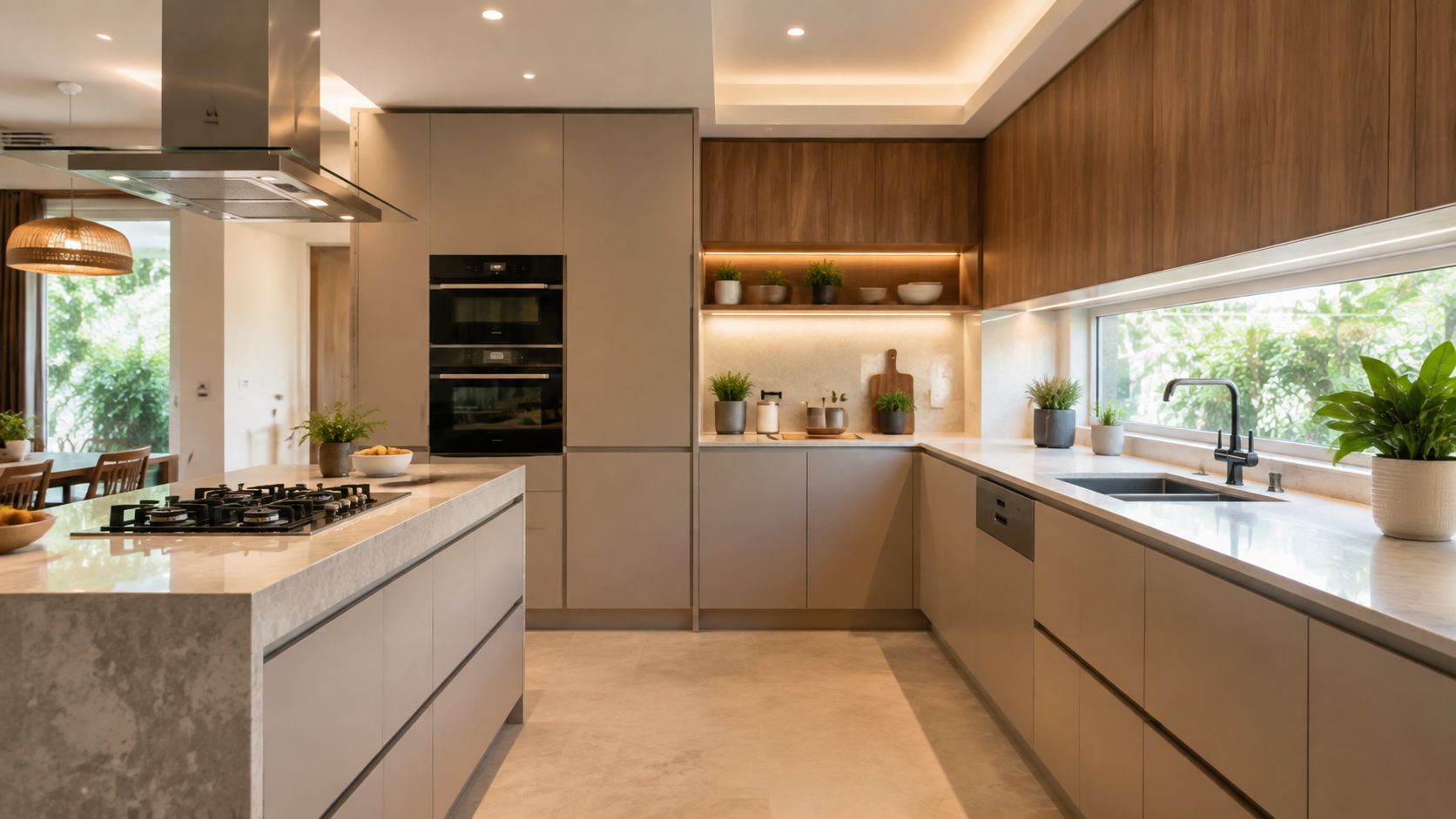
Water exposure decides the specification
Start by marking the kitchen into practical zones:
Wet zones: Sink-base cabinets, the area below an RO system, plumbing cut-outs, and lower units immediately beside the sink.
Moderate zones: Lower cabinets away from plumbing, bottle pull-outs, appliance units, and storage exposed to regular cleaning.
Dry zones: Wall cabinets, lofts, and upper storage that don't receive direct water.
Visible surfaces: Shutters and panels where finish quality, cleaning, and appearance matter as much as structural strength.
The most sensible hierarchy in Indian homes is IS:710 BWP plywood for wet-load areas, IS:303 BWR plywood for drier cabinet sections, and HDHMR or pre-laminated boards for smoother shutter applications where water contact is controlled. This zone-based approach is reflected in Indian material guidance for modular kitchens (Vinawood's India-focused plywood guide).
Practical rule: Don't ask your designer for one board. Ask for a material schedule that names the board for every cabinet zone.
Using premium waterproof construction throughout can over-engineer low-risk areas and inflate the budget. Using a cheap dry-interior board throughout creates a predictable weakness below plumbing. The right specification spends more where failure is likely and saves where exposure is limited.
Decoding Indian Plywood Standards for Kitchen Use
“Waterproof plywood” is not a specification. Ask for the BIS code and grade on the quotation. That detail identifies how the board is meant to perform, while a generic brand label does not.
IS 710 is the Indian standard associated with marine or BWP plywood. BWP means boiling-water-proof, making it the right specification for cabinet areas exposed to humidity, splashes, and cleaning water. IS 303 covers general-purpose and moisture-resistant plywood, including BWR and other grades. BWR means boiling-water-resistant, so it suits occasional moisture rather than repeated wet exposure.
MR belongs in a different category. MR means moisture-resistant, not water-resistant. Indian material guidance places MR-grade plywood away from sinks and plumbing because moisture resistance does not offer the protection of a waterproof adhesive system. The distinction between IS 710 and IS 303 should guide every kitchen material schedule, as explained in Woodage's BIS standards guide.
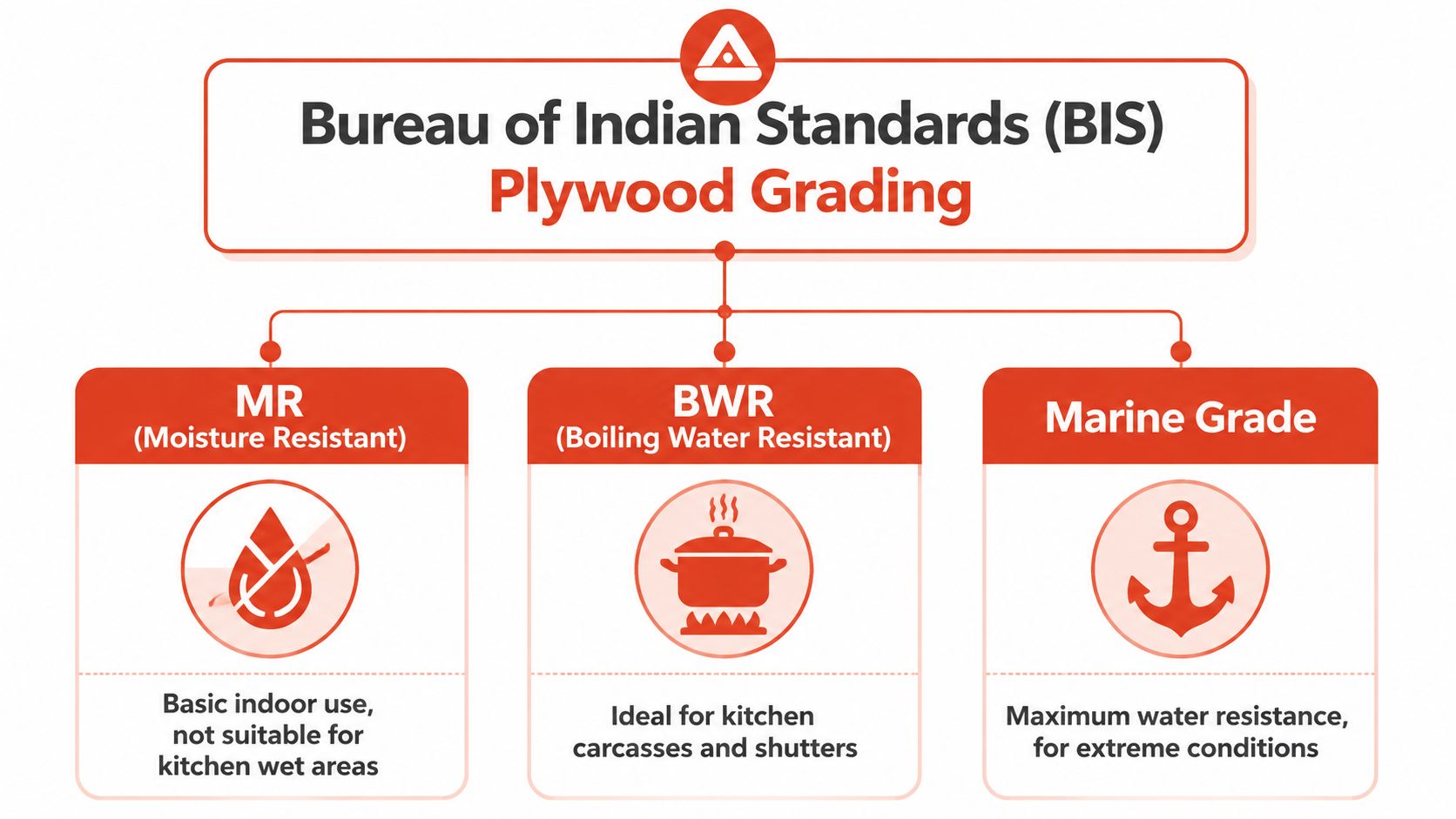
Read the grade, not just the label
Check the specification in this order:
Identify the standard: Look for IS 710 or IS 303 wherever plywood is specified.
Confirm the grade: The quotation should state BWP, BWR, or MR. Reject vague descriptions.
Match it to the zone: Use BWP near plumbing and repeated water exposure, BWR in drier storage, and MR only in dry interiors.
Inspect the core and edges: Swelling often begins at exposed edges, cut-outs, and fastener points. A stable core and waterproof adhesive system help protect hinge alignment.
Record the specification: Keep the grade, thickness, and product details with the final quotation.
IS 303 does not identify one moisture class. It includes BWR and other general-purpose grades, so “IS 303” alone does not prove that a board suits every kitchen location. The exact grade and intended application still need confirmation.
Thickness also needs verification. The BIS document for IS 303 lists allowed thicknesses of 3, 4, 5, 6, 9, 12, 15, 19, 22, and 25 mm (BIS IS 303 document). Market descriptions may differ, so check the actual board specification rather than assuming a commonly quoted thickness follows the BIS schedule.
Choosing Carcass Materials by Kitchen Zone
The carcass is the kitchen's structural body, including its sides, top, bottom, shelves, and supporting panels. Don't choose it by appearance. Choose it by the water, load, and cleaning exposure each module will receive.
Wet zones need BWP first
Use IS:710 BWP plywood for the sink base, RO leak-prone area, plumbing cut-outs, and lower cabinets directly beside the sink. A leak can remain hidden in these areas, wet utensils may be placed temporarily, and cleaning water often reaches the cabinet floor.
Published Indian product guidance commonly places BWP plywood at roughly ₹85–120 per sq ft, with an expected kitchen life of 15–20 years. Those figures come from Woodage's BWP, HDHMR, and MDF comparison. Treat the range as a planning reference, not a substitute for a written product quotation.
For moderate lower units, BWP remains the safest choice, but IS:303 BWR plywood can be a sensible selection when direct plumbing exposure is absent. BWR is commonly listed at around ₹65–90 per sq ft, with an expected working life of 8–12 years in less exposed areas, according to the same Indian product guidance.
Drier sections can use a measured specification
Wall cabinets and lofts generally face less direct water. BWR plywood is suitable for these drier sections when the edges are properly finished and the cabinet isn't positioned where steam or splash regularly accumulates.
HDHMR can work well for shutters and selected cabinet applications where moisture exposure is controlled and the finish is sealed. MDF is useful for smooth finished surfaces, but it shouldn't be treated as a universal wet-zone carcass material. MR plywood is a dry-interior product, commonly listed around ₹45–65 per sq ft, and is explicitly not recommended for kitchens, especially below sinks or near plumbing (Woodage's material comparison).
Material | BIS Grade | Best Zone | Cost per Sq Ft | Expected Lifespan |
|---|---|---|---|---|
BWP plywood | IS:710 | Sink base, RO area, plumbing-adjacent lower cabinets | ₹85–120 | 15–20 years |
BWR plywood | IS:303 BWR | Upper cabinets, lofts, drier lower storage | ₹65–90 | 8–12 years |
HDHMR | Product-specific, verify specification | Sealed shutters and controlled-moisture applications | Varies by product | Confirm product specification |
MDF | Product-specific, moisture exposure must be controlled | Smooth shutters and finished low-risk surfaces | Varies by product | Confirm product specification |
The table makes the decision clear. BWP is the wet-zone recommendation, BWR is the dry-storage recommendation, and HDHMR or MDF belongs where finish and controlled exposure matter more than constant water resistance. A Hyderabad-focused material guide makes the same practical distinction for sink units, RO areas, lower cabinets, wall cabinets, and lofts (Alcorone's BWP versus BWR guide).
Selecting Shutter and Finish Materials That Last
Shutters are the part you touch, see, wipe, and judge every day. Their substrate and finish must work together. A smooth board with a poor edge treatment can fail sooner than a simpler shutter with a well-sealed perimeter.
HDHMR is a strong option when you want a dense, smooth substrate with better moisture tolerance than ordinary MDF. It suits contemporary shutters, routed profiles, and surfaces that need a consistent base. MDF remains useful for smooth painted or laminated shutters, particularly in controlled areas, but it shouldn't be placed where water can sit on an unsealed edge. Pre-laminated boards reduce finishing work, provided the exposed edges and cut-outs receive proper protection.
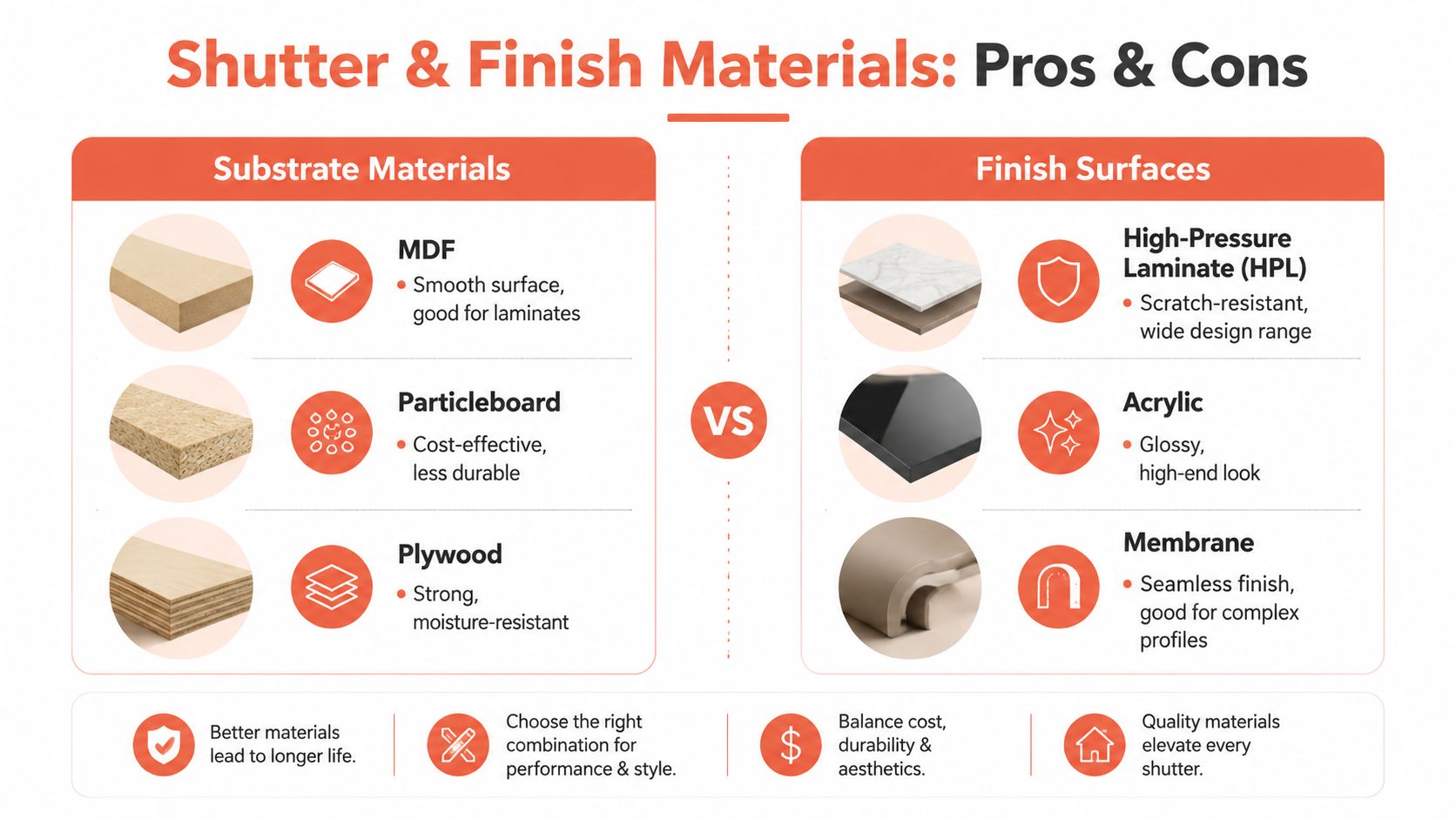
Match the surface to daily cleaning
For most Indian homes, high-pressure laminate is the practical default. It handles regular wiping, offers a broad design range, and is easier to live with than a delicate high-gloss surface. Choose a textured or matte laminate if you want fingerprints and minor marks to remain less visible.
Acrylic creates a glossy, high-end appearance, but its reflective surface demands more frequent cleaning and shows smudges readily. It works well on upper shutters and carefully planned contemporary kitchens, especially when the homeowner accepts the maintenance involved. PU coatings offer a smooth painted appearance and suit premium designs, but repairs and refinishing require more care than replacing a standard laminate panel.
Turmeric stains, oil splatter, and abrasive cleaning are the ultimate tests. Ask to see a finish sample under strong centre lighting, then run your hand across the edge. Check whether the edge banding looks continuous, whether the corner feels sealed, and whether the finish has a practical cleaning instruction.
Surface advice: A beautiful finish can't compensate for an exposed substrate. Spend time on edge sealing, especially around handles, sink-adjacent shutters, and appliance cut-outs.
The shutter decision should also sit beside the countertop decision. If you're comparing granite, quartz, and other worktop options, use this detailed resource to compare countertop surfaces for kitchens before finalising the colour and finish pairing. For a darker worktop scheme, review black granite modular kitchen design ideas and judge the shutter finish in the same lighting where you'll use the kitchen.
Hardware Materials and Corrosion Resistance Standards
A cabinet can have an excellent carcass and still become frustrating if its hardware is weak. Hinges loosen, channels jam, pull-outs become noisy, and handles lose their finish because homeowners often specify hardware as an afterthought.
For everyday indoor kitchens, grade 304 stainless steel is the benchmark. It offers strong corrosion resistance in humid environments and is widely used as the reference point for stainless-steel kitchen hardware and cabinets. Stainless steel is selected for resistance to water, heat, and pests, but grade and finish still matter. Lower grades may stain or pit faster in Indian cooking conditions (Saha Interiors' stainless-steel kitchen material guide).
Check each moving component
Ask your designer or vendor to identify the material and finish of the parts you'll use most:
Hinges: Confirm the metal grade, adjustment range, soft-close mechanism, and screw-holding method. Hinges near steam or plumbing need more protection than hinges in a dry loft.
Drawer channels: Check whether the channel moves smoothly under the intended load and whether the finish resists corrosion. A channel that feels smooth when empty may behave differently once stocked.
Tall-unit mechanisms: Examine the frame, baskets, runners, and connection points. Pull-outs need rigid construction because repeated movement places stress on fasteners.
Handles and profiles: Match the finish to your cleaning habits. A textured or brushed finish can be more forgiving than a highly polished surface that displays every mark.
Hardware should match the cabinet specification. A high-grade BWP sink base fitted with poorly protected channels is still an incomplete solution. Likewise, premium runners don't rescue a swollen board whose screw points have already weakened.
Request the hardware schedule before production. It should identify the hinge type, channel system, pull-out mechanism, handle finish, and warranty or replacement terms. Touch and operate the same models at an experience centre rather than choosing from a catalogue photograph.
Balancing Material Costs Without Compromising Durability
A controlled budget doesn't mean using the cheapest material everywhere. It means putting money where a failure would be disruptive, expensive, or difficult to repair.
The sink unit deserves priority because plumbing leaks and repeated wet cleaning create the highest risk. Lower cabinets close to the sink come next, followed by hardware that receives daily movement. Upper cabinets and lofts can use a more measured BWR specification when they're protected from direct water. Shutters can then be selected according to the finish you want, rather than forcing every visible panel to use the same expensive substrate.

Spend according to consequence
A sensible allocation looks like this:
Protect the wet core: Specify IS:710 BWP for the sink base, RO area, and plumbing-adjacent modules.
Use BWR intelligently: Choose IS:303 BWR for upper storage and other drier sections where constant waterproof construction isn't necessary.
Keep the finish practical: Use laminate when low maintenance matters more than a showroom gloss. Reserve acrylic or PU for areas where you're comfortable with their cleaning and care requirements.
Don't downgrade moving parts: Hinges, channels, and pull-outs affect daily usability, so inspect their material and operation before approving the quote.
Save on replaceable decoration: Decorative backsplash tiles, basic lighting, and some interior organisers can be upgraded or changed without rebuilding the carcass.
MR plywood may look attractive on an initial estimate, but it isn't a sensible kitchen saving near water. The lower purchase price can be erased when swelling affects the cabinet base, edges, hinge alignment, or adjacent panels. The material guidance cited earlier places MR at roughly ₹45–65 per sq ft and identifies it as unsuitable for kitchen wet areas (Woodage's comparison of BWP, BWR, HDHMR, and MDF).
For a broader planning framework covering scope, priorities, and renovation decisions, read the Blanc Haute Luxury Kitchens guide. You can also use this resource on material choices that keep interiors low-maintenance when coordinating the kitchen with wardrobes, utility storage, and other built-in elements.
Common Material Mistakes and How to Avoid Them
A kitchen should not use one board everywhere. The sink base, wall units, lofts, and shutters face different levels of moisture, heat, handling, and cleaning. A vendor offering the same material for all cabinets may be simplifying procurement instead of matching the specification to each zone.
A finish sample proves very little about the construction beneath it. Before approving the design, request the board grade, thickness, finish, edge band, adhesive system, and hardware model in writing. A glossy shutter can still conceal a weak substrate, poor edge treatment, or unsuitable hinges.
Use this approval checklist
Before production, verify:
Zone mapping: The quotation marks wet, moderate, and dry cabinet locations.
BIS details: Plywood descriptions specify IS:710 BWP or IS:303 BWR where applicable. Reject vague labels such as “waterproof board”.
Thickness: The stated thickness matches the approved specification. The IS 303 schedule covers 3, 4, 5, 6, 9, 12, 15, 19, 22, and 25 mm, so question any unexplained change, as noted earlier.
Edges and cut-outs: Sink openings, plumbing holes, hinge recesses, and exposed bottoms receive suitable sealing.
Hardware schedule: Hinges, channels, handles, and pull-outs have named products or grades.
Installation quality: Cabinets are level, fasteners are anchored correctly, and sink and countertop junctions are sealed.
Check delivered boards against the approved schedule before installation. A specified board can be substituted at site when several suppliers or contractors are involved. Keep the material schedule with the work order, photograph labels on delivered sheets, and record any approved change. This guide on preventing material substitution in Chennai interiors explains the checks that help control this risk.
Use IS:710 BWP for wet zones, IS:303 BWR for drier carcass sections, and HDHMR or MDF for sealed, low-risk shutter applications. Edge sealing, suitable hardware, and careful installation protect those choices in daily use.
Interiors by DeX plans, coordinates, and executes modular kitchens in Chennai with documented board, hardware, hinge, channel, and finish selections. Visit Interiors by DeX to review material pairings at its experience centre and assign the right specification to each kitchen zone.