DE X INSIGHTS
10 Loft Storage Ideas for Chennai Homes

The space above your wardrobe looks useful until you need something from it. Then it turns into a dusty cavity that needs a stool, awkward stretching, and a lot more confidence than one should have while handling luggage over their head. In Chennai homes, that problem shows up everywhere. New flats have tighter rooms, older apartments have ad hoc lofts, and villas often have generous overhead volume that still gets used badly.
Good loft storage ideas don't start with boxes or shutters. They start with access. If you can't reach the storage safely, or if the structure can't carry the load you plan to put into it, the loft becomes dead space or a hazard. After that, the right choice depends on what you're storing, how often you need it, whether the area faces humidity, and whether you're doing a full renovation or trying to improve an already finished room.
That matters even more in Chennai because compact and mid-sized homes still dominate practical planning. A local market view cited in a ULI report notes demand and supply remain concentrated in mid-sized units, which is exactly why vertical storage keeps becoming part of the basic design brief instead of an afterthought in many homes. You can read more about how to use loft space for storage if you want a broader overview before deciding on a specific format.
1. Vertical Pull-Out Shelving Systems
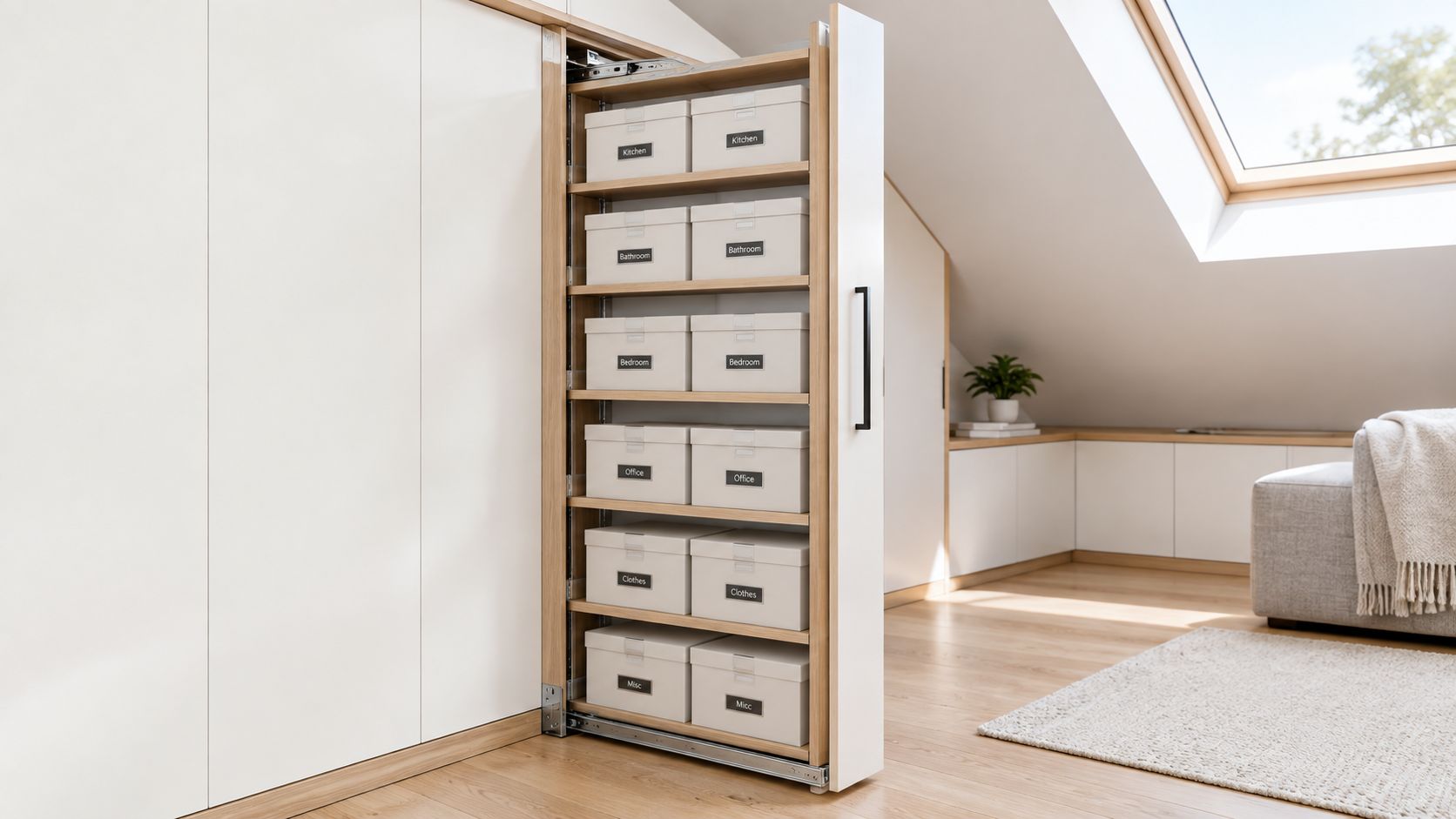
If your loft stores things you need a few times a month, fixed deep shelves usually fail. Items disappear at the back, the front row blocks everything else, and retrieval becomes a two-person job. Vertical pull-out shelving solves that by bringing the storage outward instead of forcing you to climb inward.
This works especially well above study units, passage storage, and full-height wardrobes in Chennai apartments where the loft cavity is long but not very deep. I'd use it for seasonal clothes, pooja items used during festival periods, archived files, light appliance boxes, and labelled toy bins in a child's room.
What makes it work
The tracks need a level installation and a strong carcass. Even a slight tilt becomes obvious once the shelving is loaded, and then the system starts dragging or racking. Use uniform bins so each shelf carries a predictable load and the pull-out motion stays smooth.
A compact planning guide for Indian homes notes that a wardrobe built to 2400 mm can store about 30 percent more than a 2100 mm wardrobe, with the top 600 mm often reserved for rarely used items such as festival or archive storage in compact urban home planning guidance for India. That's one reason pull-out loft sections feel more useful than a plain shuttered box. They make that upper zone reachable without turning it into a blind cavity.
Practical rule: Heavier bins go lower within the pull-out stack. The top section should stay light enough to handle with one hand while the other steadies the unit.
For villas, this system also works in children's rooms where educational kits and outgrown toys need sorting by category rather than by bulk. If you're budgeting the joinery, compare the extra hardware cost against the convenience. It's usually worth it when access happens regularly, and not worth it for long-term storage you may open only twice a year. If you're also pricing adjacent utility organisation, this kind of planning mindset is similar to Sydney garage storage cost planning.
2. Hinged Attic Ladders with Integrated Storage
Some lofts fail because the storage itself is fine, but access is poor. A loose aluminium ladder pulled from the balcony isn't a system. It's a workaround. Hinged attic ladders make sense when the loft volume is large enough to enter or when you need regular overhead access in a villa, duplex, or top-floor renovation.
They suit homes where the ceiling opening can be planned cleanly during civil work. In a Chennai villa, that could mean seasonal bedding over a family lounge, festival storage over a first-floor passage, or a utility loft where cleaning stock and spare linens need safer access than a stool can provide.
Best use case and trade-off
If you open the loft weekly or more, a better ladder mechanism matters a lot. Manual folding ladders are fine for occasional use. Once access becomes routine, homeowners usually want smoother operation and a predictable landing area.
A practical Chennai-specific approach is to coordinate the opening size, swing direction, and nearby light point before false ceiling work closes everything up. This is exactly the stage where planning loft storage in Chennai apartments becomes easier than fixing access after handover.
Use any integrated ladder-frame compartments for things you reach often. Keep the deeper loft cavity for lower-frequency storage. Mixing those two zones badly defeats the whole point.
Keep the floor clear: The ladder needs a reliable landing area without coffee tables, loose rugs, or a bed edge blocking descent.
Check ceiling build-up: False ceiling depth, AC lines, and electrical routing can interfere with the folding mechanism.
Store light items near the opening: Quick-access storage should be the first thing you reach after climbing up, not the last box at the far wall.
Safe access changes how often people use overhead storage. Once retrieval feels stable, the loft stops being a dumping zone and starts behaving like part of the house.
I wouldn't recommend this in most small bedrooms unless the opening can be placed without interrupting fan sweep, wardrobe shutters, or circulation. It shines more in larger rooms, landings, and flexible utility areas.
3. Modular Wooden Crate Stacking System
Not every loft needs expensive hardware. In many renovations, especially in older Chennai flats, the simplest answer is still the smartest one. A modular wooden crate system works when the loft shape is uneven, the ceiling line is awkward, or you want the storage arrangement to change over time.
Crates are useful for archives, spare linens, baby clothes kept for later, craft materials, and sorted household extras. They're also forgiving in villas where the overhead cavity may run around beams, columns, or odd corners that fixed shelves can't use efficiently.
Why crates beat one large compartment
One large loft chamber encourages random stacking. The front boxes block the rear boxes, labels disappear, and every retrieval disturbs the full row. Crates create smaller categories that can be lifted, rotated, and replaced without dismantling the entire loft.
Use plywood, not low-grade particle board, especially if the loft sits over a kitchen passage, utility edge, or an exterior wall that may experience seasonal moisture. Leave small air gaps between stacks so stored textiles and paper goods don't sit in stale enclosed air.
A storage planning guide for small Indian apartments describes the traditional overhead loft as the cheapest cubic storage in a home and recommends using it for low-frequency, lightweight items such as luggage, cartons, and festival belongings. The same guide also suggests allocating concealed storage to roughly 12 to 15% of the floor plate in storage design guidance for small apartments in India. Crates fit that hidden-storage logic well because they make overhead capacity more legible.
For a family apartment, I'd divide crates by life stage and usage. School records in one, travel gear in another, puja decor in another, and donor clothes pending transfer in another. That sounds simple, but it's what keeps a loft from turning into a memory dump.
4. Overhead Pulley and Hoist Systems
This is the most misunderstood option on the list. Homeowners often like the idea because it sounds effortless. In practice, pulley and hoist systems work only when the item is bulky, heavy, infrequently used, and difficult to lift manually. Otherwise, the mechanism becomes more trouble than the storage problem.
Use this in villas, covered utility areas, hobby rooms, or garage-like enclosed spaces. It can help with large suitcases, boxed décor, sports gear, or seasonal household equipment. I wouldn't make it the default answer for a bedroom loft.

Where people get it wrong
They install a lifting device without checking what it fixes. If the issue is poor sorting, a hoist won't help. If the issue is unsafe ladder use for seniors, then a hoist can make sense, but only when the support and anchoring are engineered properly.
Chennai homes with slab modifications, false ceilings, or retrofitted loft ledges need extra caution. Before choosing this route, review the structural and access issues discussed in loft storage safety for Chennai apartments.
Use soft straps: They're usually kinder to bins and luggage than point hooks.
Balance each load: Uneven packing causes swinging and awkward lowering.
Label every container: Nobody wants to lower a heavy bin just to discover it contains old cables and broken toys.
Watch for this trap: A hoist can encourage people to keep too many low-value, rarely used things simply because moving them overhead becomes easier.
That's why I'd reserve this for clearly defined storage categories. If the item doesn't justify a lifting mechanism, it probably belongs in simpler cabinetry, crates, or a declutter pile.
5. Wall-Mounted Pegboard and Hook Systems
Lofts are often thought of as enclosed volume. That's fine for luggage and bedding, but it's poor for items you want to see quickly. Pegboards and adjustable hook systems work best when the loft area is part of a usable room, not just a hidden overhead cavity.
In a hobby corner, home gym zone, children's mezzanine-like loft, or study nook in a villa, pegboard storage keeps light items visible and changeable. School bags, headphones, racquets, skipping ropes, cables, craft tools, and tote bags all work better on a pegboard than inside an opaque deep box.
Use this when needs change often
This is one of the few loft storage ideas that improves with rearrangement. As a child grows, the same board can move from toy baskets to school accessory hooks to hobby storage. In a work-from-home loft area, it can shift from stationery and tech accessories to sample boards and packaging materials.
A recent India-focused market analysis highlights rising demand for space-saving, modular, and customisable home storage solutions, including wall-mounted organisers and easy-to-assemble systems in the India home storage market analysis. Pegboards align with that shift because they let the storage adapt without full carpentry replacement.
To keep it useful, don't overload it with tiny unrelated things. Create zones. Sports on one side, tools on another, school items in labelled baskets below. The board should reduce search time, not create visual noise.
If the room already feels busy, paint the pegboard backing in the wall colour and keep hardware finishes consistent. That small move can make an open system feel intentional instead of temporary.
6. Built-In Wooden Storage Benches with Lift-Top Compartments
Some lofts are not overhead at all. In villas and top-floor rooms with sloped roofs or dormer-like edges, the lower perimeter often becomes dead space because standing height drops off. That's where a built-in bench with lift-top storage earns its place.
This is useful under a window, along a low parapet line, beside a reading corner, or on an upper landing. It's especially good for linens, board games, spare cushions, low-frequency toys, and guest bedding that shouldn't occupy prime wardrobe shelves.

Why this works in Chennai renovations
Older homes often have awkward corners that can't take full-depth wardrobes cleanly. A bench turns that low zone into usable storage without making the room feel top-heavy. It also gives you a seated function, which matters in bedrooms, reading corners, and family lounges.
Ventilation matters here more than people expect. Chennai humidity can affect stored fabric, papers, and wood finishes when compartments stay shut for long periods. Add discreet vents, use moisture-tolerant finishes, and avoid storing damp laundry, sports shoes, or recently cleaned rugs.
A built-in bench also works well when you want a quieter visual result than a row of upper cabinets. It won't replace a full loft, but it often solves the last part of the room that no one knows how to use well.
7. Metal Wire Shelving with Under-Shelf Baskets
Closed storage isn't always the best answer in a humid climate. In utility lofts, service areas, and secondary storage rooms, metal wire shelving often outperforms solid cabinets because it lets air move around the contents.
That makes it a practical choice for pantry overflow, cleaning stock, utility supplies, extra paper products, reusable shopping bags, laundry accessories, and housekeeping inventory in villas or large apartments. It's less suited to formal bedrooms unless you can screen it visually.
When airflow matters more than appearance
Use wire shelving where humidity exposure is possible and where easy visual checking matters. A closed loft above a utility machine can trap stale air. A breathable shelving system helps you spot dust build-up, leaks, forgotten stock, or rust marks before they become bigger problems.
A neutral Indian case study found that 93.33% of surveyed flat residents had cabinet storage, yet only 66.7% felt their storage was sufficient in this flat-resident storage study. That gap is useful here. More enclosed cabinetry doesn't always improve real usability. Sometimes visibility, categorisation, and access matter more than adding another shutter.
Storage feels insufficient when people can't see, reach, or sort what they already own.
Under-shelf baskets help with smaller loose items that would otherwise make wire shelves look chaotic. Keep the bottom shelf for heavier stock, and use coated or treated metal so the finish holds up better near damp areas. If the space is visible from a corridor, matching baskets can soften the industrial look.
8. Vacuum-Sealed Storage Bags with Hanging Systems
This is one of the easiest upgrades for finished apartments because it doesn't demand major carpentry. If the loft depth is shallow but the height is decent, vacuum bags can cut bulk and make soft goods easier to sort.
Use them for duvets, spare pillows, guest quilts, off-season clothing, festive textiles, and soft decorations. I wouldn't use them for leather goods, delicate zari-heavy garments, or anything that needs shape retention.
Good for volume, bad for forgetfulness
The strength of this system is compression. The weakness is invisibility. Once bags are flattened and stacked or hung, homeowners often lose track of what is inside unless they label clearly.
A 2026 India-focused storage benchmark recommends full-height wardrobes with lofts and suggests that in small bedrooms, roughly 30 to 40% of the built-in furniture footprint should be dedicated to storage so the rest of the floor area stays usable. It also notes that ceiling-height wardrobes and lofts work best when everyday items stay lower and seasonal goods move upward in smart storage ideas for small Indian homes. Vacuum bags suit that exact zoning method.
For Chennai homes, the humidity issue is simple. Bags must seal well, and the loft itself should stay reasonably dry. Check them during humid periods, especially if the loft sits near an external wall or above a bathroom passage. If a family uses this method, I'd still keep one accessible linen shelf below so nobody has to unpack compressed bedding for daily use.
9. Sloped Ceiling Custom Cabinetry with Deep Storage
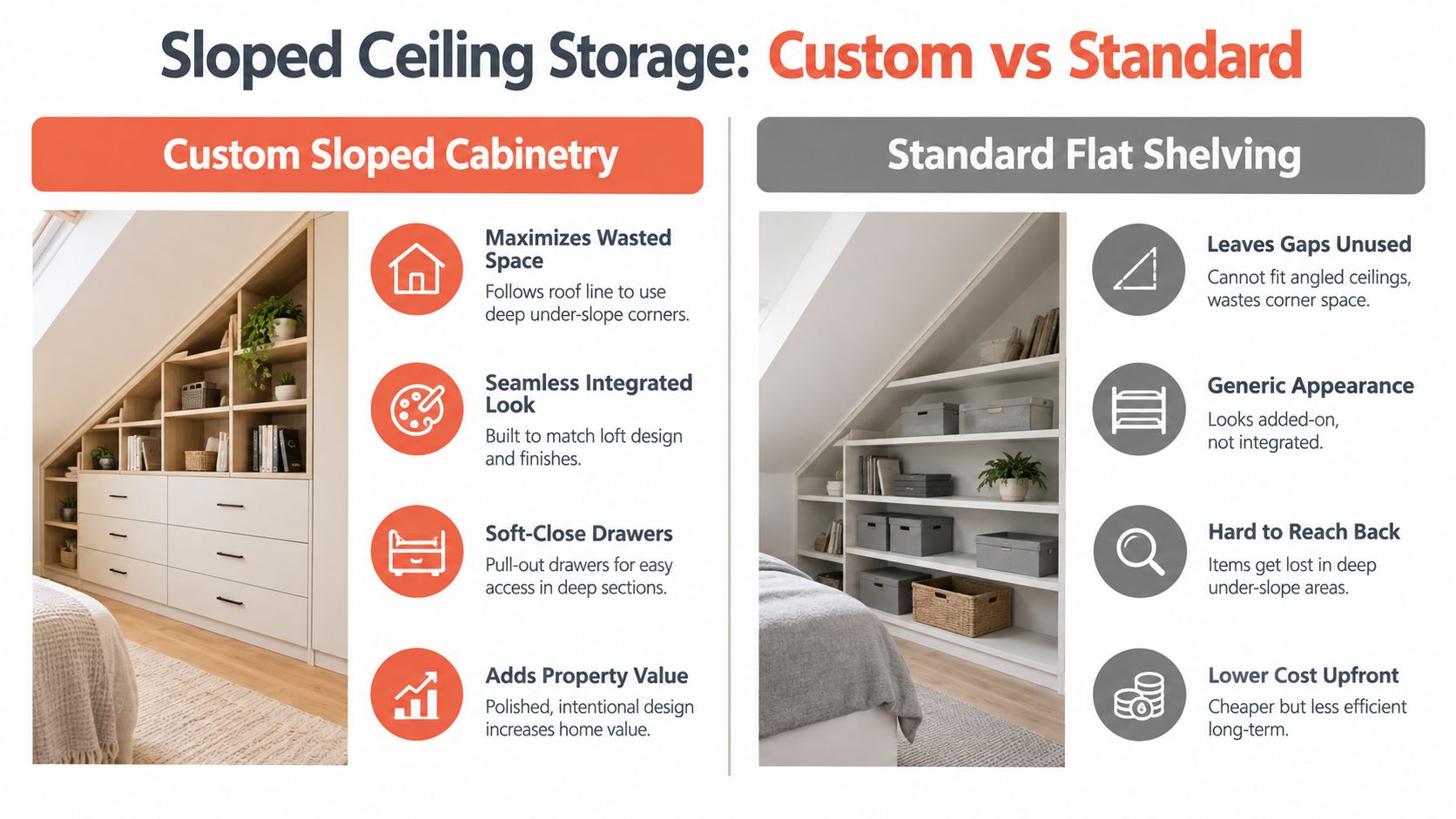
Sloped ceilings create the biggest gap between available volume and usable volume. Standard shelves leave dead triangles. Standard wardrobes stop early. Standard loft shutters become clumsy. Custom cabinetry is the right answer when the geometry is difficult and the storage need is long-term.
This matters more in villas, top-floor extensions, attic conversions, and renovation projects where the roofline dips sharply. Deep under-slope cabinets can store bedding, archives, keepsakes, and low-frequency personal items, while shallower drawers near the front can handle things you still need to reach occasionally.
Custom work is justified only when the geometry is hard
If the ceiling is flat and the room is straightforward, don't overcomplicate it. But when slopes intersect with beams, windows, or varying depth, custom joinery saves space that standard units leave behind.
A hidden-storage guide for Indian homes notes that standard wardrobes are often about 2100 to 2200 mm tall while ceilings are around 3000 mm, leaving an 800 to 900 mm vertical gap that can be used as a loft with a typical capacity of about 0.5 to 0.8 cubic metres in hidden loft storage guidance for Indian homes. In sloped rooms, that usable gap changes along the wall, which is why custom detailing matters.
For homeowners planning full bedroom storage rather than only a loft insert, wardrobes and storage solutions by Interiors by DeX are relevant to review during design development. The key is to match each cabinet depth to item type. Deep corners for archive boxes. Shallow pull-outs near the front for things you might need without unloading half the room.
10. Rolling Storage Carts and Mobile Organising Systems
Some loft-like spaces are really flexible upper rooms, not sealed storage cavities. In those rooms, fixed cabinetry can become a burden because the function keeps changing. A rolling cart system gives you mobility, especially in hobby zones, home offices, children's study areas, and spare rooms that double as storage.
In Chennai apartments, I've seen this work best in compact multi-use rooms where one wall carries built-ins and the remaining low-height edge needs lighter, movable storage. In villas, it works in craft rooms, tuition rooms, and family workspaces.
Best for active storage, not deep storage
Use carts for supplies you touch often. Paper stock, art materials, chargers, labels, wrapping tools, stationery, or children's school items all fit well. Don't waste a rolling system on old files or backup vessels that won't move for months.
The broader Indian housing context helps explain why this matters. Knight Frank's India rental housing report states that the average apartment size in India is typically 93 to 120 square metres, or about 1,000 to 1,300 square feet, in Knight Frank's India rental housing report. Homes in that size band usually need storage that supports daily circulation, not just maximum closed volume.
Choose carts with locking wheels and stable trays. If the floor is uneven or the room has thresholds, low-quality casters become annoying quickly. Also keep pathways open. A mobile system only stays useful if it can move without hitting a cot, desk, or wardrobe shutter.
Loft Storage Ideas, Top 10 Comparison
Solution | 🔄 Implementation Complexity | ⚡ Resource & Cost | ⭐ Expected Quality/Effectiveness | 📊 Ideal Use Cases / Expected Outcomes | 💡 Quick Tips |
|---|---|---|---|---|---|
Vertical Pull-Out Shelving Systems | Moderate–High; precise track alignment and often professional fit‑out | Higher upfront cost; ball-bearing tracks & cabinetry components | ⭐⭐⭐⭐, very effective for vertical optimization | Maximizes full‑height loft space; easy access to seasonal/boxed items without ladder | Install tracks level; heavier items on lower shelves; label boxes; maintain tracks |
Hinged Attic Ladders with Integrated Storage | High; ceiling reinforcement and safe deployment mechanisms required | Moderate–High (motorized increases cost); insulation and hardware | ⭐⭐⭐, good for combined access+storage but limited capacity | Best where access and compact storage are both needed; saves floor space | Verify ceiling integrity; choose motorized if frequent access; keep floor clear |
Modular Wooden Crate Stacking System | Moderate; custom measurement and fabrication required | Low–Moderate material cost; labour for custom cuts and reinforcement | ⭐⭐⭐, flexible and adaptable, good aesthetic value | Fits irregular/sloped loft geometry; reconfigurable storage for boxes, linens | Measure slopes accurately; use plywood, add casters to lower crates; allow ventilation gaps |
Overhead Pulley and Hoist Systems | High; secure ceiling‑joist mounting and professional installation | High cost for motorized hoists and safe mounting hardware | ⭐⭐⭐⭐, highly effective for bulky/heavy items when installed correctly | Ideal for bulky seasonal items, sports gear, and users needing mechanical lifting | Get structural assessment; label containers; distribute weight evenly; schedule maintenance |
Wall-Mounted Pegboard and Hook Systems | Low; simple mounting and reconfigurable layout | Low cost (pegboard, hooks, baskets) | ⭐⭐⭐, very flexible but limited for heavy loads | Best for hobby tools, sports gear, and evolving storage needs; maximizes wall space | Create zones, use baskets and consistent hook sizes, paint backing for aesthetics |
Built-In Wooden Storage Benches with Lift-Top Compartments | High; custom carpentry and precise fit to architectural features | High (custom build, gas stays, upholstery) | ⭐⭐⭐⭐, excellent for dual seating + concealed storage | Ideal for window seats, reading nooks, and integrated loft seating/storage | Use humidity‑resistant finishes, add ventilation, choose soft‑close hinges |
Metal Wire Shelving with Under-Shelf Baskets | Low–Moderate; assembly and secure anchoring required | Low–Moderate; epoxy‑coated steel components | ⭐⭐⭐⭐, very effective in humid climates and for high‑capacity needs | Suited to pantry, utility or garage lofts; breathable, adjustable storage | Anchor to studs, store heavy items low, inspect/touch up coating to prevent rust |
Vacuum-Sealed Storage Bags with Hanging Systems | Low; simple to implement though hanging infrastructure needed | Low cost (bags, hooks/rails) | ⭐⭐⭐, highly space‑efficient for compressible textiles | Best for bedding, seasonal clothing and decor where compression is acceptable | Label bags, store in cool/dry areas, check seals monthly in humid seasons |
Sloped Ceiling Custom Cabinetry with Deep Storage | Very High; precision measuring, design and professional carpentry | Very high cost due to bespoke fabrication | ⭐⭐⭐⭐⭐, top performance for converting sloped spaces into usable storage | Optimal long‑term solution for sloped ceilings; seamless integrated look and max capacity | Hire experienced craftsmen, measure slopes at multiple points, use pull‑out drawers for deep areas |
Rolling Storage Carts and Mobile Organizing Systems | Low; off‑the‑shelf units require minimal setup | Low–Moderate cost depending on material and caster quality | ⭐⭐⭐, versatile and convenient for temporary/movable needs | Great for multipurpose lofts, renters, and spaces needing frequent reconfiguration | Choose locking brakes, use furniture pads to protect floors, distribute weight evenly |
Turn Loft Volume into Everyday Capacity
The best loft storage ideas aren't the ones that hold the most. They're the ones that stay safe, reachable, and relevant to the way your household lives. Before choosing any format, confirm structural support, check how you'll access the storage, and decide whether the loft is for weekly use, monthly use, or long-term holding.
That first sorting step saves a lot of bad joinery. Group items by weight, frequency of use, and sensitivity to humidity. Light seasonal belongings can go higher. Everyday items should stay lower. Paper archives, textiles, and luggage need different handling, and kitchens or utilities need more attention to air movement than a dry bedroom wall.
A Chennai-specific reality also shapes the decision. Average flat sizes in Chennai rose from 1,100 sq. ft. in 2019 to 1,445 sq. ft. in 2024, a 31% increase, according to local market reporting cited in a ULI housing report reference. Even so, these are still mid-sized homes in practical planning terms, not sprawling houses with endless spare rooms. That's why lofts still matter. They protect floor area for circulation while shifting rarely used belongings upward.
Custom cabinetry is worth the cost when the geometry is awkward, the storage need is permanent, or the room already has enough visual complexity that loose systems will look untidy. Simpler solutions like crates, vacuum bags, pegboards, and carts work better when the household routine changes often or the home is already finished and you don't want a major renovation.
If you're planning a renovation, discuss loft dimensions early. Also review lighting positions, fan clearance, electrical runs, shutter swing, finish durability, and whether the storage should align with wardrobes, passage cabinets, or kitchen overheads. That coordination matters more than the storage idea itself, because a well-designed loft has to fit into the room without stealing comfort or making maintenance harder.
For homeowners who want integrated planning rather than piecemeal fixes, Interiors by DeX is one relevant Chennai option to consider. Its residential scope includes wardrobes, loft and overhead storage, kitchen storage planning, and end-to-end interior execution for apartments and villas. If you're still comparing formats, even browsing storage loft beds for small rooms can help clarify the larger principle. Storage works best when it is built around use, not just around available volume.
Interiors by DeX plans and executes residential interiors in Chennai, including wardrobes, loft and overhead storage, kitchen storage, and renovation-led space planning that can make these ideas work in real apartments and villas. If you want a loft system that fits your ceiling height, access needs, and daily routine instead of just filling empty space, visit Interiors by DeX.