
A standard modular kitchen in Chennai typically costs ₹1.2 lakh to ₹5.5 lakh or more, depending on size, finish, and accessories. The core challenge isn't the headline number, it's figuring out what each quote truly includes.
If you've ever sat with two kitchen proposals on your dining table and wondered why one looks almost affordable while the other feels wildly inflated, you're not alone. In Chennai, two quotes for what appears to be the same kitchen can differ because one vendor has priced only the carcass and shutters, while another has folded in hardware, countertop, installation, and site work. That's why modular kitchen and price has become less about finding the lowest figure and more about understanding the scope behind it.
Why Two Modular Kitchen Quotes Can Look So Different
A homeowner in OMR recently compared two quotes for a 10x8 kitchen. One came in at ₹1.8 lakh, the other at ₹3.4 lakh, and both vendors insisted they were pricing the same room. That kind of gap makes people assume someone is overcharging, but the more common problem is simpler. The quotes are often built on different assumptions, different inclusions, and different levels of finish.
The number on the first page rarely tells the whole story
A kitchen quote can hide a lot in plain sight. One vendor may be offering just the basic cabinet structure, while another includes soft-close fittings, pull-out accessories, a granite countertop, transport, and installation. The cheaper proposal can look smart until you realise the missing items add up fast.
This is exactly why Chennai buyers need to stop comparing a single headline and start comparing scope. The right question isn't, “Which quote is lower?” It's, “Which quote includes the same things?” If one vendor leaves out the countertop and another doesn't, those are not competing offers.
Practical rule: compare only quotes that specify the same kitchen size, same module count, same hardware tier, same countertop, and same installation scope.
The market has no single standard format for modular kitchen quotations. That means a fair comparison has to be created by the homeowner, not assumed by the seller. If you want to pressure-test a proposal before you sign anything, a kitchen remodel cost calculator can help you think in cost buckets before you talk to vendors.
The goal here is simple. By the end of this guide, you should be able to look at any proposal and tell whether it's a real apples-to-apples quote or just a low opening number with half the job missing.
What Actually Makes Up a Modular Kitchen
A modular kitchen is not one price line. It's a stack of separate cost heads, and each one can move the final bill in a big way. If you don't break it down, you end up comparing a full proposal against a partial one and calling that a decision.
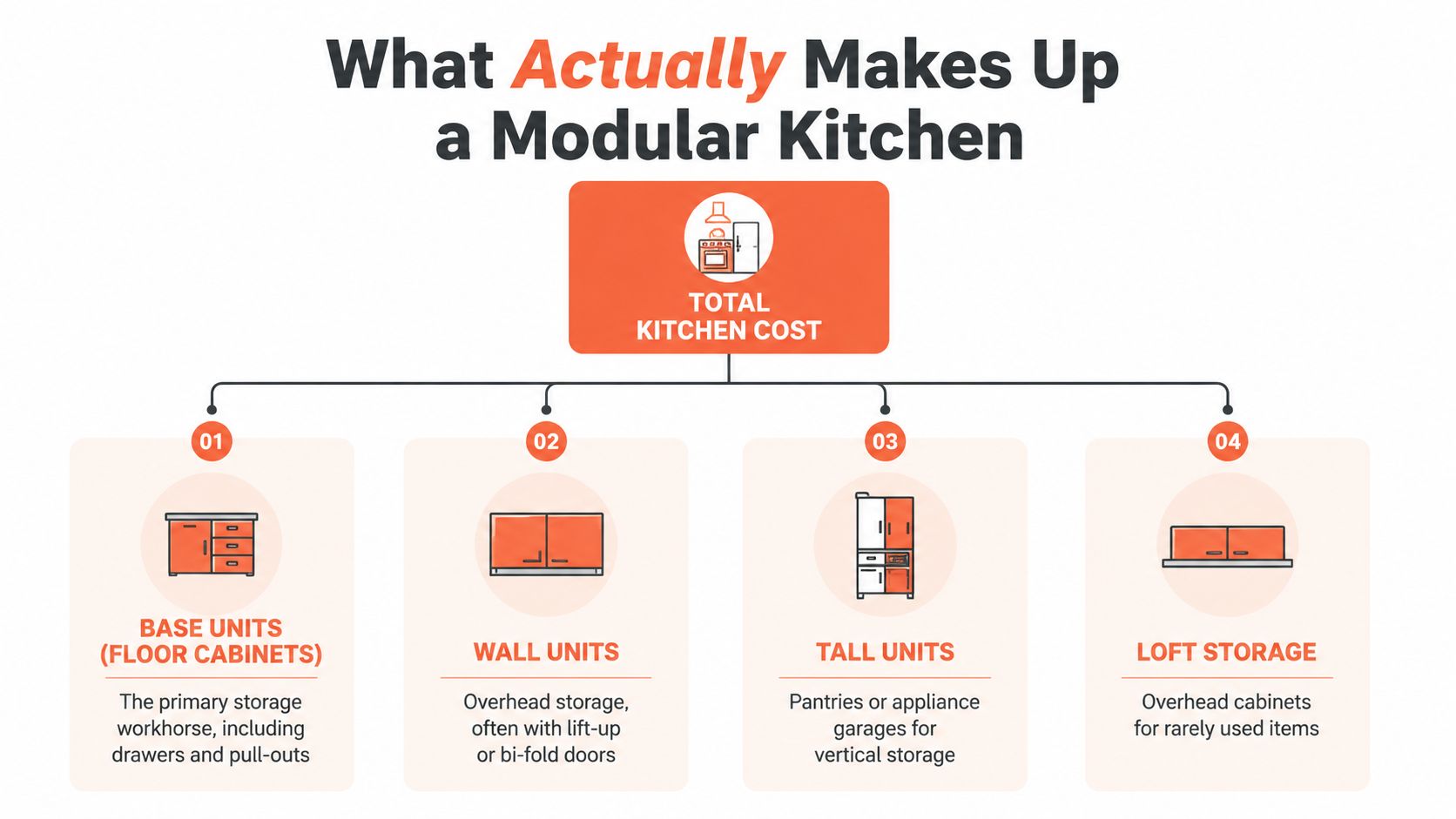
The skeleton, the face, and the fittings
The structure starts with base units, wall units, tall units, and loft storage. Base cabinets do the heavy lifting below the counter. Wall cabinets carry lighter storage overhead. Tall units are the vertical pantries or appliance garages that eat up more material but also improve storage discipline. Lofts are useful, but they're still an added module, not a free extra.
Then come the visible and functional layers. Shutters and finishes decide the look, and that's where laminate, acrylic, PU, and veneer begin to separate fast on price. Hardware is the quiet budget spoiler, because hinges, channels, lift-ups, and drawer systems can change both feel and longevity. Accessories like pull-out baskets, cutlery trays, and corner solutions also add real money, even if they seem small when discussed one by one.
Countertops deserve their own line. Granite, quartz, and solid surface are not minor add-ons, they can shift the final quote materially. Installation, transport, and GST are separate overheads, and vendors don't always present them the same way. In India, modular kitchen cabinetry is generally classified under HSN 9403, with 18% GST applying to that classification source.
Why homeowners get misled by package pricing
Package pricing feels convenient, but it often mixes visible items with invisible exclusions. A vendor can say the kitchen starts at one number, then add the counter, the sink cut-out, the accessories, and the labour later. That's how an apparently modest quote becomes a much larger invoice.
A good kitchen quote should read like a parts list, not a sales poster. Ask yourself one simple question for every line. Is this included, excluded, or separately billed?
How Material Choices Drive Your Kitchen Cost
Material choice is the biggest lever you control, and Chennai homeowners should be blunt about that. If you choose a moisture-sensitive carcass or a high-gloss premium shutter, you are not just buying a look. You're buying a different service life, a different maintenance pattern, and a different final invoice.
Carcass and shutter tiers are not interchangeable
For Chennai, carcass material matters because humidity and routine cooking exposure punish weak boards. Marine plywood and other moisture-resistant boards sit at the safer end of the spectrum for coastal homes. Commercial plywood, MDF, and particle board can work in the right setting, but they are not equal in wet-risk performance. If a vendor refuses to name the board grade in writing, don't move forward.
Shutter finish is the most visible choice, and also the easiest place to overspend emotionally. Laminate is the sensible budget finish because it's practical and design-flexible. Acrylic gives a glossy premium look. PU pushes into a more high-end finish. Veneer looks rich, but it asks more from the homeowner in care and maintenance. For an overview of material selection logic, the guide on what material is best for a modular kitchen is worth a look before you finalise finish samples.
Component | Material Option | Approx. Cost Range | Durability & Notes |
|---|---|---|---|
Carcass | Particle board | Lower tier | Budget-friendly, but weakest fit for moisture-heavy homes |
Carcass | MDF | Lower to mid tier | Smooth finish potential, but moisture caution is real |
Carcass | Commercial plywood | Mid tier | More dependable for everyday use than fibre boards |
Carcass | Marine plywood | Higher tier | Stronger choice for humid Chennai conditions |
Shutters | Laminate | Lower tier | Practical, easy to maintain, wide design choice |
Shutters | Acrylic | Mid tier | Glossy finish, more visual impact, more cost |
Shutters | PU | Premium tier | Seamless look, stronger premium positioning |
Shutters | Veneer | Premium tier | Natural look, higher care requirement |
Countertops and hardware deserve separate scrutiny
A countertop is not just a surface. It's a distinct material decision with its own labour, cuts, and installation risks. Granite is usually the most familiar option, quartz sits higher up the budget ladder, and solid surface comes with a different aesthetic and care profile. Hardware is similar. Local fittings can keep the invoice low, but branded systems from names like Hettich, Hafele, and Blum generally raise the quote because they're tied to smoother motion, better load handling, and stronger documentation.
If your vendor bundles everything into one “modular” label, push back. Separate the carcass, shutters, hardware, countertop, and accessories on paper. That's the only way to see where the money is going.
Comparing Kitchen Quotes the Right Way
The safest way to compare quotes is to force them into the same structure. Don't start by asking which quote is cheaper. Start by asking whether the vendor has priced the same kitchen in the same way. That's the difference between a real comparison and a guess.
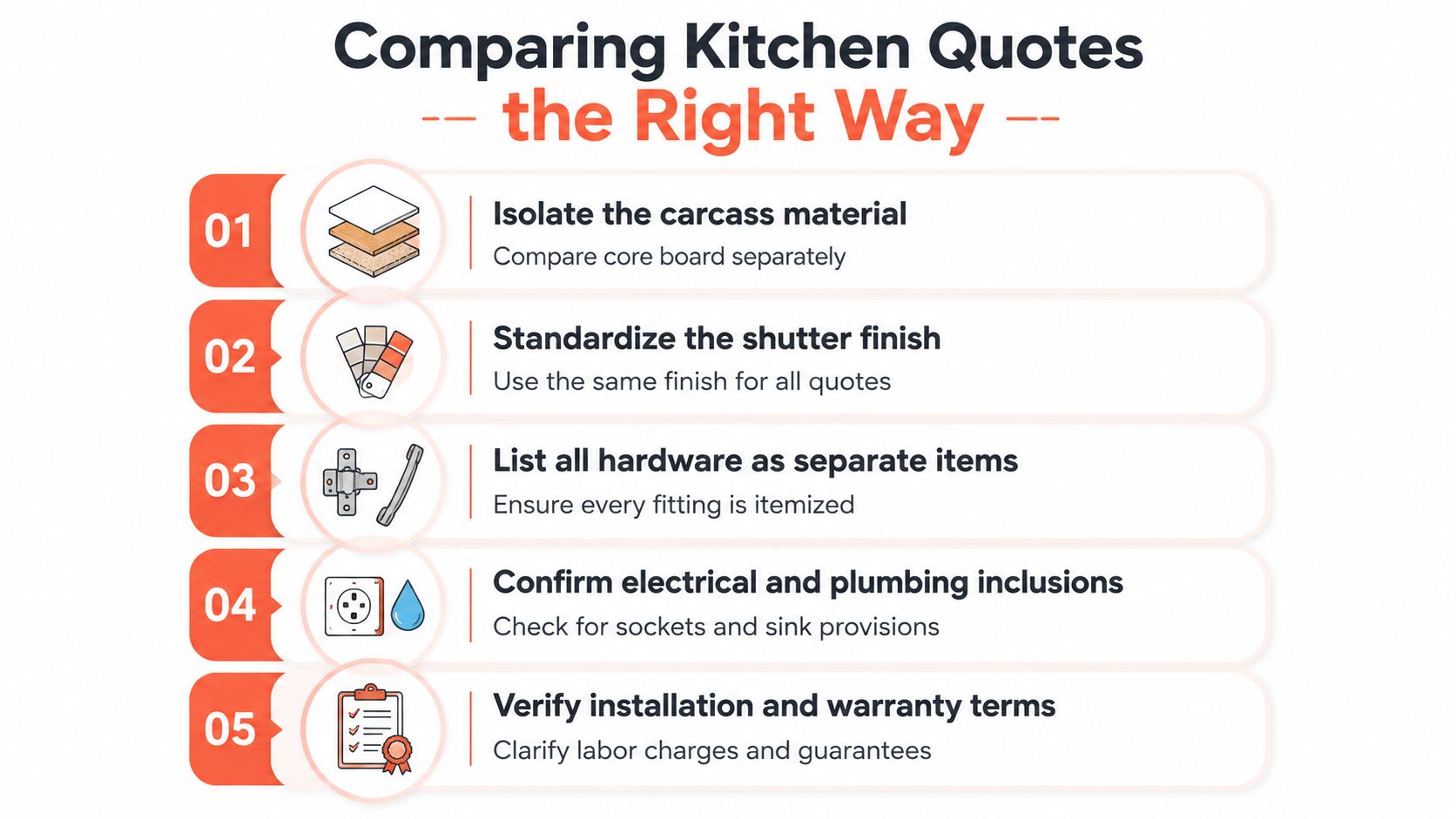
Lock down the same scope first
First, isolate the carcass material and thickness. A quote for plywood carcass and a quote for particle board carcass are not on the same footing. Next, verify shutters and finish. If one vendor has priced laminate and another has priced acrylic, the gap is expected, not suspicious.
Then separate hardware. Hinges, channels, soft-close systems, handles, lift-ups, and drawer runners should each be visible somewhere in the proposal. Accessories matter too. Pull-out baskets and corner units are often the first things omitted in a low opening quote and then added later when the design is already locked.
Countertop scope needs special attention because it can change the total quickly. In Chennai, countertop inclusion or exclusion can shift the budget by a meaningful amount, so ask whether granite, quartz, or solid surface is part of the base price or billed separately. For a line-by-line planning approach, the compare two interior quotes in Chennai guide is a useful companion when you're checking proposals from multiple vendors.
Installation scope is where quote honesty shows up
Ask whether the quote covers plumbing cut-outs, electrical points for built-in appliances, backsplash tiling, transport, unloading, and onsite adjustments. A bare-carcass proposal can look neat until the installer says the electrical work is extra. That is the moment many homeowners discover they never had a full quote in the first place.
Don't compare a cabinet-only quote against a fully loaded proposal and call the cheaper one a bargain.
Use a simple spreadsheet and list every vendor against the same columns, carcass, shutters, hardware, countertop, installation, GST, warranty, and exclusions. If a line is missing, treat it as missing cost, not free value. That habit alone saves you from most budget shocks.
The Hidden Cost of Choosing the Cheapest Option
The cheapest quote often feels sensible on day one. In a Chennai home, especially near the coast, that feeling can fade quickly if the materials aren't built for moisture, grease, and daily use. The core cost of a kitchen is not just what you pay now, it's what you pay again later.
Cheap boards and cheap hardware create repeat spending
Budget-grade particle board can look attractive on paper because the upfront figure is lower. The problem is that a weak carcass in a humid home is more likely to swell, lose edge integrity, and force replacement earlier than a sturdier build. That means you don't just lose the first payment, you also inherit repair anxiety and future disruption.
Hardware creates a similar trap. Non-branded hinges and channels can save money at installation time, but they tend to age badly under regular use. Shutters go out of alignment, drawers squeak, and service calls become part of the ownership experience. Reputable modular companies usually make the process easier because the hardware line and service terms are clearer from the start.
Warranty and after-sales are part of the price
Unorganised carpenters can disappear after installation. Established modular companies usually keep a defined after-sales path, and that matters if you plan to stay in the home for years. For homeowners comparing long-term support models, Interiors by DeX is one Chennai-based option that handles modular kitchens as part of end-to-end residential interiors, with structured installation and after-sales support.
A kitchen that needs repeated patchwork is not cheaper. It's just delayed spending.
Cost Factor | Budget Kitchen (Particle Board) | Quality Kitchen (BWP Plywood) |
|---|---|---|
Upfront spend | Lower | Higher |
Moisture tolerance | Weaker | Stronger |
Hardware reliability | Basic fittings | Better branded hardware options |
Service burden | More likely to rise | More controlled with proper installation |
Replacement risk | Higher over time | Lower when maintained properly |
Think in terms of ownership, not just purchase. A kitchen that survives daily use cleanly is the one that saves you money over time.
How Kitchen Layout Changes the Final Price
Layout is not only about convenience, it changes the bill. The more walls, corners, and cabinet runs you add, the more shutters, hardware, countertop length, and labour you need. That's why a kitchen that looks similar in photos can price very differently once the plan is measured correctly.
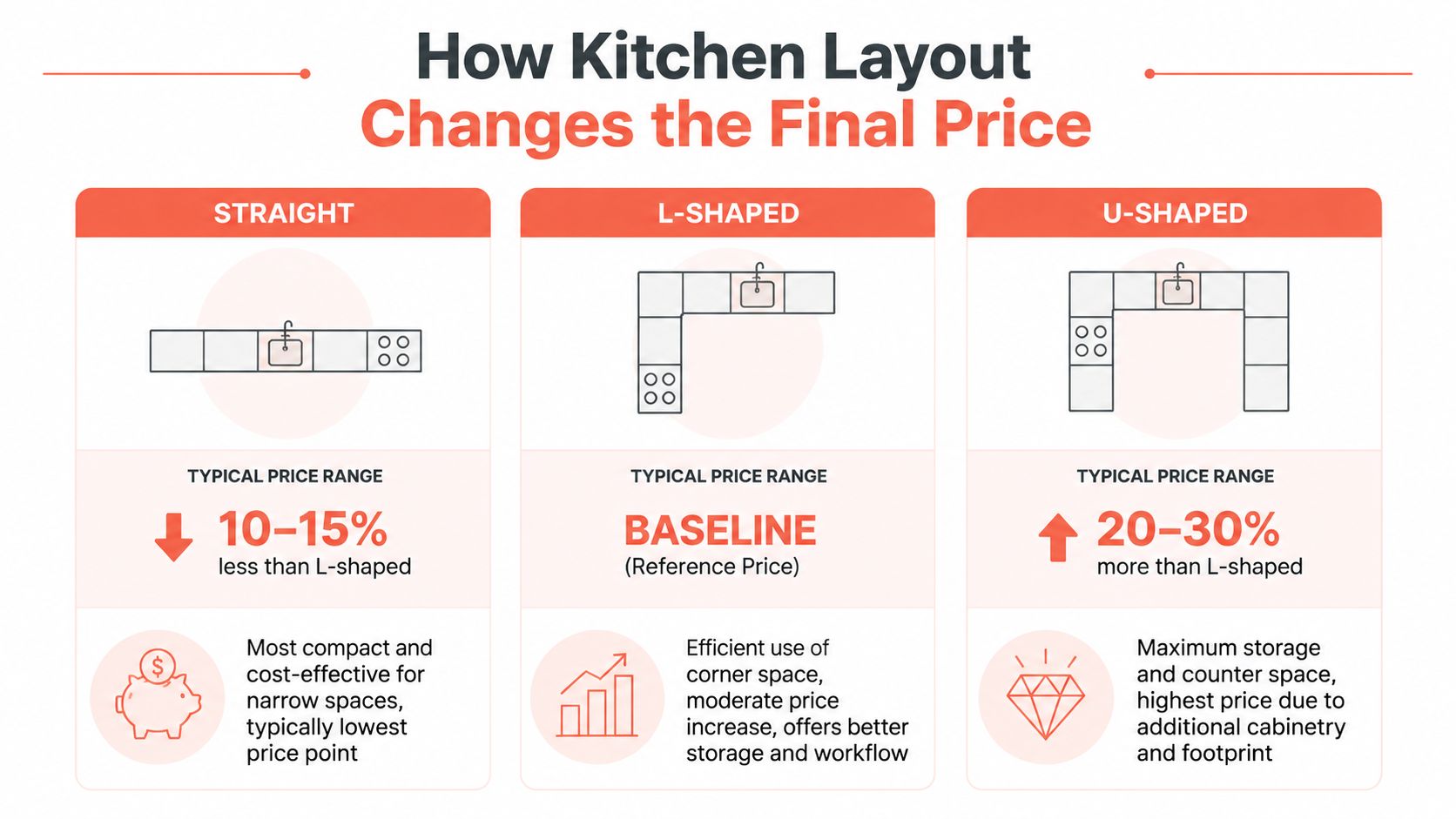
Straight, L-shaped, and U-shaped kitchens behave differently
A straight kitchen is the most compact option. It uses fewer modules, which keeps the budget tighter, but the trade-off is obvious. You get less storage and less counter room. A U-shaped kitchen uses the most cabinetry and countertop area, so it naturally climbs higher in price and makes more sense in larger villas and roomy apartments.
An L-shaped kitchen sits in the middle, and for many Chennai flats it's the most practical compromise. It creates a usable work triangle without demanding the footprint of a U-shaped layout. If you're planning a flat kitchen, the layout mistakes most homeowners make are often about clearance and corner use rather than finish choice, so the article on kitchen layout mistakes in Chennai flats is worth keeping open while you review drawings.
Match the layout to the home, not the mood board
Straight kitchens suit narrow rooms and modest budgets. L-shaped layouts fit many 2BHK and 3BHK homes because they balance storage and movement. U-shaped kitchens suit larger homes that can support more counter depth and more cabinet volume. Parallel and island layouts can work too, but they're premium decisions and should only be chosen when the floor plan genuinely supports them.
Use this rule. If the layout adds a wall, a corner, or an island, expect the price to move. Don't let a pretty render fool you into thinking material cost will stay flat.
Your Modular Kitchen Budgeting Checklist
A quote review should feel like a checklist, not a negotiation guess. Chennai homeowners need to ask the same seven questions every time, because hidden exclusions usually hide in the gaps between them.

The seven checks that protect your budget
Verify the carcass material and brand. If the quote doesn't name the board clearly, that's a red flag.
Confirm shutter finish and edge banding quality. Poor edge treatment shows up later as wear and swelling.
List all hardware by brand. Hettich, Hafele, Blum, or generic fittings should never be blurred together.
Itemise electrical points and appliances included. A quote that ignores these is incomplete.
Check plumbing fixtures and sink specifications. Sink cut-outs and plumbing support should be clear before work starts.
Clarify installation, masonry, and electrical labour costs. Many surprises arrive here.
Review warranty for products and labour. If the warranty language is vague, assume the after-sales support is too.
If you want a second checklist while reviewing execution scope, the practical notes at browse our helpful checklists from EZ Plumbing can help you think through plumbing and fit-out items more carefully.
What to ask before paying any advance
Ask for a line-item breakdown, not a lump sum. Ask what's included, what's excluded, and what can be added later only at extra cost. Ask how GST is shown, how delivery is handled, and what happens if site conditions force changes during installation.
The cleanest quote is usually the one with the fewest surprises, not the lowest first number.
A transparent proposal gives you control. A vague proposal gives the vendor room to rewrite the budget once work begins.
If you want a kitchen that's designed, manufactured, and installed with scope clarity from the first meeting, Interiors by DeX can help you compare materials, finishes, and installation details without the usual quote confusion. For Chennai homeowners, that's the difference between chasing hidden costs and signing off on a kitchen you can budget for with confidence.