
You're halfway through renovating a Chennai flat when the kitchen decision becomes unexpectedly difficult. The contractor has quoted a stainless steel setup, the modular showroom has shown you warm plywood finishes, and both options look convincing under showroom lights. Then you remember the damp corner below the sink, the pressure cooker that gets used every morning, and the monsoon moisture that never quite leaves the room.
That's the question behind stainless steel cabinets kitchen projects. Stainless steel isn't automatically superior, and plywood isn't automatically a compromise. The right choice depends on humidity, cooking intensity, cleaning habits, appearance, and how much inconvenience you're willing to accept during the next decade.
Why Chennai Homeowners Are Asking About Stainless Steel Cabinets
A family renovating an apartment in Adyar or along OMR usually starts with practical concerns, not design theory. Their contractor's quote includes plywood carcasses, laminate shutters, hardware, and installation. A stainless steel fabricator offers a different proposition, a cabinet system that won't swell at the sink, attract termites, or absorb repeated splashes from wet cooking.
Chennai makes those concerns more urgent. Coastal air, monsoon humidity, steam from pressure cooking, and frequent floor and counter washing put continuous stress on kitchen materials. A cabinet beside the sink may face damp cloths every day, while the unit under the counter can remain exposed to moisture long after the visible spill has been wiped away.
India already has a substantial stainless steel ecosystem. An industry report estimates stainless steel production and consumption at about 3.53 million tonnes and 3.56 million tonnes respectively in FY2024, and places the steel kitchenware market at around INR 15,000 crore, with projected annual growth of 10% to 15%. The same report links stainless steel's popularity in Indian kitchens to durability and suitability for premium home products, including cabinets and related built-ins. (Industry report on stainless steel kitchen cabinets)
Why the material has moved indoors
Stainless steel has crossed over from restaurants and institutional kitchens into upscale Indian homes because homeowners want surfaces that tolerate heavy cooking and repeated cleaning. Open-plan apartments have strengthened that interest. The kitchen is no longer hidden behind a door, so homeowners want storage that looks deliberate while coping with daily use.
Food hygiene also changes the conversation. A smooth, non-porous surface is easier to wipe after tamarind spills, oil splashes, and wet-grinder use than a damaged or poorly sealed wood-based edge. Independent market coverage identifies stainless steel as a leading material in India's cookware and kitchenware categories, with estimates placing its share at about 27% in 2025, or roughly 33.9% to 35.1% in 2025 to 2026, depending on category scope. The same coverage identifies South India as the leading regional market with 31.4% share, a useful signal for Chennai households considering steel in high-use kitchens. (India cookware market coverage)
My Chennai design advice: Don't choose stainless steel because a showroom calls it indestructible. Choose it because your kitchen's moisture, cleaning, and cooking pattern justify the tradeoff.
If you're comparing materials across the whole home, this guide to material choices that keep interiors low-maintenance is a useful companion. The decision should be based on how your household lives, not on a single material's marketing promise.
What Stainless Steel Kitchen Cabinets Actually Are
A stainless steel kitchen cabinet is a storage unit made primarily from stainless steel sheet, with a cabinet box, shutters, shelves, drawers, and supporting hardware designed for residential use. The common grades discussed by fabricators include SS304 and SS202, although grade alone doesn't tell you whether the finished product has been built properly.
The cabinet maker first measures and plans the modules, then cuts and forms the sheet. CNC bending creates repeatable folds, while TIG or MIG welding joins frames, corners, and seams. The visible surface may receive a brushed, mirror, or matte treatment. A brushed finish has directional grain, a mirror finish reflects strongly, and a matte finish reduces glare.
Three construction approaches
Welded hollow boxes use formed steel panels joined into a rigid carcass. They can feel substantial and clean-lined, but the fabricator must control weld quality and alignment carefully. Poor seams can become visible, collect residue, or develop staining when moisture remains trapped.
Modular bolt-together systems use separate panels and connectors. They're easier to transport and replace, and they suit apartments where access is tight. Their success depends on accurate drilling, strong fasteners, and careful levelling during installation.
Hybrid systems combine a steel carcass with glass, laminate, or wood-look shutters. This is often the most comfortable compromise for a home where moisture resistance matters but an entirely metallic appearance would feel too severe.
Residential cabinets also differ from restaurant units. Commercial kitchens often use heavier construction and prioritise wash-down cleaning, while a home system must balance rigidity with manageable weight, refined detailing, quieter operation, and compatibility with appliances and stone worktops.
Hardware deserves the same scrutiny as the sheet. Ask about soft-close hinges, stainless steel drawer channels, magnetic catches, adjustable legs, and integrated handles. A cabinet may have a good steel grade but still disappoint if the hinges sag, the channels bind, or the drawers amplify every closing sound.
Why homeowners select it
Families usually choose stainless steel for four reasons: termite resistance, washability, heat tolerance, and moisture protection. The material is also described in India-focused kitchen guidance as 100 percent waterproof, heat-resistant, hygienic, and termite-proof, which explains its appeal in wet zones and monsoon-prone homes. (India-focused kitchen guide)
The visual language is modern and industrial. In a contemporary Chennai apartment with flat shutters, concealed handles, glass, and simple lighting, steel can look intentional rather than commercial. In a traditional home filled with warm timber, patterned tile, and soft fabrics, it needs balancing materials or it may look disconnected.
The Real Benefits That Show Up in Daily Use
Stainless steel earns its place through ordinary kitchen routines, not showroom photographs. Consider the morning sequence in a South Indian home: wet grinding, tempering, pressure cooking, rinsing vessels, wiping the counter, and preparing the next meal before the previous moisture has fully disappeared.
Hygiene where cooking gets messy
Tamarind water, turmeric, coconut paste, and oil splashes are easier to remove from a non-porous steel surface than from a swollen edge or chipped laminate. Stainless steel doesn't absorb moisture in the way wood-based materials can, so a properly finished cabinet face won't retain the same kind of stain or dampness at the surface.
That doesn't mean the kitchen becomes self-cleaning. Food residue still collects around handles, hinges, drawer gaps, and poorly sealed seams. The benefit is that the main surface gives you a simpler cleaning base, especially if your household wipes the kitchen several times a day.
Moisture around sinks and cooktops
The cabinet below a sink is where many material differences become visible. Repeated wet cloths, plumbing condensation, and small leaks can cause wood-based boards to swell at edges and joints. Stainless steel keeps its basic form when exposed to those conditions, provided the grade, finish, fasteners, and installation are appropriate.
The same applies near the stove. Oil mist and steam settle on shutters and side panels, while heat creates repeated changes in the local environment. Stainless steel is a practical choice where the cabinet sits close to burners, ovens, or a frequently used wet-grinder station.
Longevity and fire-related risk
A family cooking twice a day wants cabinet boxes that remain usable through years of routine wear. Stainless steel resists swelling, termite attack, and surface breakdown better than vulnerable wood-based construction, but it can still scratch, dent, stain, or fail at badly made joints.
Near a gas burner, stainless steel also offers a useful safety advantage because it doesn't ignite like a combustible wood-based panel. It isn't a substitute for correct gas installation, ventilation, or safe storage of oils. It gives the immediate cabinet surface better tolerance around a heat-heavy zone.
Appearance in an open-plan home
Brushed or matte steel can suit an open kitchen where appliances, lighting, and hardware already follow a contemporary vocabulary. A long, uninterrupted run of flat shutters can look crisp from the living room, particularly when paired with warm flooring, timber accents, or a textured backsplash.
Practical rule: Stainless steel pays back most clearly where the kitchen is wet, heavily used, frequently cleaned, and visually connected to the rest of the home.
These benefits depend on specification. A poorly welded low-grade cabinet won't perform like a well-built SS304 system, and a thin shutter can still dent. The grade, thickness, finish, and installation details matter more than the word “steel” printed on a quotation.
Honest Drawbacks Most Guides Glide Past
The first drawback is noise. A stainless steel shutter or drawer can produce an audible clang when it closes, and that sound travels easily through an open-plan Chennai apartment. During the morning rush, the kitchen may announce every drawer movement to anyone still in the living room.

Soft-close hardware, rubber buffers, internal liners, and correctly adjusted channels reduce the problem. They don't erase the harder acoustic character of metal. If your kitchen doubles as a family conversation area, ask to operate a completed installation before you sign.
Impact damage is visible and difficult to disguise
Thin panels, including the 0.5 mm to 0.6 mm sheets sometimes proposed for cabinet work, can dent when a pressure cooker falls against a shutter or a child swings a stool into a corner. Steel doesn't sand out the way a timber-based surface can, and a dented panel may need to return to the workshop rather than receive a quick on-site touch-up.
That's why thickness should be treated as a performance decision, not a small line item. A heavier residential shutter feels more stable, but it also adds fabrication cost and may require stronger hardware.
The look can feel too clinical
Photographs flatten sound, touch, and surrounding materials. In person, a full run of reflective metal can feel cold in a home built around warm wood, traditional tile, brass details, and soft lighting. Brushed finishes are more forgiving, but the overall character remains harder and more commercial than membrane, veneer, or acrylic cabinetry.
Mirror finishes bring another problem. They show fingerprints, cooking marks, and smudges quickly, especially around handles and drawer fronts. Stainless steel can also attract ferrous dust near fabrication or cooking areas, while mid-grade 202 stainless may show surface rust sooner in coastal Chennai humidity.
Cost and fabrication inconvenience
Custom steel work typically involves more specialised fabrication, site measurement, transport planning, and finishing coordination than a standard modular package. That can mean a higher upfront quote and a longer lead time. If your handover date is tight, confirm shop drawings, fabrication milestones, delivery access, and installation dates before paying an advance.
Grades, Finishes, and Maintenance That Decide Long-Term Performance
The specification sheet matters more than the showroom sample. For a Chennai kitchen, I'd review grade, thickness, finish, cleaning method, fasteners, and weld quality before discussing colour.
Start with the grade
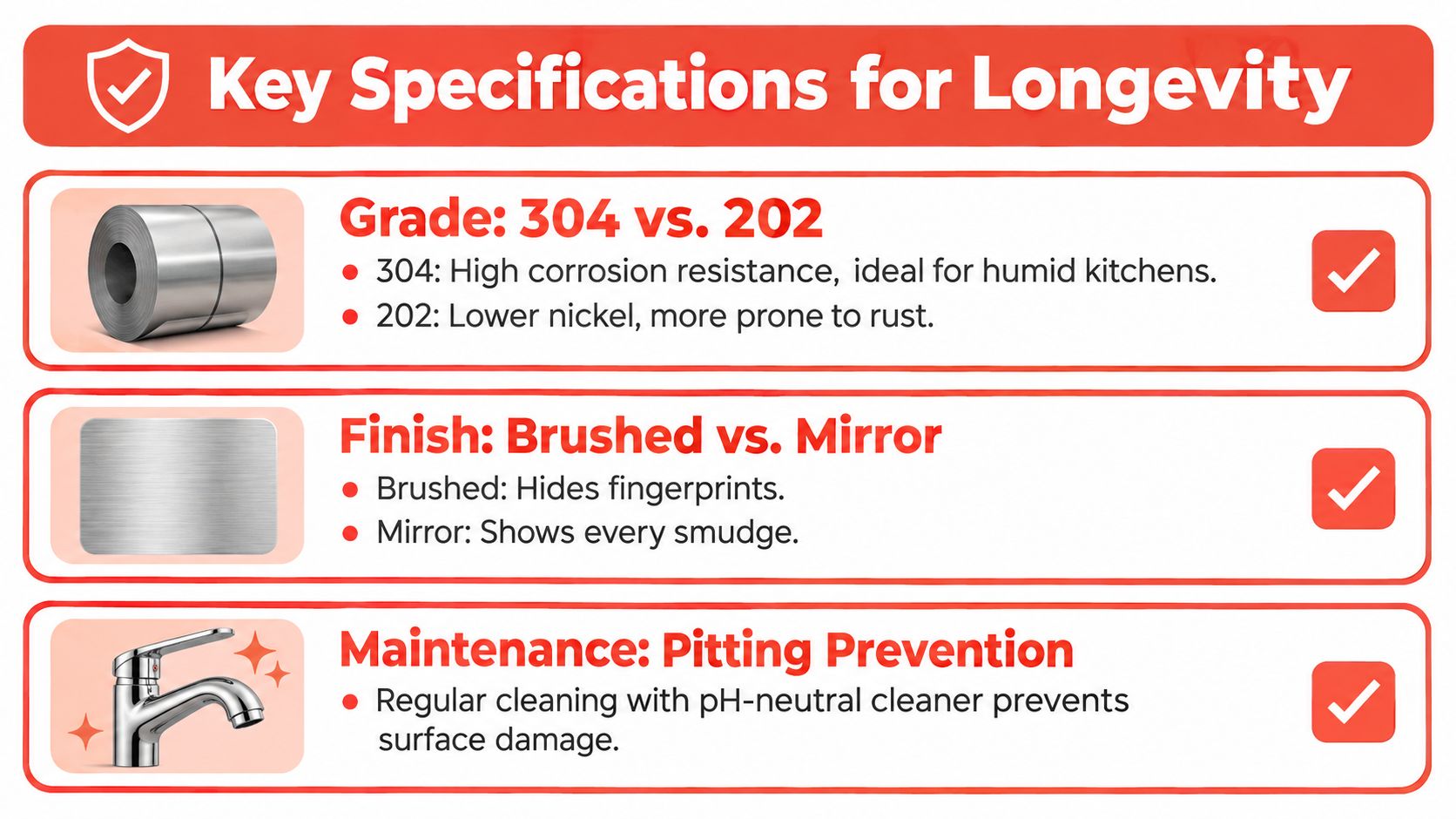
SS304 is the benchmark for residential kitchen cabinets in India. Its composition includes 18% chromium and 8% nickel, creating a stable passive oxide layer with strong general corrosion resistance, weldability, and finish flexibility. That makes it the sensible choice for humid and coastal conditions, especially around joints, edges, welds, and sink units. (Stainless steel cabinet grade guide)
SS202 is less expensive and may be considered for dry back-storage, utility cupboards, or areas with limited moisture exposure. I wouldn't specify it for the main sink run or a coastal kitchen where long service life is the priority. The practical issue isn't prestige. It's whether the material has enough resistance at the locations where water, salt, cleaning chemicals, and food residue remain in contact.
Indian technical specifications commonly call for 304 austenitic sheet with a 2B or polished finish, a chemistry range of 17% to 19% chromium, 7% to 9% nickel, and maximum carbon of 0.11. The smooth surface supports cleanability and reduces moisture absorption in daily use. (Indian technical specifications for stainless steel applications)
Thickness is not a decoration choice
For residential shutters, I'd favour 0.8 mm to 1 mm where the budget permits. Thinner sheets may look acceptable on a sample door but feel flexible in a full-height shutter, around a drawer opening, or beside a heavy appliance. Ask the fabricator whether the stated thickness applies to every visible panel, only the shutter, or only the outer skin.
For steel bars and flats, Indian Standard IS 6603:2001 covers non-precipitation-hardening wrought stainless steels and allows the purchaser to require corrosion-resistance testing using IS 10461 Part 1 and Part 2. That gives you a concrete quality question to put into a purchase specification. (Indian stainless steel standard information)
Choose a finish for your habits
Brushed or satin finishes hide fine marks and fingerprints better than mirror surfaces. Clean in the direction of the grain so the surface keeps a consistent appearance.
Mirror finishes reflect light and can make a compact kitchen look sharper, but they expose every smudge. I use them selectively, not across every drawer and shutter.
Matte finishes reduce glare and often sit comfortably in an open-plan room. Confirm how the finish is produced and repaired, because not every matte treatment responds to cleaning in the same way.
Keep the passive layer intact
Use a microfiber cloth and diluted mild detergent for regular wiping. Follow the grain on brushed panels, rinse away residue, and dry joints after cooking so tea-staining doesn't develop around seams. Avoid chloride-based cleaners, abrasive powders, and steel scrubbers, because they can attack the protective surface and leave scratches.
For practical care principles that also apply to sinks and vessels, this guide to cleaning stainless steel cookware is more useful than a generic polish advertisement. Inspect hinges and drawer channels quarterly, especially below the sink.
Put these items in writing before fabrication:
Grade: State SS304 or the approved alternative for every cabinet component.
Thickness: Record the sheet thickness for shutters, carcasses, shelves, and reinforcement.
Finish: Name brushed, mirror, matte, or another agreed treatment, with a physical sample.
Verification: Request a grade certificate and confirm thickness at delivery.
Fabrication: Review weld continuity, corner finishing, edge safety, and drainage around wet areas.
For a broader material comparison, this discussion of what material is best for a modular kitchen can help you organise the decision before you compare quotations.
Stainless Steel Versus Wood-Based Modular Cabinets
The fair comparison isn't steel versus “wood” in the abstract. It's a specified SS304 system against a specified BWR or marine plywood modular kitchen, with the same layout, hardware quality, worktop, accessories, and installation standard.
Criterion | Stainless Steel (304, 0.8-1 mm) | Wood-Based Modular (BWR/Marine Ply) |
|---|---|---|
Upfront cost | Usually higher, especially with custom fabrication and heavier panels | Usually easier to fit into a standard modular budget |
Lived-in feel | Cool, precise, reflective, and contemporary | Warmer, quieter, and easier to coordinate with traditional interiors |
Longevity | Strong resistance to moisture, termites, oil splatter, and heat when specified and installed correctly | Good moisture performance when properly selected and sealed, but vulnerable edges and joints need attention |
Repairability | Scratches may remain visible, while dents often require workshop repair or panel replacement | Scratched or faded shutters can often be refoiled, repainted, or replaced locally |
Cleaning | Non-porous and straightforward to wipe, but fingerprints may show | Finishes vary, and damaged or swollen edges are harder to clean reliably |
Best fit | Humid, coastal, high-use, hygiene-focused kitchens | Homes prioritising warmth, finish variety, quieter operation, and easier local repairs |
Cost needs a real quotation
I won't give you a fake universal per-running-foot price. Chennai quotes vary with grade, thickness, shutter treatment, drawer hardware, accessories, worktop, appliance integration, transport, and site access. The right comparison is a fully itemised proposal, not a headline rate that excludes handles, corner units, fillers, installation, or finishing.
A steel kitchen can also alter the rest of the budget. You may spend more on sound reduction, reinforcement for a heavy mixer or grinder, and careful coordination with a quartz worktop. If you're researching why homeowners need quartz slabs, consider the cabinet and counter as one load-bearing, moisture-exposed system rather than separate purchases.
Feel and repair tell different stories
Wood-based modular cabinetry wins on warmth. Membrane, acrylic, veneer, and laminate finishes can make a kitchen feel connected to a living room with timber furniture or warm painted walls. They also soften sound when drawers and shutters close.
Stainless steel wins where moisture and cleaning dominate. A 304 carcass is less likely to swell at a wet edge, suffer termite damage, or retain dampness from repeated splashes. But when a steel shutter dents, the repair usually involves removal and workshop work. A scratched wood shutter can often be repainted, refoiled, or swapped on site.
For Chennai homeowners comparing factory-made systems with local carpentry, this guide to modular versus on-site carpentry in Chennai provides useful context. My verdict is simple: choose steel for demanding conditions, and choose wood-based modular cabinetry when warmth, quietness, repair flexibility, and a lower initial commitment matter more.
When Stainless Steel Is the Right Call for Your Home
Choose stainless steel when your kitchen has heavy daily cooking, persistent humidity, frequent wash-down cleaning, or high termite concern. It's particularly suitable for a sink run, utility kitchen, semi-open layout, or home where several meals are prepared every day. It also makes sense for families who value a non-porous surface more than a soft, furniture-like appearance.
I wouldn't recommend an all-steel kitchen when the room is meant to feel like a warm gathering space, when the rest of the home relies on timber and traditional detailing, or when the budget can't absorb roughly 1.3x to 1.6x the modular wood price. That range is part of the stated decision framework here, not a universal Chennai rate, so insist on comparable itemised quotations before treating it as a budget rule. A hybrid solution may work better, with a steel carcass and warmer shutters.
Use this three-step buying process
Shortlist two fabricators. Ask each one to quote the same layout, grade, thickness, hardware, finish, and accessories.
Visit completed installations. Open drawers, close shutters, inspect sink units, and look at welds and corners in a lived-in kitchen.
Demand documentation. Get SS304 certification, thickness verification, finish samples, hardware details, and the installation scope before signing.
If your kitchen also needs display planning for crockery, appliances, or open shelving, look at established front-of-house display solutions for ideas on presenting functional storage without making the room look like a service area.
The best cabinet isn't the one trending in a Chennai showroom. It's the one matched to how your household cooks, cleans, stores, and lives.
Interiors by DeX plans and executes Chennai home interiors, including modular kitchen layouts, cabinet detailing, material selection, installation, and handover. If you're deciding between stainless steel, wood-based modular cabinetry, or a hybrid, visit Interiors by DeX with your floor plan and ask for a practical specification-led recommendation.