
You've chosen a premium colour for your new Chennai flat, the walls look smooth, and the handover photographs are attractive. A year later, the bedroom corner has mould, the living-room paint is peeling near the balcony, and a damp patch keeps returning behind the wardrobe. The problem may not be the colour or even the paint brand. It may be the wall system underneath.
Wall finishing materials influence moisture movement, cleaning, repair work, salt-air resistance and the time a surface remains presentable. Paint is only one layer. A durable result depends on the substrate, plaster, primer, putty, decorative surface and the conditions in each room.
Why Wall Finishes Matter More Than Paint Colours in Chennai

A homeowner may select a soft teal for the bedroom and a washable sheen for the kitchen, but those choices can't correct a leaking bathroom pipe or a cracked exterior wall. In Chennai, coastal humidity, salt exposure, slow drying and poor ventilation can make an attractive finish fail sooner than expected. The visible defect often appears on the paint, while the cause sits behind it.
The first question is what wall are you finishing? India's 2011 Census classified occupied houses by predominant wall material, including burnt brick, concrete, stone, mud or unburnt brick, wood, metal sheets and other categories. The classification is about the structural wall, not its visible decoration, so a painted or tiled brick wall remains a brick wall in the underlying system. The Census of India H-03 B dataset also provides information by state, Union Territory and district, with rural and urban separation.
Three questions to ask before choosing a finish
Is the substrate sound? Look for cracks, hollow plaster, powdering, laitance, salt deposits and previous dampness.
What does the room experience? A bedroom, bathroom, utility area and balcony need different moisture and cleaning strategies.
What maintenance will you accept? A textured panel may look distinctive, but patching it can be harder than repainting a flat acrylic surface.
Practical rule: A premium topcoat can't rescue unstable plaster, active seepage or poor preparation.
Cement remains a major part of this decision because plaster, mortar, concrete, repair compounds, tile adhesives and other systems rely on cementitious binders. India produced 426.29 million tonnes of cement in financial year 2023–24, according to the India Brand Equity Foundation cement industry summary. That national figure doesn't predict Chennai consumption, but it shows the scale of the cement-based construction and renovation ecosystem supporting common wall finishes.
Understanding Wall Layers from Substrate to Final Finish
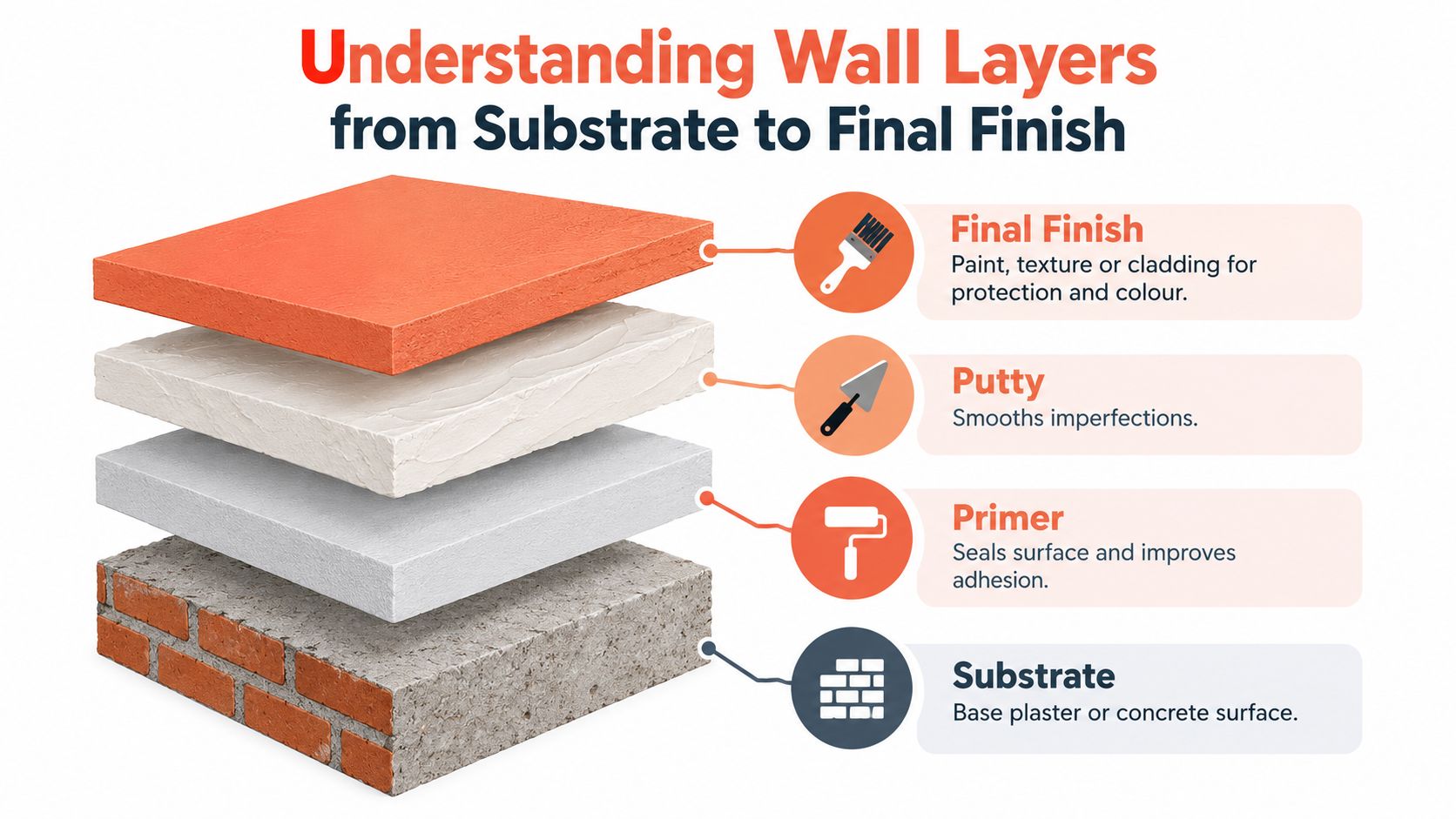
Think of a wall like a prepared canvas. The canvas material affects how the artwork behaves, and the paint can't compensate for a warped or damp surface. A Chennai apartment wall usually moves through several stages before the final colour or cladding appears.
The layers beneath the visible surface
Substrate: This is the structural base, commonly reinforced concrete, burnt brick or another masonry system. It controls movement, porosity, hardness and how moisture travels.
Plaster: Cement or gypsum plaster corrects unevenness and creates a workable plane. It acts like the levelling layer beneath a finished canvas.
Primer and putty: Primer helps control absorption and adhesion. Putty smooths minor surface imperfections, but it isn't a substitute for proper plaster or crack repair.
Final finish: Acrylic paint, mineral paint, texture, wallpaper, laminate, tile or a decorative panel provides the visible appearance and the final maintenance surface.
The order matters. Applying putty over dust, loose plaster or dampness may produce a smooth wall briefly, but the bond can fail. Wallpaper can bubble over a wall that continues to release moisture, while a decorative panel can conceal a defect without solving it.
Match preparation to the substrate
CPWD guidance identifies approximately 6 mm cement plaster or about 2 mm putty as suitable preparation over reinforced-concrete surfaces. AAC-block walls may require gypsum or cement plaster with galvanised-iron chicken-wire mesh, and gypsum plaster should be avoided in wet areas. The mesh helps manage stress at junctions where concrete, masonry and plaster move differently. These details are covered in the CPWD guidance on interior wall preparation.
A practical inspection should identify RCC, brick, AAC block or stone before the applicator specifies the build-up. At RCC and masonry junctions, the contractor should treat the joint, repair cracks and remove weak material before applying putty or paint.
Don't confuse a finish with waterproofing
Waterproof paint may reduce surface absorption in an appropriate application, but it won't reliably stop a plumbing leak, façade crack or rising damp. If the source remains active, a less breathable covering can trap moisture and move the failure to another part of the wall.
For plaster quality, thickness also matters. One Indian construction specification states that the average finished plaster thickness, excluding the key of masonry joints, should not be less than 15 millimetres. The construction specification makes this a useful quality-control reference before applying paint, wallpaper, panelling or tiles.
Common Wall Finishing Materials Compared for Indian Homes
Acrylic emulsion remains the practical default for many living rooms and bedrooms because it offers broad colour choice, straightforward touch-ups and accessible cleaning. A textured finish adds depth and can disguise minor visual variation, but matching a damaged patch is more difficult.
Cement plaster works well as a durable base and can remain visible in selected contemporary interiors when sealed correctly. Gypsum plaster creates a smooth interior surface, though it isn't appropriate for wet areas. Wall tiles handle splash zones and repeated washing, but grout lines need maintenance and damaged tiles can be disruptive to replace.
Laminate and decorative cladding panels create strong visual statements on TV walls, passages and selected bedrooms. They can protect high-touch areas, but the substrate must be dry and even. Permanently bonded panels also make future repairs more involved than repainting.
For bathroom work, don't treat a decorative tile surface as the entire waterproofing strategy. The membrane, junctions, falls and installation details matter before the tile is fixed. A useful reference on compliance concepts is legal requirements for bathroom waterproofing, although Chennai projects must still follow their own local specifications and site conditions.
Wall Finishing Materials Quick Comparison
Material | Moisture Resistance | Cleaning Ease | Repair Complexity | Cost Position | Best Rooms |
|---|---|---|---|---|---|
Acrylic emulsion paint | Moderate when the substrate is sound | Easy to moderate, depending on sheen | Low | Budget to mid-range | Living rooms, bedrooms, passages |
Textured finish | Moderate, product dependent | Moderate | Moderate to high | Mid-range | Living rooms, feature walls |
Cement plaster | Good as a base when detailed and cured properly | Moderate | Moderate | Budget to mid-range | General walls, service areas, exteriors |
Gypsum plaster | Suitable for dry interiors | Moderate | Moderate | Mid-range | Bedrooms, living rooms, dry areas |
Wall tiles | High in correctly detailed wet zones | Easy on tile faces, grout needs care | High | Mid-range to premium | Bathrooms, kitchen splash zones |
Laminates | Moderate, edge and joint dependent | Easy | High | Mid-range to premium | TV units, feature walls, high-touch areas |
Decorative cladding panels | Product dependent | Usually easy | Moderate to high | Mid-range to premium | Feature walls, passages, selected bedrooms |
Use the table as a starting point, not as a substitute for a site inspection. The same material can perform differently over a dry, well-cured wall and a wall with concealed dampness.
Chennai Climate Risks and How They Affect Wall Finishes
Chennai's warm-humid coastal setting changes the way a wall dries. Mould can develop in shaded corners, condensation can collect behind furniture, salt can mark exterior-facing surfaces, and repeated humidity can expose weak adhesion. A finish that performs well in a dry inland room may need different preparation here.

Read the wall before specifying the coating
Reinforced concrete, brick and AAC block don't absorb or move in exactly the same way. CPWD guidance recommends different preparation approaches, including mesh at dissimilar-material junctions. Internal walls should receive two or more coats of low-VOC premium acrylic emulsion over a prepared surface, while wet areas need a finish system suited to their exposure rather than gypsum plaster.
Before painting, the site team should:
Identify the substrate: Confirm whether the wall is RCC, brick, AAC block or another masonry type.
Repair visible defects: Remove loose material, treat cracks and correct laitance or powdering.
Check moisture: Don't seal a wall only because the surface feels dry on one visit.
Treat junctions: Use suitable mesh and joint detailing where materials meet.
Coordinate ventilation: Confirm that bathrooms, kitchens and utility spaces can release humid air.
The Chennai home renovation guidance from Interiors by DeX is a useful starting point for coordinating wall work with broader renovation decisions.
Condensation isn't the same as water ingress
A cool wall with surface condensation may show scattered mould or damp-looking areas that improve with airflow. Active water ingress usually follows a more persistent pattern, such as a spreading patch, a leak line, bubbling paint, salt deposits or dampness linked to rain, plumbing or a neighbouring wet area.
The response must match the cause. Improve extraction and airflow for condensation, but investigate plumbing, façade cracks, balcony details and rising damp when moisture is entering the wall. An impermeable decorative layer can hide the symptom and make later diagnosis harder.
For cement plaster, CPWD specifications recognise 12, 15 or 20 mm plaster thicknesses depending on location and conditions, while project specifications commonly use 20–25 mm for external surfaces. The CPWD specifications and schedule also reinforce the need for controlled thickness, curing, compatible primer and appropriate waterproofing treatment. Thickness should never be increased casually, because a thick single coat can shrink and crack.
Room-by-Room Wall Finish Recommendations for Chennai Homes
A good specification changes from room to room. The living room needs visual flexibility and occasional cleaning, while a bathroom needs water-tolerant construction and careful junction detailing. Treating every wall with the same paint system usually creates avoidable maintenance problems.
Living room and bedrooms
Use a sound plaster base, compatible primer and washable acrylic emulsion for most living rooms and bedrooms. A breathable mineral or lime-based finish can suit a dry, absorbent wall where the homeowner wants a softer, low-emission surface, but it needs skilled application and isn't a universal replacement for paint.
Avoid clay finishes on walls with persistent wetness. Clay can help manage water vapour in suitable conditions, but it won't solve seepage. For a feature wall, a removable panel system may offer better future flexibility than permanently bonding a fragile decorative surface.
Kitchen and utility area
The kitchen needs a finish that tolerates wiping, steam and occasional splashes. Use tile or another water-tolerant surface in the splash zone, with washable paint on the remaining wall where direct water exposure is limited. Seal joints and edges carefully, because water often enters through details rather than the centre of a panel.
Utility areas deserve more attention than many homeowners give them. Drying clothes, washing machines and service pipes can raise local humidity, so repair the substrate first and prioritise airflow over decorative complexity.
Bathroom
Use a waterproofing system below the finish, then choose tiles or another approved water-resistant surface for exposed areas. Gypsum plaster should be avoided in wet zones. Tile adhesive, grout, corners, pipe penetrations and wall-floor junctions need coordinated execution.
Balcony and exterior-facing walls
Balcony walls face rain, salt air and stronger temperature variation. Use a suitable cementitious repair and plaster system, resolve cracks and provide compatible exterior primer and coating. CPWD cost and specification documents identify water-thinnable cement primer with VOC content below 50 g/L, along with waterproofing cement paint applied in two or more coats for relevant uses. The CPWD DSR reference gives the specified new-work application rate of 3.84 kilograms per 10 square metres, which should be considered with preparation and the product's spreading instructions.
For homes with pets or frequent furniture movement, maintenance planning matters as much as colour. Guidance on how mobile detailers protect walls illustrates the broader value of selecting surfaces that tolerate contact and cleaning. For apartment-specific material decisions, pet-friendly finishes for Chennai apartments can help frame the choice around actual household use.
The Anti-Fungal Paint Myth and What Actually Prevents Mould
Anti-fungal paint can be useful as one part of a finish system, but it isn't a complete mould strategy. If a bathroom leak, façade crack, plumbing defect or condensation problem continues, the wall still supplies the moisture that mould needs.
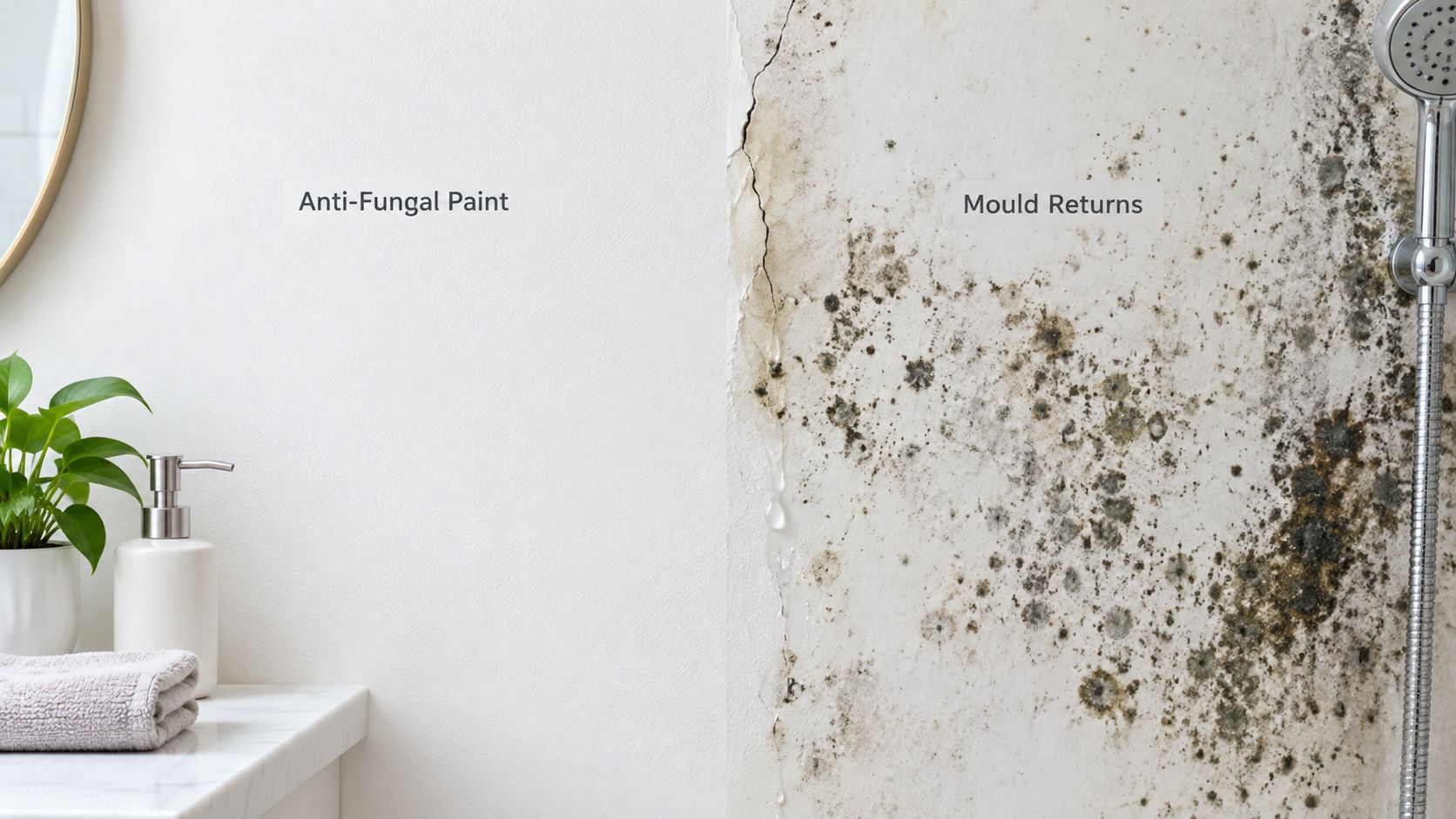
A common failure looks like this: a contractor cleans a dark patch, applies primer and adds anti-fungal paint. The wall appears fresh, but the bathroom exhaust remains weak and the dampness behind the surface isn't repaired. Mould returns at the same corner, while the new coating makes the original cause less visible.
Build a mould-control system
Find the water source: Check plumbing, external cracks, window edges, balconies and adjoining wet rooms.
Improve air movement: Use an effective exhaust fan in bathrooms and kitchens, and avoid sealing furniture tightly against damp exterior walls.
Select compatible layers: Primer, putty and paint must suit the substrate and moisture condition.
Clean safely: Remove affected material using an appropriate method before repainting. Do not just cover active growth.
Plan access: Leave inspection points around plumbing and avoid making every future repair destructive.
Some impermeable finishes can trap moisture, particularly when applied over walls that haven't dried properly. Breathable lime or mineral finishes may suit selected dry interiors, but they still won't make persistent water ingress acceptable.
The finish is the last line of the system, not the first repair.
Air filtration can support indoor comfort during remediation and cleaning, but it doesn't replace source control. Homeowners considering supplementary equipment can review options to shop air purifiers for mould, while keeping repair, ventilation and drying at the centre of the solution.
How to Choose Wall Finishes Without Regret
Start with the wall, not the colour card. A contractor should identify the substrate, inspect for dampness, test weak areas and explain the preparation system before discussing decorative upgrades. This approach prevents an expensive panel, texture or wallpaper installation from covering a defect that will later need removal.
Use a practical selection checklist
Substrate: Is the wall RCC, burnt brick, AAC block or another material?
Surface condition: Are there cracks, hollow areas, salt deposits, powdering or old adhesive?
Moisture source: Is the problem condensation, plumbing, rain penetration, façade failure or rising damp?
Room exposure: Does the wall face water, steam, furniture contact, salt air or frequent cleaning?
Primer compatibility: Does the technical data sheet support the substrate and selected topcoat?
VOC information: Check the product data sheet for the complete system, including primer, adhesive, sealant and panel substrate.
Repair method: Can a damaged section be patched without removing the whole finish?
Future changes: Will the finish allow repainting, access to services or a later renovation?
Application control: Has the team agreed on plaster thickness, curing, coat count and coverage?
Handover records: Keep product names, colour codes, batch details and maintenance guidance.
CPWD's housing-design compendium gives concrete VOC reference points for comparing paints. It lists interior flat coatings at less than 50 grams of VOC per litre and interior non-flat coatings at less than 150 grams per litre. For exterior coatings, it lists less than 200 grams per litre for flat finishes and less than 100 grams per litre for non-flat finishes. Use these limits as a technical comparison point, not as proof that the whole wall system has low emissions. The CPWD housing-design compendium is the relevant reference.
Think beyond the installation price
The cheapest finish can become expensive if it needs frequent repainting, difficult patching or complete removal after dampness. A more durable choice can also create future waste if it is permanently bonded and impossible to repair selectively. Removable panels, repairable plaster, documented material grades and low-emission water-based products can support a more manageable lifecycle where the wall condition allows them.
A sustainability review of Indian interiors has estimated that low-carbon and reuse-led substitutions can reduce embodied fit-out carbon by roughly 25–55%, with wall finishes, acoustic panels and insulation among the relevant categories. The Indian sustainable interior design discussion provides that reference, but homeowners should still assess product durability, maintenance and disposal rather than choosing a material only for its label.
For a coordinated apartment or villa renovation, low-maintenance material choices for interiors can help connect wall finishes with storage, flooring, lighting and daily use. Interiors by DeX is one Chennai-based option that coordinates residential design, material selection, painting support, wall panelling and site execution within turnkey interior projects.
Choose the finish only after the wall passes inspection. When the substrate is stable, the moisture source is controlled and the room's maintenance needs are clear, paint, tile, plaster, laminate or panelling can each work well. The regret usually begins when a decorative finish is asked to perform the job of a repair system.
If you're planning a Chennai apartment, villa or renovation, speak with Interiors by DeX about substrate checks, room-specific wall finishes, painting support and coordinated site execution. Share photographs, room use and any history of dampness so the team can help you select a finish that looks right and remains practical to maintain.