DE X INSIGHTS
Cost of Modular Kitchen in Chennai: A Practical Guide
A functional modular kitchen in Chennai typically costs ₹1.2 lakh to ₹5.5 lakh, with a working range of roughly ₹1,500 to ₹4,000+ per square foot depending on the layout, materials, finish, hardware, and accessories. A basic laminate kitchen sits near the lower end, while acrylic, PU, premium carcasses, stone upgrades, and dense storage can push the project much higher. Chennai modular kitchen pricing guidance supports this broad planning range.
You've probably reached the stage where the designer has asked for your kitchen dimensions, finish preference, chimney model, and hardware brand, but the quote still feels difficult to judge. One vendor may quote a compact figure for “modular units”, while another includes drawers, countertop, installation, and GST. Both may sound reasonable until you compare the actual scope.
After quoting and executing kitchens across Chennai apartments and villas, my view is simple: the cost of a modular kitchen is driven more by layout and specification density than by room size alone. Running feet, corners, drawers, tall units, shutter finish, carcass grade, and site work decide whether your budget stays controlled or expands quickly.
What a Modular Kitchen Actually Costs in Chennai
For a Chennai apartment, plan a functional modular kitchen within ₹1.2 lakh to ₹5.5 lakh. A broad working range is ₹1,500 to ₹4,000+ per square foot, while accessory-inclusive specifications can reach ₹2,000 to ₹4,500 per square foot. HomeLane's Chennai cost guide supports the lower planning range, and Saha Interiors' Chennai pricing breakdown records a sample total of ₹1,90,100 excluding GST. Treat these figures as planning bands, not fixed packages.
The bill is driven by cost density, not room area alone. Modules along the walls, corners, drawers, tall units, shutter finish, carcass board, countertop, and internal hardware all change the final number. Chennai material rates and installation conditions make a single national per-square-foot average a poor quoting tool.
Why size alone gives the wrong answer
An 8-rft straight kitchen can cross ₹3 lakh when it carries expensive shutters, several drawers, premium internal hardware, a tall unit, and a chimney. The run is short, but each section contains costly components.
A 14-rft U-shaped kitchen can stay below ₹4 lakh with mid-range laminate shutters, a practical carcass, standard granite, and fewer specialised accessories. It uses more cabinetry, yet its lower specification density controls the total. These are planning illustrations based on the layout-driven pricing pattern described in this Chennai modular kitchen cost guide, not fixed package prices.
Practical rule: Ask for the quote by running foot and component. Check the count of corners, drawers, lift-ups, tall units, and pull-outs before comparing totals.
National averages also hide Chennai-specific material choices. Marine plywood or BWP carcasses, acrylic shutters, PU finishing, and granite countertops carry different rates because supply, moisture requirements, factory finishing, and site installation vary. A vendor offering only one square-foot rate has not shown enough detail for a safe comparison.
Before signing, define what the package includes. The modular kitchen scope guide separates cabinets from countertops, appliances, civil work, plumbing, electrical changes, installation, and taxes. Use that checklist in the BOQ. A low headline price may cover cabinets only, leaving the items that make the kitchen usable outside the quote.
The Core Cost Drivers Behind Every Chennai Quote
Every Chennai modular kitchen quote should be read through four main lines: carcass, shutters, hardware, and countertop. If those lines aren't clearly separated, you can't tell whether a vendor is saving money through a sensible specification or excluding important work.
Carcass and shutters
The carcass is the structural box behind the visible doors and drawers. Chennai rate cards place marine-ply carcasses around ₹450 to ₹620 per square foot, acrylic shutters around ₹650 to ₹880 per square foot, and PU shutters around ₹1,100 to ₹1,400 per square foot. Homeli's Chennai modular kitchen price list attributes the higher rates to moisture-resistant board stability and the additional factory finishing required for acrylic and PU surfaces.
MDF and laminate builds can be more economical, but wet-zone usage needs care. For a Chennai kitchen, I prefer a water-resistant plywood specification around the sink and plumbing areas, with the board grade written into the BOQ rather than described loosely as “premium plywood”.
Hardware and countertop
Hardware includes hinges, drawer channels, tandem boxes, lift-up mechanisms, corner solutions, baskets, and internal organisers. It can consume a substantial portion of the quote because every drawer and moving mechanism adds a product cost as well as installation time.
Countertops also create a visible difference. Standard granite is commonly listed around ₹250 to ₹420 per square foot, while premium granite can reach ₹620 to ₹880 per square foot in the Chennai rate card cited above. Quartz and solid-surface tops need their own itemised rates because material, edge profile, cut-outs, supports, and installation can vary.
Component | Entry-Level (₹/unit) | Mid-Range (₹/unit) | Premium (₹/unit) |
|---|---|---|---|
Carcass | Lower-cost board or laminate build | BWR or BWP plywood specification | Marine plywood with higher-grade detailing |
Shutters | Basic laminate | Acrylic or textured laminate | PU or lacquered glass |
Hardware | Standard hinges and channels | Soft-close drawers and selected pull-outs | Branded tandem systems, lift-ups, and advanced corner hardware |
Countertop | Standard granite | Better granite or selected quartz | Premium granite, quartz, or solid surface |
The table is a specification guide, not a universal rate card. Ask the vendor for the exact board, thickness, finish, brand, quantity, and installation scope before accepting any “per unit” comparison.
Material Tiers from Laminate to PU Finishes
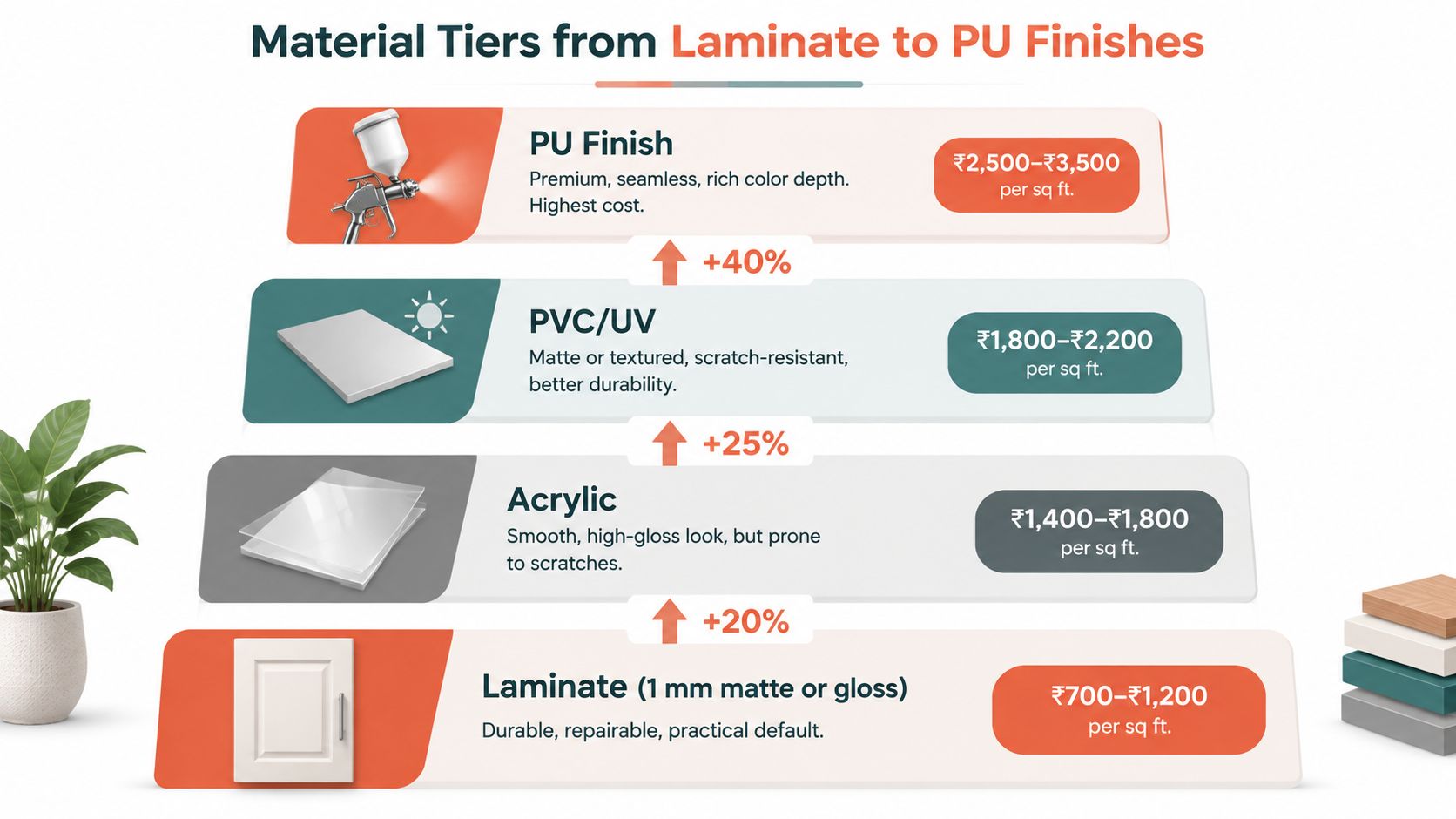
Finish selection should be treated as a price ladder, not a collection of equally priced colours. The practical Chennai default is matte laminate because it handles daily use, is easier to repair, and doesn't demand the surface discipline of a sprayed finish. Acrylic gives a more reflective appearance, while PU creates the richest continuous colour surface and the highest finishing commitment.
Laminate is the sensible starting point
A 1 mm matte or gloss laminate is durable, repairable, and forgiving in a busy kitchen. Matte laminate is usually my first recommendation for families who cook frequently, want predictable maintenance, and would rather spend their budget on better carcass protection or drawer hardware.
Acrylic delivers a smooth, high-gloss face and can make a compact kitchen look brighter. It also shows scratches more readily, especially on frequently handled shutters. Coastal exposure and direct sunlight deserve attention, so don't choose acrylic solely because it photographs well in a showroom.
Acrylic and PU need a reason
Acrylic can cost approximately 30% to 45% more per shutter than a basic laminate specification, based on the finish comparison provided in the brief. For a 10-rft kitchen, moving from matte laminate to PU can add approximately ₹60,000 to ₹90,000 to the quote, depending on the number of shutters, drawers, wall units, and finishing scope.
PU is a sprayed, finish with strong colour depth that looks continuous. It needs controlled factory or site application, careful surface preparation, and disciplined handling. If the vendor cannot explain where the PU work happens, how samples are approved, and how damaged shutters are handled, don't pay premium money for a vague finish description.
Use the material selection guide for modular kitchens when you're narrowing the choices. My recommendation is direct: choose laminate for most of the kitchen, use acrylic only where the visual effect matters, and reserve PU for a deliberate design feature rather than every shutter.
How Layout Choice Changes the Final Bill
Your layout sets the cost density of the kitchen. A straight kitchen keeps the budget controlled with one run, no corner mechanism, and fewer fillers. An L-shaped plan improves workflow but adds a second run and one corner. A U-shaped plan provides more storage, yet it needs two corner solutions and a larger cabinet count.
The extra cost comes from hardware and fabrication, not only from additional boards. Corner carousels, magic corners, dead-corner fillers, extra countertop joints, and lift-up hinges for upper shutters all raise the quote. In Chennai, each corner unit can add ₹18,000 to ₹28,000 in hardware alone, according to the supplied layout cost guidance.
Layout | Typical Running Feet | Corner Mechanisms | Approx. Cost Uplift vs Straight |
|---|---|---|---|
Straight | 8 to 10 rft | None | Lowest baseline |
L-shaped | More than one wall run | One corner solution | Roughly 25% to 35% higher |
U-shaped | Three connected runs | Two corner solutions | Roughly 50% to 70% higher |
Use these bands for planning, not as a fixed quotation. Chennai pricing changes with the number of shutters, drawer hardware, tall units, countertop joints, and finish selected. A straight layout remains the lowest baseline, while L-shaped and U-shaped plans carry higher cabinetry and corner-hardware requirements.
The floor plan decides the storage bill
For many Chennai apartments, an L-shaped kitchen offers the strongest balance between storage, movement, and cost. Choose a straight layout when the room is narrow or the budget is tight. Select a U-shape only when the room allows comfortable circulation. Tight parallel runs can force shallower countertops and cause doors and drawers to collide.
Before meeting a designer, review this guide to planning a 10 x 10 kitchen layout to understand how the room footprint affects work zones. Measure the available walls, appliance positions, window clearances, and passage width first.
Decide early whether you need wall storage, floor drawers, tall units, open shelves, or lift-up cabinets. Every choice changes the hardware count and installation effort, not just the appearance. My recommendation is clear: start with the layout that fits the room, then control the finish and accessories within that plan.
Labour Installation and Hidden Costs to Budget For
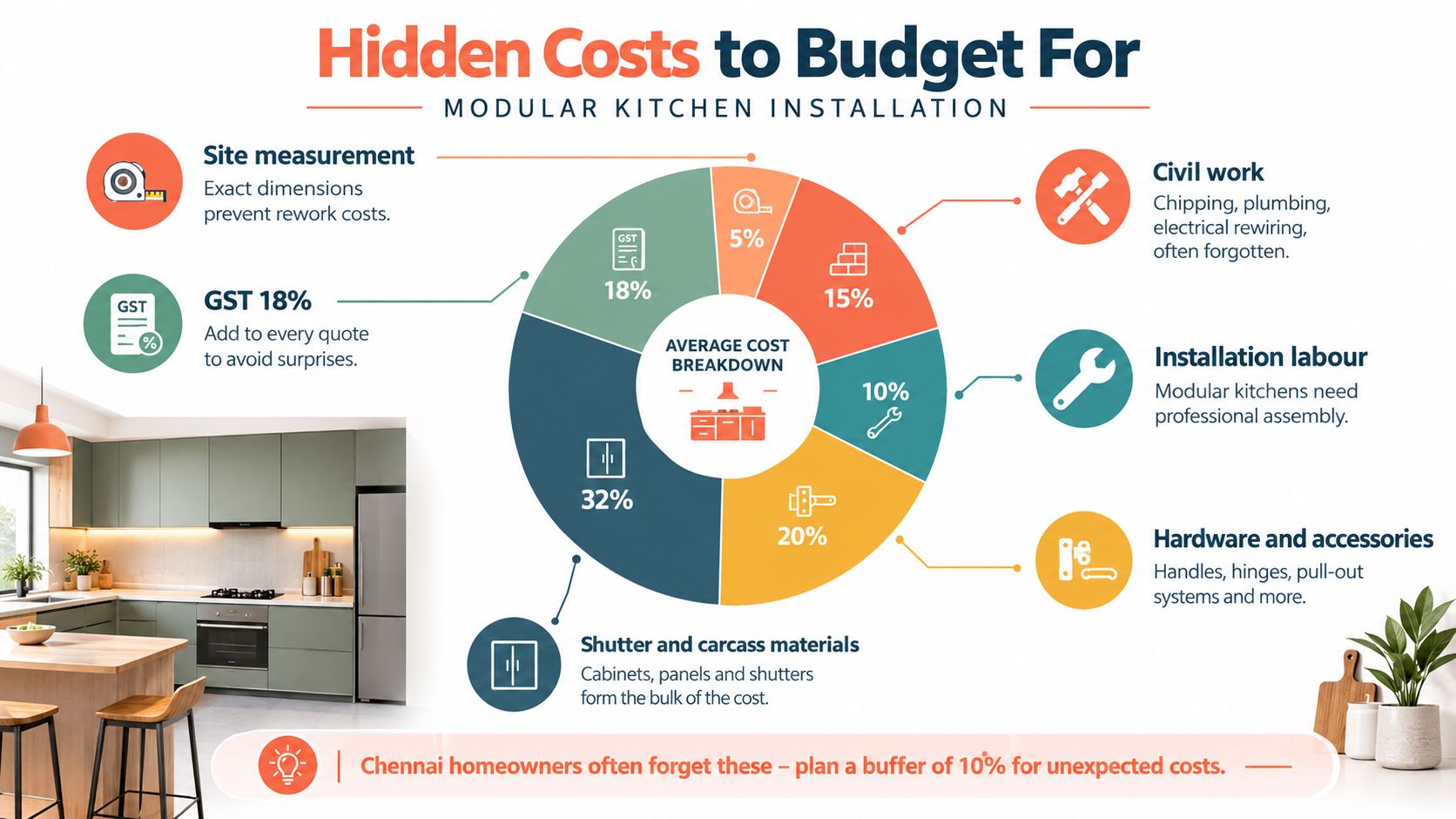
A modular kitchen quote becomes unreliable when it stops at the factory-made cabinets. Chennai homeowners often forget site measurement, demolition, plumbing changes, electrical relocation, installation, GST, and appliance coordination. These items may not appear in the first number shown by the designer.
For older apartments, civil and plumbing additions can range from ₹15,000 to ₹40,000, depending on the existing platform, sink location, wall condition, and utility changes. Installation labour is commonly planned at 8% to 12% of the modular package in the supplied Chennai budgeting guidance. GST on branded modular kitchen cabinetry is generally 18% under HSN 9403, as described in this GST guidance for modular kitchens.
Check the quote before you compare it
Ask these questions in writing:
Civil scope: Is old-platform removal, wall chasing, tiling, levelling, and debris removal included?
Utility work: Who moves plumbing, electrical points, gas lines, chimney ducts, and appliance sockets?
Installation: Does the price include delivery, assembly, levelling, cut-outs, handles, and final adjustments?
Tax treatment: Is GST included in the displayed total or added to the net value?
After-sales: What happens when a hinge, drawer runner, shutter, or edge band needs attention?
A hinge replacement may cost ₹350 to ₹600 per hinge, while acrylic or PU re-polishing can cost ₹80 to ₹120 per square foot after four to five years, according to the supplied planning guidance. Those aren't automatic expenses for every homeowner, but they show why hardware and finish warranties need clear terms.
A ₹3 lakh cabinet quote can become approximately ₹3.6 lakh to ₹3.8 lakh after hidden site work, installation, and tax are included. Treat that as a budget warning, not a guaranteed final total. The only dependable figure is an itemised, site-checked quote that says what is included and excluded.
A Sample Price Walkthrough for a 10-rft Chennai Kitchen
Take a 10-rft L-shaped kitchen with a mid-range BWR plywood carcass, laminate shutters, standard hardware, and a granite countertop. The point of this example isn't to promise one fixed price. It's to show how the cost of modular kitchen components stacks up, so you can replace one choice without rebuilding the entire budget from scratch.
The mid-range stack
The carcass and laminate shutters may account for approximately ₹1.5 lakh to ₹1.8 lakh. Board grade, shutter count, wall units, drawer faces, edge banding, and internal divisions make a difference.
Hardware for Hettich or Häfele hinges, tandem boxes, drawer systems, and one corner mechanism can sit around ₹45,000 to ₹60,000. Accessories such as bottle pull-outs and tandem dustbins can add ₹18,000 to ₹25,000, while countertop and dado work may add ₹25,000 to ₹35,000. Installation and GST then take the installed total to roughly ₹2.6 lakh to ₹3.1 lakh, depending on the final scope.
Component | Mid-Range (Laminate + Granite) | Upgrade Option | Cost Impact |
|---|---|---|---|
Carcass and shutters | ₹1.5 lakh to ₹1.8 lakh | Acrylic shutters | Add ₹40,000 to ₹55,000 |
Hinges, drawers, and corner hardware | ₹45,000 to ₹60,000 | Higher-grade systems or more drawers | Confirm after exact quantity |
Countertop and dado | ₹25,000 to ₹35,000 | Quartz countertop | Add ₹30,000 to ₹45,000 |
Bottle pull-outs and tandem dustbins | ₹18,000 to ₹25,000 | Additional organisers | Add according to selected accessories |
Installation and GST | Included in the worked total | Recalculate after substitutions | Total reaches roughly ₹2.6 lakh to ₹3.1 lakh |
The India modular kitchen pricing benchmark for 2026 places a standard 12-rft L-shaped kitchen with laminate, granite, mid-range hardware, and basic chimney and hob around ₹1.6 lakh to ₹2.5 lakh in metros. Premium PU or acrylic versions of the same layout can reach approximately ₹3.4 lakh to ₹5.2 lakh. The 10-rft example above is more useful for Chennai homeowners because it shows the substitution effect directly.
If your budget is tight, keep the laminate shutters and improve the carcass and drawer hardware first. If the visual finish matters most, upgrade selected shutters to acrylic rather than increasing every accessory at the same time.
Smart Steps Before You Finalise Your Kitchen Quote
The safest way to control your kitchen budget is to control the specification before the vendor starts designing. Start with accurate running footage, not an attractive reference image. Mark the sink, gas, chimney, refrigerator, dishwasher, purifier, and electrical points because each one affects cabinet divisions and service access.

Use this checklist before you compare proposals:
Measure the actual run: Record wall lengths, ceiling height, windows, doors, beams, and service ledges.
Mark utility points: Photograph plumbing, gas, electrical outlets, chimney routes, and appliance locations.
Choose three finish combinations: For example, laminate with granite, acrylic with granite, and laminate with quartz. This makes the price jump visible.
Demand an itemised BOQ: Carcass, shutters, hardware, countertop, accessories, labour, civil work, appliances, and GST must sit on separate lines.
Inspect completed work: Visit one finished Chennai project and one ongoing site from the same vendor. Check shutter alignment, edge bands, drawer movement, silicone work, and installation discipline.
For proposal comparison, the guide on how to read an interior proposal in Chennai is a practical reference. A good proposal should state the plywood grade, shutter finish, hardware brand, quantities, countertop material, installation scope, warranty, exclusions, and payment stages.
Before signing, confirm warranty terms for brands such as Hettich, Blum, or Ebco, and ask how the carcass is protected against water damage. A vendor should also explain who owns civil, plumbing, electrical, appliance integration, and after-sales work. Interiors by DeX offers Chennai homeowners an end-to-end route covering design development, modular manufacturing coordination, site execution, installation, handover, and structured after-sales support, with material selections and scope documented before execution.
Visit Interiors by DeX with your kitchen dimensions and utility layout to request a Chennai-specific, itemised modular kitchen proposal. Their team can help you compare laminate, acrylic, PU, carcass, hardware, countertop, installation, and GST choices before you commit to the final specification.