The most popular advice on engineered wood vs MDF is usually too vague to be useful. “Use plywood for strength and MDF for finish” sounds sensible, but it doesn't tell you which plywood grade, which MDF standard, or whether the board will face kitchen moisture, coastal humidity, heavy shelves, or repeated hinge movement.
For a Chennai home, the better question is not which material wins. It is which certified board, grade, thickness, and finish suits each location. MDF is itself an engineered wood product, while plywood is another engineered panel with a different structure and performance profile. The right specification depends on moisture exposure, structural load, screw retention, emissions, and execution quality.
A practical comparison looks like this:
Decision factor | MDF | Plywood and other layered engineered boards |
|---|---|---|
Core structure | Fine wood fibres bonded under heat and pressure | Veneers bonded in cross-grain layers |
Surface finish | Very smooth and uniform | Depends on face veneer and preparation |
Routing and profiles | Excellent for clean routed details | Possible, but edges may splinter |
Screw and hinge loading | Requires careful detailing, especially at edges | Generally more dependable for repeated loading |
Moisture exposure | Use the correct moisture grade, never assume all MDF is suitable | Select MR, BWR, or BWP grade according to exposure |
Typical Chennai use | Painted shutters, TV units, decorative panels in dry areas | Kitchen carcasses, long shelves, sink zones, humid applications |
Defining Engineered Wood and MDF Core Differences
The phrase engineered wood vs MDF creates a category error. Engineered wood is a broad family of manufactured wood products. MDF, or Medium Density Fibreboard, is one member of that family, alongside plywood, particleboard, and other panels made by bonding wood fibres, particles, veneers, or strands.
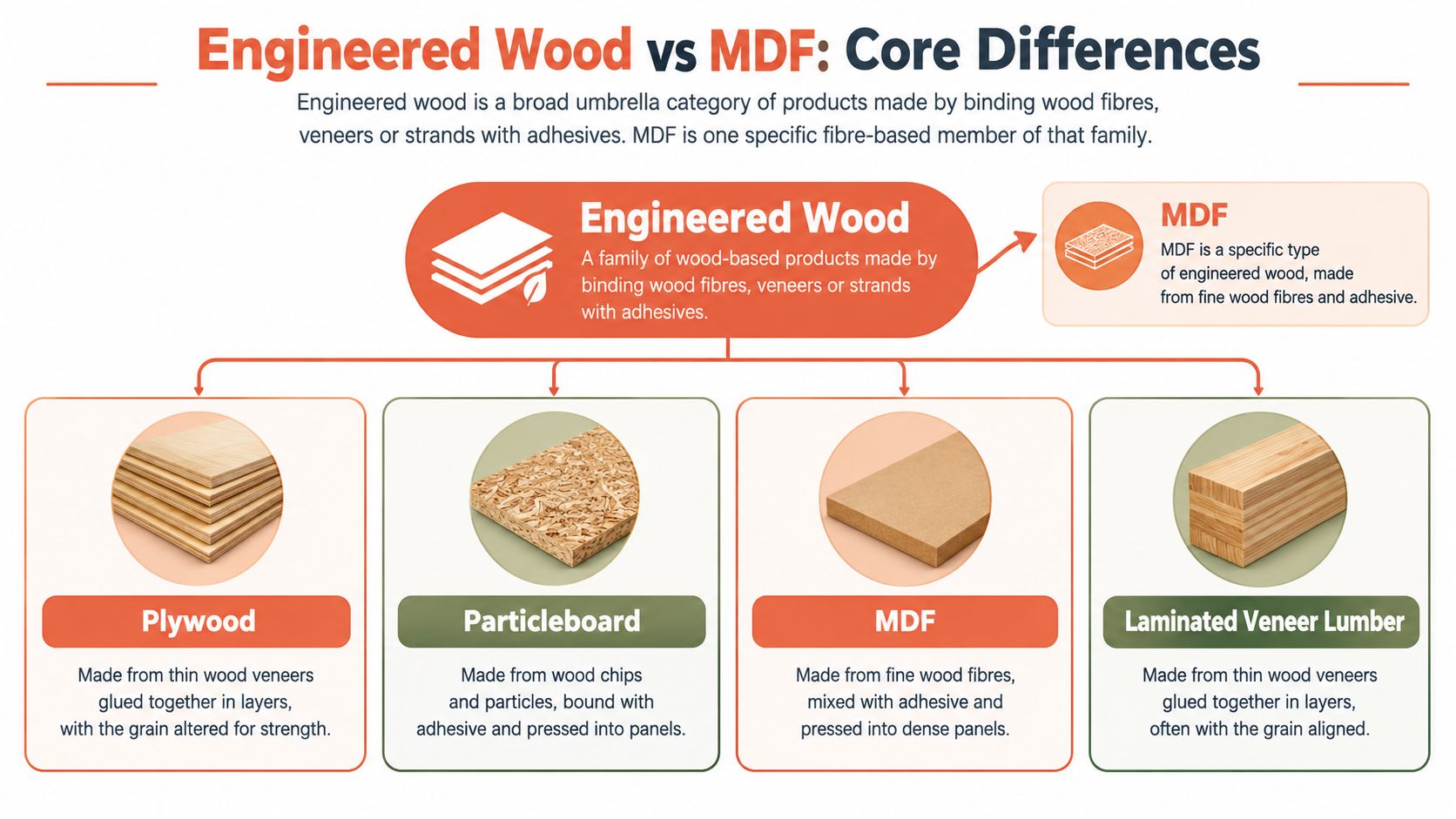
In Indian interior conversations, however, “engineered wood” often informally means plywood or a layered wood panel, while MDF is discussed separately. That shorthand is understandable, but it can hide the detail that determines performance. A contractor may say “engineered wood” without stating whether the core is plywood, particleboard, or another board. A homeowner should always ask for the exact product and applicable standard.
The standards behind the labels
For MDF, IS 12049 covers MDF for general purposes, while IS 14276 covers high-density fibreboard. IS 14587:2023 specifically addresses prelaminated MDF. This standard distinguishes Grade 1 for humid environments from Grade 2 for dry environments, and it separates applications into flooring, counters and tabletops, regular furniture, and vertical applications. Its performance criteria include density, moisture content, internal bond strength, modulus of rupture, modulus of elasticity, abrasion resistance, moisture resistance, dimensional accuracy, and formaldehyde content. These requirements are summarised in the BIS material and wood furniture standards overview.
Plywood follows a different route. IS 303 covers general-purpose plywood and identifies MR, BWR, and BWP grades by moisture performance. BIS revised IS 303 in 2024, with implementation required by 14 February 2025, and the revision changed modulus-of-rupture and modulus-of-elasticity requirements while extending mycological testing across grades. The board's name alone isn't enough.
Practical rule: Specify the board standard, grade, thickness, density, and intended location. “Premium board” isn't a specification.
This is why a dry bedroom wardrobe and a kitchen sink cabinet shouldn't receive the same material just because both are “interior furniture”. MDF can be the better substrate for a painted, routed shutter. A suitable plywood grade can be the safer choice for a loaded carcass exposed to humidity. Homeowners looking at international kitchen examples may also find this cabinet material advice for DC homeowners useful, but Chennai projects still need Indian BIS documentation and local moisture planning.
Comparing Structural Strength and Moisture Resistance
A cabinet doesn't fail because its label is wrong. It fails because the board was asked to handle a load, joint, or moisture condition outside its practical capability. Plywood's cross-layer construction generally gives it stronger behaviour under repeated screw loading and bending. MDF offers a dense, even panel, but its fibre structure is more vulnerable at exposed edges and after water enters the core.
BIS evaluation reflects this difference through measurable properties. MDF is assessed for density, moisture content, modulus of rupture, modulus of elasticity, internal bond strength, screw-withdrawal strength, water absorption, and thickness swelling under the relevant standard. The IS 12406 MDF documentation places MDF in an approximate 600 to 900 kg/m³ density range and differentiates grades for dry and more humid service conditions.
Where the board carries the load
MDF's smoothness doesn't automatically make it structurally stronger. A long wardrobe shelf, wide loft shutter, or hinge-intensive door puts repeated stress into screw holes and spans. Plywood or another structurally oriented panel is usually more forgiving in these conditions, especially when the design includes central supports, sensible spans, and properly drilled hardware positions.
A published BIS summary reports Grade I MDF at approximately 600 to 800 kg/m³, with a minimum MOR of 30 N/mm² for boards thicker than 12 mm and minimum internal bond strength of 0.60 N/mm². These are grade benchmarks, not universal values for every board sold in the market. The same BIS MDF performance summary supports checking the actual board declaration rather than relying on density alone.
Material Type | Screw-Holding Capacity | Moisture Swelling Risk | Best Structural Application |
|---|---|---|---|
Standard MDF | Acceptable when detailed correctly, weaker at vulnerable edges | High if water reaches the core | Dry decorative panels, painted shutters, light-use components |
Moisture-classified MDF | Better than standard MDF for its stated service condition | Reduced, but still requires edge protection | Selected shutters, counters, and furniture components where the grade matches exposure |
MR plywood | Strong layered construction | Moderate, suitable for controlled interior moisture | Dry-room carcasses, wardrobes, study furniture |
BWR or BWP plywood | Strong screw retention and load behaviour | Lower risk when certified and sealed correctly | Kitchen carcasses, sink-adjacent furniture, utility and humid zones |
Standard interior MDF should be restricted to dry wardrobes, TV units, shutters, and decorative panels unless the product has a documented moisture grade suited to the location. Kitchen sink cabinets, utility zones, and bathroom-adjacent storage need moisture-resistant MDF or a suitable plywood grade, with sealed edges and protected drillings. The low-maintenance material guidance for interiors is useful when translating this distinction into actual furniture details.
Evaluating Finish Compatibility and Machining Quality
MDF earns its place in high-quality interiors through its surface and machining behaviour. The panel has no natural grain, knots, or alternating veneer lines, so it provides a consistent substrate for paint, lacquer, routed grooves, mouldings, and decorative profiles. For a contemporary Chennai apartment with painted shutters or a detailed TV backdrop, that uniformity can save preparation time and produce a cleaner visual result.

Why MDF works well for painted details
A painted MDF shutter can receive routed profiles without the grain telegraphing through the finish. The same advantage applies to fluted panels, shallow grooves, custom display systems, and decorative wall elements. CNC routing is predictable because the material is relatively uniform across the panel, while plywood can reveal veneer variation or splinter at an edge if the tool, blade, or feed rate isn't suitable.
Plywood remains effective for laminate and veneer applications, particularly when the furniture needs structural strength beneath the finish. Its face quality matters, though. Knots, patches, core gaps, and uneven surfaces can require additional preparation before painting. For a laminate-clad kitchen carcass, that preparation may be less important than the board's moisture and screw performance.
Routing creates a new vulnerability
A routed groove exposes more of the MDF fibre core. The same clean machining that gives the shutter its appearance can increase the area vulnerable to humidity. Cut edges, hinge recesses, screw holes, and cable openings should be sealed before laminate or paint is applied. Edge banding is not a decorative afterthought. It is part of the moisture-control system.
Use a suitable primer or sealer on routed profiles and exposed edges, then inspect the finish for pinholes and incomplete coverage. A laminate on the front face can't protect an open edge underneath the shutter. Similarly, a painted panel that looks sealed from the room side may still absorb moisture through its back, bottom edge, or hinge cup.
For plain, flat, painted furniture in a dry, ventilated room, MDF can deliver excellent value and finish consistency. For a broad shelf, a heavy door with repeated hinge movement, or a location that receives wet cleaning, the substrate decision should return to load and moisture performance rather than appearance alone.
Navigating Formaldehyde Emissions and BIS Certifications
“Is MDF toxic?” is too broad a question to guide a purchase. MDF and plywood are wood-based panels that may use adhesive systems, and formaldehyde performance is a specification issue. The useful question is what emission class applies to the board, what test supports the claim, and whether the finished assembly includes other sources such as laminate adhesives, paint, or edge-banding glue.
BIS documentation refers to formaldehyde testing through methods including the perforator method. In the available IS 303 material, Class E1 is below 8 mg per 100 g of an oven-dry sample, while Class E2 is 8 to 30 mg per 100 g. These classes should be tied to a documented board test or conformity declaration, not used as loose marketing language. The BIS plywood product manual explains why a homeowner should request evidence for the actual product.

What to ask your contractor for
Request the board's BIS licence or conformity details, manufacturer identity, product standard, grade, thickness, density where applicable, formaldehyde class, and test documentation. The revised IS 12406:2025 framework includes formaldehyde-content and formaldehyde-emission requirements. BIS implementation guidance states that the revised standard is to replace the earlier standard after 9 February 2026, so project documentation should identify which framework applies.
A claim such as “eco-friendly”, “green”, “zero-emission”, or “low formaldehyde” isn't enough by itself. Ask whether the declaration applies to the raw board only, or to the completed cabinet after adding laminate, adhesive, paint, edge banding, and hardware. A low-emission core doesn't automatically make every finished assembly identical in indoor-air performance.
Identify the board: Record the manufacturer, standard, grade, thickness, and batch or product reference.
Check the emissions class: Ask for E1 or another documented class instead of accepting an unqualified “safe” claim.
Separate moisture from emissions: A low-formaldehyde panel isn't automatically suitable for a sink cabinet.
Review the whole assembly: Include adhesives, laminates, paints, and sealers in the indoor-air discussion.
Plan ventilation: Air movement after installation is sensible, especially in compact bedrooms and wardrobes.
For homeowners who want a broader overview of checking air quality at home, independent testing guidance can help frame ventilation and measurement decisions. For modular kitchen choices, this material guide for modular kitchens can also support a room-specific specification instead of a blanket board selection.
Analysing Costs and Long-Term Durability
The cheapest sheet isn't necessarily the cheapest furniture decision. The project cost includes cutting, edge treatment, hardware fixing, finishing, transport, installation, and the cost of correcting a swollen or sagging component later. MDF can be economical where its machining and finish advantages are useful, but a low initial material cost doesn't justify placing standard MDF in a wet or structurally demanding location.
Where MDF can reduce unnecessary spend
MDF is sensible for dry decorative elements, painted shutters, routed panels, and moderate-load furniture where the board grade matches the environment. Its consistent surface can reduce filler and preparation work, particularly for painted fronts. Prelaminated MDF can also simplify site finishing because the visible surface arrives prepared, although exposed edges and drilled areas still need attention.
Plywood costs more in applications where a stronger layered panel or a higher moisture grade is required. That premium is easier to justify in a kitchen carcass, a long unsupported shelf, a utility cabinet, or a shutter carrying repeated hardware movement. The relevant question is not whether plywood is more expensive. It is whether replacing the component later would cost more than specifying the correct board initially.
Count the hidden execution costs
A proper estimate should identify:
Edge protection: Edge banding, sealing, and treatment of routed profiles.
Hardware support: Pilot holes, hinge reinforcement, drawer fixing, and support blocks where required.
Span control: Centre supports or shorter shelves to reduce deflection.
Moisture detailing: Raised plinths, ventilation, protected backs, and separation from standing water.
Maintenance access: Removable panels and reachable plumbing around sink cabinets.
A hybrid specification often gives better value than using one board throughout. Plywood can handle carcasses, shelves, and high-load parts, while MDF can provide the painted shutter or routed decorative face. This isn't a compromise if the drawings clearly assign each material to the role it performs well.
Durability also depends on workmanship. A certified moisture-resistant board with unsealed cut edges can fail sooner than a correctly detailed board in a less demanding location. The board, finish system, hardware, and installation must be treated as one assembly.
Selecting the Right Material for Chennai Home Interiors
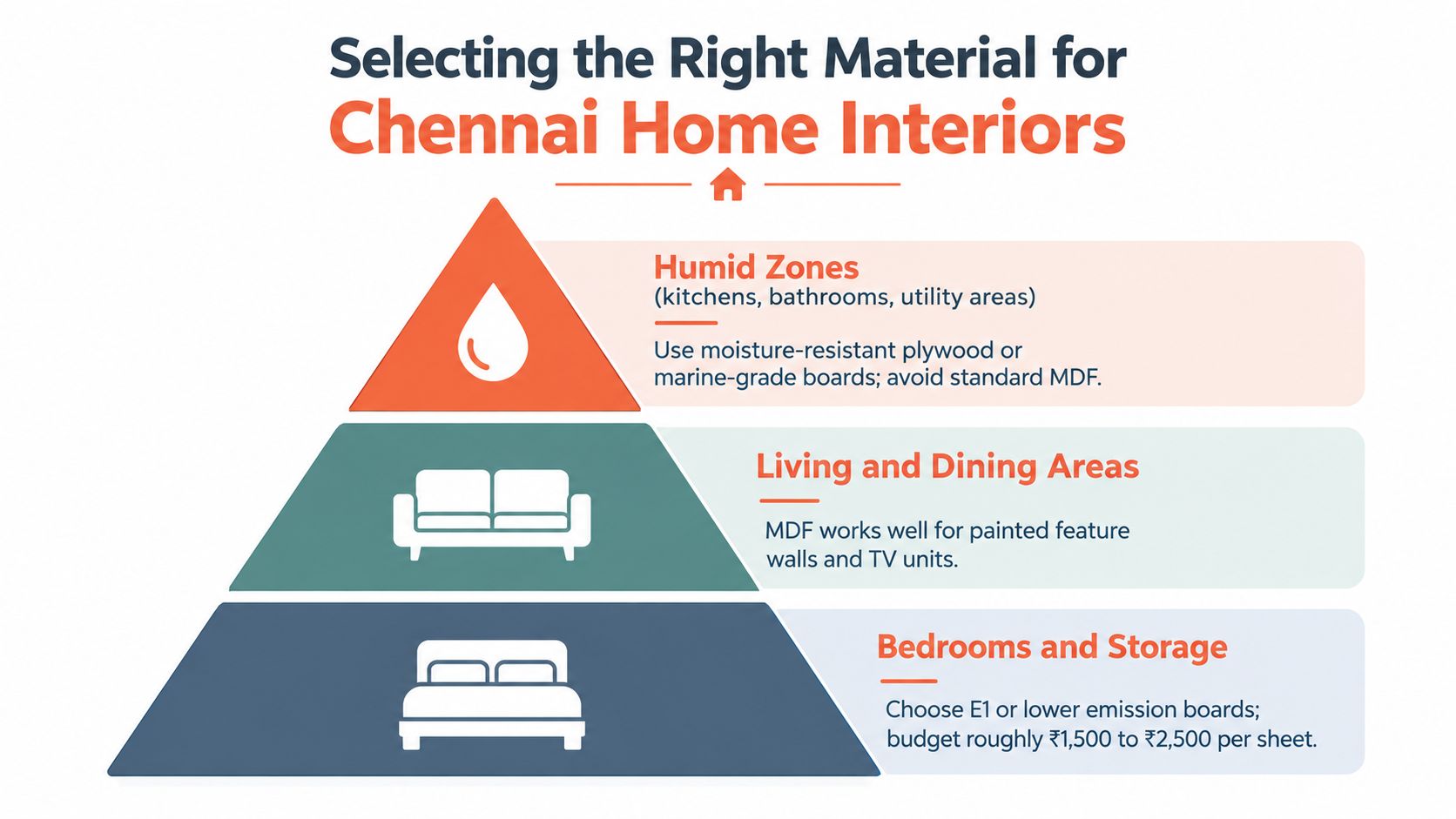
Chennai homes contain different micro-climates. A ventilated bedroom wardrobe is not equivalent to a sink cabinet. A living-room TV unit may remain dry, while a utility cabinet can experience wet clothes, cleaning water, and humid air. Material selection should follow these conditions instead of applying one brand or board type across the entire home.
Kitchen and utility areas
Kitchen sink cabinets need documented moisture performance, sealed edges, and protection around plumbing cut-outs. MR plywood is intended for controlled interior use, while BWR or BWP plywood is more appropriate where water exposure and humidity are material concerns. IS 303 differentiates MR and BWR grades by adhesive-bond performance, and its testing includes immersion in water at 60 ± 2°C for three hours, followed by eight hours of drying, before adhesion is evaluated. The IS 303 standard material also specifies plywood moisture content between 5% and 15% when tested under IS 1734 Part 1.
Don't accept “plywood” without the grade. Don't accept “moisture resistant” without a product document. Standard MDF belongs nowhere near a sink just because it has a laminate face.
Bedrooms and living spaces
For bedroom wardrobes, MDF works well for painted shutters and decorative profiles when the room is dry and the edges are sealed. A plywood carcass or shelf may be preferable where hanging loads, broad spans, or repeated hardware movement are involved. Choose a documented formaldehyde class for large installations in bedrooms, particularly where ventilation is limited.
Living-room TV units, display systems, and feature walls usually have less moisture exposure. MDF is practical for painted panels, grooves, and routed designs. Use plywood for shelves carrying substantial equipment or for components that need stronger fixing.
A simple room-by-room allocation
Kitchen carcass: BWR or BWP plywood, or a documented moisture-resistant panel suited to the location.
Sink cabinet: Moisture-resistant construction with fully sealed edges and protected plumbing penetrations.
Bedroom shutters: MDF for smooth paint or routing, provided the board and finish suit the dry environment.
Wardrobe shelves: Plywood where loads and spans are significant, with supports designed into the layout.
TV unit: MDF for painted decorative surfaces, plywood where shelf loading or hardware demand is higher.
Utility storage: Moisture-tolerant board, sealed edges, ventilation, and separation from wet floors.
Bathroom-adjacent furniture: Select a board with documented moisture and swelling performance rather than relying on laminate alone.
The ₹1,500 to ₹2,500 per sheet budget shown in the visual should not be treated as a verified universal market price. Board cost varies by product, grade, manufacturer, thickness, finish, and supplier. Ask for a line-item quotation that identifies the material instead of comparing only a total interior price.
Final Recommendations for Modular Furniture Specifications
A durable interior specification should be readable by the homeowner, contractor, fabricator, and installer. Write the board into the drawing and purchase order, not just into a sales conversation. “MDF for wardrobes” leaves too much room for substitution. “Prelaminated MDF, IS 14587:2023, Grade 2, dry furniture application, stated thickness and formaldehyde class” gives the site team something verifiable.
Use this handover checklist
Record the exact board: Note manufacturer, product name, applicable IS standard, grade, thickness, and density where relevant.
Match grade to location: Separate dry bedrooms, living areas, kitchens, utilities, and bathroom-adjacent furniture.
Request certification: Obtain the BIS licence or conformity details and the product test declaration.
Verify emissions: Record the formaldehyde class and ask whether the evidence applies to the board or finished assembly.
Inspect the edges: Check cut edges, routed profiles, hinge recesses, drillings, and cable openings for complete sealing.
Check structural detailing: Confirm shelf supports, hinge fixing, drawer hardware, spans, and reinforcement before final installation.
Protect from water: Inspect plinths, sink cut-outs, plumbing gaps, backs, and floor contact points.
Prevent substitution: Compare delivered sheets and labels with the approved material schedule.
The guide to preventing material substitution in Chennai interiors is particularly relevant during procurement and site execution. A substitution isn't harmless if it changes the board's grade, moisture classification, density, emissions declaration, or screw performance.
The most reliable specification is often hybrid. Use a structurally appropriate plywood or moisture-resistant engineered panel where the furniture carries load or faces humidity. Use MDF where a smooth, routed, painted finish provides a real design benefit. Then protect both with correct edge sealing, hardware installation, ventilation, and documented quality checks.
Interiors by DeX plans, coordinates, and executes Chennai home interiors, including modular kitchens, wardrobes, TV units, storage, and custom furniture, with material selections recorded for the project. Visit Interiors by DeX to discuss a room-by-room board specification that matches your home's humidity exposure, finish requirements, and long-term use.