DE X INSIGHTS
Kitchen Glass Door: Complete Guide for 2026

A toughened frosted or fluted kitchen glass door for a sliding opening is usually the most practical Chennai option, with IS 2553 compliance and a rough price of ₹400 to ₹2,000 per square foot, depending on the glass, frame, hardware, and installation. The right choice is not just the prettiest panel. It must also tolerate daily cooking, humid coastal air, grease, fingerprints, and the fabrication limits of safety glass.
You're probably dealing with a familiar Chennai apartment problem. The kitchen opens directly into the living or dining area, frying smells travel quickly, and a conventional hinged door takes up valuable circulation space. At the same time, a solid door can make a compact kitchen feel dark and closed.
A well-planned kitchen glass door creates separation without sacrificing light. Frosted or fluted glass hides countertop clutter, while a sliding system avoids a swing arc and helps contain cooking odours and airborne grease. The compromise is maintenance. Glass isn't automatically low-maintenance, especially in a kitchen where oil, spice splashes, humidity, and fingerprints are part of everyday use.
Why Kitchen Glass Doors Matter in Chennai Homes
In a Chennai apartment, the difference between a comfortable open-plan kitchen and an irritating one often comes down to how the opening is controlled. During breakfast, the kitchen may work well without a barrier. Later, while frying spices or preparing a large meal, the same opening can allow odours and grease to move into the living room. A kitchen glass door gives you the option to close the cooking zone while keeping the room visually connected.
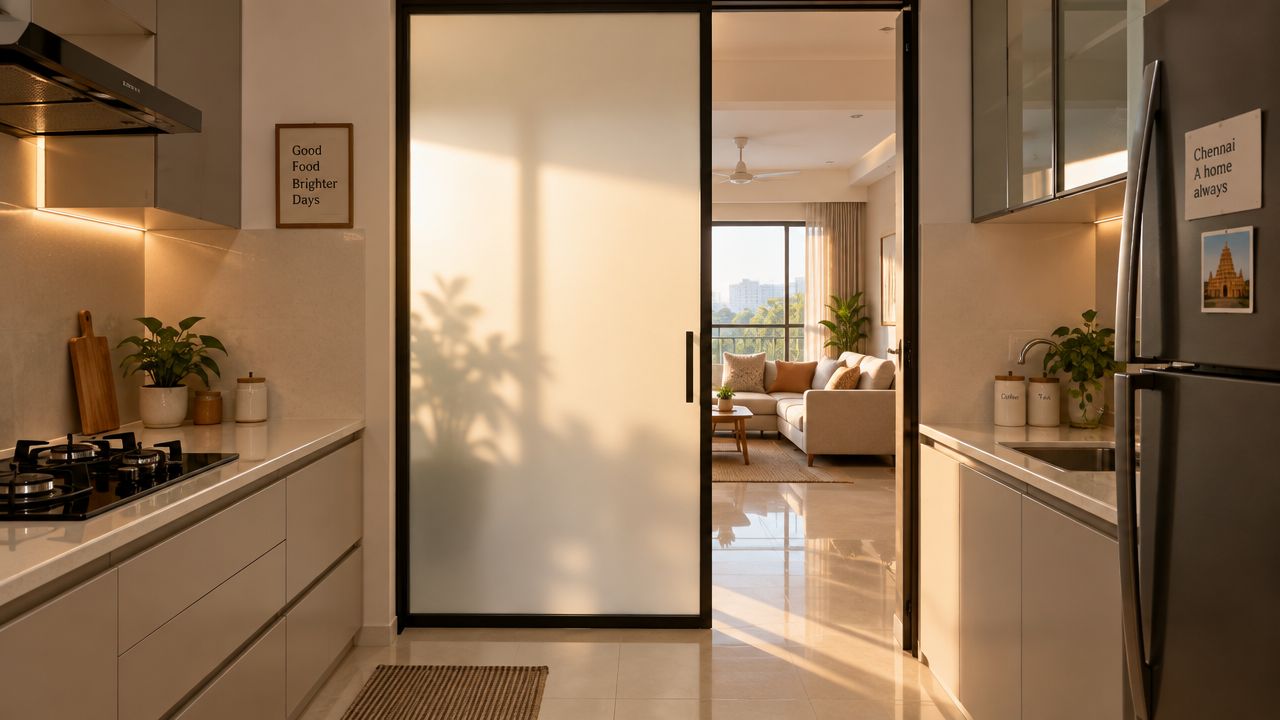
That visual connection matters in compact homes. Clear glass carries the most light but exposes every utensil and splash. Frosted glass softens the view, and fluted glass adds texture while still allowing daylight to pass through. In both cases, the door can make a narrow kitchen feel less boxed in than a solid laminate or timber panel.
The Chennai-specific trade-off
Chennai's coastal humidity affects more than the glass surface. It also influences frame finishes, tracks, rollers, hinges, and the speed at which water marks become visible. A door that looks excellent in a showroom may become frustrating if its track collects dust, its hardware is poorly aligned, or its surface treatment requires more cleaning than the household can manage.
Cooking habits matter too. Indian kitchens often involve tempering, deep frying, masala preparation, and strong spice aromas. A glass partition helps reduce the spread of fumes, but it doesn't eliminate grease. The location of the cooktop, chimney, sink, and door should be planned together so the panel doesn't sit directly in the path of splashes or exhaust discharge.
Practical rule: Choose glass to control visibility and light, but choose the configuration and hardware to control daily effort.
The category is no longer limited to decorative bespoke work. Indian B2B listings include Chennai among cities with large numbers of glass-door suppliers, alongside Bengaluru, Hyderabad, Delhi, Mumbai, Pune, Jaipur, Kolkata, Ahmedabad, Surat, Coimbatore, and others. That broad geographic presence reflects how glazed doors have become a mainstream interior component rather than a niche feature. For additional ideas on curved openings and decorative transitions, this collection of interior arch glass door inspiration can help you compare more expressive forms.
Understanding Kitchen Glass Door Types and Configurations
The best configuration depends first on the room, then on the appearance you want. A hinged door may suit a generous kitchen entrance, but it can obstruct a counter, walkway, or refrigerator when opened. Sliding doors usually make more sense in Chennai apartments because they use the wall zone beside the opening rather than claiming floor space.
Door Type | Space Requirement | Best For | Installation Complexity |
|---|---|---|---|
Sliding glass door | Clear wall length beside the opening | Compact kitchens and open-plan apartments | Moderate |
Hinged glass door | Clear swing arc in front and behind the panel | Wider openings with comfortable circulation | Moderate |
Folding glass door | Stacking or folding area at one side | Homeowners who want a wide connection to dining spaces | High |
Framed glass door | Frame depth and fixing points | Dust control, concealed connections, and added support | Moderate |
Frameless glass door | Precisely prepared fixing points | Minimalist interiors with carefully controlled tolerances | High |
Sliding, folding, and hinged systems
A sliding kitchen glass door works well when the adjacent wall can receive the panel. It avoids collisions with cabinet shutters and lets people pass through without stopping to manage a swing. Its weak point is the track. Poor alignment, debris, or low-quality rollers can make the door heavy and noisy.
Folding systems open a larger portion of the kitchen frontage. They suit homeowners who want the kitchen and dining zone to feel connected while entertaining, but the hardware carries more moving parts and needs careful coordination. Folding panels also require a suitable stacking zone.
Hinged doors provide a familiar action and can seal a small opening effectively. They're less forgiving in tight layouts, especially when the door opens towards a busy work triangle.
Framed and frameless choices
Aluminium or steel frames give the glass a defined perimeter and can make hardware connections easier to protect. They also add visual structure, which may suit kitchens with darker cabinetry or industrial detailing. Frameless doors create a cleaner appearance, but the installer must get drilling, hinge placement, clearances, and wall alignment right.
Full-height panels maximise openness, while smaller inset or cabinet-front panels offer a more controlled way to introduce glass. For a cabinet, the door weight, hinge capacity, shelf layout, and cleaning access matter as much as the glass finish.
Safety Standards and Glass Material Specifications
Safety should be settled before colour, texture, or handle design. IS 2553 (Part 1):2018 is the relevant BIS architectural safety-glass specification for building and general uses, including doors and partitions. It classifies architectural safety glass into toughened and laminated types. The BIS safety-glass quality control documentation identifies IS 2553 as the governing Indian standard for safety glass in buildings.
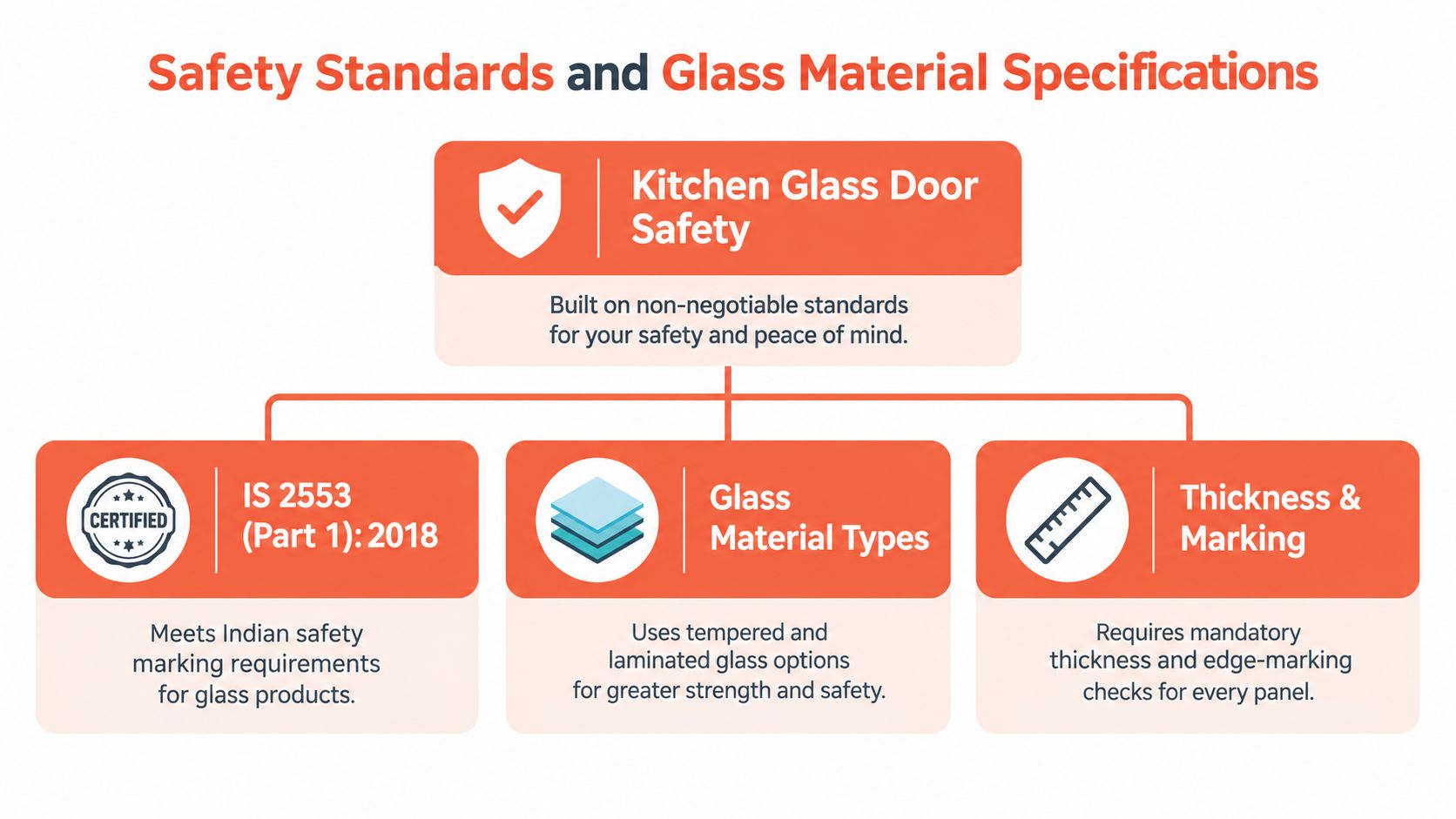
Toughened glass is generally the practical choice where the panel faces repeated handling and possible impact. Heat treatment creates high surface compression, and if the glass fails, it is designed to break into small, blunt fragments rather than long, sharp shards. That doesn't make an incorrectly installed door safe. Edge stress, misaligned hinges, excessive force, and badly positioned drilled holes can still create failure risks.
The decision that cannot be postponed
Every cut, hole, notch, and edge-finish decision must be completed before tempering. Once glass is tempered, post-tempering drilling or cutting can cause immediate failure. Handle holes, hinge cutouts, sliding fittings, lock positions, and soft-close components therefore need to be finalised before the fabricator places the tempering order.
Many avoidable delays begin here. A homeowner may approve a handle after fabrication, or a contractor may change the hinge position on site. With tempered glass, the solution usually isn't a minor alteration. It can require a replacement panel, new measurements, and additional installation time.
Industry and MSME guidance commonly describes toughened glass as offering about 4 to 5 times the resistance to mechanical shock and vibration of ordinary annealed glass, as documented in this toughened-glass technical reference. Treat that figure as a reason to specify the right material, not as permission to overlook installation tolerances.
What to verify before ordering
Ask the supplier for the applicable BIS marking and product specification. Confirm the glass type, edge treatment, planned holes, hardware model, and installation responsibility in writing. If you're comparing international terminology, this guide to meeting NZ toughened glass standards is useful for understanding how another market frames safety and compliance, but Chennai projects still need Indian requirements.
Before selecting the panel, coordinate the glass with the wider best material choices for a modular kitchen, particularly where cabinetry, appliances, and electrical points meet the door opening.
Choosing the Right Glass Finish and Surface Treatment
Finish selection controls two things at once: what people see through the door and how often you'll need to clean it. Clear glass gives the strongest connection between kitchen and living area, but it also reveals fingerprints, oil mist, water spots, and every splash near the sink or hob.
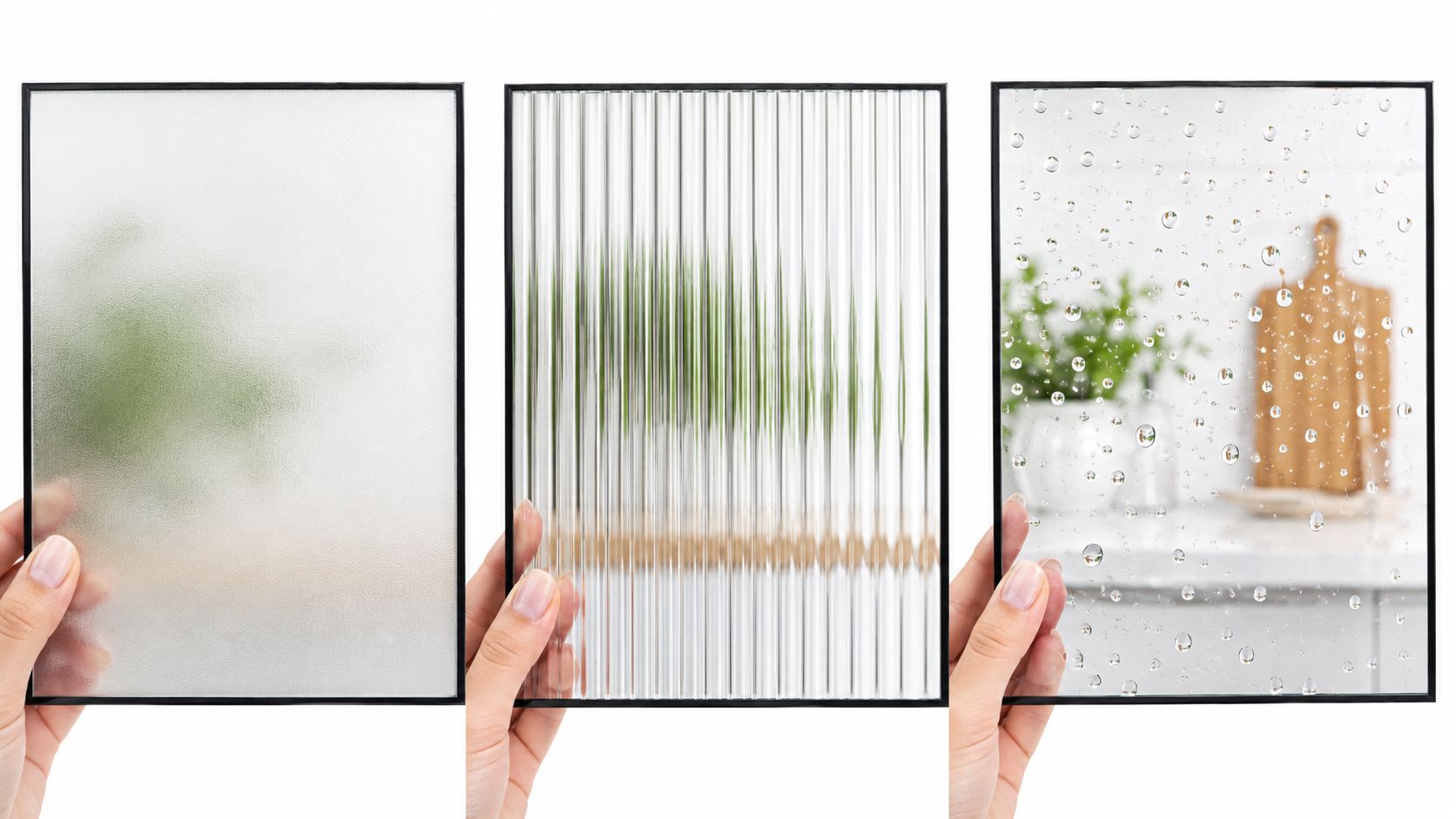
Frosted and fluted finishes are often more forgiving visually. They allow light through while reducing the view of clutter, which is valuable when the kitchen opens into a living room. They aren't maintenance-free, though. Grease can settle into texture, and a damp coastal environment can make water spotting more noticeable on some surfaces.
Match the finish to the way you cook
Use this practical comparison:
Clear glass: Choose it when light and visual openness matter most, and the household is comfortable wiping the surface frequently.
Frosted glass: Choose it when you want privacy from the living area and a softer view of shelves, appliances, and countertop activity.
Fluted glass: Choose it for texture and partial concealment, but check how easily the grooves can be cleaned before approving a deep profile.
Patterned glass: Choose it when you want stronger visual character and some concealment, while accepting that the pattern may make small stains less obvious rather than removing them.
The position of the panel matters as much as the finish. A door beside the sink will collect different marks from one beside the hob. If the door faces the cooking zone, a strong chimney and sensible clearances will do more for cleanliness than choosing a textured panel alone.
A workable cleaning routine
Wipe oil and spice residue before it dries. Use a soft microfibre cloth and a pH-neutral cleaner that won't attack the glass finish or frame coating. Avoid abrasive pads, harsh powders, and aggressive scraping, particularly on frosted or textured surfaces.
For Chennai homes, regular wiping also prevents humidity-related water marks from becoming a permanent-looking film. Include the edges, lower track, handle, and frame in the same routine. A beautiful panel can still feel poorly designed if the track holds dust or the handle remains greasy.
The finish should coordinate with the rest of the kitchen, including the cabinetry and storage layout. If you're setting a broader budget for a modular kitchen and its price, keep cleaning effort and hardware quality in the comparison, not just the panel rate.
Kitchen Glass Door Pricing and Value Considerations
Glass-door prices vary because buyers often compare different systems under the same name. A cabinet-front panel, a framed sliding partition, and a designer toughened door don't carry the same glass, hardware, labour, or installation requirements.
Indian marketplace listings show examples from about ₹400 per square foot for a standard kitchen glass door to ₹2,000 to ₹8,000 for different glass-door types, as reflected in India-specific kitchen glass door listings. Another market listing places the average glass kitchen cabinet price around ₹17,316, which reinforces the need to ask what the quoted figure includes.
Specification | Price Range (₹) | Best Use Case |
|---|---|---|
Standard kitchen glass door | Around ₹400 per sq ft | Basic glazed cabinet or partition applications |
Different glass door types | ₹2,000 to ₹8,000 | Buyers comparing varied finishes, formats, and specifications |
Glass kitchen cabinet listing average | Around ₹17,316 | A market reference for cabinet-front systems |
Toughened glass options | ₹17,500 to ₹25,000 | Higher-specification or designer door applications |
Glass-metal door average listing | ₹34,560 | Larger or combined glass and metal systems |
What changes the quote
A lower price may reflect a simpler panel, lighter hardware, fewer fabrication requirements, or installation being excluded. A higher quote may include toughened or designer glass, a metal frame, specialised hinges, soft-close hardware, tracks, handles, site measurement, delivery, and fitting.
Ask for an itemised quote covering:
Glass: Type, finish, thickness, edge work, and safety marking.
Frame: Aluminium, steel, or frameless fixing details.
Hardware: Hinges, rollers, handles, locks, and soft-close mechanisms.
Fabrication: Drilling, notching, polishing, and tempering.
Site work: Measurement, delivery, installation, alignment, and adjustments.
The cheapest panel often isn't the cheapest complete solution. If a track binds, a hinge pulls on a corner, or the surface is difficult to clean, the household pays through repairs and frustration. Framed or sliding formats can offer better practical value where dust control and space efficiency matter, even if a frameless hinged panel appears visually simpler.
Installation Process and Critical Decision Points
Installation starts before the glass reaches the site. Indian walls and openings rarely behave like perfectly square showroom samples, so the installer should measure the finished opening, wall plumb, floor level, adjacent cabinetry, skirting, and appliance clearances.
A dependable sequence looks like this:
Measure the opening: Record width, height, diagonals, wall conditions, and the final floor level.
Confirm the configuration: Decide whether the door is sliding, hinged, folding, framed, or frameless.
Freeze the hardware: Approve handles, hinges, rollers, locks, soft-close fittings, and fixing points.
Release fabrication: Send the final drawing for cutting, drilling, edge finishing, and tempering.
Prepare the site: Complete frames, tracks, backing supports, and surrounding cabinetry before delivery.
Install and adjust: Set the panel, align the track or hinges, test clearances, and check the closing action.
Hardware is a design decision
For a sliding door, the track must be level and adequately supported. Rollers should move without forcing the panel, and the installer should check that the door doesn't collide with a cabinet or wall return. For a hinged door, the jamb, hinge positions, handle height, and closing clearance need to work together.
Never ask a site team to drill a tempered panel because a handle feels too low. The fabrication constraint described in the safety section makes this a pre-order decision. A signed drawing showing hole positions is a simple way to prevent confusion.
Guidance on installing glass doors for businesses is useful for understanding why professional alignment, support, and hardware coordination matter, even though a residential kitchen has different dimensions and usage. For Chennai apartments, coordinate the opening with the broader modular kitchen installation process, including countertop, appliance, electrical, and cabinet sequencing.
DIY installation may look manageable for a small cabinet panel. Full-height doors, heavy frames, overhead tracks, and complex folding systems are different. Use an installer who can explain the load path, fixing substrate, glass specification, and adjustment plan before work begins.
Maintenance Guidelines and Long-Term Care for Kitchen Glass Doors
A kitchen glass door stays attractive when cleaning is treated as part of the design, not as an afterthought. In Chennai, humidity, cooking oil, spice residue, and water marks can appear together, so a simple routine works better than occasional heavy scrubbing.

A practical care schedule
After active cooking: Wipe fresh oil mist and spice splashes with a soft cloth before they dry.
During regular cleaning: Use a pH-neutral glass cleaner and clean both faces, the handle, lower edge, and nearby frame.
For frosted or fluted glass: Use a soft brush or cloth that can reach texture without scratching it, then remove remaining moisture.
For sliding systems: Vacuum or brush the track, then inspect rollers for grit and uneven movement.
For hinged systems: Check screws, hinge alignment, and soft-close action before the door begins to sag or bind.
For aluminium frames: Keep standing moisture away and inspect corners for residue or surface deterioration.
Don't use abrasive powders, rough scrubbers, or improvised blades on the glass. They can mark finishes and make future cleaning more difficult. If a panel develops a crack, edge chip, or sudden change in movement, stop using it and have the installer inspect it rather than applying pressure to make it close.
The most durable result comes from matching the surface to the household's habits. Clear glass suits a home that values display and accepts frequent wiping. Frosted or fluted glass is more forgiving of visual clutter, but it still needs careful cleaning. Good hardware alignment reduces strain during every opening, while a clean track prevents users from pulling the panel harder than intended.
Interiors by DeX plans, manufactures, and executes Chennai home interiors, including modular kitchens, storage, appliance integration, electrical coordination, glass-fronted cabinets, and site installation. If you're planning a kitchen glass door for an apartment, villa, renovation, or NRI-managed property, visit Interiors by DeX to discuss the opening, finish, safety specification, and complete kitchen execution.