DE X INSIGHTS
Laminate vs Acrylic: A Guide for Chennai Homes

You're halfway through renovating your Chennai home, the kitchen shutters are still undecided, and two samples are sitting on the dining table. One is a calm matte laminate. The other is a glossy acrylic panel that looks dramatic under showroom lights. Your designer recommends acrylic for the wardrobe loft, the carpenter says laminate is easier to maintain, and your family wants an answer that won't become a regret after the first year of cooking.
That decision matters in a Chennai apartment or villa because finishes face coastal humidity, steam, oil splatter, frequent wiping, fingerprints, and hard daily use. A typical 2BHK or 3BHK home may have around 900 to 1,400 sq ft, and the finish affects more than appearance. It influences cleaning, repair, replacement cost, and how prospective buyers judge the home later.
The right answer isn't “acrylic is premium” or “laminate is practical”. The better answer is zone-specific. Use the expensive finish where its visual impact earns its place, and use laminate where daily use matters more than showroom gloss.
A Chennai Homeowner's Finish Dilemma
A family renovating a flat in OMR recently found itself stuck between two perfectly reasonable specifications. They wanted matte laminate for the kitchen because the lower shutters would face oil, turmeric, wet hands, and repeated wiping by the household help. Their designer suggested glossy acrylic for the wardrobe loft and selected upper shutters because those broad, eye-level surfaces could make the compact kitchen and bedroom feel brighter.
The family's concern was practical. Would acrylic remain attractive after constant cleaning? Would laminate look too ordinary when the rest of the home had a contemporary design? Near the stove, heat and cooking residue would test any finish. In the wardrobe, the larger concern was fingerprints, edge quality, and whether the glossy surface would still look intentional after years of use.
The Chennai conditions that change the decision
Humidity is the quiet pressure behind many finish failures. Water doesn't need to flood a shutter to cause trouble. It can enter through an unsealed edge, a damaged joint, a drilled hinge area, or a poorly finished corner, then affect the board below the decorative face.
Daily handling creates a different problem. A maid wiping kitchen shutters may use a cloth that's too wet or a scrub pad that's too rough. Children press their hands against wardrobe doors. Family members open pantry shutters with oily fingers. A finish that looks excellent but demands delicate handling may be the wrong finish for a busy household.
Resale also deserves attention. An all-acrylic kitchen can look expensive in photographs, but a buyer may notice scratches, smudges, damaged corners, or mismatched replacement panels during a site visit. A well-planned combination of matte laminate and selected acrylic often looks more considered than covering every shutter in the costliest available surface.
Designer's rule: Don't specify a finish for the whole home before deciding how each zone will be used.
The central question is straightforward: where does acrylic's premium create a visible improvement, and where does laminate deliver better lifecycle value? To answer it properly, first understand what these two materials are.
What Laminate and Acrylic Actually Are
Laminate is a factory-made decorative sheet bonded to MDF, HDF, plywood, or another board. In conventional high-pressure laminate, resin-fused kraft paper forms the core, while the decorative layer supplies the colour, pattern, and texture. The completed sheet is fixed to the shutter substrate with an adhesive system such as contact adhesive or PUR glue.
In Indian homes, a 1 mm laminate sheet is a common specification. Options include matte, suede, textured, glossy, woodgrain, stone-look, and anti-fingerprint surfaces. Greenlam, Merino, and CenturyPly are familiar Indian market names, but the brand does not determine the result by itself. The selected series, board, adhesive, edge treatment, and fabrication quality decide how the shutter performs in daily use.
A Sunmica shutter in a Chennai home is usually a board faced with a decorative laminate sheet. It may have woodgrain texture, a soft matte finish, or a solid colour. An acrylic shutter uses a different face material and produces a more reflective, uniform appearance. The face is generally a glossy acrylic sheet bonded to a prepared board.
Acrylic is not PU paint or glass
Acrylic in modular interiors commonly means a PMMA, or polymethyl methacrylate, panel or sheet used as the visible shutter face. Acrylic-faced shutters are known for deep, mirror-like gloss. They are not glass, and they are not the same as a sprayed polyurethane paint finish.
The distinction matters when a vendor writes “PU acrylic” or “acrylic finish” in a quotation. Ask whether the specification means a factory acrylic panel, an acrylic-faced shutter, a high-gloss laminate, or a painted PU surface. Compare the chemistry, edge construction, and maintenance requirements before approving the sample. This separate guide to the pros and cons of polyurethane acrylic is useful when the quotation mixes these terms.
Acrylic products in India are commonly offered from 1 mm to 2 mm. OEM demand centres on 2.0 mm, while retail buyers often choose 1.3 mm to 1.5 mm for handling and perceived quality, as discussed in the India decorative laminates market by Mordor Intelligence. Another India-facing specification lists an acrylic laminate thickness of 6.0 mm and references EN 438 and IS 2046. The practical lesson is direct: your BOQ must identify the exact product, thickness, standard, and construction.
Edges reveal the actual specification
Laminate shutters commonly use PVC or ABS edge banding. Acrylic shutters may use a matching acrylic edge, a coordinated edge band, or laser edging, depending on the product and fabrication method. Inspect the complete sample, including the face, back, corner, and edge. A polished front alone tells you very little about how the shutter will handle Chennai humidity and repeated kitchen use.
The board and surface should also be selected together. Homeowners can consult this modular kitchen material selection guide before finalising the kitchen specification. The visible sheet is only one part of the shutter assembly, so the quote should identify the substrate, adhesive, edging, and fabrication method, not only the finish name.
Side by Side on the Metrics That Matter
The laminate vs acrylic decision becomes clearer when you stop comparing showroom photographs and assess the surfaces against real Chennai use. A kitchen shutter near the hob, a wardrobe door in a children's room, and a TV unit all face different stresses.
The verified India-focused comparison places acrylic at 3H pencil hardness and standard commercial laminates at 2H, while acrylic reaches more than 95 gloss units compared with 70 to 80 gloss units for laminates. These figures describe the compared products, not every product sold under the material category, so your vendor should still provide the selected range's technical sheet.
Laminate vs Acrylic Performance Comparison
Criterion | Laminate (HPL) | Acrylic (PMMA) | Chennai Verdict |
|---|---|---|---|
Surface hardness | The cited comparison lists standard commercial laminate at 2H | The cited acrylic comparison lists 3H | Acrylic has the stronger stated pencil-hardness result, but visible scratches remain a care issue |
Scratch visibility | Texture and matte finishes disguise minor marks better | Gloss makes scratches, fingerprints, and wipe marks more obvious | Matte laminate suits family kitchens and children's rooms |
Impact behaviour | Damaged sheets can chip or lift at weak edges, but individual panels are generally easier to replace | Acrylic edges can chip during handling or impact, and damage is visually prominent | Use experienced fabrication for acrylic and protect all edges during transport |
Moisture behaviour | The laminate face resists routine exposure, but the core and open edges can absorb moisture | The cited comparison describes zero moisture absorption for the acrylic surface, while the substrate and edges still need protection | Edge sealing and board selection matter more than the label alone |
Gloss and colour depth | Available in matte, suede, textured, and glossy options, with cited gloss of 70 to 80 gloss units for the compared laminates | Mirror-like face, with cited gloss of more than 95 gloss units | Acrylic wins for a statement surface, not necessarily for every shutter |
Repairability | A damaged shutter or sheet can usually be replaced without redoing the whole room | A visibly damaged face often calls for full shutter replacement for a consistent result | Laminate has the stronger lifecycle-cost advantage |
Cleaning tolerance | Routine wiping is usually forgiving, particularly on textured and matte options | Requires soft microfiber cleaning and non-abrasive products to preserve the reflective face | Acrylic works for households willing to maintain it carefully |
Acrylic's gloss is valuable when it catches light on a broad, visible surface. It can make a small kitchen or bedroom focal panel feel more open. But Indian kitchens aren't showroom sets. Oil, steam, masala residue, and water droplets quickly make a reflective surface look untidy if the household doesn't wipe it properly.
Families with young children should be especially cautious with dark glossy acrylic. The issue isn't only whether a mark exists. It's whether the mark is immediately visible from across the room. Matte and suede laminate offer a more forgiving appearance for lower cabinets, wardrobe doors, and study units.
Humidity changes the failure pattern too. In a dry climate, a homeowner may focus mainly on scratches and impact. In Chennai, the bigger concern is moisture reaching the substrate through edges, joins, hardware cut-outs, or damaged surfaces. A face can resist water while the board underneath still suffers if fabrication is careless.
For general context on material comparisons outside kitchens, this Long Island flooring guidance for homeowners reinforces a useful principle: compare the complete installed system, not only the name printed on the sample. In Chennai, that means checking the board, adhesive, edge, ventilation, and warranty alongside the decorative face.
Real Cost Numbers for Chennai Projects
For a Chennai kitchen, compare the complete installed finish, not only the sheet price. Acrylic costs more because it combines a premium glossy face with more demanding fabrication and a narrower supplier base. Conventional laminate is usually easier to source, which supports more predictable replacement and repair costs.
India pricing guides place laminate kitchen shutters at around ₹800 to ₹1,400 per sq ft, compared with ₹1,400 to ₹2,200 per sq ft for acrylic. For an 80 sq ft kitchen, the cited installed all-in totals are roughly ₹84,000 to ₹1,52,000 for laminate and ₹1,42,000 to ₹2,36,000 for acrylic, based on this India kitchen finish cost comparison.
Chennai Project Cost Bands for Laminate vs Acrylic
Segment | Matte Laminate | Textured Laminate | High-Gloss Acrylic | PU on Acrylic |
|---|---|---|---|---|
Economy | ₹800 to ₹1,000 | ₹900 to ₹1,200 | ₹1,400 to ₹1,700 | Confirm as a separate painted system |
Mid-range | ₹1,000 to ₹1,200 | ₹1,100 to ₹1,400 | ₹1,700 to ₹2,000 | Confirm coating, substrate, and application schedule |
Premium | ₹1,200 to ₹1,400 | ₹1,300 to ₹1,500 | ₹2,000 to ₹2,200 | Confirm as a separate premium finish, not a generic acrylic label |
Use this table as a planning framework, not a fixed Chennai rate card. The final quote changes with shutter area, board, hardware, edge treatment, transport, installation, and selected brand. Humidity makes the specification even more important, because poor edge sealing or weak fabrication can turn a cheaper initial quote into an earlier replacement.
A separate market discussion places decorative HPL sheets at ₹600 to ₹1,200 per 8×4 ft sheet, mid-range high-gloss laminates at ₹1,000 to ₹1,500, and premium acrylic or speciality laminates above ₹3,000 per sheet. It also notes that acrylic can cost around 2 to 4 times equivalent laminate coverage in some comparisons. These figures come from India laminate and acrylic buying guidance. They show why a low material quote does not automatically mean a low installed cost.
Cost discipline: Ask for separate lines for sheet, substrate, adhesive, edge banding, hardware, cutting, transport, installation, and replacement terms.
Hidden costs need a clear check. Laminate may require specified PVC or ABS edge banding. Acrylic may require matching edges, tighter fabrication control, protective packaging, or a replacement shutter if the face is damaged. Use this modular kitchen cost guide for a broader budgeting framework, then compare equal shutter areas and equal installation scope. A Chennai homeowner should choose laminate where daily wear is high and reserve acrylic for surfaces where its visual effect justifies the added lifecycle cost.
Where Each Finish Works Best in Your Home
Acrylic belongs where light, reflection, and visual drama matter. Laminate belongs where hands, dust, water, and daily abuse matter more. That sounds simple, but many Chennai homes reverse the logic by using high-gloss acrylic on every shutter and then struggling to keep the kitchen looking clean.
Kitchen zones
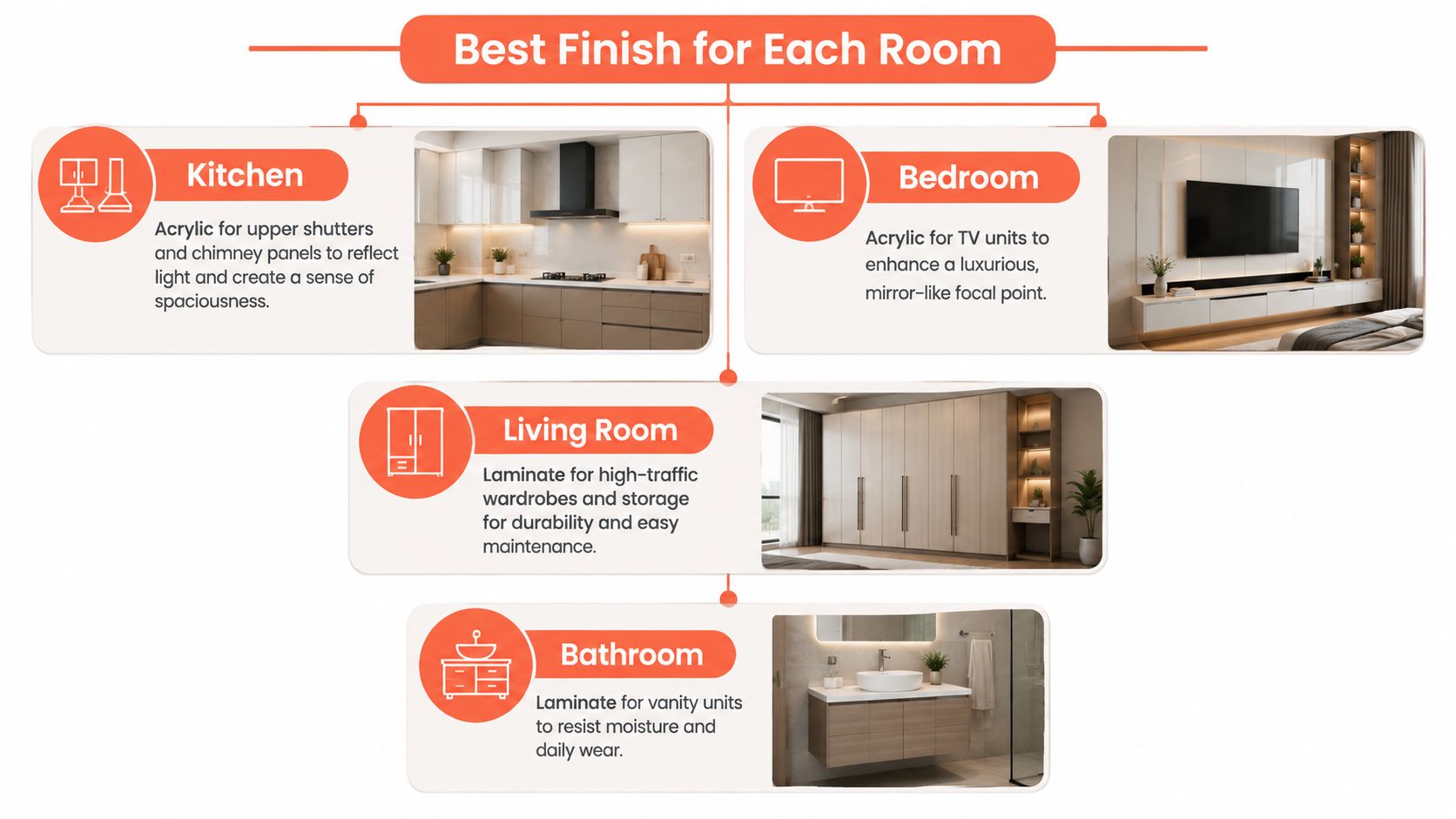
Use acrylic for selected upper shutters, chimney-side panels, and display fronts where the surface sits away from the floor and receives less direct handling. Its reflective face can help a compact kitchen feel brighter, especially when paired with sensible lighting and pale counters.
Use matte or suede laminate for lower shutters, drawers, pantries, and areas beside the sink. These surfaces face oil splatter, wet fingers, kicked dust, and repeated opening. Textured laminate is usually the calmer choice for a family that doesn't want to wipe visible marks several times a day.
A full-acrylic kitchen is often an over-spec in a Chennai mid-segment flat. It increases the cost across surfaces where the gloss provides little functional benefit, and it can make resale evaluation harder if the shutters show scratches or inconsistent care.
Bedrooms and living areas
For a child's wardrobe, study unit, or full-height storage, choose matte, suede, or textured laminate. It handles everyday contact visually better and gives you more freedom with woodgrain, colour, and patterns.
Acrylic makes sense for a statement wardrobe shutter, bedroom TV unit, or selected living-room panel. Keep it focused. A broad glossy panel can create a focal point, while a complete wall of reflective doors may produce glare and expose every fingerprint.
A practical typology map
2BHK flat: Matte laminate for most kitchen bases, pantry, wardrobes, and study units. Add acrylic to selected upper shutters or the TV unit if the budget permits.
3BHK apartment: Use a hybrid kitchen, textured laminate for family bedrooms, and acrylic only for the main bedroom's statement panel or living-room feature.
Independent house or villa: Spend on acrylic where architecture and lighting give it room to perform. Keep utility kitchens, children's storage, and lower-use service areas in durable laminate.
Bathroom vanity fronts deserve caution. A compact laminate specification is usually more appropriate than a delicate decorative face in a splash-prone zone. The board, edge, plumbing protection, and ventilation must be resolved together.
Installation, Care, and Lifespan in Humid Weather
The carpenter's last day on site often determines whether the finish ages well. A good laminate sheet can fail when an edge is poorly bonded. A premium acrylic panel can disappoint when the fabricator damages a corner during transport or leaves an exposed joint near a wet area.
Fabrication details to inspect
For laminate, ask whether the edge uses PVC, ABS, or laser edging, and whether the colour matches the face. Look for lifting, gaps, uneven trimming, and sharp corners. On acrylic, inspect the edge for chips, hairline cracks, inconsistent colour, and visible adhesive marks before installation.
The acrylic face needs more careful handling because its glossy surface exposes fabrication defects immediately. Ask the vendor to confirm the sheet thickness, substrate, backing, adhesive, and edge method in writing. A sample corner is more useful than a front-only sample.
IS 2046 provides a valuable Indian technical reference for decorative laminated sheets. It tests properties including surface wear resistance, boiling water resistance, dry heat, staining, and cigarette burn, while the BIS product manual for IS 2046 defines 17 performance-based varieties and includes a moisture-resistance test for double-faced compact laminates using a water bath maintained at 65 ±2 C. That standard helps you ask better procurement questions, but it doesn't excuse poor edge sealing or an unsuitable substrate.
Cleaning without shortening the finish's life
For laminate, use a soft damp cloth and mild soap. Wipe oil and food spills promptly, then dry the surface. Don't use abrasive pads, strong solvents, or excessive water around edges.
For acrylic, use a clean microfiber cloth and an ammonia-free or manufacturer-approved cleaner. Keep abrasive powders, rough scrubbers, and harsh chemicals away from the face. Wipe in a controlled manner so water marks don't dry on the panel.
Chennai's humidity makes ventilation and leak control important for both finishes. Acrylic's face may resist moisture, but a poorly sealed edge can still expose the substrate. Laminate is more forgiving in everyday use, yet it also depends on sound bonding and protected board edges.
For practical material decisions aimed at reducing routine maintenance, this low-maintenance interior material guide is useful. Lifecycle cost is simple to understand: laminate usually costs less at the beginning and is easier to replace panel by panel, while acrylic costs more upfront and earns its place only when its visual effect remains valuable to you.
Final Recommendation and Homeowner Checklist
There's no single winner in laminate vs acrylic. There is a clear winner for each home zone.
Home Zone | Economy Pick | Mid-Range Pick | Premium Pick |
|---|---|---|---|
Kitchen upper shutters | Matte laminate | High-gloss laminate or selected acrylic | Acrylic for feature uppers and chimney-side panels |
Kitchen base units | Textured laminate | Branded matte or suede laminate | Premium textured laminate, with acrylic limited to selected fronts |
Pantry and utility | Matte laminate | Textured laminate | Compact or specialised moisture-suitable laminate |
Bedroom wardrobes | Matte laminate | Textured or suede laminate | Acrylic only for statement shutters |
Kids' wardrobes | Matte laminate | Textured laminate | Premium textured laminate, not full glossy acrylic |
TV units | Suede laminate | Matte or woodgrain laminate | Acrylic for a controlled focal panel, with glare considered |
Bathroom vanity | Moisture-suitable laminate | Compact laminate | Compact laminate with carefully sealed edges |
My default Chennai specification is matte or textured laminate for most working surfaces, acrylic for selected upper kitchen shutters and one or two statement panels. I wouldn't approve an all-acrylic kitchen unless the homeowner understands the cleaning requirement, accepts the replacement cost, and has a strong design reason for using gloss everywhere.
Before you sign the final BOQ, check these points:
Zone budget: Allocate the finish budget by kitchen, wardrobe, TV unit, and utility area instead of approving one finish for the entire home.
Exact material: Record the brand, range, shade code, sheet or panel thickness, and substrate.
Edge specification: Name PVC, ABS, acrylic matching edge, or laser edge, and inspect a finished corner.
Hardware fit: Confirm hinge, handle, J-profile, push-to-open, and drilling compatibility with the selected shutter.
Sample approval: View samples in daylight and under your actual kitchen lighting, not only in a showroom.
Care and warranty: Get the approved cleaner, care sheet, warranty exclusions, and single-shutter replacement terms in writing.
Finished-site visit: Visit a completed project and inspect lower shutters, sink-side edges, wardrobe corners, and glossy panels in real use.
Interiors by DeX plans and executes Chennai home interiors, including modular kitchens, wardrobes, custom furniture, finish selection, installation, and handover. Visit Interiors by DeX with your floor plan and preferred finish samples to compare a practical laminate and acrylic specification zone by zone before you approve the quote.