
You've moved into a new flat in Chromepet or along OMR. The kitchen is tiled, the cabinets look neat, and the showroom plan promised plenty of storage. Then you try to put away the pressure cooker, mixer jars and tiffin boxes. Suddenly, the question isn't how many cabinets you have. It's whether the storage inside them suits the way you cook.
That's where modular kitchen accessories can help, or waste valuable cabinet space. In Chennai, every fitting should earn its place, stand up to daily cooking, and leave room for the plumbing and appliances your kitchen depends on. Think of accessories as working infrastructure, not decoration.
Why Chennai Kitchens Need Smarter Accessories
A kitchen can look complete and still frustrate you at every meal. A spice pull-out placed away from the hob makes you reach across the counter. A deep drawer that can't take your pressure cooker becomes expensive empty space. An under-sink organiser that blocks a valve turns a tidy cabinet into a service problem.
The right choices depend on what you cook, where you cook it, and how often you use each item. A household that makes dosa regularly needs easy access to tawa and ladles. A family that buys rice and provisions in bulk may value a tall pantry. If you mostly cook simple meals, several specialised pull-outs may add little beyond cost and cleaning.
The test is simple: an accessory should make a regular task easier without making another task harder.
Chennai's heat, humidity, oil and masala also deserve a place in the decision. A fitting near the sink faces water exposure. A drawer close to the hob collects grease and spice residue. If a basket is difficult to wipe or its moving parts don't feel solid, the neat showroom display won't matter once daily cooking begins.
The wider kitchen ecosystem offers useful context, but it shouldn't be mistaken for a direct measure of modular hardware. Ken Research's estimate of India's kitchenware market puts the market at USD 2,196 million in 2025, with projected growth at an 8.80% compound annual growth rate to 2032. That category includes consumer goods such as cookware and food-storage products, not installed cabinetry or a standalone valuation of modular accessories. It does, however, underline how much storage and organisation matter around the fixed kitchen.
How Accessories Fit Inside the Work Triangle
Start with the route you take: refrigerator, preparation area, cooking area, then sink. Draw these work centres on your plan before you choose a basket or organiser. A work-triangle reference for Indian kitchens recommends a combined travel distance of approximately 3 to 8 metres, while keeping the route clear of obstacles. The Indian ergonomics reference also reports that modular-kitchen users had greater kitchen usage than users of non-modular or semi-modular kitchens when storage was aligned to the work triangle.
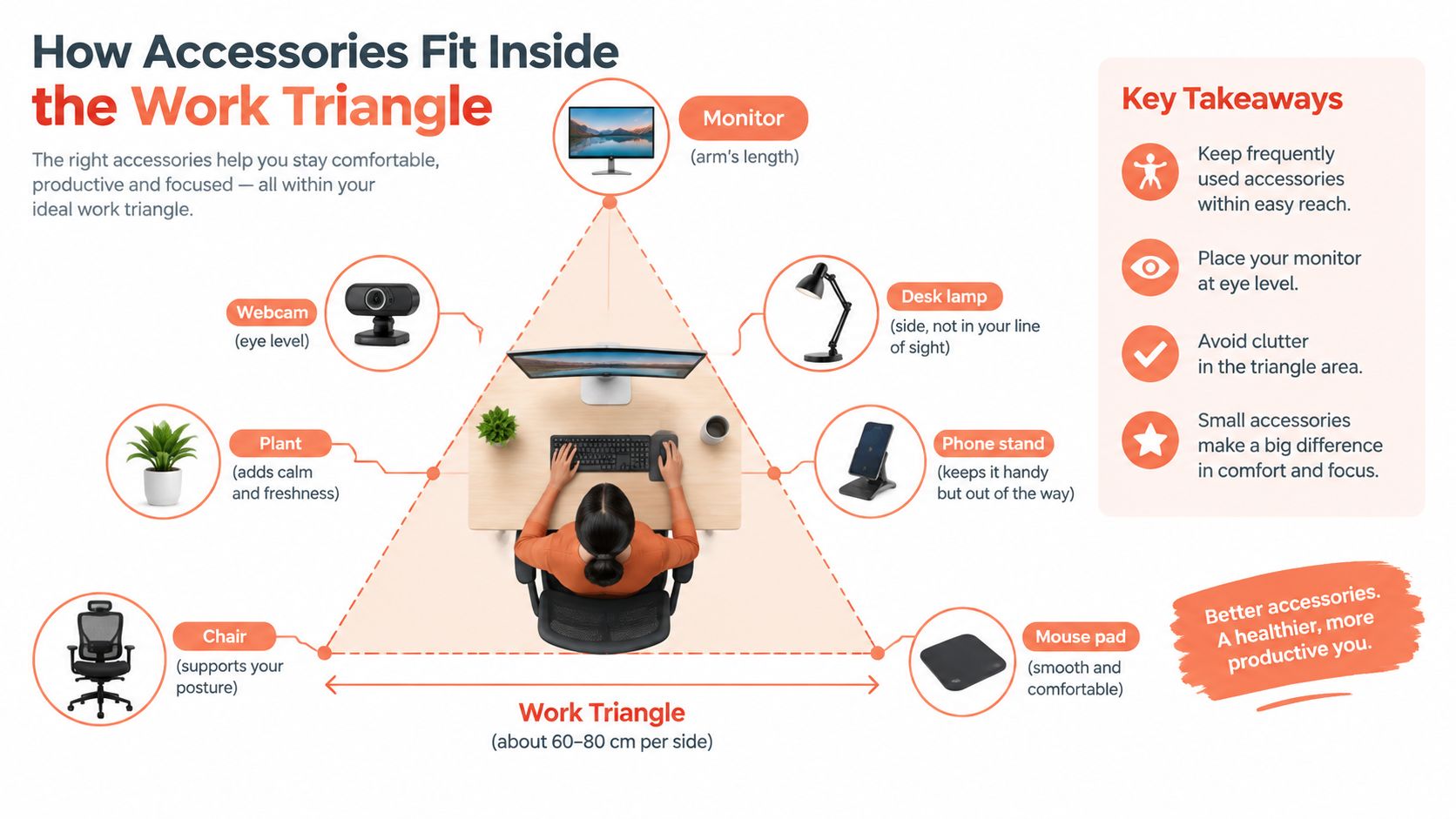
Now assign each accessory to a task, not to an attractive empty cabinet. A cutlery tray belongs near the preparation area. Keep spices and cooking oils near the hob, but not where heat or splashes will damage them. Place waste bins where you can scrape food without crossing the kitchen. Put a tall pantry near the refrigerator or at the edge of the main work route, so grocery storage doesn't interrupt cooking.
Sketch the route before you shop
Take a compact 12 by 8 foot kitchen as an example. If the fridge sits at one end, the hob along the opposite counter and the sink between them, putting spices near the fridge means crossing the preparation zone repeatedly. A better arrangement keeps the spice drawer beside the cooking area, cutlery near the chopping space, and waste within easy reach of the sink or preparation counter.
Heavy cookware needs particular care. Store a pressure cooker or a stack of thalis in a drawer or shelf you can reach without bending low or stretching overhead. A tall unit can be useful for provisions, but don't place your heaviest everyday items at the top.
Sketch the route of one real meal. If you cross the kitchen repeatedly to fetch oil, spices or a ladle, move the storage before you order the accessories.
The Six Accessory Categories Worth Knowing
Don't choose from a vendor's catalogue by counting the fittings. Compare each category against usable width, load, access and cooking habits. The furniture-hardware sector is substantial, and the India market analysis values it at USD 3.48 billion in 2025. It identifies lift systems as the fastest-growing category, with a projected 12.62% CAGR through 2031, reflecting demand for overhead storage in compact urban kitchens. That trend is a reason to consider the mechanism, not a reason to install one in every wall cabinet.
Category | Best Fit When You... | Skip If You... |
|---|---|---|
Pull-outs | Need quick access to spices, bottles, provisions or tall pantry contents | Can reach your shelves comfortably and don't need dedicated storage |
Internal organisers | Use a drawer daily for cutlery, cooking tools, lids or plates | Prefer flexible open drawers or store very different items together |
Corner solutions | Have a deep corner that hides cookware or jars | Can reach the corner easily or a mechanism would crowd the opening |
Built-in waste systems | Want waste sorting close to food preparation and the sink | The bins would block plumbing access or take more room than you can spare |
Hardware and mechanisms | Need smooth, dependable drawers, hinges or lift-up doors | You can't verify load suitability, compatibility or serviceability |
Sinks and faucets | Are planning around the sink cabinet, tap, purifier and plumbing | You haven't finalised the sink dimensions or service clearances |
A bottle pull-out earns its place if oil bottles otherwise topple in a cupboard. A spice pull-out makes sense when the household cooks with a regular set of masalas. A tall pantry helps with bulk provisions, but it's a poor choice if its width leaves no workable counter space. Drawer dividers and cutlery trays are modest upgrades that can improve a drawer you already use every day.
Corner mechanisms need a harder look. A carousel, magic corner or pull-out shelf can make a deep corner easier to access, but the best choice depends on the cabinet geometry. Sometimes a broad drawer or a simpler fixed shelf gives you more usable space for less money.
If your kitchen also includes a food processor, plan the appliance and its attachments as one storage problem. A practical guide to comparing food processor add-ons can help you think through which components need a home and which can stay out of the kitchen cabinet.
Sizing and Integration With Modular Layouts
A fitting that doesn't fit the cabinet opening is a costly mistake, even if the catalogue lists the right nominal width. Indian modular kitchens commonly use a 720 mm base-cabinet carcass, a 100 to 150 mm plinth, and a 20 to 40 mm countertop. Together, those components give a finished counter height of approximately 840 to 910 mm, with base cabinets commonly 560 to 580 mm deep. The modular kitchen dimensions guide describes these as common conventions, not a universal standard.

Measure the cabinet's clear internal opening, not just its outside width. Then check the door swing, hinge position, drawer extension, plumbing, appliance clearances and any wall or chimney obstruction. Wall cabinets are commonly shallower than base cabinets, so don't assume a fitting designed for one will work in the other.
Let the layout set the limits
In an L-shaped kitchen, measure the inside corner carefully before choosing a carousel or pull-out mechanism. In a parallel kitchen, a deep drawer can be awkward if it blocks the cook's knees or narrows the working aisle when open. In a U-shaped plan, check that an open door or drawer doesn't collide with a neighbouring cabinet or appliance.
For a simple paper check, draw your cabinet openings and mark each clear width and depth. Say a tall pull-out, a corner unit and a wide drawer insert all appear on your first shopping list. If the tall unit overlaps an appliance zone, the corner mechanism conflicts with the door swing, and the drawer insert doesn't fit the internal width, remove those three before visiting a showroom. A dimensioned drawing helps you compare a product's actual fit with your plan; modular kitchen dimensions and planning can give you another reference point.
Plan the sink cabinet around its bowl, waste pipe, tap connections and any purifier. If you're deciding where a below-counter purifier can sit, consult a step-by-step sink purifier installation guide before finalising a fixed under-sink organiser. Keep the service space accessible rather than designing a basket that must be dismantled for maintenance.
Durability and Finish Choices That Survive Daily Cooking
A premium label won't rescue a weak board or a poorly specified runner. In Chennai, fittings face regular exposure to cooking oil, water, masala and humid conditions. Ask what the cabinet is made from, what load the fitting is designed to carry, and whether the runner or hinge can be serviced or replaced.
For board selection, the India-focused plywood specification guide associates BWP plywood with IS 710 and greater moisture exposure, such as kitchen carcasses and sink-adjacent units. It associates BWR plywood with IS 303 for less exposed areas. The same source describes common conventions of 18 mm carcasses and shutters, 12 mm selected shelves or dividers, and 6 mm back panels, while emphasising that the correct specification depends on span, support, hardware and load.

Ask what the finish and hardware can handle
A drawer holding pressure cookers needs a suitable box, support and runner, not just a smooth showroom glide. Ask the vendor to specify the load capacity and intended use. For hinges and runners, request the product specification and confirm what replacement or service looks like if a part wears out.
Finishes should suit the cabinet's location. Matt laminate is a practical choice for many hardworking surfaces and is generally straightforward to clean. Gloss PU and acrylic can give a polished appearance, but visible marks and repair needs should factor into the decision. Membrane finishes can suit a particular design, but don't choose one just because it looks perfect in a sample. Inspect a finish in the light and setting where it will be used, especially around the hob and sink.
For regular laminate care, a guide to the best way to clean laminate can help you avoid harsh cleaning habits. For the wider material choice, this guide to modular kitchen materials is another useful comparison. In every case, prioritise a sound board, appropriate hardware and a finish you can maintain over a decorative upgrade you'll worry about every day.
Future-Proofing for Appliances and Service Access
Don't fill every cabinet with organisers. A removable back panel, a reachable socket or clear access to plumbing can be more valuable than another basket. Kitchens change when you add an induction cooktop, dishwasher, air fryer or purifier. A layout that can't accommodate those changes may force you to remove cabinetry or redo electrical work.
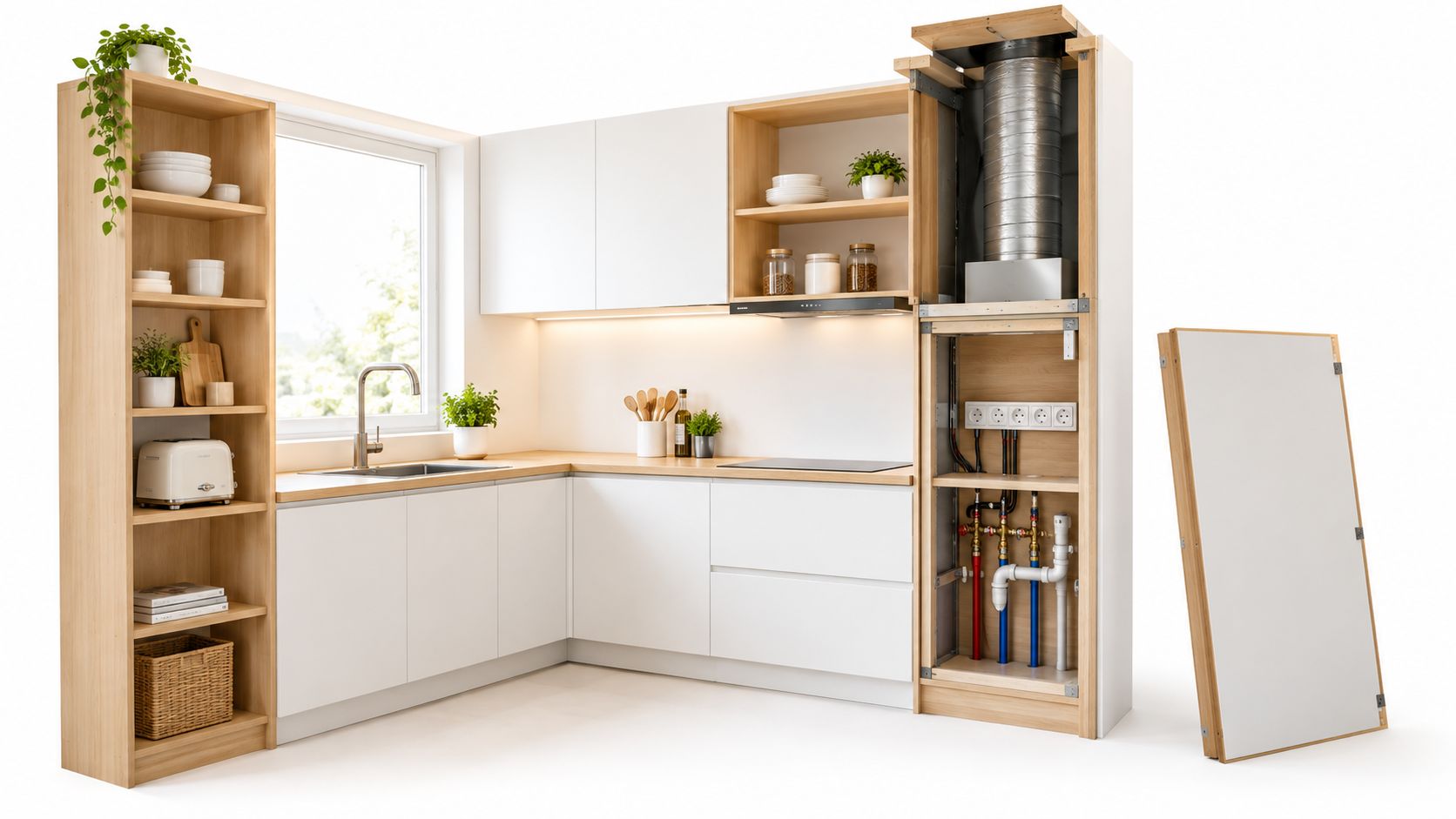
A 2025 Status of eCooking in India snapshot estimated that 12 to 17 percent of Indian households owned at least one electric-cooking appliance, making induction and other electric appliance bays a real planning consideration. The figure doesn't mean you must buy an induction hob now. It does mean you should discuss accessible power, ventilation and appliance clearances before the cabinet layout is fixed. The eCooking snapshot is useful context for that conversation.
Keep services reachable
Before installation, mark where the chimney, hob, refrigerator, purifier and any planned dishwasher will need power or connections. Keep heat-producing appliances away from vulnerable cabinet finishes, and avoid placing heavy appliances in awkward overhead cabinets. Under the sink, leave the shut-off valve, pipe joints and purifier connections reachable.
Plan for the appliance you might add later, not only the one already on your purchase list. Ask for removable backs or access panels where plumbing and electrical connections need inspection. Keep the final drawings or schedule of appliance and hardware assumptions, so a future installer knows what the cabinetry was designed to accommodate.
Safety also belongs in the conversation. BIS material for gas and oil-burning appliances identifies safeguards such as flame-failure protection, overheat cut-off and protection against gas or water leaks. Confirm the appropriate safety features with the appliance supplier and installer, and make sure an organiser or cabinet panel doesn't obstruct them. Flexible service access is a better investment than a tightly packed cabinet you can't safely inspect.
Budgeting Without Overpaying
Budget by function, not by how full the accessory list looks. Start with the items that solve a daily problem, add upgrades only where the layout justifies them, and leave out anything that blocks a service route or steals space from a more useful drawer. I wouldn't assign a generic Chennai price band without a confirmed scope and specification: cabinet size, materials, hardware and installation all change the quote.
Priority | Consider | Check Before Approving |
|---|---|---|
Essentials | Bottle pull-out, useful waste bin, tandem box under the hob, tall storage if provisions need it | Confirm the location, internal dimensions and load suitability |
Worth paying for | Soft-close hinges, a well-fitted corner mechanism, lift-up wall unit | Confirm access, serviceability and whether it solves a real reach problem |
Usually skip | Decorative plate racks, elaborate spice carousels, under-sink units that fight plumbing | Ask what daily task it improves and whether a simpler option works |
Don't buy a tall unit because a showroom has one on display. If it crowds the counter or conflicts with the refrigerator, it's not a sensible use of your budget. Likewise, a corner mechanism only earns its cost when it improves access to a corner you otherwise can't use well.
Ask for a written schedule of accessory types, finishes and hardware, along with what the quoted scope includes. Confirm the guarantee, replacement terms and after-sales process before signing. Those details affect the cost of ownership, especially when a moving part needs attention later. Compare proposals by checking like for like, not by comparing a complete specification with a cheaper quote that omits important fittings.
For a broader view of how kitchen scope affects project costs, use this guide to modular kitchen pricing as a reference. Keep some budget for dependable materials and accessible services. A smaller set of well-chosen accessories usually serves a Chennai household better than a crowded list of fittings.
A Short Decision Checklist Before You Finalise
Take these questions to your design consultation:
Does it earn its zone? Place it where you use the stored items.
Can the cabinet carry the load? Confirm the board, support and hardware.
Will it survive daily cooking? Check moisture exposure and cleaning access.
Can you still reach services? Keep plumbing and electrical access clear.
Does it suit your cooking? Choose for your home, not the showroom display.
A few well-placed fittings beat a cabinet full of compromises. Ask your interior partner to explain the purpose and fit of each accessory, cabinet by cabinet.
Interiors by DeX plans and executes modular kitchens in Chennai, including layout, storage accessories, finishes and installation. Bring your kitchen plan and cooking priorities to Interiors by DeX to discuss a practical accessory selection with clear scope and documented choices.