
The most popular advice on particle board vs MDF is simple, and it's wrong for a Chennai flat. People say "always buy MDF, it's the strong one," or "particle board is fine because it's only the box." A name on a quotation doesn't keep a shutter flat through the monsoon, and it doesn't stop a carcass swelling beside the sink.
What decides is the 2025 BIS grade, the formaldehyde class on the test report, and whether every cut edge is sealed. A coarse particle board with an HMR grade, E1 paperwork and full edge banding will outlast a standard MDF door with a raw back edge. A painted, routed shutter still wants fibre, not chips. Price doesn't settle it either.
Say the quote for your new kitchen lists both boards. One line says commercial MDF for shutters. The next says water-resistant particle board for the carcass. Neither line is a specification. Read the grade, the edge and the hardware before you sign.
Particle Board vs MDF in One Scan
One quotation, two materials, the same kitchen. Scan the rows before you argue about the rate.
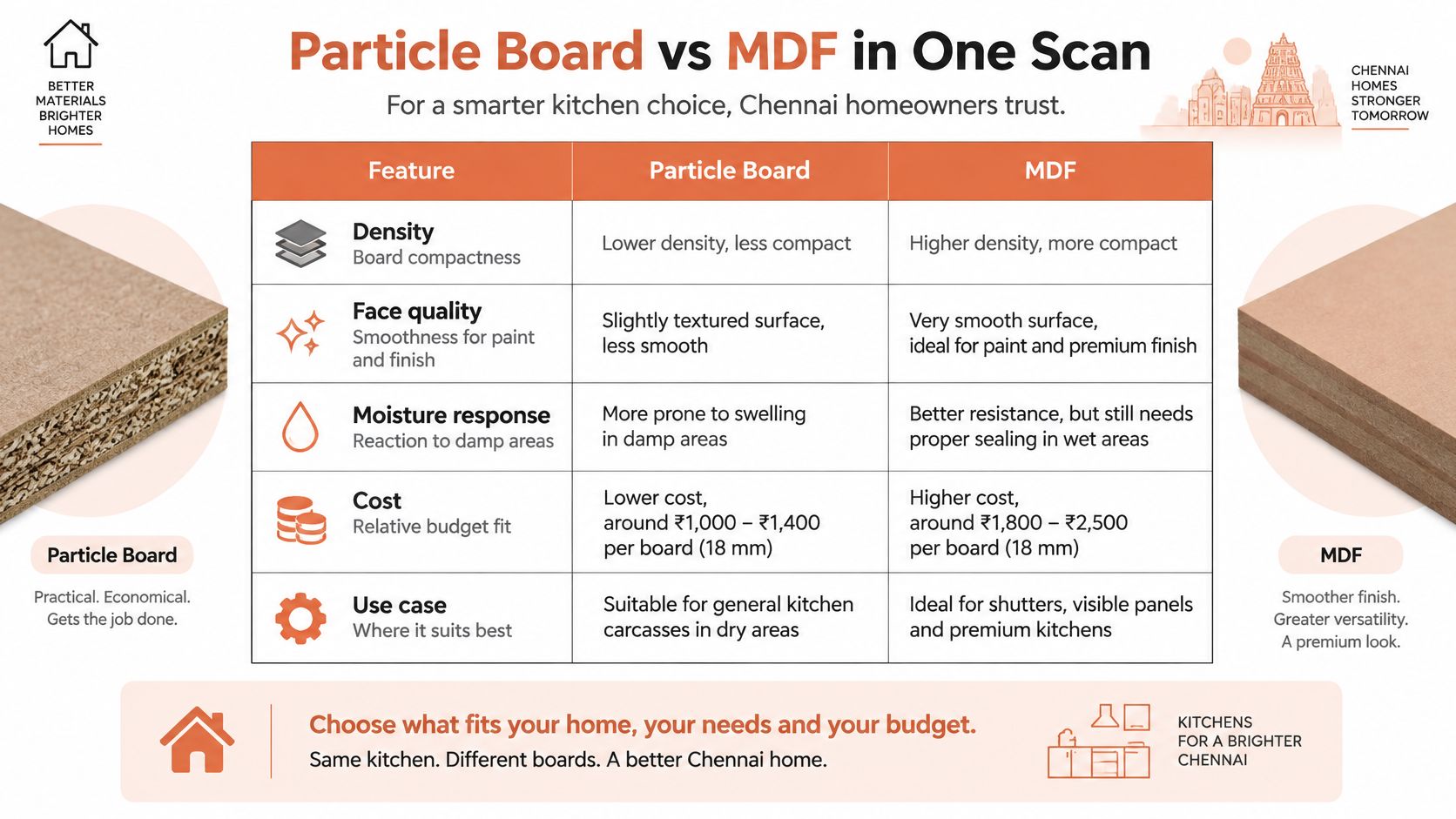
Criterion | Particle board | MDF |
|---|---|---|
Density | Read the declared density on the IS 3087 report | 600 to 900 kg/m³ under IS 12406 |
Face and routing | Coarser core, better under laminate than paint | Uniform fibre, clean for paint, laminate and routed profiles |
Screw holding | Adequate in the face if density is high; weak on the edge | Stronger face withdrawal; still poor in the raw edge |
Moisture | Specify MR or HMR under IS 3087; standard grade swells | Specify moisture-resistant or HMR MDF; standard grade swells |
Weight | Lighter for the same thickness | Heavier, so hinges and shelf spans need checking |
Cost | Lower core cost for flat carcasses | Higher, justified on visible machined faces |
Formaldehyde | E1 or E2 class on the test report | Formaldehyde test under the MDF standard; ask for the declared class |
Typical Chennai use | Sealed carcasses and supported shelves | Painted shutters, routed wardrobe doors, TV unit fronts |
Density. MDF in that BIS band machines to a compact, even sheet. Particle board has no single number hiding in the name, so the report has to state it.
Face and routing. Fibre stays smooth for paint and a shaker profile. Chips look acceptable under laminate and poor under thin paint.
Screw holding. A face screw sits better in denser MDF than in coarse particle board. Drive either screw into a raw edge and the board splits.
Moisture. Standard grades of both boards swell in coastal humidity. An MR or HMR grade changes that result more than the material name does.
Weight. MDF is the heavier sheet, so shutter height and hinge rating have to be checked together.
Cost. Particle board is the lower-cost core for a flat, load-spread carcass once the edges are sealed. MDF costs more and earns it on a visible machined face.
Formaldehyde. Particle board needs an E1 or E2 class on the report. MDF needs a declared class from its own test, not a slogan.
Typical use. Keep particle board on sealed carcasses and supported shelves. Keep MDF on painted shutters, routed wardrobe doors and TV fronts.
If one row still feels wrong, read the matching part below. This scan isn't a blanket winner.
Solid timber for a pelmet or window lining is a separate choice from these panels. A clear note on wood options for remodel trim from SouthRay Kitchen & Bath helps when that lining is wood, not a coated board.
The sealed edge and the printed grade beat the marketing name every time.
What the Indian Grade on the Quote Means
Ignore a line that only says commercial MDF or water-resistant particle board. Those phrases aren't grades.

IS 12406 is the MDF document. IS 3087 is the document for medium-density particle board. Some panel sheets also carry IS 12823 or IS 14587. A BIS publication of building-related Indian standards lists those particle-board and fibreboard standards for panelling and partitioning. The code on your quote is stronger proof than the word MDF.
The edition year matters
BIS notices on the revised product standards state that IS 12406:2025 replaced the earlier MDF standard and IS 3087:2025 replaced the 2005 particle-board standard. Implementation was required by 9 February 2026, after which the older editions would be withdrawn. The revisions changed classifications and requirements. The particle-board revision also added an optional steady-state formaldehyde-emission test, and that test needs a manufacturer declaration when it's used. A blog still describing the withdrawn edition can send you to the wrong line item.
What you should see written
A usable line contains six things, not a colour photo of a shutter.
Standard and year: IS 12406:2025 or IS 3087:2025, written in full.
Grade: On particle board, separate regular, MR and HMR. On MDF, name moisture-resistant or HMR when the room needs it.
Thickness and density: Both figures, not a guess from a sample chip.
Formaldehyde class: E1 or E2, kept apart from the moisture grade.
Laboratory report: Issued by a BIS-recognised laboratory for the properties that grade claims.
A colour chip doesn't prove moisture performance. For MDF you still want moisture content, bending strength, internal bond, screw withdrawal and swelling in numbers.
Paste this to the vendor: "Please confirm the standard edition, grade, thickness, formaldehyde E class, and the swelling and screw-withdrawal numbers before cutting. A label that only says commercial or water-resistant isn't enough."
How those grades sit in a working kitchen layout is set out in what material is best for a modular kitchen.
Strength Screw Holding and Finished Edges
Treat both sheets as engineered panels. "MDF is strong and particle board is weak" is a showroom line, not a test.
The BIS entry for IS 12406:2021 defines general-purpose MDF as boards in a density range of 600–900 kg/m³, and it links conformity to moisture content, density, bending strength, tensile strength perpendicular to the surface, screw-and-nail withdrawal and water swelling. The same framework points to formaldehyde-release testing for wood-based panels. MDF is wood fibre pressed with resin under heat, so the face is even enough to paint, laminate and route.
Particle board is judged with IS 2380 methods for density, static bending, perpendicular tensile strength, fastener withdrawal and water swelling. A dense three-layer particle board can beat a soft, low-density MDF on those tests. Bonding and fastening results decide the cabinet, not the nickname.
Hinges on the face
Face screws into MDF hold hinges and drawer runners more reliably than screws in a coarse chip face. Both boards crumble if the screw enters an unbanded edge, or if the fitter redrills the same hole after a misaligned hinge. Use confirmat screws or proper cabinet connectors, drill a pilot, and don't fix a handle through the edge. The failure you get is a stripped hole and a shutter that won't stay closed.
Shelves that sag
A tall MDF shutter is heavy, so hinge count and adjustment are part of the spec. Two hinges on a full-height door is how that door drops within a year. A particle-board shelf that carries books needs a shorter span or a front stiffener. State the hardware load on that shutter. Don't assume it from the material name.
The edge you can see
MDF routes and paints cleanly, which is why it suits shaker rails and profiled wardrobe doors. Particle board telegraphs chips under thin paint. Laminate, or a thick PVC or ABS edge band, is the fair finish on that core.
Practical rule: Write the screw type, the pilot and the hinge count on the drawing. The board name doesn't carry the hardware.
Moisture Weight Cost and Indoor Air
Formaldehyde class and moisture results belong on the purchase order. A brochure sentence doesn't.

Four lines to demand
Storage first. For every wardrobe, TV unit, study and bedroom carcass, ask for the declared formaldehyde class, density, thickness tolerance and a test report from a BIS-recognised laboratory. BIS laboratory scope records require particle board to be classed E1 or E2, list formaldehyde-content testing for MDF under IS 12406, and recognise moisture-resistant and HMR MDF categories. "Low emission" isn't a class. E1 is the tighter of the two particle-board classes. Ask for it in bedrooms.
Wet zones next. Beside a sink, compare the maker's cyclic humidity or boil-test result with the moisture-resistant or HMR category, and with MR or HMR under IS 3087. A green core, or a sticker that says commercial MDF, isn't that result. If the report doesn't show the wet test, don't put that sheet under the sink.
Edges in the same sentence. Specify PVC or ABS banding on every cut, sealed sink and pipe cut-outs, and a raised plinth where the box meets a wet floor. A raw edge of either board wicks Chennai humidity. That's how a door binds after one monsoon, even when the face laminate still looks new.
Weight and price last. Particle board is the lower core cost for a flat carcass. Denser MDF is heavier, so the hinge rating has to match the shutter, not the catalogue photo. Buying the cheaper core and then replacing a dropped door isn't a saving.
The same paperwork keeps daily cleaning simple, which is the point of material choices that keep interiors low-maintenance.
Put the E class, the wet-test result and the edge band on one line. If any of the three is missing, don't release that run.
Kitchens Wardrobes and Shelves in Chennai
Apply the grade room by room. A mixed specification is normal, and it's the right way to buy.

The BIS preview of the MDF standard is the useful comparison for a Chennai home, because particle board under IS 3087 is split into regular, MR and HMR grades, with formaldehyde classed separately as E1 or E2. Fibre is the better face for routed profiles, painted shutters and clean machined edges. Particle board is a sound core for straight, load-spread carcasses when it's sealed and supported. Don't accept an unqualified "water-resistant" claim. Ask for conformity papers plus water absorption, thickness swelling and screw withdrawal.
Two particle boards with the same shop name aren't the same sheet. The IS 3087 product manual identifies flat-pressed single-layer, three-layer, multilayer and graded boards, and extrusion-pressed solid or tubular boards, and it separates E1 from E2 with water-absorption checks. The rows below assume the grade that's written, not a weaker core sold under the same words.
Location | Prefer | Reject unless upgraded |
|---|---|---|
Kitchen carcass away from the sink | MR particle board or MR MDF with banded edges | Standard grade or open cut edges |
Sink, hob and dishwasher zone | HMR grade, sealed cut-outs, raised plinth | A board labelled only water resistant |
Painted or routed shutters | Certified MDF in a suitable thickness | Coarse particle board under thin paint |
Wardrobe and loft carcass | MR particle board with supported joints | Long spans with no stiffener or edge band |
Book and display shelves | MDF or denser particle board, shorter span, front lip | Thin standard particle board across a wide bay |
Utility, balcony or wet service | HMR panel or a non-wood alternative | Ordinary interior-grade board |
Two flats, two correct choices
A 12 mm painted MDF shutter on a coastal apartment kitchen stays even only when the sealer isn't skimpy and the hinges match the weight. Reject coarse particle board under that paint. A particle-board wardrobe carcass in an air-conditioned bedroom, finished with 2 mm edge banding and supported joints, is a fair box. Reject it if the loft span has no stiffener.
Within splash range of the sink or hob, require HMR, sealed cut-outs and a raised plinth. For a balcony or utility, use HMR or move off wood panels. People who sort damp storage from dry cabinets, as in this look at garage storage options by budget from Home Pro's Remodeling & Repairs, are making the same split you should make in a service balcony.
How These Panels Age After Installation
Follow one modular kitchen and one wardrobe through five years on the coast. The failures are ordinary, and they're visible if you look on handover day.
The first month
The usual damage happens before you cook a meal. A site cut for a pipe is left raw. An edge band is missing behind a filler. A hinge screw sits in a hole that was drilled too wide. At handover, photograph the edge bands, the plinth gap, the hinge screws and the grade written on the drawing. Those photos are what you use when a shutter drops in month four.
The third monsoon
Thickness swell shows at the plinth, the dishwasher side or a balcony store when the panel was only a standard grade. Particle board usually fails first where a chipped laminate lets water into the chips. The face bubbles, the screw loses its bite, and the door twists. MDF usually fails differently. A heavy shutter drops on two hinges, or paint cracks on a sharp routed corner because the sealer was thin. Neither failure means the other material was "bad." It means the grade or the edge was wrong for that spot.
Daily care and the only real repair
Wipe spills the same day. Don't leave a soaking cloth on the bottom edge. Keep a wet mop off the plinth. Those habits protect both boards. They don't rescue a standard-grade sheet in a wet zone.
Replace a swollen panel. Filler doesn't bring the thickness back, and a skim of putty cracks off at the next wet wipe. Redrill a stripped hole only with a proper insert, not a fatter screw in the same crushed fibre. The certified grade and the sealed edge decide whether that same profile can be ordered again later.
An Institute of Wood Science and Technology assessment puts the supply picture in plain figures. It reports about 30 particle-board industries in India, most in the unorganised sector, using plantation-timber lops and tops, wood waste and agricultural residues, together producing about 1 million cubic metres a year. The same assessment reports installed MDF capacity of roughly 1.4 million cubic metres and production of about 1.15 million cubic metres, about 80% utilisation, with the MDF market at nearly ₹1,600 crore and a five-year compound annual growth rate of 20%. That more organised MDF base can support steadier specs for routed shutters. Particle board's value stays tied to economical residue cores. Factory scale still doesn't replace the grade on your drawing.
Approve the Board Before Production Starts
Mark the drawing this week. Don't wait for the factory to "use the usual board."
Mark certified MDF only on painted, routed or frequently handled faces, such as kitchen shutters and TV fronts.
Mark MR particle board on flat wardrobe carcasses and loft boxes that stay dry, and only where the joints are supported.
Mark HMR, sealed cut-outs and a raised plinth on the sink, hob and dishwasher run.
Beside each mark, write the thickness, the hinge count on any tall shutter, and edge banding on every visible edge and every sink-side edge. Use two patterns. A 12 mm painted MDF shutter for the coastal kitchen. An air-conditioned bedroom carcass with 2 mm banding.
If a line still says only MDF or only particle board, return that sheet before anyone cuts.
One approval, then cutting
One team should lock the kitchen, the wardrobe and the TV unit so the grades match across the home. A shutter spec that fights the carcass spec is how substitutions start. Interiors by DeX plans that modular scope for Chennai apartments and villas, with documented material selections and a 5-year replacement guarantee on modular products. To see how a signed grade gets swapped on site, read how to prevent material substitution in Chennai interiors.
Bring the layout to the experience centre or the site measure. Agree the grade on each component. Release cutting only when the quote names the standard edition, the grade and the edge.
Interiors by DeX plans, manufactures and installs modular kitchens, wardrobes and storage for Chennai apartments and villas, with the board grade, edge and hardware written into the selection. If you're fitting a new flat and want those marks agreed before factory cutting, visit Interiors by DeX and book a layout review at the experience centre or on site.