
Does every part of your kitchen really need the same platform material, even when the hob edge handles hot cookware and the island mostly handles coffee cups?
A quartz kitchen platform can work well in a Chennai home, but choosing it only by colour leaves important questions unanswered. The better approach is to judge each zone by its heat, stain and wear risks, then coordinate the surface with the cabinets, supports and cooking habits beneath it.
Quartz Kitchen Platforms Compared With Other Materials
Quartz is a strong all-round choice for busy family kitchens, but no single material wins everywhere. Its main appeal is the combination of a consistent appearance and manageable everyday care. That doesn't make it the right surface for every cooking task.
Nexdigm's overview of India's quartz industry identifies residential construction as the dominant consumption sector and describes engineered quartz as dense, non-porous, stain-resistant and scratch-resistant. It's now a residential finishing option for platforms and islands, not only a material reserved for premium architectural projects.
Kitchen platform materials compared
Material | Stain resistance | Heat tolerance | Routine care | Best fit |
|---|---|---|---|---|
Engineered quartz | High, non-porous surface | Moderate, resin can soften near 150°C, according to Wizzybuilds' countertop material guide | Wipe with mild soap, no sealing | Busy family kitchens with daily spills |
Natural granite | High when sealed | High, mineral surface | Periodic sealing | Hot-cooking zones and heavy use |
Marble | Low, etches with acidic liquids | Moderate | Frequent sealing and gentle cleaning | Baking counters and display areas |
Sintered stone | High | High | Low routine care | Hob-side zones and heat-heavy cooking |
Laminate | Moderate, surface can chip | Low | Low routine care | Budget projects and rental homes |
Read the table as a set of trade-offs, not a ranking. A household that fries daily should give heat tolerance more weight than one that mainly prepares salads, sandwiches and coffee. A family dealing with turmeric, oil and drink spills may prioritise stain resistance instead.
Granite needs attention to sealing, while marble demands greater care around acidic ingredients. Sintered stone deserves consideration beside the hob, although its fabrication and edge detailing still need careful planning. Laminate can suit a restrained budget, provided its edges and joints are protected from damage.
For a closer quartz-versus-granite comparison, Trademaster Construction's a homeowner's guide to countertop choices offers another way to frame the decision. The broader guide to kitchen-top materials is useful when you're matching the surface to the rest of a modular kitchen.
Selection rule: Choose the material for the task first, then choose its colour and finish.
A showroom sample can help you judge appearance, but it can't confirm installation quality. Before ordering, settle what the platform is made of, where it can safely handle heat, and what the complete installation will cost in your Chennai home.
What Engineered Quartz Is Made Of
Think of engineered quartz as hard particles held together by a binder, much like the stone chips in terrazzo or the gravel in concrete. It isn't a solid piece of natural quartz cut directly from a quarry. Manufacturers combine natural quartz crystals with polymer resin and pigments to produce a slab.
The British Safety Council's explanation of artificial stone describes this composite construction and the importance of understanding the material being processed. For a homeowner, the useful distinction is simple: the mineral particles and the binder do different jobs.

What each ingredient contributes
Natural quartz crystals provide hardness and abrasion resistance. They help the surface withstand ordinary kitchen wear, although that doesn't make the finished platform scratch-proof.
Polymer resin binds the particles into a coherent slab. It also helps create a non-porous face and a more predictable appearance.
Pigments and additives establish the colour and visual effect, from quiet speckling to prominent marble-like veining.
Don't assume every product uses an identical recipe. Ask for the manufacturer's composition information and product identification rather than accepting a verbal description such as premium quartz.
The binder explains an important trade-off. It allows manufacturers to control the appearance, but it also introduces heat sensitivity that a purely mineral description can hide. A slab can contain hard stone particles and still have a component that reacts badly to concentrated heat.
From slab to finished platform
Fabricators cut slabs into kitchen runs, islands, vanities and cladding panels. Their measurements, cutting accuracy and polishing determine how cleanly the edges meet, how the pattern continues and how the finished opening fits an appliance.
Ask to see the actual slab or a representative full-slab image before approving a heavily veined design. A small sample won't show where a large vein will cross the sink or disappear into a cut-out.
The stone does the work, while the resin sets the look and the limits.
Pros, Cons and Heat Limits by Kitchen Zone
Quartz is stain-resistant, not heat-proof. Chennai's normal summer heat isn't the main concern. The practical risk is concentrated contact with a tawa, kadai or pressure-cooker base taken straight from a flame or induction hob.
That contact can damage or discolour the binder, sometimes leaving a permanent mark. Heat resistance doesn't mean you can leave the trivet in a drawer. Place the protection where your hand naturally moves when lifting cookware off the hob.
Where quartz earns its place
Quartz suits the areas where spills and everyday preparation dominate. Its non-porous face helps with turmeric, oil and coffee when you wipe them promptly, and it doesn't need the periodic sealing associated with many natural stones.
A controlled pattern also makes it easier to coordinate the platform with modular shutters, wall finishes and flooring. You can choose a quiet background for colourful cabinets or a more expressive slab for a restrained kitchen.
Its main advantages are practical:
Simple routine care without a separate sealing schedule.
Stain resistance for the spills that accompany daily cooking.
Scratch resistance during ordinary use, with sensible protection.
Predictable appearance across coordinated surfaces and cabinet runs.
The disadvantages deserve equal attention. Longer runs may need visible seams, deep edge chips can be difficult to repair invisibly, and the slab needs a firm, level base. Product consistency also matters, so a low price shouldn't replace checks on the manufacturer, batch and warranty.
Suggested surface by kitchen zone
Kitchen zone | Suggested surface | Main risk | Placement note |
|---|---|---|---|
Hob edge and cookware landing | Granite, sintered stone or a fixed trivet | Heat from tawas, kadais and pressure-cooker bases | Mark the landing during layout |
Sink area | Engineered quartz | Water, stains and scratches from pots | Keep joints away from sink corners |
Prep and rolling zone | Engineered quartz | Knife marks and turmeric or oil spills | Use a cutting board for knives |
Breakfast bar or island | Engineered quartz | Stains and impact on edges | Check overhang support before fabrication |
The useful conclusion isn't that you must replace quartz with granite everywhere. Quartz may suit most of the platform while a different surface protects the hottest landing point. You can also retain a continuous quartz appearance and provide a permanently positioned, suitable trivet.
Say the sink and preparation area occupy one run, while the hob sits on another. Quartz can serve the washing and preparation tasks, with a heat-safe landing beside the hob. The material change should be drawn deliberately, not improvised after installation.
Durability still needs sensible habits
Use a chopping board rather than cutting directly on the platform. Avoid striking exposed edges with heavy pots, especially around the sink, where cookware moves frequently.
An island has a different risk pattern from a hob edge. Bags, stools and serving dishes may knock its corners, so choose an edge detail you can live with rather than selecting solely from a close-up photograph.
For a Chennai household that regularly sets hot cookware down while cooking, the deciding question is whether the layout provides an obvious protected landing. Size that landing around your actual cookware, including the vessel you use for family meals, rather than around a decorative sample.
Daily Cleaning and Stain Removal
A quartz kitchen platform needs a repeatable cleaning routine, not an assortment of aggressive cleaners. Keep mild dish soap, a soft cloth, a microfibre drying cloth and a plastic scraper within reach. Check the product's care sheet before introducing a specialist stain remover.
An everyday cleaning sequence
Lift loose debris. Clear crumbs with a soft cloth rather than dragging them across the finish with a dry scrubbing pad. Abrasive scrubbing can gradually dull the appearance.
Wash gently. Use warm water with a few drops of mild dish soap, working from the back of the platform towards the front. Pay attention to oil around the hob.
Remove soap residue. Rinse the cloth and wipe again. Leftover detergent can create a dull film that makes a clean counter look grubby.
Dry the surface. Finish with microfibre, particularly around the tap and draining area. This reduces visible water deposits.
Address stains promptly. Use the matching first method below rather than leaving a coloured spill until the kitchen is closed for the night.
Inspect the sink area weekly. If the manufacturer permits diluted white vinegar, use it briefly on mineral film, then rinse and dry thoroughly. Otherwise, choose its approved hard-water cleaner.
Stain removal lookup for quartz
Stain | First method | Avoid |
|---|---|---|
Turmeric | Warm soapy water at once, then rinse | Leaving it to dry or using bleach |
Cooking oil and ghee | Warm soapy water, then a quartz-approved degreasing wipe | Scouring powders or steel wool |
Coffee or tea | Wipe promptly with soapy water | Letting it dry overnight |
Hard-water film | Diluted white vinegar if manufacturer-approved, then rinse and dry | Strong acid cleaners left on the surface |
Dried food, glue or paint | Plastic scraper with warm water, checking product guidance for residues | Metal blades or knives |
Stain-resistant doesn't mean stain-proof. Quick action matters, particularly with turmeric mixed into oil, which can spread into a thin film rather than remain as an obvious spill.
Don't attack a stubborn mark by repeatedly using a harsher pad. Stop, identify the residue and ask the supplier for a compatible treatment, especially if the mark might be a burn rather than a stain.
Routine cleaning doesn't require sealing. Use the same gentle method across the quartz surface, while keeping cookware heat protection as a separate habit.
Cost Drivers and Budget Planning in Chennai
The word quartz doesn't define an installed price. Your quotation combines a particular slab with fabrication, handling, support and site work. A material-only rate won't tell you what the completed kitchen will cost.
Grand View Research's India countertops outlook covers the broader countertop market, not a Chennai quartz installation price list. For your budget, a measured and itemised quotation is more useful than a national market figure.
What changes the quotation
A plain slab is like a plain cotton shirt: simpler to cut and easier to match. A prominent vein is closer to a patterned shirt whose stripes must line up. The fabricator may need more careful positioning and leave less usable material after cutting.
Colour and pattern complexity affect slab selection, layout and potential wastage.
Thickness and support design affect material use, handling and the work beneath the surface.
Length and seams add joint preparation, alignment and finishing.
Edge profiles require different shaping and polishing operations.
Sink, hob and tap cut-outs add labour and demand accurate appliance information.
Overhang supports can require corbels, brackets or legs.
Site preparation may include correcting uneven cabinets, removing an old top or making good adjoining finishes.
Don't assume a rounded edge costs the same as a simple square detail, or that every installer includes the tap opening. Ask for the scope in writing.
Compare completed work, not headline rates
Request separate entries for the slab, specified thickness, cut-outs, edge work, transport, fitting and support. Add old-platform removal, debris disposal and levelling where applicable.
Task Masters Inc.’s guide to budgeting for your Twin Cities kitchen is useful for thinking about renovation cost categories, not for importing overseas prices into Chennai. Coordinate the platform allowance with the wider modular kitchen budget, especially where cabinet changes affect support.
Ask who pays for slab waste and who replaces material damaged during fabrication or fitting. Keep a contingency for site corrections that become clear only after measurement or removal of the existing platform.
Budget check: A cheaper quote isn't comparable until it includes the same slab, fabrication details and site responsibilities.
Installation Checks for Thickness, Support and Seams
Start beneath the slab. Cabinets or masonry must be fitted, stable and level before the fabricator takes the final template. A thicker platform can't compensate for a poorly prepared base.
Confirm the sink and hob models before cutting. Having the actual appliances available helps the fabricator verify openings rather than relying on an approximate catalogue dimension.
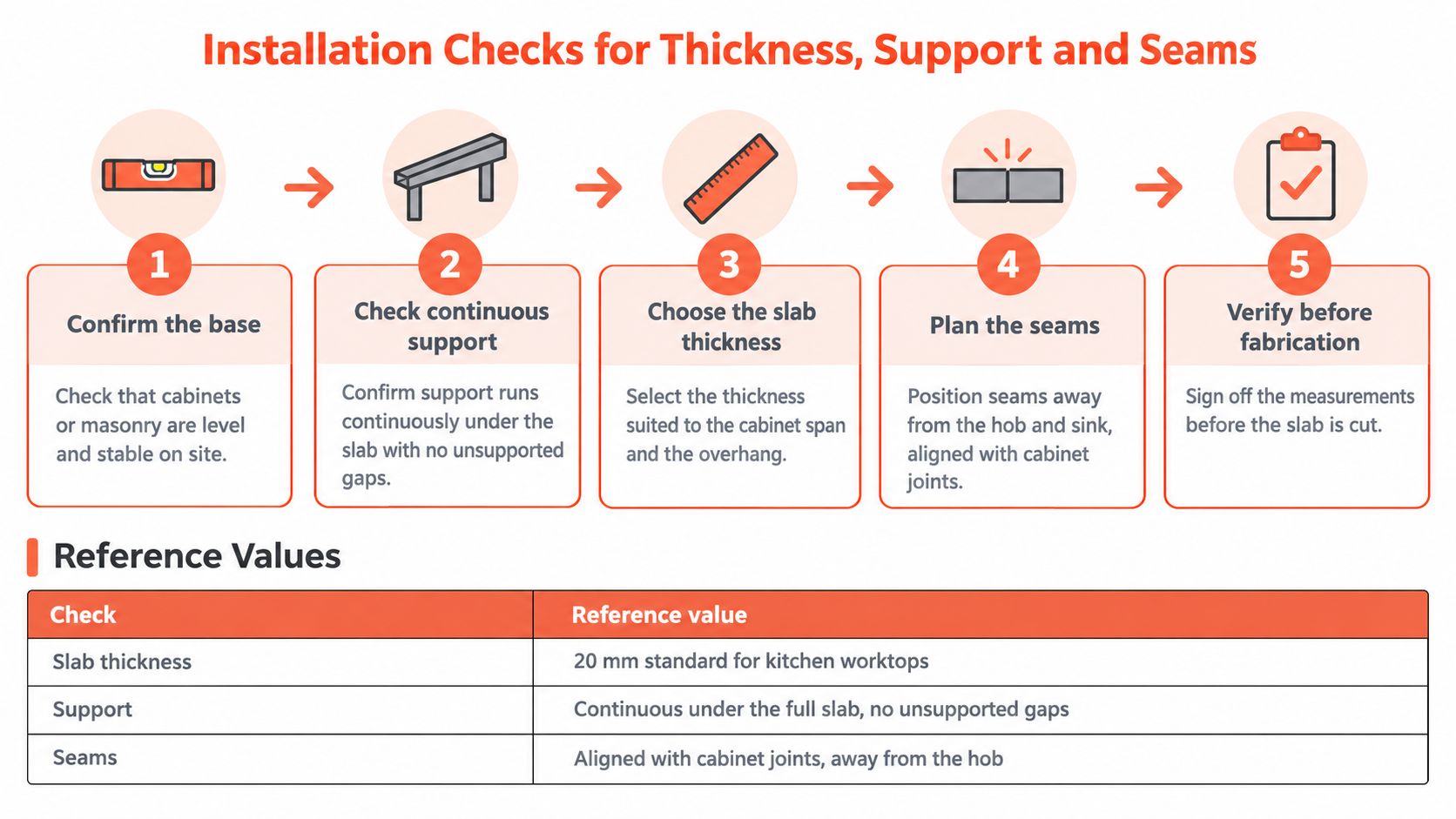
Check the structure before approving fabrication
Work from the base upwards: verify levelness, identify service gaps, agree support, then approve thickness and seams. Treat the following as reference guidance to reconcile with the selected manufacturer's requirements, not permission to leave vulnerable spans unsupported.
Installation reference values for quartz platforms
Check | Reference value | Why it matters |
|---|---|---|
Slab thickness, fully supported run | 18 mm | Adequate where support is continuous |
Slab thickness, service gaps or appliance openings | 20 mm | Helps resist bending, but doesn't replace required support |
Unsupported gap width | Wider than about 400 mm counts as unsupported. These thickness and gap references follow Universal Quartz's thickness guide. | Identifies areas needing a specific support solution |
Expansion gap at walls and cabinets | 1.5 to 3 mm, sealed with 100% silicone | Allows movement at adjoining materials |
Unsupported overhang | No more than one third of the supported width | Limits bending stress |
Maximum unsupported projection | 24 inches | Sets an outer limit, not an automatic allowance |
Edge deflection under load | 3 mm maximum under about 60 kg. Expansion, overhang and deflection values are specified in the Quantra fabrication and installation manual. | Provides a technical support criterion for the installer, not a homeowner load test |
Standard slab length | 3,000 mm in the cited guide; confirm the purchased slab's actual dimensions | Runs exceeding the available slab length need a seam |
Joint location | Away from sink and hob cut-outs, with a 45-degree mitre at L-corners described in Universal Quartz's countertop design guide | Keeps joints away from vulnerable openings and plans corner appearance |
Reinforce cut-out corners and agree their radii before cutting. The installer should also reconcile platform thickness and support build-up with the planned kitchen working height, so the finished surface remains comfortable.
Ask how the slab will be processed
Fabrication dust is a different issue from ordinary use of the finished platform. The engineered-stone installer manual identifies respirable crystalline-silica exposure during cutting, shaping and polishing, with prolonged or repeated inhalation associated with serious lung disease, including silicosis.
Ask who cuts the slab, where processing happens, whether wet methods and suitable extraction are used, and what respiratory protection workers wear. Require controlled cleanup rather than dry sweeping, and don't accept uncontrolled dry modifications inside an occupied home.
The final signed drawing should record thickness, overhang dimensions, joint positions, cut-out radii and support details. Give the cabinet maker, fabricator and site installer the same revision so nobody has to interpret a different plan.
Confirm Your Platform Choice Before Ordering
Does the platform plan match how you use each part of the kitchen? A colour approval alone cannot answer that. Before ordering, connect the surface choice to the cooking zones, supporting structure, fabrication plan and written quotation.
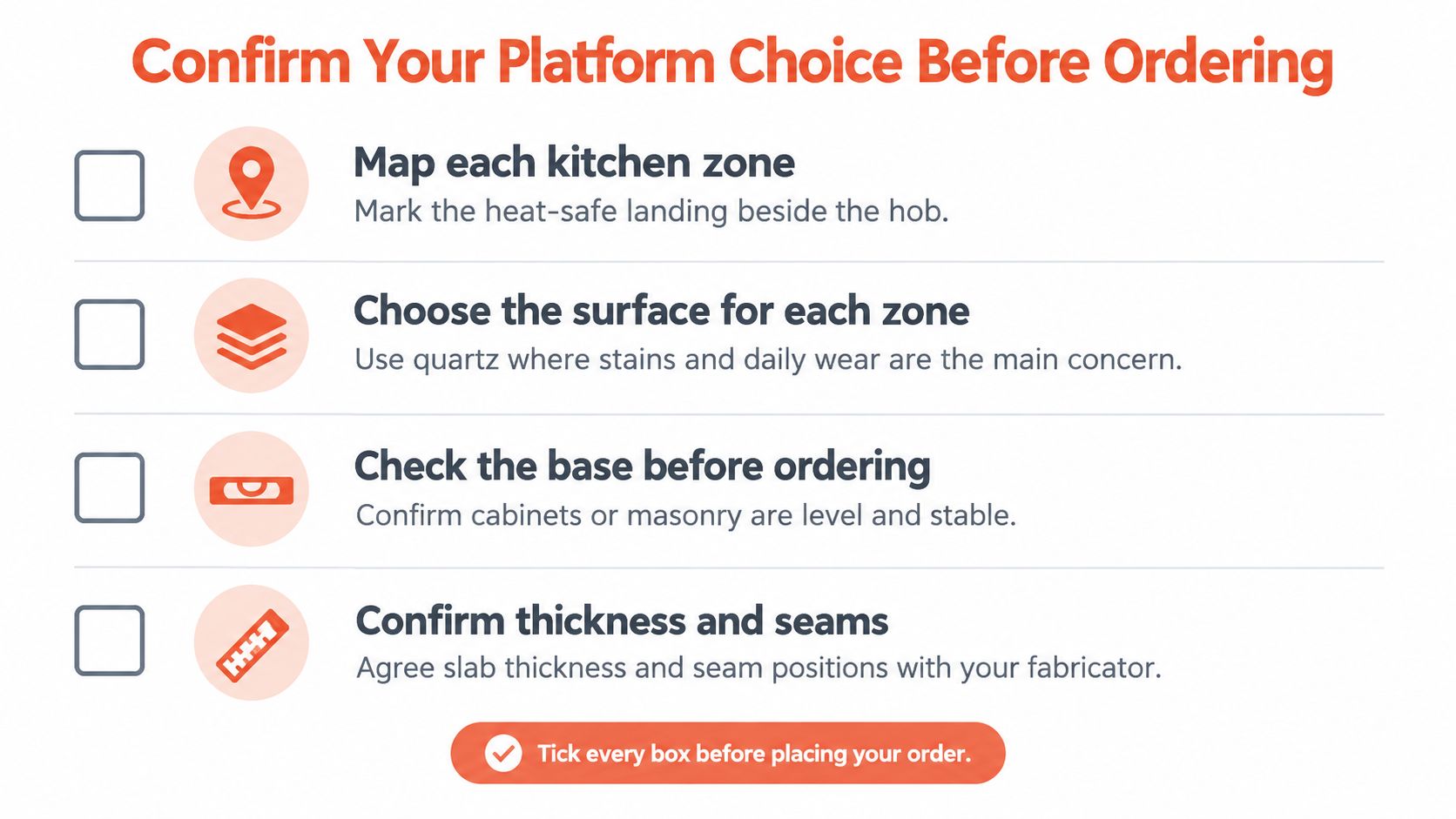
Your pre-order checklist
Map the working zones. Mark where you wash, prepare, cook and serve, including a heat-safe landing beside the hob.
Choose surfaces by zone. Quartz can suit areas where stains and daily wear are the main concerns. Plan the hob edge, sink, prep area and island according to their different heat, stain and wear risks.
Confirm the supporting structure. Include islands, breakfast bars, appliance gaps and any platform projection beyond the cabinets.
Approve the fabrication drawing. Check that it shows joints, expansion gaps, openings and edge details before you commit to the slab.
Request an itemised quotation and safety statement. Record who fabricates the slab, where processing happens and which dust controls the contractor will use.
Get warranty terms in writing. Ask about heat marks, edge chips, joint failure and installation defects. Check the manufacturer's stated service life under routine care.
Schedule templating after the cabinets are complete. The base cabinets should be installed and levelled before measurements are taken.
Establish who remains accountable
If a kitchen firm manages the project, ask whether it fabricates in-house or appoints a subcontractor. Confirm who handles countertop complaints and whether the slab, workmanship and modular cabinetry have separate warranties.
A modular-product guarantee may not cover every countertop issue. Read the exclusions, claim process and care requirements before paying the final balance.
Give hot cookware a clear, protected landing place. Then choose the surface for each remaining zone based on its use, rather than assuming one material must suit the whole kitchen.
Interiors by DeX offers modular kitchen planning, finish selection and turnkey installation as part of residential interior projects in Chennai. Visit Interiors by DeX to discuss your kitchen layout, identify the heat-safe cooking zone and request a clearly scoped proposal covering the platform and its supporting cabinetry.