
The popular advice that stainless steel is “rust-proof” oversimplifies what happens in a Chennai kitchen. The sheet may resist corrosion, but its grade, the way a fabricator finishes sink cut-outs and joints, and the cleaners used on it all affect how the counter performs over time.
Stainless steel can be a practical work surface for a busy home, especially where frequent cooking, straightforward cleaning and a metal finish suit the household. India's domestic stainless-steel consumption rose from 2.61 million tonnes in FY2020–21 to 4.80 million tonnes in FY2024–25, an 84% increase, reflecting deep and continuing supply for kitchen and architectural applications (Indian stainless-steel consumption data). But market familiarity alone doesn't guarantee a successful installation.
The decisions that matter most are grade selection, fabrication quality and maintenance discipline. A well-chosen sheet can still disappoint if it flexes over an unsupported span or if water sits around an unfinished sink edge. This guide focuses on those real-world choices, so you can judge stainless steel by how it'll work in your home, not just by its reputation.
Why Stainless Steel Deserves a Second Look
Stainless steel isn't a single, uniform material. Its corrosion resistance depends partly on its composition and on the protective passive layer that forms at the surface. That layer helps the metal resist corrosion, but harsh cleaning chemicals, salt residue and poor detailing can compromise performance. “Stainless” doesn't mean that every grade will stay spotless in every condition.
The distinction matters in Chennai, where kitchen counters may face frequent splashes, damp sink edges, salt in cooking and, depending on the home's location, coastal air. The broad sheet can look sound while staining begins around a seam or cut-out that stays wet. A homeowner choosing a countertop should therefore ask not only, “Which finish do I like?” but also, “What grade is it, how will it be supported, and how will I clean it?”
Familiar material, specific decisions
Stainless steel has a long history in India's kitchen and materials sector. Earlier domestic industry data recorded that kitchenware accounted for more than 90% of stainless-steel consumption until 2000, before its share declined as construction, infrastructure, engineering and other applications expanded (historical Indian stainless-steel industry assessment). That history helps explain why metal kitchen products are familiar to Indian households. It doesn't remove the need to specify a countertop carefully.
Three practical choices shape the outcome:
Grade: 304 is a common starting point for a residential worktop. More chloride exposure may justify considering 316.
Fabrication: Support, welds, edges and sink detailing affect rigidity and cleanability.
Care: Gentle cleaning and drying help preserve the finish, especially where water collects.
A stainless counter may suit a household that cooks often, wants a smooth work surface and accepts that use can leave visible marks. Someone who expects a permanently pristine, scratch-free surface may prefer to compare other materials before committing. The right question isn't whether stainless steel is universally good or bad. It's whether the grade, detailing and finish fit the way your kitchen is used.
Grades and Specifications That Actually Matter
A quote that says only “food-grade stainless steel” doesn't tell you enough to choose a countertop. Ask for the grade designation, the applicable standard and a mill test certificate that identifies the material supplied. Those details help distinguish a specified sheet from an unverified substitute.
The Bureau of Indian Standards identifies 304 and 316 as austenitic grades under IS 6911:2017, which covers stainless-steel plate, sheet and strip for household and architectural applications. It lists 430 separately as a ferritic grade (BIS compendium for stainless-steel standards). For a Chennai home, 304 is generally a practical baseline for ordinary wet-kitchen exposure. If the counter faces unusually high chloride exposure, such as frequent salt residue or coastal air, discuss whether 316 is more appropriate.
Grade | Standard | Type | When to specify |
|---|---|---|---|
304 | IS 6911:2017 | Austenitic | A practical baseline for most residential worktops with normal kitchen exposure |
316 | IS 6911:2017 | Austenitic | Consider where chloride exposure is unusually high, including frequent salt contact or coastal air |
430 | IS 5522:2014 | Ferritic | Don't accept it as an assumed equivalent to 304 or 316. Match its performance to the exposure and fabrication detail |
What the standard and certificate can tell you
IS 5522:2014 covers stainless-steel sheets and strips intended for utensils and food-related applications. Its listed grades include austenitic 304 and 302, along with ferritic 430. BIS product guidance says stainless steel for utensils should conform to IS 5522 or IS 15997 and describes compulsory BIS certification requirements for those raw materials under the Steel and Steel Products Quality Control Order (BIS product guidance for stainless-steel utensils). For countertop procurement, ask your supplier what standard applies to the sheet and request the relevant certification or marking details.
Certification alone doesn't specify the whole countertop. It won't confirm the installed sheet's support, finish, thickness or weld quality. Ask the fabricator to put the grade, sheet details, finish and joint approach in writing, and to provide the mill test certificate rather than relying on a generic food-grade description.
A useful overview of benchtop planning and fabrication details is this stainless steel benchtop workflow guide. Use it as a prompt for questions, then check the actual material and installation plan against your kitchen's needs.
How Stainless Steel Compares to Granite, Quartz, and Other Surfaces
The best surface depends on what your household cooks, how you clean, and what kind of ageing you can live with. Stainless steel is particularly compelling when heat tolerance, hygiene and a continuous, cleanable work area matter. It's less convincing if you want a surface that looks untouched after years of chopping and scrubbing.
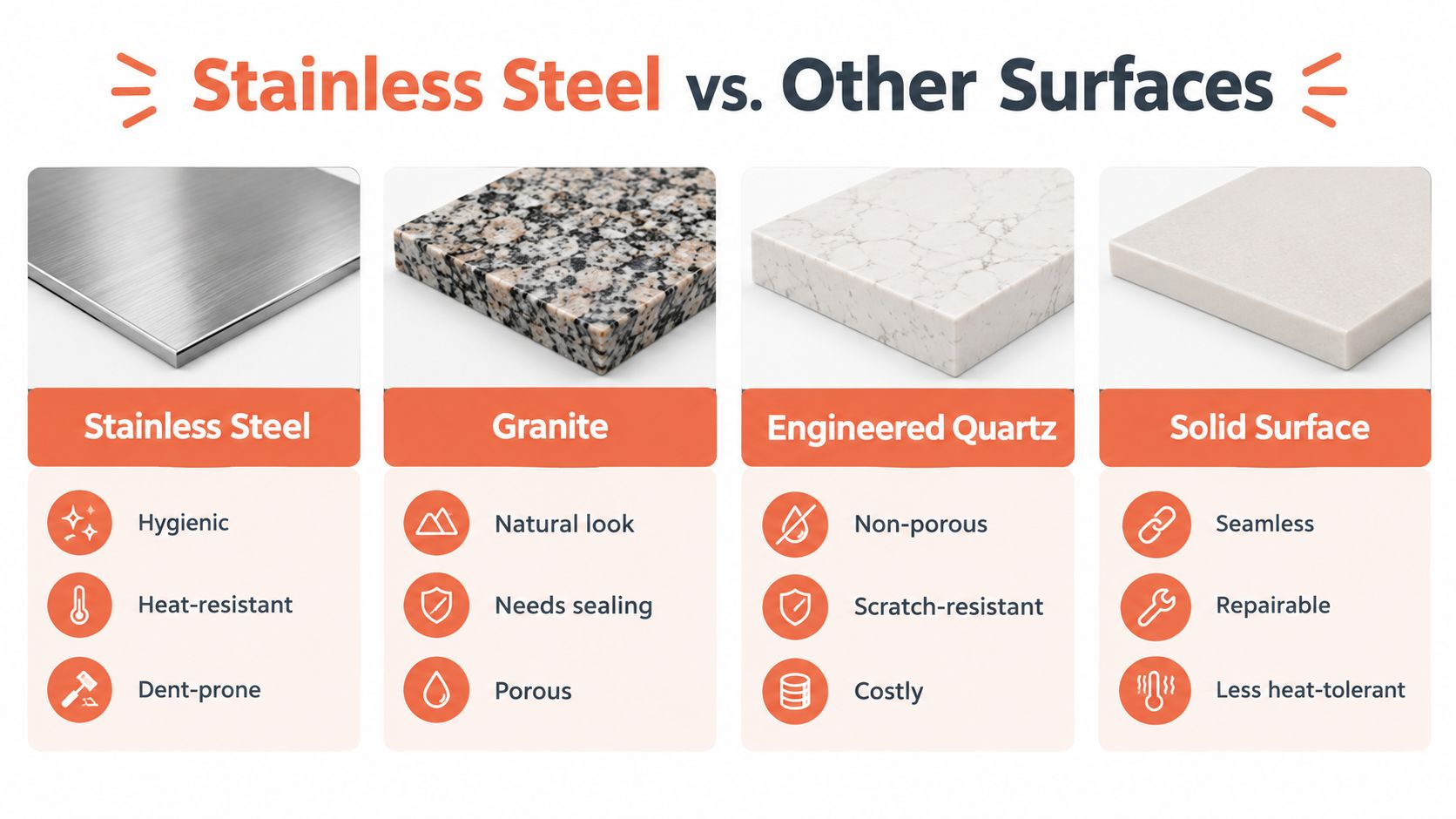
Compare how each material lives in a kitchen
Stainless steel: Tolerates heat well and supports a smooth, hygienic work surface. It can show scratches, fingerprints and dents, so the finish and expectations matter.
Granite: Offers natural variation and a stone appearance. Its care needs depend on the stone and finish, and a homeowner should clarify sealing and stain care with the supplier.
Engineered quartz: Provides a consistent appearance and a non-porous surface. Don't assume it's suitable for direct contact with hot cookware; check the product maker's care guidance.
Solid surface: Can provide a joined-up look and may be repairable, depending on the material and damage. It's generally less tolerant of heat than stainless steel.
Turmeric and oil are part of ordinary Indian cooking, but stain resistance isn't the only test. Consider whether marks show easily, whether the surface can be repaired or refinished, and whether you're comfortable with its appearance changing through use. Stainless steel's functional durability can be high even while its cosmetic durability is more limited: the counter may remain serviceable as fine scratches build up.
Cost comparisons also need to look beyond the slab or sheet price. Fabrication, support, sink integration, edge treatment and backsplash detailing all contribute to the installed result. A surface with a lower material price can require other expenses to achieve the finish and functionality you want. For a broader overview of available kitchen surfaces and their characteristics, see this guide to kitchen top materials.
Fabrication and Installation in a Modular Chennai Kitchen
A stainless countertop needs support. A thin sheet spanning a cabinet run can flex, drum when tapped or develop visible waviness, often called oil-canning. Fabricators typically address this with a moisture-resistant, fully supported substrate or a welded stainless-steel frame. The appropriate construction depends on the layout, span and installation details, so ask for a cross-section or clear description rather than approving the sheet by appearance alone.
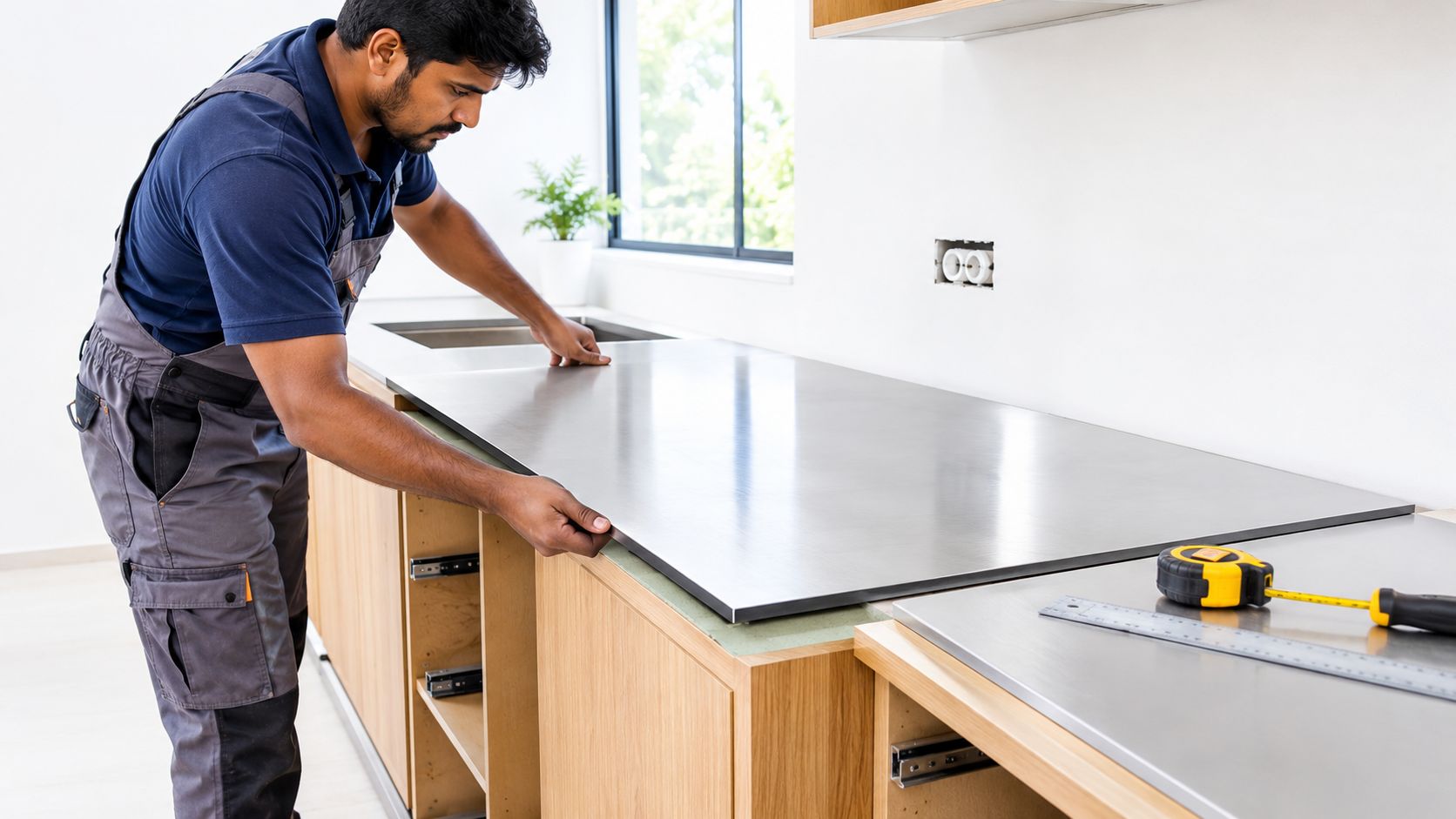
Treat the sink and joints as critical details
The highest-risk areas are often the sink cut-out, backsplash junctions, corners and welds, not the open sheet. Water and food residue can collect where edges are poorly finished or gaps are left unsealed. Ask who will form and finish each edge, how the sink will meet the counter, and how the backsplash joint will be sealed.
FSSAI catering guidance says food-contact work surfaces should be clean, hygienic, impermeable and easy to clean, and cites stainless steel as an example of a solid, corrosion-resistant material (FSSAI catering guidance). That benchmark makes practical sense in a home, too: a smooth, intact worktop with finished joints is easier to maintain than open gaps or grooves that trap residue.
Practical rule: Ask the fabricator to show you how the sink edge, welded corners and backsplash return will look before installation. A neat drawing or sample detail can expose gaps in the plan early.
Choose a finish with real use in mind. A mirror finish reflects light but makes fingerprints and small scratches more obvious. Brushed or satin finishes tend to be more forgiving in a busy family kitchen because marks blend into the surface texture. If you need to cover an unused tap hole or another opening, a purpose-made stainless cover from Ring Hot Water illustrates the kind of fitted accessory that can close an opening without leaving an exposed gap.
Coordinate the countertop with cabinet levels, appliance clearances and plumbing before fabrication. This modular kitchen installation guide for Chennai apartments can help frame those site-coordination questions.
Cost Factors Chennai Homeowners Should Plan For
The sheet price is only one part of the quote. A sound comparison separates the material from the work needed to turn it into a rigid, well-finished countertop. Ask for itemised costs so you can see whether a lower quote leaves out support, edge finishing or sink integration.
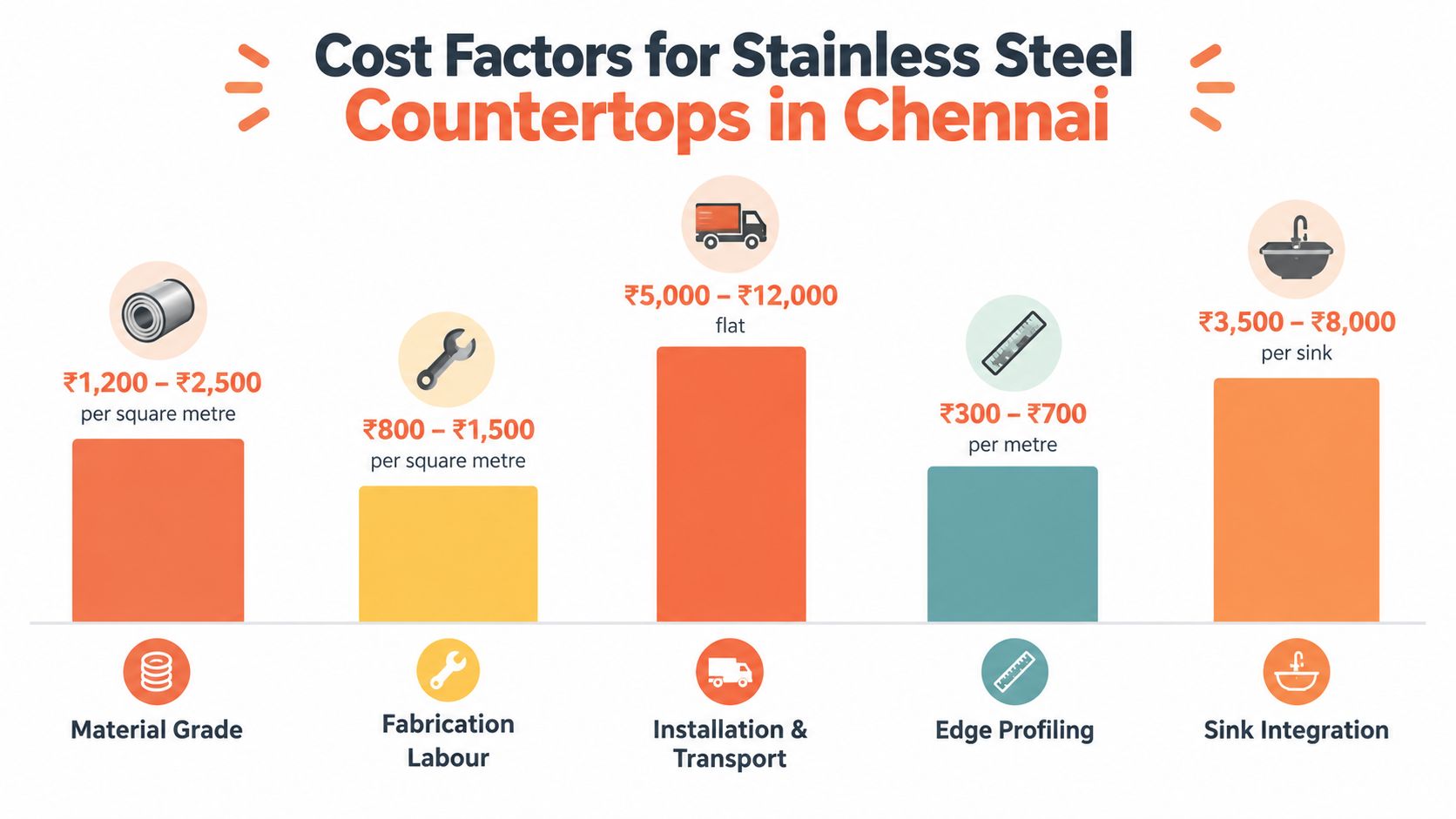
Read the quote beyond the sheet
Check how the fabricator has priced:
Material specification: Grade, sheet thickness and finish should be stated. Don't compare quotes if one leaves these details vague.
Support: Confirm whether the price includes a moisture-resistant substrate or a fabricated metal frame.
Fabrication: Review edge profiles, bends, welded corners and the finish on seams.
Cut-outs and integration: Sink and hob openings, tap positions and backsplash returns may involve distinct work.
Delivery and installation: Clarify transport, site access, fitting and any on-site welding.
Published Indian market reporting placed stainless steel at USD 2.39 per kilogram in December 2025, following a 1.1% decline from September, and noted the sensitivity of alloy surcharges to nickel, chromium and molybdenum costs (Indian stainless-steel price and cost discussion). That input-price movement is one reason a quote can change. It doesn't tell you the installed price of your countertop, which also depends on its dimensions, grade, finish and fabrication scope.
Avoid treating a cheaper sheet as the only route to savings. If a quote cuts support or leaves difficult joints unfinished, the installation may be harder to clean or less rigid. It's often more useful to compare the written scope line by line than to compare a single headline rate.
Ask for a complete scope: Material grade and finish, support method, sink and hob cut-outs, backsplash detail, weld treatment, transport and installation should all be clear before you approve the work.
For a broader budgeting conversation, compare the countertop scope with the rest of your modular kitchen cost plan. That helps you understand whether a change to the counter affects related cabinetry or installation decisions.
Daily Care That Actually Protects the Surface
Care should be gentle and consistent, particularly around the sink. Chennai homes may deal with water spots and residue, while coastal exposure can add another reason to keep surfaces clean and dry. A quick wipe doesn't replace sound fabrication, but it helps stop stagnant water and residue from lingering at vulnerable edges.
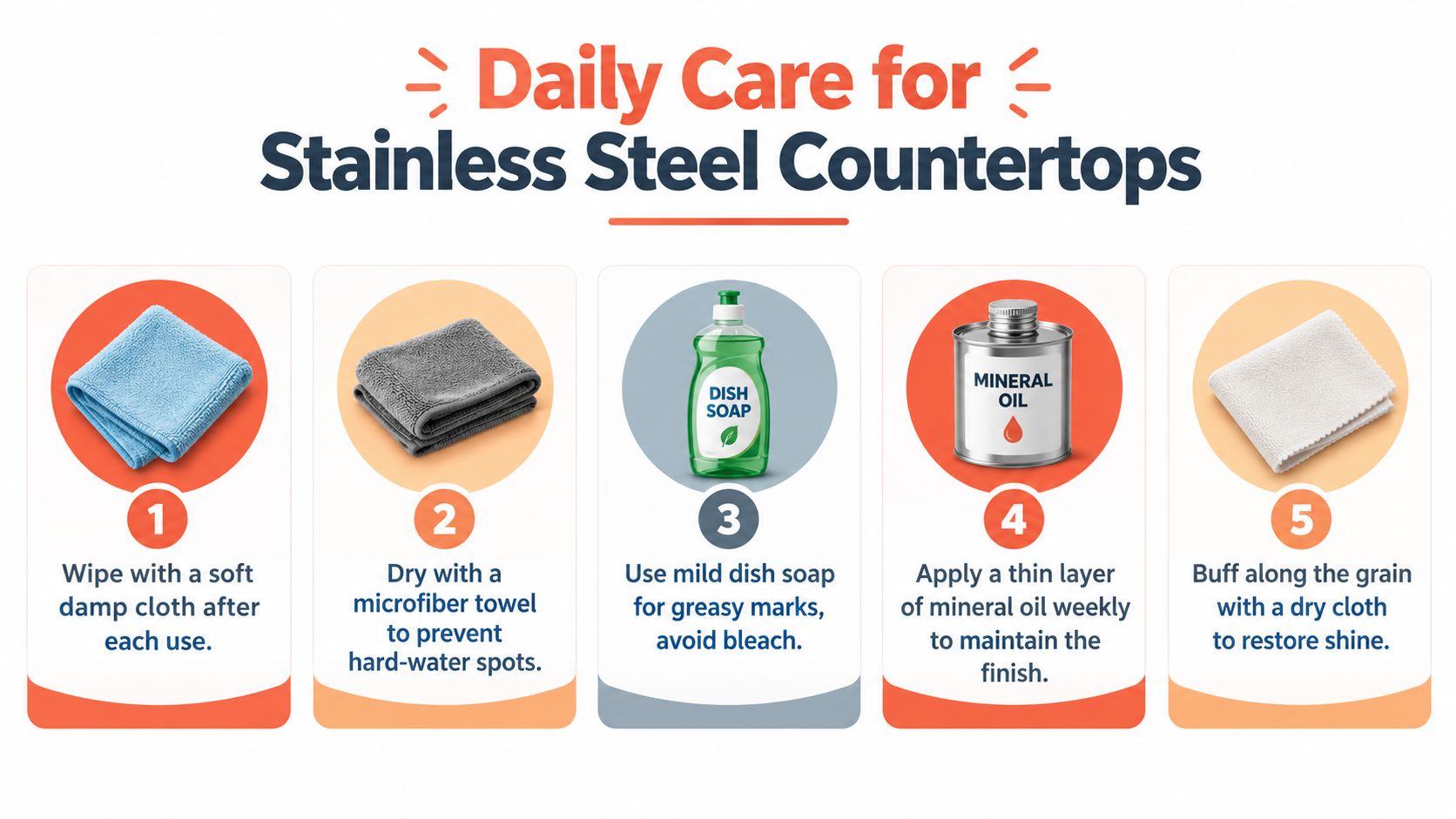
A low-fuss cleaning routine
After food preparation, wipe the counter with a soft damp cloth. For greasy marks, use mild dish soap, then rinse away residue and dry the surface with a clean cloth. Drying is especially helpful around sink edges, where water that repeatedly sits can leave deposits or encourage tea-staining, the brownish surface discolouration that can appear around wet areas and joints.
Chromium forms stainless steel's protective passive layer, but chlorine compounds can damage it, while abrasives can scratch the finish and make wear more visible, especially around sink cut-outs and continuously wet zones (guidance on stainless-steel care and corrosion risks). Skip chlorine-based cleaners and steel scrubbers. For product choices, this guide to all-purpose and multi-surface cleaners can help you think about cleaner types, but always check the label before using a product on metal.
Respond to marks without making them worse
Hard-water deposits: Wipe away water and dry the area rather than allowing spots to build up.
Greasy residue: Use mild dish soap and a soft cloth, then rinse and dry.
Scratches: Don't attack them with a steel scrubber. Ask the fabricator whether the finish can be professionally refinished and whether that would match the surrounding surface.
Dents or damaged joints: Have a fabricator assess the damage. A superficial mark may be a cosmetic issue, while a compromised seam or edge needs more attention.
A brushed finish often ages more gracefully than a mirror finish because small marks are less conspicuous. The key is to accept that stainless steel can remain functional while showing evidence of use. If you want a countertop that always looks untouched, it may not be the right match for your cleaning habits or expectations.
Choosing Stainless Steel for Your Chennai Home
Start with the sink, not the showroom sample. A counter beside a heavily used sink faces more splashes and lingering moisture than a lightly used prep area, so the cut-out, edge finish and drying routine deserve close attention. Then consider whether your home is exposed to coastal air or frequent salt contact, and whether the household uses gentle cleaners or abrasive scrubbers.
A practical specification follows from those conditions. For ordinary residential use, 304 is generally the starting point. Discuss 316 where chloride exposure is unusually high. Don't accept 430 as an equivalent substitution without checking its suitability for the exposure and fabrication detail. IS 5522:2014 lists 304, 302 and 430 for sheets and strips intended for utensils and food-related applications, giving homeowners a concrete Indian standards reference (BIS compendium covering IS 5522:2014).
Take a short checklist to the design meeting
Exposure: Is the kitchen near the coast, or is salt residue likely to reach the worktop often?
Water: Where will splashes collect, and how will the sink edge and backsplash joint be finished?
Cooking and cleaning: Will the household accept visible scratches, and can everyone avoid chlorine cleaners and steel scrubbers?
Specification: Will the quote name the grade, finish, support method and relevant material documents?
Ownership: Does the budget account for fabrication and installation as well as the sheet?
Stainless steel may be the wrong choice if your priority is a permanently pristine appearance and you're unwilling to accept fingerprints or surface marks. If you value a hard-working, cleanable surface and can specify its weak points properly, a brushed finish with sound support and carefully finished joints can make sense. Interiors by DeX plans, manufactures and executes residential interiors in Chennai, including modular kitchens and countertop installation coordination; its documented selections and 5-year replacement guarantee on modular products are relevant to homeowners considering an integrated project.
Discuss the grade, finish, support and sink detailing before you approve a stainless-steel countertop, and ask for each item to appear in the project scope. Interiors by DeX can help coordinate countertop selection with modular-kitchen design, installation and handover in your Chennai home.