
The wall behind your bed is plain, the wardrobe takes up half the room, and buying artwork isn't high on the budget list. You'd like the bedroom to feel finished, but there's barely room for another piece of furniture. In a Chennai flat, that's a familiar decorating problem.
A small, well-placed drawing can define the sleeping area without adding furniture or taking away storage space. It might be a leafy branch beside the headboard, a loose mountain outline above it, or a narrow patterned border. The important part is fitting the drawing to the visible wall space, not copying a mural from a much larger room.
These bedroom easy wall drawing ideas use basic tools and simple shapes. Plan for a few hours of drawing and painting, with separate time for preparation, drying, and curing according to the product instructions. Suburban Furniture's accent wall guide is a useful starting point when deciding which wall deserves attention.
Start small: Choose a design you can comfortably draw on paper before you commit it to plaster.
For rented homes, permission and removal matter as much as appearance. For owned homes, check the finish and furniture layout before opening the paint.
1. Minimal Botanical Line Drawings
A leafy stem is a sensible first wall drawing because it doesn't need perfect symmetry. Small variations can look natural, provided the overall branch has a clear shape. Keep it open and light rather than filling every gap with another leaf.
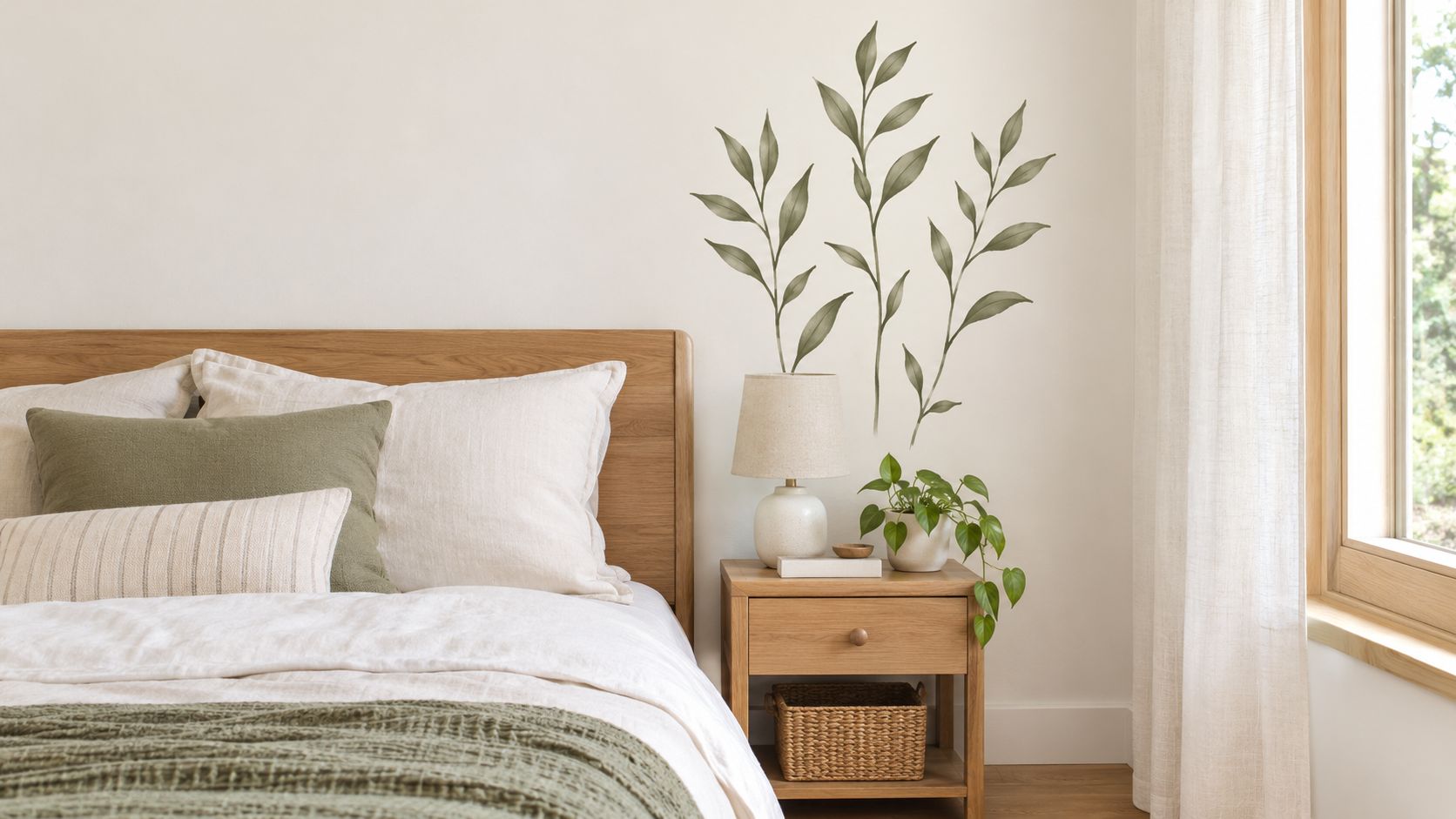
Try slender leafy stems above a bedside table, repeating the muted green in your cushions. If the headboard wall is crowded, place a tall branch on the exposed strip beside the wardrobe, outside the door's opening path. Wood-finish storage and plain bedding give the drawing enough company without making the room busy.
Keep the outline simple
Practise a leaf-and-stem combination on paper first. Then mark the main stem lightly in pencil and paint with a small artist's brush and a compatible water-based interior product.
Check the background: Compare the outline against your existing wall shade. These bedroom putty colour ideas can help you judge a neutral base.
Check the furniture: Keep the main leaves visible above pillows, lamps, and the headboard.
Check the lighting: Test the colour in daylight and under the bedroom's evening lights.
Wall needed: A narrow bedside strip is enough. You can scale the design down to a small sprig without losing its character.
The trade-off is surface texture. Very fine stems are harder to keep even on rough plaster, so use broader, simpler leaves there. In a rented flat, draw the same composition on paper or canvas instead. A painted branch is restrained, but it still needs repainting to remove.
2. Painted Arch Outline Behind the Bed
An arch outline suits a bedroom that needs a stronger frame around the bed but doesn't need another solid block of colour. Most of the original wall stays visible. The rounded top also offers a softer contrast to rectangular wardrobes, loft shutters, and storage units.

A terracotta outline on an off-white wall can frame a wooden bed neatly. For a quieter finish, consider muted taupe around a plain upholstered headboard. These are proposed combinations, so test them against your actual flooring and wardrobe finish.
Set the bed position first
Mark the bed centreline, not just the centre of the empty wall. A bedside cabinet or built-in wardrobe may push the bed away from the room's visual middle. Review the final double-bed headboard design before deciding where the arch begins and ends.
Use a cardboard template or a measured string-and-pencil guide for the curve. Low-tack painter's tape can guide the straight sections, while a suitable curved stencil helps at the top. Follow the paint and tape manufacturers' application and removal instructions rather than guessing when to peel.
An outline uses less painted area than a filled arch, but it doesn't make an uneven curve less noticeable.
Wall needed: A clear area around the headboard works best. If wardrobes closely flank the bed, a smaller botanical or geometric drawing may fit more comfortably.
This isn't the most reversible choice for a tenant. Get approval first, photograph the existing finish, and agree on reinstatement. Don't assume an outline can be wiped away later.
3. Simple Mountain Skyline
A mountain ridge suits a long, mostly clear wall above the bed. It uses less paint than filled peaks, and a short, single outline is easier to scale down if the wall is narrow or storage takes up one side. Keep the upper wall plain so the drawing does not crowd the room.

For a guest room, a charcoal-grey ridge can sit above a low wooden bed. In a child's room, use subdued blue-grey lines for overlapping peaks, but keep the shapes broad and simple. Too many even peaks can make the design look like a triangle border.
Draw the whole ridge before painting
Sketch the ridge on paper first. Mark the highest and lowest points on the wall, connect them lightly, then check the shape from the doorway and from the bed. Adjust it before applying paint.
Allow for bedding: Keep the main peaks visible above the headboard and pillows.
Limit the palette: If you layer ridges, use colours that sit well together.
Protect the budget: An outline needs less paint than filled shapes and takes less time to cover later.
For a child's room, leave the drawing easy to change as interests and room use shift. A single ridge is simpler to repaint or extend than a detailed scene. In a rental, check whether wall painting is allowed; a removable board offers another option without committing the wall.
Wall needed: A horizontal strip above the bed. Shorten the ridge if a wardrobe or built-in storage interrupts the wall. On textured plaster, use broad lines rather than small scenic details, which can look uneven. Keep the drawing clear of furniture instead of carrying it behind wardrobes.
4. Moon, Stars, and Constellation Doodles
A cream wall with a warm-grey crescent and scattered stars can suit a child's room without becoming a full themed interior. In an adult bedroom, a restrained constellation cluster beside a reading chair offers a quieter version. Leave visible space between the motifs.

The easiest stars are dots or short intersecting strokes. You don't need to outline every point. A carefully shaped crescent gives the composition its main feature, so practise that shape before touching the wall.
Test the spacing with paper
Cut out paper motifs and temporarily position them using a method tested on your wall finish. View them while sitting on the bed, not only while standing close to the wall. Move anything that clashes with a wall light, switch plate, or wardrobe edge.
Keep astronomy accurate: Use an accurate star chart for a named constellation. Otherwise, describe it as a decorative pattern.
Keep fittings accessible: Don't paint over switches, sockets, electrical fittings, or ventilation openings.
Keep bedtime lighting separate: The drawing doesn't need a bright spotlight all night.
Indian residential lighting guidance recommends layered bedroom lighting, with ambient, reading, and accent light serving different purposes. Use a separately controlled accent fitting if you want to highlight the drawing, rather than making it the room's only useful light.
Wall needed: A small open patch is enough. This is particularly easy to scale down around existing storage.
For a child whose interests change, consider removable motifs or framed drawings. Test adhesives first, because a removable label isn't a guarantee that weak paint will stay intact.
5. Loose Geometric Line Patterns
If you're comfortable with a ruler but not a paintbrush, start with outlined rectangles, triangles, and diagonal lines. A small composition can look deliberate without requiring freehand drawing skills. Resist the temptation to extend it across every available surface.
Outlined rectangles in taupe and muted rust can sit neatly above a plain headboard. Beside an integrated study unit, a triangle-and-circle arrangement can work as a smaller feature. Repeat a colour already present in the chair, bedding, or cabinet handles rather than introducing an unrelated palette.
Straight edges need sound paint
Make a scaled sketch before taping the wall. Decide on a consistent line width, then use a ruler and bubble level to set out the main shapes. Check how the composition sits beside wardrobe shutter lines and shelves.
Tape needs a sound, fully cured surface, and even then you should test an inconspicuous patch. The practical preparation advice in these wall-painting ideas is relevant before you commit to a larger taped composition.
Use restraint: Keep most of the wall plain if open shelves already hold books and accessories.
Match the surface: Choose broader shapes and fewer fine intersections on textured plaster.
Plan removal: Follow the tape manufacturer's instructions rather than pulling it sharply from an untested finish.
National housing records track differences in room count, construction materials, and dwelling condition, as outlined in the Ministry of Statistics and Programme Implementation housing chapter. The practical lesson is to choose for the actual wall, not an assumed smooth showroom surface.
Wall needed: A compact rectangular patch works well. Geometry scales down neatly, but painted lines remain a permanent alteration unless repainted.
6. Soft Waves and Flowing Contour Lines
Soft curves are more forgiving than a measured arch. They don't have to be identical, and a slight variation can suit the drawing. The mistake is adding so many lines that the wall starts to look tangled.
Try sand-coloured flowing lines across an ivory headboard wall. For a narrow reading corner, use a vertical group of muted blue curves instead. These versions use the same technique but suit different amounts of exposed wall.
Let the furniture set the direction
Horizontal waves work best where the headboard wall is visibly wide. A vertical arrangement is more useful beside a tall wardrobe or dressing unit. Stop the composition before it reaches switches, shelves, or a cabinet door's opening path.
Practise long brush movements on a large sheet of paper or spare board. Mark gentle pencil curves, leave generous gaps, and inspect them from the doorway before painting.
Know when to stop: If the drawing already looks balanced from the bed, another curve probably isn't necessary.
For the painted version, choose compatible water-based interior materials and request the technical documentation. Guidance on low-VOC paints in Indian homes explains why declared VOC content is more useful than relying only on terms such as eco-friendly or low odour. Check any protective clear coat as well as the coloured paint.
Wall needed: Either a wide, shallow strip or a narrow vertical patch. That flexibility makes waves useful when storage leaves awkward gaps.
The trade-off is consistency. A relaxed shape can tolerate variation, but repeatedly correcting wet lines may leave an untidy edge. In a rental, transfer the drawing to a removable art panel rather than relying on repainting a large flowing composition later.
7. Simple Flower and Daisy Outlines
A flower made from a small centre and rounded petals is an approachable alternative to a detailed floral mural. Large, open outlines are easier to read than a dense spread of tiny flowers. Keep the colours tied to the room rather than treating the wall as a separate project.
Cream daisy outlines could brighten a muted pink wall in a child's bedroom. Dusty-rose flowers above a bedside cabinet offer a smaller option for a neutral room. Sage or warm white may fit better if the existing wardrobes have a strong wood finish.
Make a template you can reuse
Draw the centre and petals on a sample board first. Once you're happy with the shape, make a reusable template and vary its orientation. You'll get a related group without making every flower look mechanically identical.
Use fewer, larger blooms: They're easier to place around furniture than a scattered all-over pattern.
Keep centres visible: Don't position a flower centre behind a wall light, switch plate, or tall bedside lamp.
Check the coating: Use a compatible washable finish where cleaning is important, rather than assuming craft paint will suit the wall.
Think about bedroom use before choosing the medium. Poster paint, chalk, markers, and wall coatings aren't interchangeable, so check the product's intended surface, cleanability, and removal guidance. Indoor-air guidance for Indian homes also supports ventilation and stronger precautions for vulnerable occupants during paint-related work.
Wall needed: A bedside patch or an open area above the headboard. Scale down by reducing the number of blooms, not by squeezing many tiny flowers together.
For a room that must remain in use, framed flower drawings may be the more practical starting point. They let you test the colour and size without committing the wall.
8. Kolam-Inspired Dot-and-Line Border
A narrow dot-and-loop border can bring a locally rooted pattern into a Chennai bedroom without competing with the furniture. Traditional kolam is associated with threshold and floor drawings in Tamil households. Using it on a bedroom wall is a contemporary adaptation, not a traditional placement.
Try a white border above a teak-toned headboard against muted terracotta. Another option is a compact geometric panel beside a dressing unit, with the surrounding wall left plain. Both give the pattern a defined place rather than stretching it around the whole room.
Begin with a simple repeat
Practise the repeat on squared paper. Mark a light, evenly spaced dot grid with a ruler or reusable stencil, then draw the connecting lines. Check the complete repeat before painting, because small spacing errors become more noticeable along a border.
Respect the pattern: Choose a documented design or consult a local practitioner when cultural specificity matters.
Work with storage: Stop the border cleanly before a wardrobe, mirror, or loft unit interrupts it.
Check the wall: Address dampness, peeling paint, and salt deposits before decorating.
Allow curing: Follow the coating manufacturer's curing and ventilation instructions.
Wall needed: A narrow band or small panel. This is a useful budget choice when there's little exposed wall, although it needs more careful spacing than loose waves.
Don't use artwork to disguise a moisture problem. India-wide wall-décor guidance and market analysis supports matching decorative treatments to a smooth, sealed surface and choosing broader forms where texture makes fine edges difficult.
For a rented flat, draw the pattern on a removable board or framed sheet. Temporary chalk is only worth considering after a surface test confirms that it can be removed without leaving marks.
Difficulty, materials, and placement for each bedroom wall drawing idea
Item | Difficulty | Key Materials | Best Placement |
|---|---|---|---|
Minimal Botanical Line Drawings | Easy | Pencil, template or stencil, small brush, water-based paint | Above a bedside table or beside the wardrobe |
Painted Arch Outline Behind the Bed | Easy to moderate | Measuring tape, level, pencil, template, painter's tape, brush, wall paint | Behind the bed, centred on its final position |
Simple Mountain Skyline | Easy | Pencil, measuring tape, painter's tape, brush or small roller, wall paint | Across the headboard wall |
Moon, Stars, and Constellation Doodles | Easy | Paper templates, pencil, small brushes, wall paint, circle stencil | Above the bed or in an upper corner |
Loose Geometric Line Patterns | Easy | Ruler or straightedge, level, pencil, painter's tape, circle template, wall paint | Above the headboard, beside a study desk, or on a narrow wall panel |
Soft Waves and Flowing Contour Lines | Easy | Pencil, soft eraser, artist's brush, water-based paint | Across the headboard wall or beside a reading chair |
Simple Flower and Daisy Outlines | Easy | Cardboard or stencil sheet, pencil, round template, small brushes, wall paint | Above a bedside cabinet or on a child's bedroom wall |
Kolam-Inspired Dot-and-Line Border | Easy for a basic border; moderate for interlaced patterns | Ruler, pencil, dot-grid template, fine brush, wall paint | Above the headboard or beside a dressing unit |
Choose One Wall, Test One Idea, Then Build Your Bedroom Around It
Start with the furniture you're keeping. Look at the bed, wardrobe, bedside cabinets, and study unit, then identify the wall area that remains visible during daily use. A drawing that disappears behind pillows or an open cupboard door isn't a good use of your effort.
Choose one idea that fits that space. A botanical sprig suits a narrow gap, while an arch needs room around the headboard. Waves adapt to awkward strips, and a compact kolam-inspired panel can work where a larger mural would feel crowded.
Make the test as realistic as possible
Sketch the design at full scale on paper before touching the wall. Test the brushwork and colour on a spare board, then view it against the room's finishes in daylight and evening light. Don't judge a muted colour only under a bright work lamp.
Check the wall first: Photograph the finish and look for damp patches, peeling areas, and salt deposits.
Check the fittings: Preserve access to switches, sockets, ventilation, and electrical points.
Check permission: Agree on painting and reinstatement with the landlord before altering a rented wall.
Check the products: Confirm surface compatibility, ventilation requirements, drying time, and curing instructions.
A removable treatment isn't automatically risk-free, and a small painted drawing isn't automatically easy to undo. Test adhesives, tape, and drawing materials in an inconspicuous area. Keep the original paint details where possible, but don't assume a later touch-up will disappear into an older finish.
Bedroom usability comes before the decorative result. Follow the manufacturer's occupancy guidance, especially when children, pregnant residents, older adults, or people with asthma use the room. If the bedroom must stay occupied and you can't provide suitable ventilation, begin with artwork made away from the wall.
Plan larger changes before drawing. New wardrobes, a wider headboard, relocated sockets, or revised lighting can make a finished composition awkward or partly hidden. A professional team such as Interiors by DeX can coordinate those decisions before carpentry and painting begin.
The best result doesn't need the most paint. It needs a manageable design, a sound surface, and enough clear wall for the drawing to sit comfortably beside the things you already own.
Interiors by DeX offers Chennai homeowners end-to-end residential interiors, including bedroom storage, custom furniture, painting support, finish selection, and lighting coordination. Visit Interiors by DeX to discuss a bedroom plan that fits your wall-drawing idea around the furniture, available space, and budget before work begins.