
You're standing in a half-finished Chennai bedroom with two wardrobe quotations on your phone. One says “commercial ply”, another says “BWR plywood”, and a third offers MDF shutters at a lower price. All three sound plausible. None tells you enough.
The core question in MDF vs plywood for wardrobes isn't which material wins everywhere. It's which board belongs in each wardrobe component, under Chennai's humidity, cleaning habits, storage loads, finish requirements, and installation conditions. A reliable quotation should identify the Indian Standard, grade, thickness, intended use, and edge treatment, not just name a board category.
The Wardrobe Board Decision Most Chennai Homeowners Get Wrong
A homeowner may assume the BWR quotation is automatically superior, while the MDF shutter quotation looks like a finish upgrade. That assumption misses the construction behind the visible surface. A wardrobe has a carcass, shelves, shutters, lofts, back panels, plinths, hardware fixing points, and exposed cut edges. Each part faces a different combination of load and moisture.
“Commercial ply” is especially weak wording. It doesn't tell you whether the board is MR, BWR, or BWP, whether it carries the relevant BIS Standard Mark, or whether the quoted thickness is suitable for the component. “MDF shutters” is also incomplete. The quotation should identify the applicable MDF classification, finish, edge sealing, and whether the panel is intended for a dry or humid environment.
Practical rule: Never approve a wardrobe quotation that names only the material. Approve a written specification for every board location.
Chennai makes this distinction important. A wardrobe beside an attached bathroom, against an external wall, or in a non-air-conditioned bedroom faces a different risk from one installed in a dry, well-ventilated interior. The lower back panel and plinth can suffer before the front shutters show any problem, particularly when cleaning water, seepage, or humid air reaches an unsealed edge.
The useful comparison therefore has five lenses: durability, moisture, load, finish, and lifecycle. Durability asks how the board handles daily use. Moisture considers humidity, leaks, and wet cleaning. Load covers shelves, lofts, and hardware. Finish looks at paint, laminate, membrane, and routed profiles. Lifecycle includes repairability, documentation, service, and the consequences of choosing the wrong board.
This approach leads to a clear recommendation. Don't choose an all-MDF or all-plywood wardrobe by habit. Specify plywood where structural failure would be costly, and MDF where its smooth machining and finish quality provide a real advantage.
What the Indian Standards Actually Say About MDF and Plywood
BIS standards give you the vocabulary needed to challenge vague material descriptions. Start with MDF, which is covered by IS 12406. BIS describes it as an engineered wood product made by compressing wood fibres with resin binders under heat and pressure. The standard addresses density, mechanical strength, dimensional accuracy, bending performance, and moisture-related properties. MDF products generally fall within a 600 to 900 kg/m³ density range, as described in the BIS material specification for MDF.
For Chennai wardrobes, ask whether water absorption and thickness-swelling performance has been tested or declared where humidity is a concern. Those tests matter because a smooth MDF face can still fail when an exposed cut edge absorbs moisture. Also ask which edition and classification the quotation uses. BIS stated that IS 12406:2021 was revised to IS 12406:2025, with implementation scheduled for 9 February 2026, after which the earlier standard would be withdrawn. The BIS revision notice says manufacturers had to update declarations, testing or laboratory records, and product marking.

Read the plywood line carefully
Plywood is covered separately by IS 303:2024. Its general-purpose grades include MR, BWR, and BWP. MR means moisture-resistant, BWR means boiling-water-resistant, and BWP means boiling-water-proof. These terms are performance categories, not interchangeable marketing labels. The BIS IS 303:2024 product manual also recognises F10 to F50 bending classes, allowing structural performance to be considered instead of relying on the word “plywood” alone.
The standard lists common thicknesses including 3, 4, 5, 6, 9, 12, 15, 19, 22, and 25 mm, as shown in the BIS plywood product manual. Thickness and grade are separate decisions. A quotation should state both.
Know the pre-laminated MDF categories
Pre-laminated MDF has another useful framework. IS 14587:2023 distinguishes Grade 1 for humid environments and Grade 2 for dry environments. Each grade has four application types based on surface-abrasion performance. Type 1 covers flooring, Type 2 covers counters and table tops, Type 3 covers regular furniture, and Type 4 covers vertical applications. The pre-laminated board comparison explains why furniture and vertical-application types are the relevant starting points for wardrobes.
When reading a quotation, ask five questions:
Which standard applies? Is it IS 12406 for MDF or IS 303:2024 for plywood?
Which grade is supplied? Ask for MR, BWR, BWP, Grade 1, or Grade 2 where relevant.
What is the thickness? Require millimetres for each component.
What is the intended use? Carcass, shelf, shutter, back panel, or loft?
What proves compliance? Request the Standard Mark and supporting documentation.
MDF and Plywood Compared Across the Six Criteria That Matter
The correct material depends on the job. Plywood has the natural advantage for structure and intermittent humidity when the specified grade is appropriate. MDF has the natural advantage for clean machining and painted surfaces. Neither material should be judged from a generic sample or a low headline price.
Criterion | MDF (IS 12406) | Plywood (IS 303:2024) |
|---|---|---|
Moisture resistance | Requires careful edge sealing. Moisture absorption and thickness swelling should be checked where humidity matters. | MR, BWR, and BWP grades provide clearer moisture-performance categories. It still needs sealing and correct installation. |
Load-bearing | Suitable for selected dry partitions and lighter-duty components when properly detailed. | Better suited to carcasses, lofts, tall sides, and heavily loaded shelves. |
Screw-holding | Uniform core, but exposed edges and repeated fixing can be vulnerable if poorly detailed. | Cross-laminated veneers generally provide stronger screw retention and panel integrity. |
Surface finish | Smooth, homogeneous surface works well for paint, membrane finishes, CNC grooves, and fluting. | Good for laminate and veneer finishes, though face and edge quality vary by grade. |
Dimensional stability | Consistent machining surface, but swelling can occur after unsealed edges absorb water. | Cross-laminated construction generally tolerates intermittent humidity better. |
Formaldehyde emissions | Ask for the declared emission class and supporting documentation. | Emissions depend on resin, grade, manufacturer controls, and finish. Plywood isn't automatically low-emission. |
For a broader explanation of how cabinet boxes and painted doors use these materials differently, The Cabinet Coach's cabinet material guide is a useful comparison. The key point is practical: MDF is a finish-led choice, while plywood is usually a structure-led choice.
MDF's homogeneous fibre structure avoids visible veneer voids and gives routed details a consistent appearance. That makes it valuable for painted shutters, fluted fronts, CNC grooves, and decorative profiles in dry bedrooms. Its weak point is the edge. Once water reaches an unsealed edge, swelling and loss of fixing strength may be difficult to reverse.
Plywood's cross-laminated veneers usually provide better panel integrity and screw retention. That advantage matters around hinges, shelf supports, tall sides, and lofts. However, plywood can show veneer variation or layered edges, so it may require edge-banding, veneer finishing, or a surface treatment suited to the design.
Emissions need a separate check
Moisture resistance and indoor-air emissions are separate decisions. E1 is commonly treated as a lower-emission threshold, while E0 is positioned as a stricter option, but the supplier should declare the class and provide documentation. An E1 MDF panel can still be a poor choice for an unsealed damp base. Plywood can also carry emissions depending on its resin and manufacturing controls.
For a deeper view of how engineered boards differ from MDF in interior applications, see this engineered wood and MDF guide. Use it to understand the material vocabulary, then return to the quotation and verify the exact board being supplied.
Where Each Board Belongs Inside the Wardrobe
A wardrobe should be specified by component, not by one board name. My default Chennai specification puts BWR or BWP plywood in structural and moisture-exposed areas, while using calibrated, sealed MDF where surface finish and machining matter more than water tolerance.

Carcass, loft, and back panel
The carcass carries the wardrobe's geometry and transfers the weight of shelves, drawers, shutters, and stored clothing to the floor. Use BWR or BWP plywood for the main sides, top, bottom, and vertical partitions, particularly when the wardrobe sits near an attached bathroom or external wall.
Lofts deserve the same caution. They're often used for suitcases, bedding, and seasonal storage, so the panels can carry substantial loads for long periods. BWR plywood is a sensible baseline, with BWP reserved for locations where moisture exposure is a credible concern.
The back panel is frequently treated as a cheap afterthought. That's a mistake. It closes the cabinet, helps maintain alignment, and sits closest to the wall, where dampness and trapped air can create trouble. Use appropriately specified plywood, seal the edges, and leave a considered ventilation gap behind the carcass where site conditions require it.
Shelves and shutters
Shelves carrying books, luggage, folded linen, or dense storage should generally be plywood. The longer the span and heavier the load, the less attractive a lightly specified MDF shelf becomes. Shelf thickness, support spacing, and hardware still matter, so the board alone doesn't guarantee performance.
MDF earns its place on shutters. In a dry bedroom, calibrated MDF gives a smooth, uniform face for paint, membrane, fluting, and routed profiles. It's particularly effective when the design depends on clean grooves or a continuous painted surface. Seal the edges and routed areas properly, and keep the panel away from regular wet cleaning.
A useful visual reference for traditional storage proportions and wood armoire construction is Critelli's wood armoire selection. It reinforces a point many homeowners overlook: the outside appearance doesn't reveal how the internal structure has been specified.
Plinths and edges
The plinth is close to the floor, where mopping water and minor seepage can reach it. Choose plywood for the plinth in riskier rooms, raise it appropriately, and protect every cut edge. Decorative MDF can still be used above the risk zone, but it shouldn't be allowed to form the unprotected base.
Site rule: A sealed board edge is part of the material specification, not a finishing extra.
The result is a hybrid wardrobe. That isn't a compromise. It's a rational allocation of performance, with plywood protecting high-risk and high-load areas while MDF delivers the required appearance on dry, visible surfaces. For the design, manufacturing, and installation stages of a made-to-measure unit, custom-built wardrobe planning can help organise these decisions before production begins.
How Chennai Climate Changes the Specification
Chennai's coastal humidity changes the risk calculation. Bedrooms may not stay air-conditioned throughout the day, wardrobes may sit against warm external walls, and attached bathrooms can add local moisture. Ground-floor villas also need closer attention to dampness near floors and plinths.
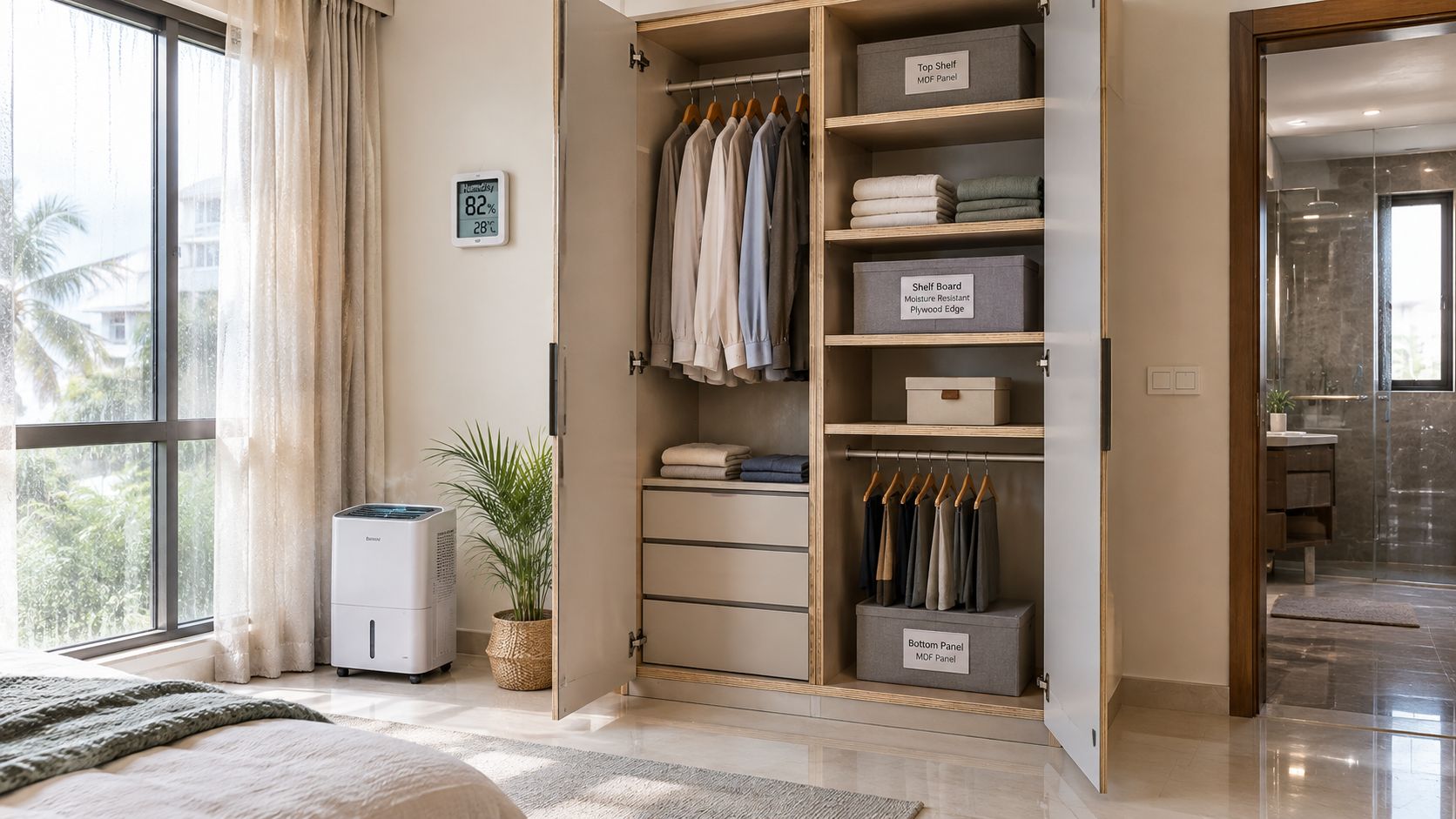
An all-MDF wardrobe in a non-air-conditioned bedroom is a risk I wouldn't accept without a very clear moisture strategy. The problem usually starts at the edges, back panel, or bottom section, not on the attractive front face. A small leak, damp wall, or wet mop can reach a vulnerable cut edge and create swelling that a later coat of paint won't repair.
An all-plywood wardrobe has the opposite problem. It can make sense structurally, but using premium plywood for every routed shutter and decorative profile often adds cost without improving the part's actual performance. MDF is usually the better machining substrate for painted and grooved fronts in dry rooms.
Details that determine actual performance
Seal every cut edge: Use an appropriate sealing and finishing system on exposed MDF and plywood edges, including routed details and hinge cut-outs.
Protect the plinth: Use a moisture-conscious base, finish the lower edge, and keep cleaning water away from unprotected board.
Allow sensible ventilation: A small, considered gap behind the carcass can help avoid trapping humid air against a wall.
Avoid external walls where possible: If placement can't change, specify the back panel and edge treatment for the wall condition.
Treat bathroom-adjacent areas differently: Use BWR or BWP plywood for structural components and don't rely on standard MDF near likely moisture paths.
The same wardrobe specification may work in a dry, continuously conditioned interior and fail on a Chennai third floor. Climate doesn't make MDF unusable. It makes careless MDF specification unacceptable.
The Procurement Checklist Before You Approve Any Quotation
Take the quotation line by line. If the vendor can't answer these questions in writing, the material description isn't ready for approval.
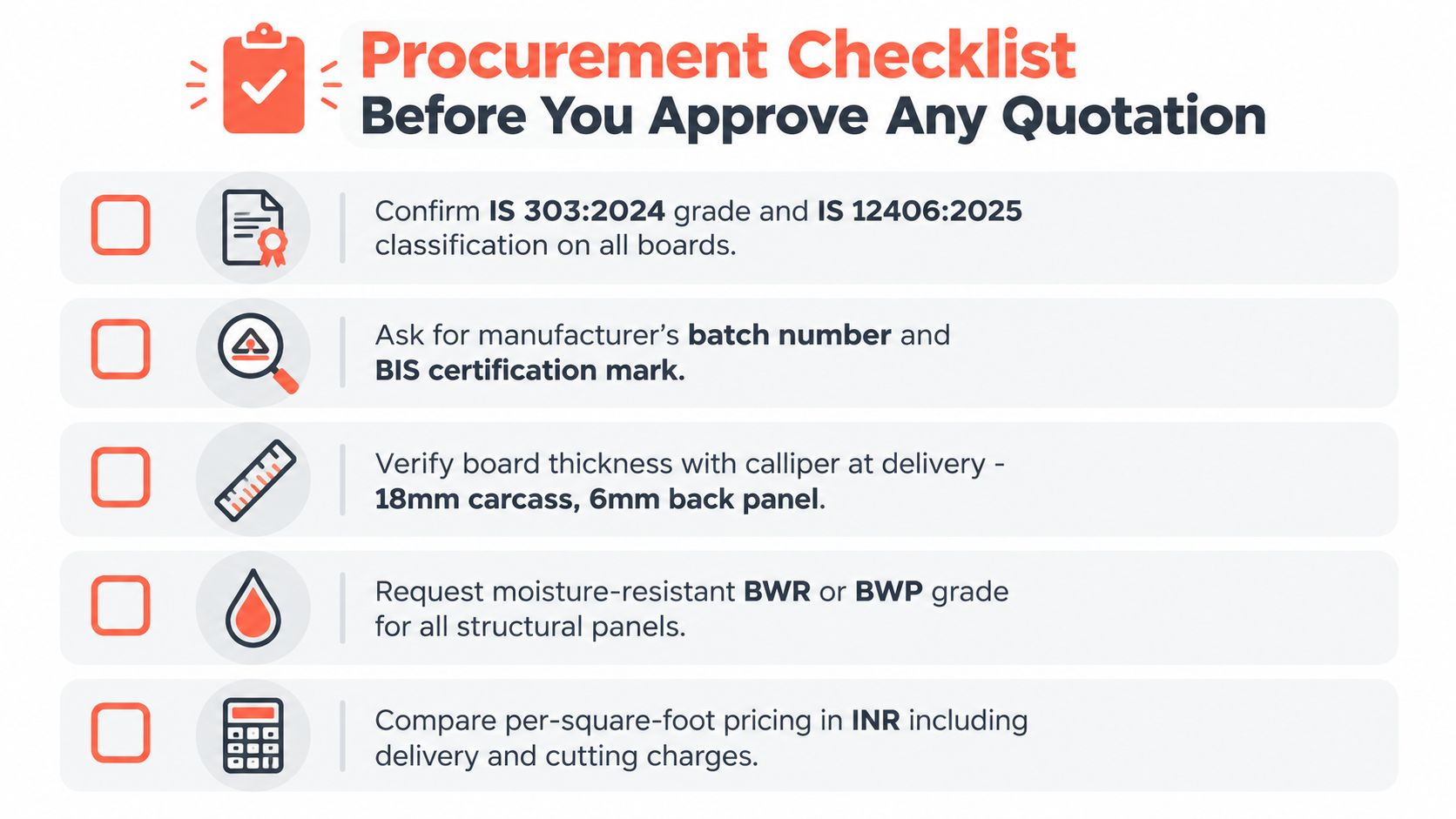
Put these items into the material schedule
Name the standard and edition. Require IS 303:2024 for specified plywood and IS 12406:2025 classification for MDF supplied under the revised framework.
State the grade. Write MR, BWR, or BWP for plywood. For pre-laminated MDF, identify Grade 1 or Grade 2 and the relevant furniture or vertical application type where applicable.
Write thickness in millimetres. Don't accept "standard thickness". State the thickness for carcass, shelves, shutters, lofts, plinths, and back panels separately.
Request the Standard Mark. Ask for the manufacturer's batch details, product marking, and BIS certification documentation.
Declare emissions. Request the formaldehyde emission class, such as E1 or E0 where declared, and ask whether the documentation applies to the raw board or finished component.
Describe edge protection. The schedule should name the edge-sealing method, not say "finished".
Request moisture evidence. Where humidity matters, ask for available water absorption or thickness-swelling information for MDF, and the relevant grade and test documentation for plywood.
Specify hardware fixing. Confirm screw type, hinge fixing method, and any reinforcement required around repeated-use hardware.
Don't compare board rates in isolation. A lower price per square foot may come with a weaker shutter finish, inferior edge treatment, shorter hardware life, or greater rework risk. Compare the complete wardrobe scope, including cutting, delivery, finishing, installation, hardware, and service.
For Chennai-specific advice on reducing material substitutions between quotation and installation, use this guide to prevent material substitution in Chennai interiors. The important principle is simple: the board specified at design stage must be identifiable when it reaches the site.
The Interiors by DeX Specification for Chennai Wardrobes
My recommendation for a Chennai wardrobe is deliberately hybrid. Use BWR or BWP plywood to IS 303:2024 for the carcass, loft, back panel, plinth, and shelves carrying substantial loads. Choose the grade according to the room's exposure, and don't accept “waterproof plywood” without the actual BIS designation.
Use calibrated, sealed MDF for shutters, fluted panels, routed profiles, and other decorative elements in dry bedrooms. MDF is the right tool where a smooth painted surface and precise machining matter. It isn't the right default for a damp base, bathroom-adjacent panel, or unprotected edge.
The material schedule should record the board standard, grade, thickness, declared emission class, edge-sealing method, and hardware fixing details. Every cut panel needs protection, including areas hidden behind laminate or inside a cabinet. A single accountable team should carry those details from design through manufacturing coordination, installation, and handover, because material substitutions often happen when responsibility is split between vendors.
Interiors by DeX positions this specification alongside a 5-year modular replacement guarantee and an after-sales response target within 24 hours of issue reporting. Those commitments don't replace correct board selection, but they give the homeowner a defined service framework if a modular product issue needs attention.
The clear answer to MDF vs plywood for wardrobes is not “plywood everywhere”. Specify plywood where moisture, load, and repair risk are highest. Specify MDF where finish quality and machining justify it. That is the durable Chennai solution, not an all-or-nothing material slogan.
Interiors by DeX plans, coordinates, manufactures, and installs Chennai wardrobes with documented material selections for apartments, villas, and renovation projects. Visit the Interiors by DeX experience centre to compare finishes, confirm the board specification, and finalise a wardrobe suited to your room's humidity and storage needs.